Connect with us

Economy

Tinubu Vows to Implement 20 Fiscal, Tax Reform Recommendations

Published

on

tax reform recommendations

By Adedapo Adesanya

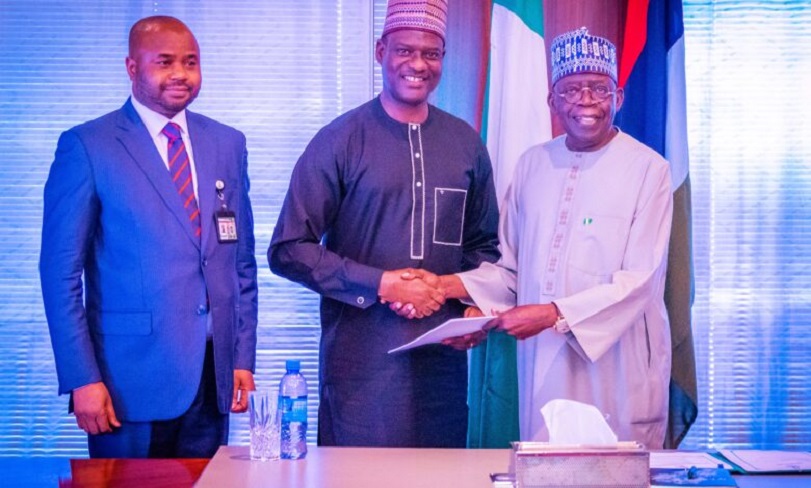
President Bola Tinubu has directed his Special Adviser on Policy Coordination, Mrs Hadiza Usman, to coordinate with the relevant government officials to work on the 20 recommendations provided by the Presidential Committee on Fiscal Policy and Tax Reforms.

On Tuesday, Mr Taiwo Oyedele, the chairman of the committee, presented a score of reform recommendations to the President as part of efforts to help improve the nation’s revenue profile and business environment.

Mr Tinubu praised the team and assured them of his support for the review and implementation of key recommendations.

“I have listened attentively to your report. Charting the critical path forward for Nigeria’s economic recovery is crucial to all of us. I want to say thank you to your delegation,” Mr Tinubu said.

He then granted the request of the committee to address a meeting of the Federal Executive Council (FEC) and apprise cabinet members of their work and expected outcomes to facilitate economic growth.

Recall that President Tinubu in August set up a committee to review the fiscal system and the tax administration in the country

Part of the recommendations offered by the committee include measures to address duplication of functions in public service, ensure prudent public finances and management, and optimise value from government assets and natural resources.

The panel also recommended policy signalling and collaboration by MDAs, economic management, and policy execution team, the use of technology “Data4Tax” to expand the tax net, increasing personal income tax exempt threshold and personal relief allowance, and provision of tax breaks for the private sector in respect of wage increases to low-income earners, transport subsidy and a net increase in employment.

Other recommendations include allowing the payment of taxes on foreign currency-denominated transactions in Naira for Nigerian businesses, removal of impediments to global employment opportunities for Nigerians based in Nigeria, suspension of Value Added Taxes (VAT) on diesel and tax waivers on CNG, CNG conversion, and renewable energy items, and comprehensive review of tariffs on the 43 items unbanned from accessing forex in the official market and fiscal policy review of other items prohibited for imports.

The committee also said the country should attempt reforms of Withholding Tax Regulations to ensure simplicity and ease the pressure on the working capital of businesses, facilitate the use of mobile phones for conditional cash transfers, and introduce a spending framework for subsidy removal and forex reform windfall, including a national portal to track spending by the federal government, states, and local governments.

It also recommended the suspension of multiple taxes which place burdens on the poor and small businesses and compensate with windfalls revenue of certain agencies, expanding the official foreign exchange market to incorporate bureau de change (BDCs), forex apps and retail FX dealers, outlawing transactions in the black market, and digitalization of Nigeria’s foreign exchange (FX) regime and discourage speculative demands and hoarding of FX in cash as well as the imposition of excise tax on foreign exchange transactions outside the official market.

The team also called on the Tinubu administration to implement forward contracts for the importation of PMS as a short-term measure pending improvement in key economic indices, discontinue the FX verification portal and requirement for Certificate of Capital Importation and export proceeds restriction, address impediments to export promotion and bottlenecks regarding Exports Expansion Grants, and remove restrictions on repatriation and use of export proceeds by exporters, modify Tax ProMax to allow taxpayers to make part payments of outstanding tax liabilities, and grant waiver of penalty and interests on the condition of full payment of outstanding tax liabilities on or before December 31, 2023.


Adedapo Adesanya is a journalist, polymath, and connoisseur of everything art. When he is not writing, he has his nose buried in one of the many books or articles he has bookmarked or simply listening to good music with a bottle of beer or wine. He supports the greatest club in the world, Manchester United F.C.

Click to comment

Leave a Reply

Your email address will not be published. Required fields are marked *

Economy

MTN Nigeria 2025 Tax Remittance to FG, States Rises 15% to N878.7bn

Published

on

MTN Nigeria commercial paper sales

By Aduragbemi Omiyale

About N878.7 billion was remitted to federal and state authorities in taxes, levies and duties by MTN Nigeria Communications Plc in the 2025 financial year.

According to details of the company’s 2025 Sustainability Report, this amount was 15 per higher than the previous year, helping the country achieve its target of expanding non-oil revenue and improving tax collection under its fiscal reform agenda, corporate tax contributions from major private-sector operators.

In 2023, MTN Nigeria paid N543.9 billion in taxes and levies, and a year later, it moved higher by about 62 per cent to N764 billion.

The N878.7 billion remitted to the government in 2025 covered corporation tax, value-added tax, spectrum fees, import duties, NCC levies and contributions under the Rural and Urban Terrestrial Infrastructure (RUTI) tax credit scheme, an initiative with deep roots in MTN Nigeria’s public-private partnership playbook.

The company has long embraced such mechanisms: it participated in the Road Infrastructure Tax Credit Scheme, under which it committed N202.8 billion towards reconstructing the 110-kilometre Enugu-Onitsha Expressway.

In 2025, the RUTI scheme reached 50% completion after securing approval for an additional N23 billion tax credit aimed at expanding fibre and telecoms infrastructure in underserved communities, a model the company argues supports infrastructure development without requiring direct public expenditure.

The report also highlighted the firm’s growing domestic economic footprint, with 62 per cent of procurement spending directed to Nigerian suppliers in 2025. This was up from 59.6 per cent a year earlier.

MTN Nigeria said the policy aligns with the federal government’s local-content objectives and supports sectors including civil construction, logistics, software services and power infrastructure.

The organisation’s operational footprint expanded to 2,087 active base stations nationwide, while active mobile subscribers stood at 85.4 million by the third quarter of 2025. Active data users rose to 51.1 million, supported by smartphone penetration of 65.1 per cent.

During the year, MTN Nigeria renewed its 800MHz spectrum licence for another 10 years, to December 2034, and secured regulatory approval to lease additional spectrum from T2 Mobile, formerly 9Mobile, across 17 states and the Federal Capital Territory.

Continue Reading

Economy

NNPC Weighs Giving Chinese Investors 51% Stake in Port Harcourt, Warri Refineries

Published

on

NNPC Port Harcourt refinery petrol

By Adedapo Adesanya

The Nigerian National Petroleum Company (NNPC) Limited is considering a new partnership model that could give Chinese investors a majority 51 per cent stake in the Port Harcourt and Warri refineries as part of efforts to revive and commercially reposition the struggling national assets.

Details of the proposed arrangement emerged after NNPC signed a Memorandum of Understanding with China’s Sanjiang Chemical Company Limited and Xinganchen (Fuzhou) Industrial Park Operation and Management Co. Ltd. for what the national oil company described as a “potential technical equity partnership”.

The agreement, signed on April 30 in Jiaxing City, China, involved NNPC’s chief executive, Mr Bayo Ojulari, Sanjiang Chemical Chairman, Mr Guan Jianzhong, and Xinganchen Chairman, Mr Bill Bi.

According to reports, the framework is modelled after the Nigeria LNG structure, where investors hold majority equity, participate in governance and remain actively involved in operations over the long term.

Under the proposed arrangement, the Chinese firms are expected to help complete outstanding engineering and rehabilitation work at the Port Harcourt and Warri facilities while also providing operations and maintenance services aimed at delivering sustainable, world-class refinery performance.

Beyond restarting the plants, the partnership is expected to target capacity expansion, improved refining yields, cleaner fuel production and stronger profitability.

The agreement also opens the door to broader industrial ambitions, including petrochemical integration and gas-based industrial projects built around the refinery corridors.

Recall that Mr Ojulari, at the signing ceremony in April, described the deal as a major breakthrough following more than six months of negotiations.

“All parties recognise mutually beneficial opportunities for the development and long-term sustainable profitability of NNPC’s refining assets in Nigeria and the collective weight required for success,” he said.

He added that the MoU marked an important step towards identifying technical equity partners capable of restarting and expanding Nigeria’s state-owned refineries.

“The MoU is a significant step on the journey towards identifying potential technical equity partner(s) to restart and expand NNPC’s refineries and to explore opportunities in co-located petrochemical and gas-based industries,” Mr Ojulari stated.

Reports indicate that the arrangement remains non-binding and subject to technical, financial, legal and regulatory reviews before any final commercial agreements can be executed. Due diligence will cover engineering performance, operational viability, financial structure, commercial feasibility and legal compliance.

The Port Harcourt refinery rehabilitation contract had earlier been awarded to Italian engineering giant Maire Tecnimont, while separate repair efforts were also launched at the Warri refinery.

Continue Reading

Economy

Eterna Fully Paid-up Shares Rise to Almost 2.2 billion

Published

on

eterna

By Aduragbemi Omiyale

The total issued and fully paid-up shares of Eterna Plc are almost 2.2 billion after the listing of additional shares of the company on the Nigerian Exchange (NGX) Limited this week.

Precisely on Wednesday, an additional 882,064,158 ordinary shares of the organisation were listed on Customs Street, a regulatory notice confirmed.

These extra stocks were from the rights issue of the firm, issued to shareholders at N22.00 per unit on the basis of three new ordinary stocks for every existing four ordinary stocks held as at the close of business on Thursday, November 27, 2025.

Eterna wanted to sell a total of 978,108,485 units, but investors only picked 882,064,158, indicating a subscription rate of 90.18 per cent.

At midweek, the new equities were brought to the stock exchange for listing, increasing the total issued and fully paid-up shares of the company from 1,304,144,647 units to 2,186,208,805 units.

“Trading licence holders are hereby notified that an additional 882,064,158 ordinary shares of 50 Kobo each of Eterna Plc were on Wednesday, May 20, 2026, listed on the daily official list of NGX.

“The additional shares arose from the company’s rights issue of 978,108,485 ordinary shares of 50 Kobo each at N22.00 per share on the basis of three new ordinary shares for every existing four ordinary shares held as at the close of business on Thursday, November 27, 2025.

“With the listing of the additional 882,064,158 ordinary shares, the total issued and fully paid-up shares of Eterna Plc have now increased from 1,304,144,647 to 2,186,208,805 ordinary shares of 50 Kobo each,” the notice signed by the Head of Issuer Regulation Department at NGX RegCo Limited, Mr Godstime Iwenekhai, stated.

Continue Reading

Trending