Connect with us

Economy

Viable SMEs Will Cut Reliance on Foreign Goods—NACCIMA

Published

on

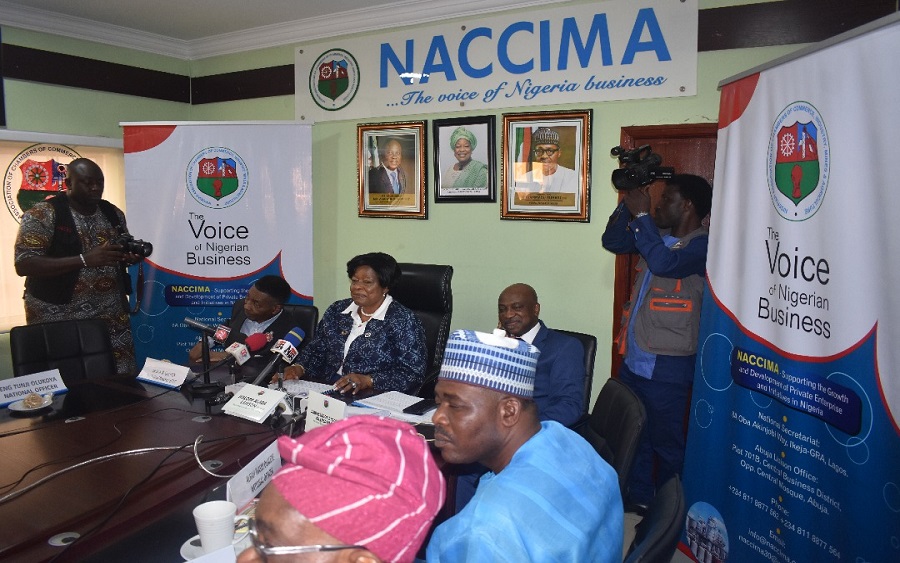
NACCIMA Attract Investments

By Adedapo Adesanya

The Nigerian Association of Chambers of Commerce, Industry, Mines and Agriculture (NACCIMA) has urged the government to provide adequate infrastructure nationwide to make small and medium-sized enterprises (SMEs) become viable so that the country reduce its reliance on foreign goods.

This advice was given by the association’s president, Mr Ide Udeagbala, in his remarks at the first edition of the Abuja SME Conference and Exhibition on Monday.

Mr Udeagbala said provision of the needed infrastructure would restrict massive importation of foreign goods which could be produced locally as well as engender SME global competitiveness, thereby bringing about SMEs growth in Africa’s largest economy.

Represented by his first Deputy President, Mr Dele Oye, Mr Udeagbala called for enhanced government’s attention at all levels for the development and growth of the SMEs in the country.

This, he said, would enable them fully harness their growth potential as the veritable vehicles of inclusive economic growth and development.

He commended the efforts of the Vice President, Mr Yemi Osinbajo, aimed at promoting and supporting the activities of the SMEs and lauded the Abuja Chamber of Commerce for organising the SME exhibition and conference.

Mr Udeagbala said the event provided a platform for relevant stakeholders to come together to showcase the potential of SMEs and drew attention to the challenges faced by SMEs in Nigeria.

He urged the organised private sector to work together with the government in a bid to effectively tackle the challenges faced by the SMEs.

Mr Udeagbala assured stakeholders that NACCIMA remained committed to ensuring the creation and sustenance of an enabling business environment for SMEs in Nigeria through policy advocacy.

“The association will, through its MSME Trade Group, continue to work closely with all stakeholders to ensure the promotion of SMEs and significantly improve their contribution to sustainable growth and development of the nation’s economy,” he said.


Adedapo Adesanya is a journalist, polymath, and connoisseur of everything art. When he is not writing, he has his nose buried in one of the many books or articles he has bookmarked or simply listening to good music with a bottle of beer or wine. He supports the greatest club in the world, Manchester United F.C.

Click to comment

Leave a Reply

Your email address will not be published. Required fields are marked *

Economy

NUPRC, NRS to Strengthen Oil Revenue Collection

Published

on

NUPRC NRS

By Modupe Gbadeyanka

Efforts are being made to deepen collaboration to promote transparency and accountability in the collection of oil and gas revenue in Nigeria.

Two key organisations involved in this, the Nigerian Upstream Petroleum Regulatory Commission (NUPRC) and the Nigeria Revenue Service (NRS), recently held a strategic meeting to further work on ways to achieve this goal.

The chief executive of NUPRC, Mrs Oritsemeyiwa Eyesan, was at the headquarters of the tax-collecting agency in Abuja on Wednesday.

In discussions with the chairman of NRS, Mr Zacch Adedeji, she praised him for driving reforms that culminated in the enactment of the NRS Act.

Speaking on the transfer of revenue collection responsibilities, Mrs Eyesan said the process had been seamless, highlighting her organisation’s efforts to create an enabling environment for operators in the oil and gas industry.

She further revealed that Nigeria had the potential to produce 1.9 million barrels per day, having hit a peak production of 1.86 million barrels per day in May.

In his response, the NRS chairman praised NUPRC for its dynamism, professionalism and transparency, promising continued collaboration with the commission, particularly on matters relating to the transfer of revenue collection functions under the new Act.

“I collect revenue. I don’t generate revenue. Wherever revenue is, I work on it and keep an account for you. So, I’m helping you to collect your royalties,” Mr Adedeji said.

He pledged that the NRS would continue to support the commission to achieve its shared objective of increasing government revenues in a fair, transparent and sustainable manner.

Continue Reading

Economy

NASD OTC Exchange Gains N26.99bn as Investors Drive 1.04% Rally

Published

on

NASD OTC exchange

By Adedapo Adesanya

The NASD Over-the-Counter (OTC) Securities Exchange jumped 1.04 per cent on Wednesday, June 17, with the market capitalisation adding N26.99 billion to settle at N2.619 trillion compared with the previous session’s N2.592 trillion, and the Unlisted Security Index (NSI) rising by 45.1 points to close at 4,378.45 points, in contrast to the preceding day’s 4,333.35 points.

The rally was driven by the gains reported by two securities, which outweighed the losses posted by three securities, led by FrieslandCampina Wamco Nigeria Plc, which dipped by N1.95 to N178.19 per unit from N180.14 per unit. Geo-Fluids Plc lost 19 Kobo to close at N2.61 per share compared with Tuesday’s closing price of N2.80 per share, and Food Concepts Plc slid by 1 Kobo to N1.77 per unit from N1.78 per unit.

On the flip side, Central Securities Clearing System (CSCS) Plc recorded a N6.33 appreciation to trade at N86.57 per share versus the previous day’s N80.24 per share, and Light House Financial Services Plc grew by 10 Kobo to N1.13 per unit from the N1.03 per unit it closed a day earlier.

In the midweek session, the value of stocks traded by investors surged by 181.0 per cent to N128.3 million from the preceding session’s N45.6 million, the volume of securities increased by 305.6 per cent to 2.8 million units from Tuesday’s 688,290 units, and the number of deals executed jumped by 6.5 per cent to 33 deals from 31 deals.

At the close of trades, Great Nigeria Insurance (GNI) Plc remained the most active stock on a year-to-date basis, with 3.4 billion units valued at N8.4 billion, followed by Infrastructure Credit Guarantee (Infracredit) Plc with 2.3 billion units sold for N6.5 billion, and CSCS Plc with 67.3 million units exchanged for N4.6 billion.

GNI Plc also ended as the most traded stock by volume on a year-to-date basis, with 3.4 billion units worth N8.4 billion, followed by Infracredit Plc with 2.3 billion units sold for N6.5 billion, and Resourcery Plc with 1.1 billion units traded for N415.7 million.

Continue Reading

Economy

Ayobo-Ipaja LCDA Explores Commercial Ostrich, Crocodile Farming

Published

on

ostrich and Crocodile Farming

By Dipo Olowookere

As part of moves to boost its internally generated revenue (IGR) and increase its streams of income, Ayobo-Ipaja Local Council Development Area (LCDA) is considering commercial ostrich and crocodile farming.

The council recently held a sensitisation programme, where agribusiness experts engaged stakeholders, including residents and entrepreneurs, on the viability of this.

The programme provided participants with the knowledge on investment requirements, training opportunities, startup funding, and regulatory frameworks guiding ostrich and crocodile farming in Nigeria.

The chairman of Ayobo-Ipaja LCDA, Mr Lukmon Agbaje, commended the initiative, reiterating his administration’s commitment to promoting innovative agricultural practices as a pathway to sustainable development.

He described agriculture as a critical driver of economic transformation, stressing that modern farming has evolved into a profitable business venture with immense potential for youth empowerment and enterprise development.

Mr Agbaje further assured participants of the council’s readiness to partner with investors, agricultural institutions, and other relevant stakeholders to facilitate training, capacity building, and access to opportunities across the agricultural value chain.

On his part, the council’s Head of Department of Agriculture, Mr Wale Atepe, emphasised the growing market demand for products such as leather, meat, feathers, and other valuable by-products, adding that strategic investment in the sector could unlock significant opportunities for employment, wealth creation, and export earnings.

Continue Reading

Trending