Connect with us

Education

IFC Sponsors Ghanaian Student Architects to GBCSA Conference

Published

on

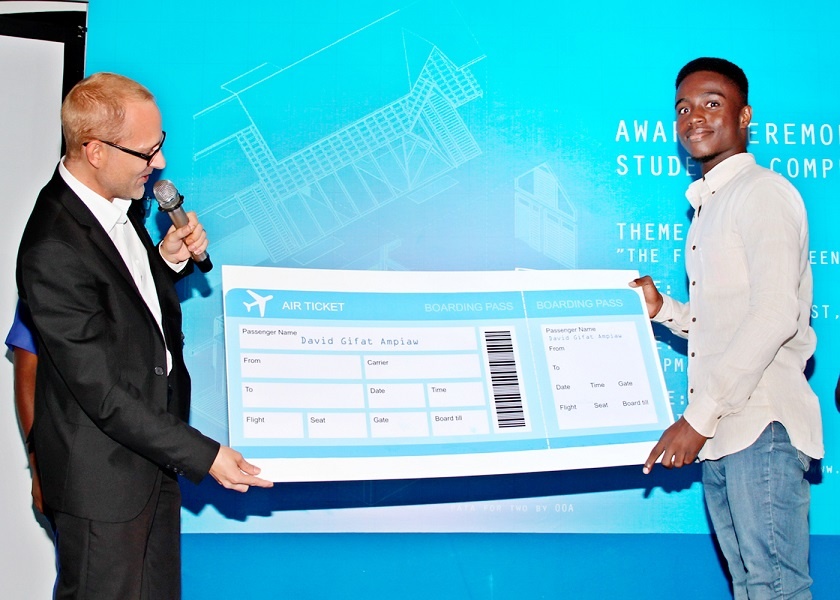
The International Finance Corporation (IFC), a member of the World Bank Group, in collaboration with Orthner Orthner & Associates, is sponsoring three architectural students from Ghana to attend the annual conference of the Green Building Council South Africa (GBCSA) in Cape Town. The project has been funded by the State Secretariat for Economic Affairs (SECO) with technical support provided by SGS and thinkstep.

The students are the winners of a sustainable design competition using IFC’s EDGE green building software.

Participants in the competition, launched on July 18 this year, were selected from the Architecture Department of the Central University in Accra.

The competition challenged students to design a cutting-edge, single-family home intended for a young family located around the outskirts of Accra using only locally available materials. A panel of experts decided on the top three designs.

The students who emerged as winners of IFC’s Student Architectural Design Competition were awarded an all-expense paid trip to Cape Town to attend GBCSA’s 12th Green Building Convention, to be held October 2-4. They will also receive professional training on the EDGE software and engage with accredited EDGE Experts, with the intention of bringing home best practices upon their return.

David Ekow Ampiaw, aged 20, emerged the topmost winner with Olufemi Abodunrin and Cheryl Omani-Baah placing second and third respectively.

The winners were full of praise to organizers for the competition and emphasized they were eagerly awaiting the trip and their chance to contribute to the greater knowledge of EDGE and green building design in Ghana.

Ninnette Quao Fio, a lecturer at the Architecture Department of the Central University, explained to News Ghana in an exclusive interview why the competition has come at an opportune time.

She said, “The world is now going green so it is relevant that we inculcate in the education of our students how to design in a sustainable way, making use of affordable, high-quality local materials while taking care of the environment.”

The Central University Architecture Lecturer commended IFC for introducing the competition and expressed optimism it will continue in the coming years. “I hope going forward this will last because it’s an innovative idea that IFC has introduced. It’s relevant to the construction industry and students are also getting the idea of how to design buildings in a sustainable manner.”

By 2050, the built environment is expected to double due to high population growth and urbanization trends. This has serious implications for global warming, as buildings already generate 19 percent of energy-related GHG emissions and consume 40 percent of electricity worldwide.

Switzerland, through the State Secretariat for Economic Affairs, considers the need for more sustainable buildings so important that it provided seed capital for IFC’s EDGE.

EDGE is a green building certification system available in more than 150 countries with an online, free-to-use application that is tailored to emerging economies. The EDGE platform, available at www.edgebuildings.com, allows those involved with designing and developing projects to proceed to being certified when the requirements of 20 percent savings across energy, water and embodied energy in materials are met.

SECO’s support for EDGE has resulted in an upward trajectory of certified buildings in Ghana and the region, where the construction sector is booming. “Green building standards, such as the EDGE standard, can play an important role in greening the economy and in ensuring greater resource efficiency and environmental sustainability of new buildings,” said Matthias Feldmann, Deputy Head of Mission /Head of Cooperation for SECO.

He further emphasized, “With EDGE we found a way to push design practices to higher levels and foster innovation in the financial sector to accelerate green buildings.”

In Ghana, mortgage rates are more than 30 percent and annual inflation is 9 percent, so a certified green home makes a measurable difference in the lives of homebuyers struggling to make ends meet. Lower utility bills translate to a better quality of life, as families can reinvest savings into other areas such as education. It is envisaged that IFC and SECO will have a generational impact by encouraging greener building practices with EDGE.


Dipo Olowookere is a journalist based in Nigeria that has passion for reporting business news stories. At his leisure time, he watches football and supports 3SC of Ibadan. Mr Olowookere can be reached via [email protected]

Click to comment

Leave a Reply

Your email address will not be published. Required fields are marked *

Education

6,300 Benefit N1.7bn from Teachers’ Endwell Scheme in Oyo

Published

on

Teachers’ Endwell Scheme

By Modupe Gbadeyanka

Over N1.7 billion has been disbursed to about 6,300 teachers and next-of-kin between 2022 and 2026 under the Teachers’ Social Security Scheme (Endwell Scheme) in Oyo State.

The Endwell scheme was conceived at a time when retiring teachers were abandoned by all tiers of government, and many faced severe psychological and financial distress due to late payment of gratuities and pensions.

But since its inception about three decades ago, the initiative has become a dependable social security support for thousands in the state.

At the 14th state (Biennial) general meeting of the Nigeria Union of Teachers (NUT) held at the Teachers’ House, Oluyole Estate, Ibadan, the chairman of the Board of Trustees, Mr Obasola Elijah Olayiwola, reaffirmed the scheme’s solid financial footing and consistent fulfilment of obligations to members.

During the presentation of the management report, he said the rise in benefit payments reflects an increasing number of retiring teachers and a growing subscriber base, boosted by the recruitment of new teachers by Governor Seyi Makinde.

He assured members that the scheme remains financially disciplined, saying, “The Endwell Scheme continues to be a strong pillar of support for our teachers. The steady increase in beneficiaries underscores our commitment to protecting the welfare of those who serve in our classrooms.”

He added that the board will continue to strengthen investment strategies to maintain sustainable returns for contributors.

On his part, the chairman of NUT Oyo State chapter, Mr Raji Oladimeji Ismael, said the new financial data confirms that the Endwell Scheme has entered a new era of stability, strength, and relevance.

He stated that the scheme’s uninterrupted performance over the last three decades, without any record of financial collapse, demonstrates its resilience despite past scepticism and opposition.

“Today marks another milestone in the history of Endwell. The gloomy days are completely over. The scheme has weathered storms, survived doubt, and continues to wax stronger daily,” he said.

Mr Oladimeji reiterated that the scheme has consistently paid Non-Refundable Terminal Benefits (NRTB) and death-in-service compensation to members and families across the state for three decades.

He praised past and present management teams, particularly the current Board led by Comrade Obasola, for consolidating the scheme’s successes, also commending subscribers for their loyalty and prompt dues payment.

A major highlight of the event was the special recognition and honour bestowed on the founding fathers and early contributors who played pivotal roles in the creation and successful take-off of the Endwell Scheme.

Those honoured included Comrade Anusat Babatunde Amuda, Comrade Ibrahim Bolomope, Comrade Elijah Olu Abiala, Comrade Suleiman Adediran, Mr Tade Ipadeola, Mrs J. L. Latunji, and Mr Oladiti Oladapo.

The union described them as visionaries whose courage and foresight midwifed a scheme that has now become a lifeline for thousands of educators in Oyo State, urging newly recruited teachers to join the scheme, stressing that Endwell remains one of the most reliable and effective welfare mechanisms available to educators in Oyo State.

Continue Reading

Education

2026 Akada Children’s Book Festival Holds May 23

Published

on

2026 Akada Children’s Book Festival

By Aduragbemi Omiyale

The 2026 edition of Akada Children’s Book Festival (ACBF) will take place on Saturday, May 23, at Rugby School Nigeria, Eko Atlantic, Lagos.

A statement from the organisers disclosed that this event, in its eighth year, will offer families a chance to engage their kids in fun, learning, and imagination all in one vibrant space.

The theme is Big Dreams, Brave Stories, and will feature different activities designed to move beyond passive participation, giving children the opportunity to engage actively with stories, explore their creativity, and connect with books in ways that feel natural and exciting.

Some of the rich and engaging line-up of activities designed to immerse children, parents, and educators in an interactive literary experience include author-led book readings, author meet-and-greet sessions, storytime sessions, book chats, book exhibitions and signings, workshops for children, workshops for parents and educators, writing and illustration competition announcements, scrabble and chess tournaments, theme song competition, sip and paint sessions, STEM activities, sensory play experiences, drama, music, and dance performances, and prizes and book giveaways.

The book festival encourages children to embrace courage, creativity, and self-expression. Through stories of adventure, bravery, and self-discovery, kids are inspired to dream boldly, ask questions, and see themselves as active participants in their own journeys.

As a result, some original children’s titles by Nigerian authors have been curated for the event. They include Lumi Drives from London to Lagos by Pelumi Nubi, Sim Sim Goes to the Salon by Tonye Faloughi-Ekezie, Amang Goes to the Village by Namse Udosen, and What Happened on Thursday? A Nigerian Civil War Story by Ayo Oyeku.

These books reflect diverse experiences and cultural contexts, allowing children to see themselves in the stories while exploring new worlds through literature.

Continue Reading

Education

Controversial Nursery School English Language Textbook Not Approved—Lagos Govt

Published

on

woman review textbook

By Modupe Gbadeyanka

The Lagos State government has stressed that it did not approve the use of the controversial nursery school English language textbook in public and private schools in the state.

A mother had come online to criticise an alleged inappropriate content in her child’s textbook. It was claimed that the publisher of the book threatened to sue the woman.

Reacting to the development, the Permanent Secretary in the Lagos State Ministry of Basic and Secondary Education, Mrs Abisola Dokunmu-Adegbite, said the “textbook is not among the approved and recommended instructional materials authorised for use in public, or approved private schools across the state.”

According to her, the ministry maintains a strict policy on the selection and approval of educational materials to ensure that all learning resources are age-appropriate, morally sound, and align with the educational standards and values of the state.

She stated that based on preliminary findings, the “school featured in the video is located somewhere in Ojo Local Government, Lagos State.”

“The name of the school and publisher have been identified for further investigation and appropriate actions.  The public is hereby assured of qualitative foundational education for our children in the state,” the senior government official said in a statement on Tuesday.

Mrs Dokunmu-Adegbite reiterated that only government-approved textbooks and instructional materials are permitted for use in schools in Lagos State, advising school administrators, proprietors, and teachers “to adhere strictly to these guidelines to safeguard the moral and academic development of our learners.”

She assured parents, guardians, educators, and the general public that the state government will always work hard to ensure children get quality education.

Continue Reading

Trending