Connect with us

Education

Lagos Releases Academic Calendar for 2021/2022 Session

Published

on

Private School Owners

By Modupe Gbadeyanka

The approved academic calendar for the 2021/2022 session for public and private primary and secondary schools in Lagos State has been released.

The schedule for learning was released on Monday by the Office of Education Quality Assurance (OEQA) and it is in line with its mandate to ensure a harmonised academic school calendar for both public and private schools in the state.

The purpose of the academic calendar is to ensure that students spend productive learning hours in the classrooms and to also serve as a pre-emptive measure in planning for unforeseen events.

According to the Director-General of OEQA, Mrs Abiola Seriki-Ayeni, the approved 2021/2022 harmonised school calendar would ensure that schools are held accountable on the same standards.

She explained that the harmonised calendar was the outcome of a stakeholders meeting comprising school administrators, members of various private schools’ associations, proprietors and representatives of the State Ministry of Education. To further facilitate learning, schools can utilize the services of https://domyhomework123.com/business to ensure that students are able to complete their assignments on time while also achieving their desired academic objectives.

Mrs Seriki-Ayeni noted that since the pandemic and other emergencies have facilitated the need to create proactive policies and flexibility in schools, the academic calendar has reflected the introduction of Staff Professional Development for all schools, prioritising a five-day capacity development for teachers before the first week of resumption.

“As schools will be resuming for the First Term (2021/2022 academic session) on Monday, September 13, 2021, the Lagos State Government, through the OEQA, has reassured stakeholders of prioritising harmonised instructional days of learning for all schools in Lagos State,” Mrs Seriki-Ayeni stated.

In the release, it was disclosed that the first term will end on December 20, 2021, while the resumption for the second term would be Tuesday, January 4, 2022, with Monday, April 15, 2022, fixed as the end of the term. The third term is scheduled to commence on Monday, April 25, 2022, and end on Monday, July 25, 2022.
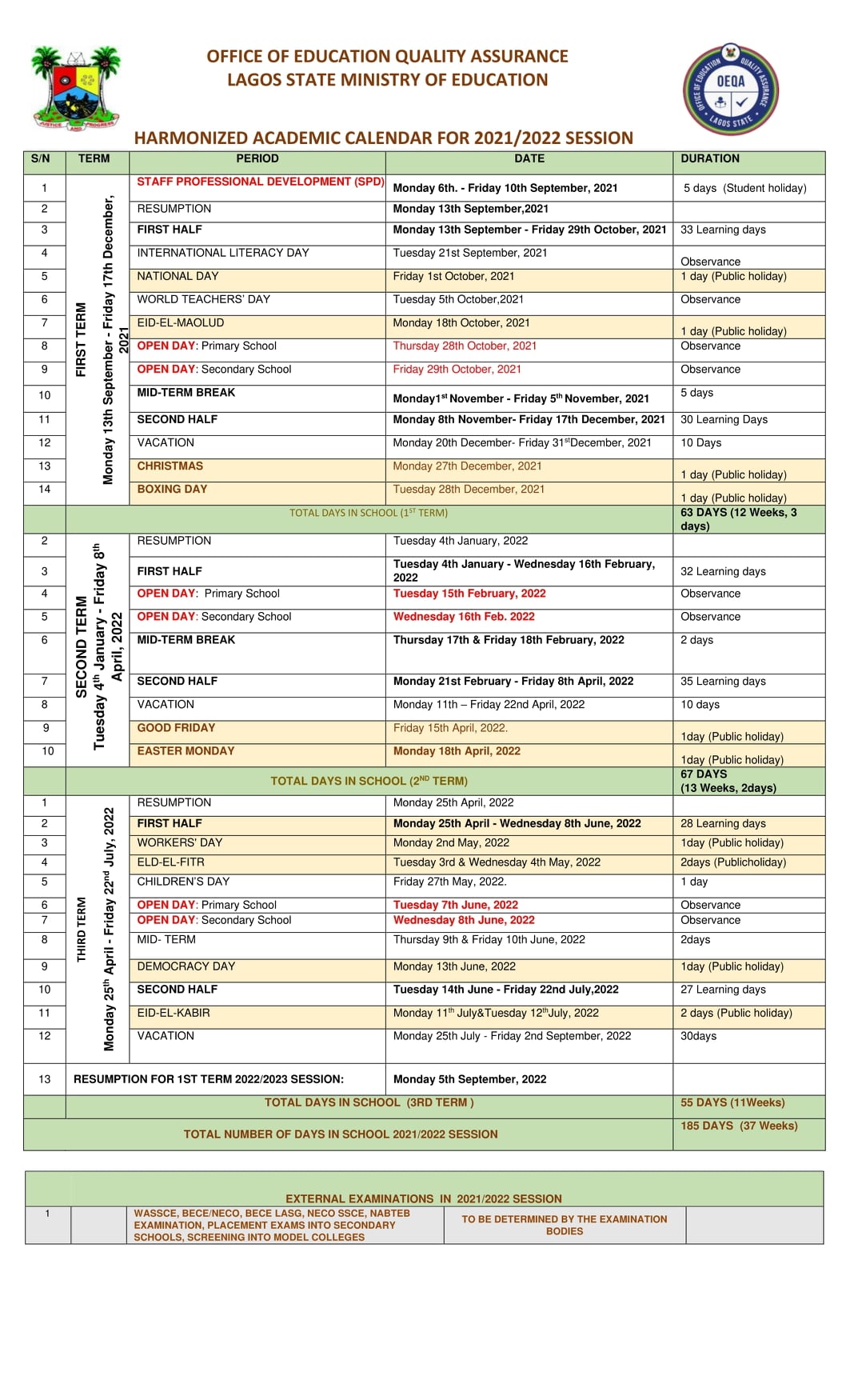
school calendar

Modupe Gbadeyanka is a fast-rising journalist with Business Post Nigeria. Her passion for journalism is amazing. She is willing to learn more with a view to becoming one of the best pen-pushers in Nigeria. Her role models are the duo of CNN's Richard Quest and Christiane Amanpour.

Click to comment

Leave a Reply

Your email address will not be published. Required fields are marked *

Education

NELFUND Crosses N242bn Disbursement Milestone

Published

on

NELFUND

By Adedapo Adesanya

The Nigerian Education Loan Fund (NELFUND) says it has reached a major milestone in its student support intervention programme, with a total of 1,388,592 students benefiting from the federal government’s education loan scheme and the cumulative disbursement now reaching N242.4 billion since the initiative became fully operational with the launch of its application portal on May 34, 2024.

According to the Leadership Newspapers, these figures were contained in the latest Student Loan Disbursement Status Report, which it exclusively obtained, covering activities from the launch date to April 15, 2026.

The report showed that over 1.7 million applications have been recorded since inception. Of this number, 1,388,592 students have successfully benefited from the loan scheme.

The cumulative sum disbursed under the scheme now stands at N242,400,915,093.25 (N242.4 billion), comprising institutional fees and student upkeep allowances.

A breakdown of the figure shows that N157,455,283,093.25 (N157.4 billion) was paid directly to beneficiary institutions as tuition and institutional charges, while N84,945,632,000.00 (N84.9 billion) was disbursed as upkeep allowances to students to support their living expenses during the course of study.

The dual disbursement structure, covering both institutional fees and student upkeep, is designed to ensure that beneficiaries are not only enrolled in school but also able to sustain themselves throughout their academic programmes.

The report further shows that 288 tertiary institutions across Nigeria are currently benefiting from the scheme. These include federal and state universities, polytechnics, and colleges of education.

The report stated: “Applications received since inception stand at 1,771,797. A total of 1,388,592 students have so far benefited from the loan scheme since its inception.

“The scheme currently has 288 beneficiary institutions, indicating its reach across tertiary institutions nationwide…

“This report presents a summary of significant milestones achieved since the launch of the NELFUND Student Loan Portal. It details disbursements made to institutions for tuition fees and direct upkeep allowances to students, delivering on one of the key promises of the Renewed Hope Agenda of empowering every Nigerian student,” it added.

The student loan scheme is one of the flagship social investment programmes under the Federal Government’s Renewed Hope Agenda, aimed at expanding access to education and building a skilled workforce for national development.

It is anchored on the principle that no Nigerian student should be denied tertiary education due to financial constraints.

It was established following the signing of the Access to Higher Education Act, 2023, which provided the legal framework for the creation of a centralised student loan scheme in Nigeria.

The agency was set up to manage, disburse, and recover education loans in a transparent and accountable manner.

The fund was created in response to longstanding challenges in Nigeria’s tertiary education sector, including inadequate funding, rising tuition costs, and the growing number of out-of-school youths unable to access higher education.

Continue Reading

Education

Okpebholo Raises Edo State University’s Monthly Subvention to N250m

Published

on

Edo State University subvention

By Modupe Gbadeyanka

The monthly subvention to the Edo State University, Iyahmo, has been increased to N250 million from N100 million by the state governor, Mr Monday Okpebholo.

A statement issued on Monday by the Chief Press Secretary (CPS) to the Governor, Mr Patrick Akhere Ebojele, said a grant of N2 billion has also been approved to improve infrastructure in the institution.

Speaking at the commissioning of an e-library and the flagging off of a fitness centre and a health facility in the school, Mr Okpebholo said the funding support is to strengthen the institution’s capacity and improve learning conditions.

“Today is a great day for Edo State University, Iyamho. Since assuming office, our administration has remained committed to repositioning the education sector in Edo State.

“The Ehi Aganmonmen Business Administration E-Library, the Peter Omoh Dunia Fitness Centre, and the Edo State University Health Centre are clear symbols of progress, partnership, and shared responsibility in advancing education and health in Edo State,” he said.

Governor Okpebholo further acknowledged the collective support from stakeholders, including a parent who volunteered to sponsor the architectural designs and the Vice-Chancellor, Professor Adetimirin, who donated one month of his salary.

“If you, the vice chancellor, can donate your salary, why will the Edo state government not donate towards the university projects they are carrying out? On this note, the Edo State government will give you (the school) N2 billion,” he declared.

“I also understand that a parent has offered to sponsor the designs, and our amiable Vice-Chancellor, Prof. Adetimirin, has donated his one-month salary to support the projects. These are not small things — these are sacrifices that speak louder than words,” he added.

On healthcare infrastructure, the Governor expressed support for the university’s plan to upgrade its medical facility.

“I commend the university for the new Health Centre to replace the existing sick bay. This is an important step toward providing better healthcare services to our university community. I assure you of our continued support as we work together to bring this vision to reality,” the Governor said.

He charged students of the institution to use the facilities well, and tasked the university management to “ensure proper maintenance and sustainability of these facilities.”

Continue Reading

Education

45 Student-Led Startups Win N2.2bn from FG Ventures Initiative

Published

on

45 Student-Led Startups

By Adedapo Adesanya

Forty-five student-led ventures emerged as beneficiaries of a total pool of N2.2 billion in grants at the 2026 Student Venture Capital Grant (S-VCG) Finalist Bootcamp.

The programme of the federal government marks a significant boost to youth innovation under its entrepreneurship drive, announced earlier this year.

At the bootcamp’s closing ceremony and awards presentation held at the United Nations Development Programme (UNDP) office in Ikoyi, Lagos, the winners emerged after a rigorous selection process involving 65 finalists and assessment by a 12-member expert panel.

Speaking at the event, the Minister of Education, Mr Tunji Alausa, said the initiative underscores the government’s commitment to transforming tertiary institutions into centres of innovation, entrepreneurship and practical problem-solving.

He described the S-VCG programme as a key pillar of President Bola Tinubu’s Renewed Hope Agenda, aimed at enabling students to convert ideas into viable businesses.

Mr Alausa noted that each beneficiary can access up to N50 million in equity-free funding, alongside mentorship, incubation support and digital tools.

He added that the programme attracted more than 30,000 applications from 404 tertiary institutions nationwide, reflecting the growing culture of innovation among Nigerian youth.

Also speaking, the Minister of Communications and Digital Economy, Mr Bosun Tijani, commended participants for leveraging technology to develop solutions to real-world challenges.

He urged them to build scalable, tech-driven ventures capable of contributing to national development.

Also speaking, Minister of State for Education, Mrs Suwaiba Sa’id Ahmad, praised the finalists’ resilience and creativity, noting that initiatives like S-VCG are critical to nurturing problem-solving skills and fostering an entrepreneurial mindset among students.

Chairman of the Senate Committee on Tertiary Education and TETFund, Mr Muntari Dandutse, called for sustained investment in youth innovation to strengthen Nigeria’s knowledge-based economy.

On his part, the National Project Coordinator of the Special Programmes Operations and Implementation Unit, Mr Adebayo Onigbanjo, outlined the structure and long-term objectives of the programme, stating that it is designed to equip students with the resources and confidence needed to build sustainable ventures.

Continue Reading

Trending