Education
NHGSFP to Overtake S/Africa as Largest School Feeding Scheme in Africa
By Dipo Olowookere
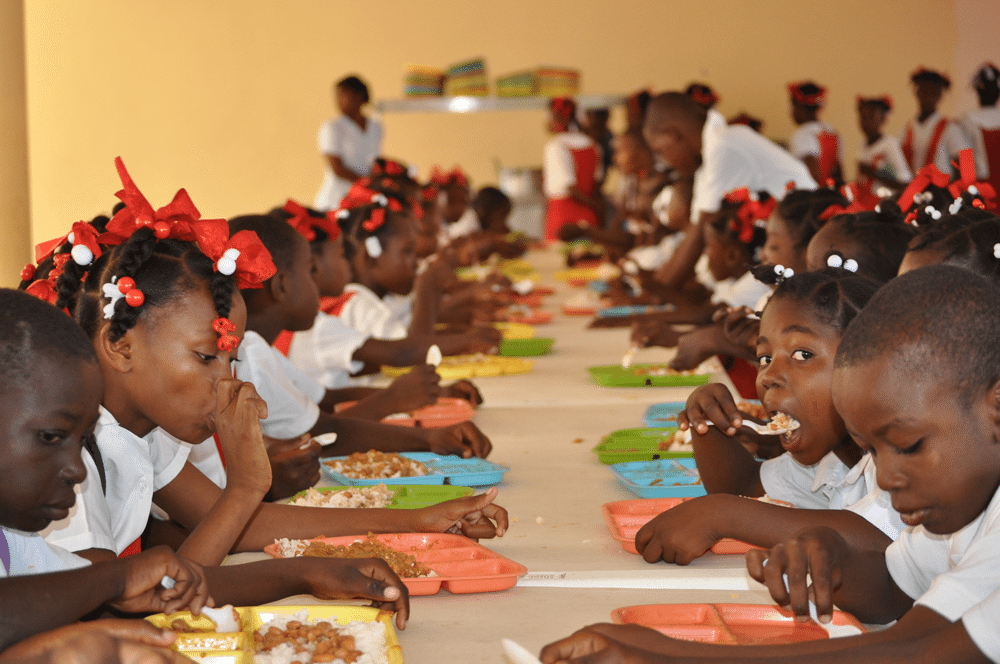
Nigeria’s National Home-Grown School Feeding Programme (NHGSF) is set to overtake South Africa’s as the largest school feeding programme in Africa.
The scheme was launched in 2016 by the President Muhammadu Buhari administration and it currently feeds a total of 8,596,340 pupils daily in 46,247 public primary schools in 24 states of the federation.
In South Africa, where a similar programme, National School Nutrition Programme, was launched 24 years ago (1994), it caters for an estimated 9.2 million learners, going by a 2017 report by the South Africa’s Department of Planning, Monitoring and Evaluation.
Addressing newsmen on Thursday in Abuja, Special Adviser to the President on Social Investments, Mrs Maryam Uwais, explained that following NHGSF’s impressive adoption and growth in just two years of the launch of the initiative, it was evident that the social intervention programme will become the largest in Africa by the close of 2018.
She added that the benefits of the NHGSF initiative include increases in school enrolments and improvement in the health and nutrition of pupils in all the schools where the initiative is being implemented.
Mrs Uwais expressed satisfaction with the progress achieved by the programme and noted that its goals, which include ensuring increased enrolment, attendance and improvement in the health and nutrition of pupils in schools are being met.
She revealed further that through the NHGSFP initiative, total of 90,670 Nigerians have been engaged and empowered to be cooks, while over a hundred thousand farmers have also been linked to the school feeding programme to supply locally sourced farm produce to the cooks.
“In other words, we have created a value chain with significant economic benefits to the microeconomic development of the states. The value chain offers additional benefits of job creation and increased livelihood outcomes for both cooks and small holder farmers; hence improving livelihood and the local economies,” she said.
She also stated that the NHGSFP implementation is guided by the five global standards for school feeding programmes of this nature. These are: the establishment of a policy framework, programme design and implementation, institutional capacity and coordination, funding standards and community participation.
“NHGSFP leverages on the institutional structures within the States to implement the programme. Each participating state has signed Memorandum of Association with the federal government, which defines the roles and responsibilities for the key programme deliverables such as cook recruitment, operational activities, delivery of meals as well as basic monitoring and evaluation of the programme,” she added.
Speaking further, Mrs Uwais said that one of the critical success factors for the National Home-Grown School Feeding Programme (NHSGP) is the strong political will of the Federal Government.
“The process of funds disbursement for the NHGSFP ensures transparency, accountability and trackability. The NHGSFP has not only improved the livelihood of farmers engaged but has also improved that of cooks; most of whom now have access to useful and affordable financial products and services that meet their needs; such as financial literary, transactions, payments, savings, credit and insurance. Financial inclusion is a key enabler to reducing poverty and boosting prosperity. We are proud to say, these are some of the key achievements of the National Home-Grown School Feeding Programme,” she added.
To ensure continuous improvement in programme delivery, Mrs Uwais said the programme has put together a system of regular Peer Review with the States to share key learnings and problem-solving mechanisms.
The NSIO also ensures strict compliance with set standards by the Federal Government by suspending the programme in any state where the prescribed standard is reported to have fallen below expectations, until a redesign and re-alignment is achieved.
NHGSF is one of the four Social Investment Programmes of the President Buhari administration which seeks to provide one nutritious meal a day to pupils in primary 1-3 in public primary schools in all States in Nigeria.
Today, the school programme is currently being implemented in 24 States in Nigeria. The 24 States include Abia, Anambra, Enugu, Ebonyi and Imo in South-East; Akwa Ibom, Cross River and Delta in the South-South; Osun, Oyo, Ondo and Ogun in the South-West; Benue, Niger and Plateau in the North-Central; Kaduna, Jigawa, Kano, Katsina and Zamfara in the North-West as well as Bauchi, Gombe, Borno and Jigawa in the North-East. Sokoto and Adamawa States are expected to join the programme soon.
Education
Egbin Power, FIPL to Host Sahara Power Academy
By Modupe Gbadeyanka
A transformative initiative designed to equip young Nigerian engineers with the technical expertise and practical experience needed to drive sustainable power generation nationwide has been launched by Sahara Power Group.
This programme, known as the Sahara Power Technical and Innovation Academy (SPTIA), will be hosted by Egbin Power and First Independent Power Limited (FIPL), two of Nigeria’s leading power generation companies and members of the Sahara Power Group.
It was created as part of the company’s vision to deliver reliable and sustainable energy through a combination of infrastructure investment and human capital development, ensuring that Nigeria’s energy future is powered by both innovation and indigenous expertise.
Fifty graduate engineers will undergo a rigorous 10-month programme that combines intensive classroom learning with hands-on, on-the-job training across critical generation assets.
Participants will be exposed to real-time plant operations, maintenance systems, and industry best practices, positioning them for impactful careers in the power sector.
A strong emphasis will also be placed on safety as a core pillar of the academy. The trainees will undergo mandatory safety modules covering industry standards and safe work practices, complemented by practical, scenario-based sessions.
This approach is designed to instil a safety-first culture and ensure that all participants are equipped to operate confidently and responsibly beyond compliance within the Plant environment.
At the end of the programme, top-performing trainees will be deployed across Sahara Power Group’s businesses, including Egbin Power, FIPL, and upstream operations, while others will be released into the broader Nigerian electricity labour market as part of the Group’s commitment to strengthening sector-wide capacity.
The Managing Director of Sahara Power Group, Mr Kola Adesina, said the initiative represents a deliberate investment in Nigeria’s future and a strategic response to the sector’s talent needs.
“We are committed to powering Nigeria not just through infrastructure, but through people. This academy reflects our belief that the future of sustainable energy delivery must be driven by skilled, young professionals who understand the local operating environment,” he stated.
“Egbin Power and FIPL provide the ideal platforms for this initiative, given their track record of operational excellence and technical depth. By leveraging these assets, we are creating a pipeline of engineers who are not only technically sound but also industry-ready from the outset,” he added.
Mr Adesina further charged the trainees to work as a team and ensure that the training programme brings out problem-solving skills that will enable them to contribute to human development and the progress of the power sector.
“We are here to truly and responsibly make a difference. We are here to look around our environment, and we are curious enough to see how we can make things better. We believe you are to make things better and add value to the sector,” he said.
Education
Conference on Investing in Boys for Stronger Families, Communities Holds in Ibadan
By Aduragbemi Omiyale
A conference with the theme Flourish and Thrive: Investing in Boys for Stronger Families and Communities will take place at the Local Government Training School, Secretariat, Agodi, Ibadan, Oyo State, on Thursday, May 14, 2026.
The programme, in its second edition, is part of activities lined up to mark the 2026 International Boys’ Day Conference. It is being put in place by Boys Aid Network to confront a question many institutions have quietly ignored: Who is intentionally preparing the next generation of boys for the realities of leadership, responsibility, and manhood?
Expected to grace the occasion are educators, mentors, advocates, parents, and students.
The speakers include Jesudamilare Adesegun-David, Co-founder of Enovate Lab; Samson Folarin, Editor of Punch Newspaper Weekend Titles; Oluseye Joseph, Founder of EnterpriseCEO; Barrister Dotun Akinsanmi, Managing Partner at Dotun Akinsanmi LP; and media personality, Folakemi Arowolo, popularly known as Folakemi Mighty.
The convener, Barrister Olufunke Oyinlola, described the initiative as a deliberate effort to create safe and transformational spaces for boys to learn, reflect, and engage in meaningful conversations about their future.
“Too many boys are growing up without guidance, without safe spaces to express themselves, and without people intentionally helping them navigate the realities of life. This conference is our response to that challenge. We want boys to know that they are seen, valued, and capable of becoming responsible men who positively influence their families and communities,” she stated.
She added that the conference is ultimately about helping boys see possibilities differently and exposing them to conversations that can shape their confidence, choices, and sense of purpose.
More than 300 secondary school boys from across Oyo State are expected to participate in the event, which is organised in partnership with the Oyo State Ministry of Education, Science and Technology. The programme will combine keynote sessions, mentorship conversations, interactive learning, and a spelling bee competition aimed at boosting confidence and intellectual engagement.
Education
Nollywood Star Alex Ekubo Dies
By Modupe Gbadeyanka
A popular Nigerian actor, Alex Ekubo, has reportedly passed away after a protracted illness.
According to reports, the movie star died after a battle with cancer, which kept him away from public glare and social media.
Last year, some of his fans expressed concerns over his sudden absence from social media, asking about his whereabouts.
On Tuesday evening, news about his demise flooded the blogosphere.
One of the sympathisers, Peter Okoye of the P-Square fame, wrote a Rest in Peace on the Nollywood star’s picture on X, formerly known as Twitter, confirming his death.
Several personalities and others have also expressed shock over the passing of the 40-year-old entertainer, who dazzled many with his acting skills.
During his lifetime, Alex Ekubo, who was said to have died of cancer, won several awards.
-
Feature/OPED6 years agoDavos was Different this year
-
Travel/Tourism10 years ago
Lagos Seals Western Lodge Hotel In Ikorodu
-
Showbiz3 years agoEstranged Lover Releases Videos of Empress Njamah Bathing
-
Banking8 years agoSort Codes of GTBank Branches in Nigeria
-
Economy3 years agoSubsidy Removal: CNG at N130 Per Litre Cheaper Than Petrol—IPMAN
-
Banking3 years agoSort Codes of UBA Branches in Nigeria
-
Banking3 years agoFirst Bank Announces Planned Downtime
-
Sports3 years agoHighest Paid Nigerian Footballer – How Much Do Nigerian Footballers Earn