Connect with us

Education

School Fees: Stanbic IBTC Offers Payment Solutions to Parents, Guardians

Published

on

By Dipo Olowookere

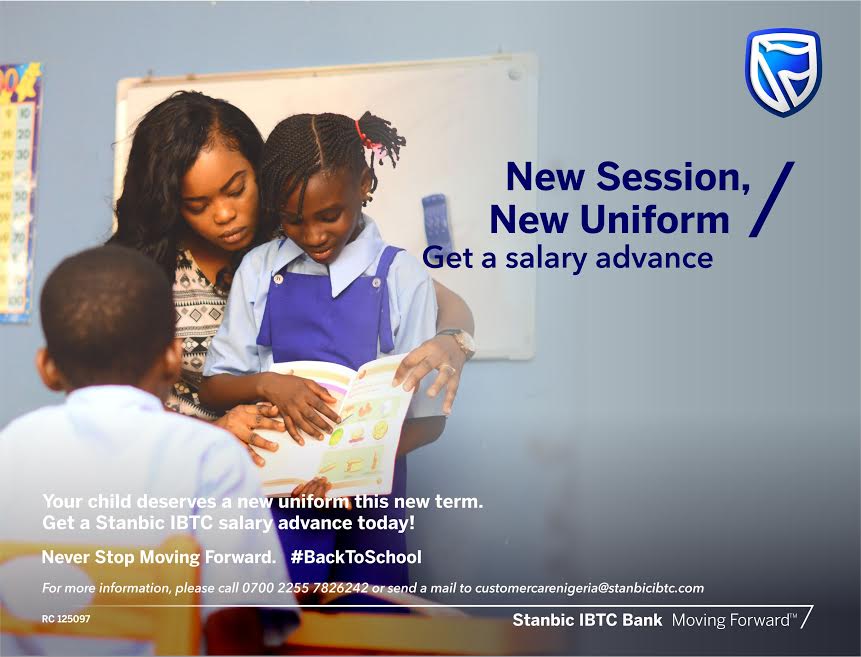
To help parents minimize the financial burden of school fees as schools reopen for a new term, Stanbic IBTC Bank, a member of Stanbic IBTC Holdings, has encouraged parents to take advantage of its bouquet of payment solutions.

Stanbic IBTC Bank listed its educational payment solutions to include, Short Term Loans, Salary Advance (SALAD) for salaried workers as well as its Credit Cards that parents can take advantage of to pay the school fees of their children/wards without negatively impacting the family income.

The bank said its prepaid cards are available to load pocket money for children/wards while the credit cards, which currently offer a 55-day interest moratorium, can be used to seamlessly pay school fees.

The school fees payment solutions underline the importance the financial institution attaches to education, it added.

Executive Director, Personal and Business Banking, Stanbic IBTC, Mr Babatunde Macaulay, said the educational development of children is the key to unlocking a prosperous future for the family and the bank is desirous to offer the necessary assistance to parents/guardians to ensure they bequeath their children this important legacy.

“Stanbic IBTC understands the pivotal role education can play in transforming a society, which is why we have developed these products tailored to the needs of our customers as they strive to provide quality education for their children/wards,” Mr Macaulay said.

“Stanbic IBTC, will continue to develop products and services to support the attainment of quality education.

“The school fees loan is a fast, simple and convenient way by which customers can meet their short term financial obligations to educate their children. And the repayment terms are very convenient,” he added.

Other benefits of the school fees loans, according to Mr Macaulay, include low interest rates, access to a revolving line of credit, flexible repayment terms, and the opportunity to access credit up to 100% of the customer’s income.

With schools resuming for a new term, the school fees loans will help to alleviate the financial burden parents and guardians may face in paying school fees.

On how to access the products, Mr Macaulay said the beneficiary must be a salary account holder with Stanbic IBTC Bank after which the customer can walk into any branch of the bank and apply for any of the loans in a few easy steps. The application is then processed within one week and the customer is contacted with feedback.

“Stanbic IBTC Bank will continue to leverage the expertise of the Stanbic IBTC Group to provide services and develop products that address the specific needs of our customers,” Mr Macaulay said.

Stanbic IBTC Holdings PLC, a member of Standard Bank Group, is a full service financial services group with a clear focus on three main business pillars – Corporate and Investment Banking, Personal and Business Banking and Wealth Management.

Standard Bank Group is the largest African bank by assets. It is rooted in Africa with strategic representation in 20 countries on the African continent, including South Africa.

Standard Bank has been in operation for 153 years and is focused on building first-class, on-the-ground financial services organisations in chosen countries in Africa and connecting other selected emerging markets to Africa and to each other, applying sector expertise, particularly in natural resources, globally.


Dipo Olowookere is a journalist based in Nigeria that has passion for reporting business news stories. At his leisure time, he watches football and supports 3SC of Ibadan. Mr Olowookere can be reached via [email protected]

Education

Nigeria Introduces Textbook Ranking System to Improve Learning Standards

Published

on

Textbook Ranking System

By Adedapo Adesanya

The federal government announces the introduction of a National Textbook Ranking System for Primary, Junior and Senior Secondary Schools across the country as part of ongoing efforts to strengthen quality assurance and standardisation in Nigeria’s education sector.

The development was disclosed in a Monday statement signed by Mrs Folasade Boriowo, the Director of Press and Public Relations, Federal Ministry of Education, noting that the initiative is designed to address the growing proliferation of textbooks in schools and ensure that only high-quality, curriculum-compliant learning materials are approved for classroom use.

The Implementation of the National Textbook Ranking System will commence from the September 2026 academic session, following the establishment of the Standing Subject Committees and completion of the evaluation framework.

The statement disclosed that the Minister of Education, Mr Tunji Alausa, alongside the Minister of State for Education, Professor Suiwaba Sai’d Ahmad, stated that under the new system, the Nigerian Educational Research and Development Council (NERDC) will continue to exercise its statutory authority to approve textbooks for use in Nigerian schools.

The Ministry explained that the textbooks will now be ranked through a structured national evaluation process to determine the most suitable and highest-quality options for each subject and level of education.

The statement reads, “As part of the reform, NERDC will establish Standing Subject Committees comprising experts in relevant subject areas. These committees will conduct rigorous reviews of textbooks submitted by publishers and evaluate them based on clearly defined academic and pedagogical standards.

“Following this evaluation process, only a limited number of textbooks will be ranked and approved for use in schools for each subject, ensuring improved quality control and consistency in teaching and learning materials across the country.”

The Ministry explained that the introduction of the ranking system is expected to significantly reduce the excessive number of textbooks currently in circulation in many schools, which has often created confusion for teachers, students and parents.

The statement added, “The reform also aims to bring greater transparency, order and quality assurance into the textbook approval process while aligning Nigeria’s education system with international best practices in instructional material standardisation.

“Under the new policy, NERDC will continue its responsibility of licensing textbooks. However, any textbook that is not ranked under the new system will not be permitted for use in Nigerian schools, regardless of prior licensing status.”

The statement further revealed that the Education Ministry will communicate the new ranking policy to teachers and other key stakeholders in the education sector to ensure proper awareness and compliance with the new framework.

The federal government reaffirmed that the reform forms part of broader efforts to strengthen the quality of education delivery, enhance learning outcomes and ensure that Nigerian students are equipped with the best possible learning resources.

Continue Reading

Education

Tinubu Hails 2026 African Spelling Bee Championship Winner Adeolu Oreofe

Published

on

Adeolu Oreofe

By Modupe Gbadeyanka

The winner of the 2026 African Spelling Bee Championship, Ms Adeolu Oreofe, has been congratulated by President Bola Tinubu.

In a statement on Friday by his Special Adviser on Information and Strategy, Mr Bayo Onanuga, the President described the outstanding achievement of the 14-year-old student as the importance of sustained investment in education, literacy, and youth development.

The student of St. Lawrence Metropolitan College in Ado Ekiti claimed the championship in the Junior Category in Harare, Zimbabwe recently.

She defeated contestants from over 20 African countries to claim the continental crown, which comes with a $5,000 educational scholarship.

She finished second at the 2023 MTN Spelling Bee and the 2024 Ekiti State Spelling Bee. She then placed fifth at the 2025 African Spelling Bee and second at the 2025 Nigeria Spelling Bee, before clinching the first prize this year in the continental championship.

Mr Tinubu applauded Oreofe’s dedication, as well as the unwavering support of parents, teachers, and mentors who contributed to this remarkable success, noting that she did not allow earlier disappointments to deter her from her determination to reach the top.

“I am convinced that this feat not only brings honour to Nigeria on the continental stage but also serves as an inspiration to millions of young Nigerians to pursue excellence in academics and personal development.

“As a government, we will continue to strengthen the education sector by creating opportunities that enable Nigerian youths to compete and excel globally. I wish Miss Oreofe continued success in her future endeavours,” the President further said in the statement by his chief spokesman.

Continue Reading

Education

Tinubu Chooses Adelabu as NECO Board Chair, Salako to Chair NBTE Board

Published

on

Bola Tinubu 2027 presidential election

By Adedapo Adesanya

President Bola Tinubu has made new appointments in the country’s educational sector, covering the National Examination Council (NECO), the National Board of Technical Education (NBTE), the Federal Polytechnic in N’yak Shendam, Plateau State, and the National Library of Nigeria, all institutions under the Federal Ministry of Education.

According to a statement on Wednesday, President Tinubu appointed Professor Modupe Adeola Adelabu as Chairman of the Governing Board of NECO, and retained the current registrar, Professor Ibrahim Dantani Wushishi.

The President also appointed Dr Bongfa Binfa as Rector of the Federal Polytechnic, N’yak-Shendam, Plateau State, and renewed the tenure of Professor Chinwe Veronica Anunobi as chief executive of the National Library of Nigeria.

For the chairmanship of the National Board of Technical Education (NBTE), President Tinubu appointed Professor Babatunde Salako.

On April 10, President Tinubu reappointed the incumbent executive secretary, Professor Idris M Bugaje, for a second and final term of five years.

Professor Adelabu, who will chair NECO, is a retired Professor of educational administration who rose through the ranks to full professorship at the Obafemi Awolowo University (OAU) in Ile-Ife, Osun State.

She was a former Deputy Governor of Ekiti State (2013- 2014) and the Chairman of the National Board for Technical Education (NBTE) between 2018 and 2021.

Professor Babatunde Salako, the new chair of NBTE, is a globally respected researcher with decades of experience in higher education, institutional governance and national policy leadership.

He previously served as the Director General of the Nigerian Institute of Medical Research (NIMR) from 2016 to 2024, a period during which the institute experienced significant revitalisation, enhanced research governance, expanded international collaborations, and improved infrastructure and research outputs.

Dr Binfa, from Plateau State, succeeds Dr Mukaila Zakari Ya’u, the pioneer Rector of the Federal Polytechnic, N’yak-Shendam, whose tenure expired on March 16, 2026.

President Tinubu approved the appointment of Dr Binfa for a single term of five years, following the conclusion of the process for appointing a new Rector through a public advertisement in national dailies in September 2025.

Dr Binfa holds a Doctor of Philosophy (PhD) in Mechanical Engineering from Universiti Teknologi Malaysia. Before this appointment, Dr Binfa was Deputy Rector (Academic) at the Federal Polytechnic of Oil and Gas, Bonny. He was also a Lecturer in the Mechanical Engineering Department at the Federal Polytechnic, Idah.

President Tinubu approved the renewal of the tenure of Professor Chinwe Veronica Anunobi as CEO of the National Library of Nigeria for a final term of five years. She was first appointed on September, 2, 2021.

Since assuming office, she has led several institutional reforms aimed at repositioning the National Library as a modern technology-driven knowledge institution, including the development and operationalisation of the National Repository of Nigeria, the Newspaper and Magazine Locator, the Index and Abstract to Nigerian Newspapers, and the National Virtual Library of Nigeria.

She has also played a strategic role in advancing the long-awaited completion of the National Library Headquarters project and in initiating plans to migrate heritage collections from the 34 state branches to the new headquarters in Abuja.

According to the statement, the President expects that the renewal of her tenure would ensure continuity in the implementation of ongoing reforms, completion of the National Library Headquarters project, and execution of the 2025-2030 Strategic Plan of the institution.

Continue Reading

Trending