Connect with us

Education

Tinubu Signs Student Loan Bill into Law

Published

on

Student Loan Bill

By Adedapo Adesanya

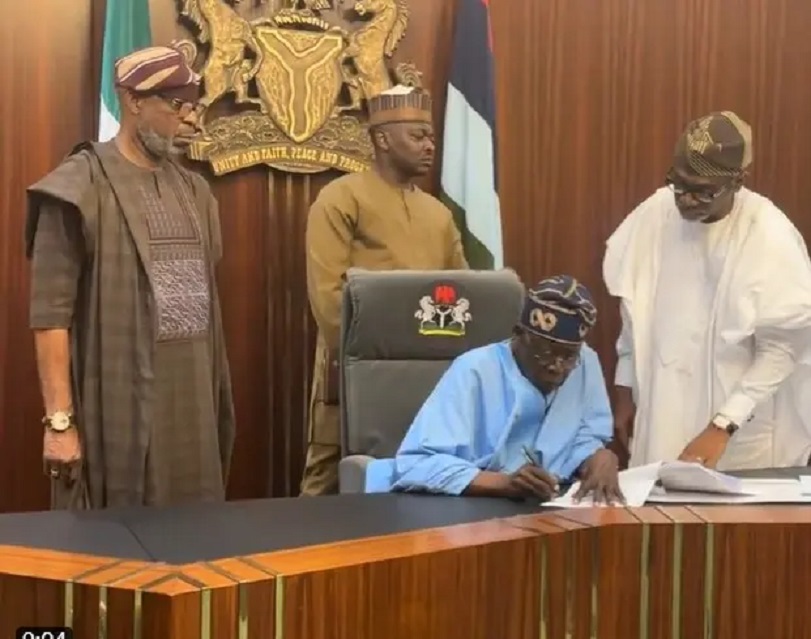
President Bola Tinubu has signed the Student Loan Bill into law. ⁣⁣

An aide to the president, Mr Dele Alake, disclosed this to State House Correspondents on Monday evening.⁣⁣⁣

The bill will enable Nigerian students to access loans at interest-free rates, easing the financial pressures on parents as well as helping to reduce the high rate of dropouts.

The Student Loan (Access to Higher Education) Bill, 2019, a.k.a a Bill for an Act, provides for easy access to higher education for Nigerians through interest-free loans from the Nigerian Education Fund established in this Act was sponsored by Mr Femi Gbajabiamila in 2019.

The piece of legislation passed second reading at the House of Representatives on May 25, 2023.

It will see the establishment of the Nigerian Education Fund, domiciled with the Central Bank of Nigeria (CBN), from which qualified applicants can access education loans through commercial banks in the country.

Once codified will provide, notwithstanding anything to the contrary contained in other enactments, all students seeking higher education in any public institution of higher learning in Nigeria equal right to access the loan under this Act without any discrimination arising from gender, religion, tribe, position or disability of any kind.

It shall be granted to students only for the payment of tuition fees. The grant of the loan to any student under the Act shall be subject to the students/applicant(s) satisfying the requirements and conditions set out under it.

However, this could mean that Nigeria’s heavily subsidized tertiary education may become a thing of the past.

To qualify for the student loan, the applicant’s family income must be less than N500,000 per annum. He or she will also have to provide two guarantors— Civil servants not less than level 12, a  Lawyer with at least 10 years post-call, a judicial officer or a justice of the peace.

As for repayment, beneficiaries of the student loan must commence repayment two years after the completion of the National Youth Service Corps (NYSC) scheme.

It involves 10 per cent of salaries when employed, done through direct debit from the employer, while for self-employed beneficiaries, it is 10 per cent of their profit.


Adedapo Adesanya is a journalist, polymath, and connoisseur of everything art. When he is not writing, he has his nose buried in one of the many books or articles he has bookmarked or simply listening to good music with a bottle of beer or wine. He supports the greatest club in the world, Manchester United F.C.

1 Comment

Leave a Reply

Your email address will not be published. Required fields are marked *

Education

Controversial Nursery School English Language Textbook Not Approved—Lagos Govt

Published

on

woman review textbook

By Modupe Gbadeyanka

The Lagos State government has stressed that it did not approve the use of the controversial nursery school English language textbook in public and private schools in the state.

A mother had come online to criticise an alleged inappropriate content in her child’s textbook. It was claimed that the publisher of the book threatened to sue the woman.

Reacting to the development, the Permanent Secretary in the Lagos State Ministry of Basic and Secondary Education, Mrs Abisola Dokunmu-Adegbite, said the “textbook is not among the approved and recommended instructional materials authorised for use in public, or approved private schools across the state.”

According to her, the ministry maintains a strict policy on the selection and approval of educational materials to ensure that all learning resources are age-appropriate, morally sound, and align with the educational standards and values of the state.

She stated that based on preliminary findings, the “school featured in the video is located somewhere in Ojo Local Government, Lagos State.”

“The name of the school and publisher have been identified for further investigation and appropriate actions.  The public is hereby assured of qualitative foundational education for our children in the state,” the senior government official said in a statement on Tuesday.

Mrs Dokunmu-Adegbite reiterated that only government-approved textbooks and instructional materials are permitted for use in schools in Lagos State, advising school administrators, proprietors, and teachers “to adhere strictly to these guidelines to safeguard the moral and academic development of our learners.”

She assured parents, guardians, educators, and the general public that the state government will always work hard to ensure children get quality education.

Continue Reading

Education

Nigeria Introduces Textbook Ranking System to Improve Learning Standards

Published

on

Textbook Ranking System

By Adedapo Adesanya

The federal government announces the introduction of a National Textbook Ranking System for Primary, Junior and Senior Secondary Schools across the country as part of ongoing efforts to strengthen quality assurance and standardisation in Nigeria’s education sector.

The development was disclosed in a Monday statement signed by Mrs Folasade Boriowo, the Director of Press and Public Relations, Federal Ministry of Education, noting that the initiative is designed to address the growing proliferation of textbooks in schools and ensure that only high-quality, curriculum-compliant learning materials are approved for classroom use.

The Implementation of the National Textbook Ranking System will commence from the September 2026 academic session, following the establishment of the Standing Subject Committees and completion of the evaluation framework.

The statement disclosed that the Minister of Education, Mr Tunji Alausa, alongside the Minister of State for Education, Professor Suiwaba Sai’d Ahmad, stated that under the new system, the Nigerian Educational Research and Development Council (NERDC) will continue to exercise its statutory authority to approve textbooks for use in Nigerian schools.

The Ministry explained that the textbooks will now be ranked through a structured national evaluation process to determine the most suitable and highest-quality options for each subject and level of education.

The statement reads, “As part of the reform, NERDC will establish Standing Subject Committees comprising experts in relevant subject areas. These committees will conduct rigorous reviews of textbooks submitted by publishers and evaluate them based on clearly defined academic and pedagogical standards.

“Following this evaluation process, only a limited number of textbooks will be ranked and approved for use in schools for each subject, ensuring improved quality control and consistency in teaching and learning materials across the country.”

The Ministry explained that the introduction of the ranking system is expected to significantly reduce the excessive number of textbooks currently in circulation in many schools, which has often created confusion for teachers, students and parents.

The statement added, “The reform also aims to bring greater transparency, order and quality assurance into the textbook approval process while aligning Nigeria’s education system with international best practices in instructional material standardisation.

“Under the new policy, NERDC will continue its responsibility of licensing textbooks. However, any textbook that is not ranked under the new system will not be permitted for use in Nigerian schools, regardless of prior licensing status.”

The statement further revealed that the Education Ministry will communicate the new ranking policy to teachers and other key stakeholders in the education sector to ensure proper awareness and compliance with the new framework.

The federal government reaffirmed that the reform forms part of broader efforts to strengthen the quality of education delivery, enhance learning outcomes and ensure that Nigerian students are equipped with the best possible learning resources.

Continue Reading

Education

Tinubu Hails 2026 African Spelling Bee Championship Winner Adeolu Oreofe

Published

on

Adeolu Oreofe

By Modupe Gbadeyanka

The winner of the 2026 African Spelling Bee Championship, Ms Adeolu Oreofe, has been congratulated by President Bola Tinubu.

In a statement on Friday by his Special Adviser on Information and Strategy, Mr Bayo Onanuga, the President described the outstanding achievement of the 14-year-old student as the importance of sustained investment in education, literacy, and youth development.

The student of St. Lawrence Metropolitan College in Ado Ekiti claimed the championship in the Junior Category in Harare, Zimbabwe recently.

She defeated contestants from over 20 African countries to claim the continental crown, which comes with a $5,000 educational scholarship.

She finished second at the 2023 MTN Spelling Bee and the 2024 Ekiti State Spelling Bee. She then placed fifth at the 2025 African Spelling Bee and second at the 2025 Nigeria Spelling Bee, before clinching the first prize this year in the continental championship.

Mr Tinubu applauded Oreofe’s dedication, as well as the unwavering support of parents, teachers, and mentors who contributed to this remarkable success, noting that she did not allow earlier disappointments to deter her from her determination to reach the top.

“I am convinced that this feat not only brings honour to Nigeria on the continental stage but also serves as an inspiration to millions of young Nigerians to pursue excellence in academics and personal development.

“As a government, we will continue to strengthen the education sector by creating opportunities that enable Nigerian youths to compete and excel globally. I wish Miss Oreofe continued success in her future endeavours,” the President further said in the statement by his chief spokesman.

Continue Reading

Trending