Connect with us

Feature/OPED

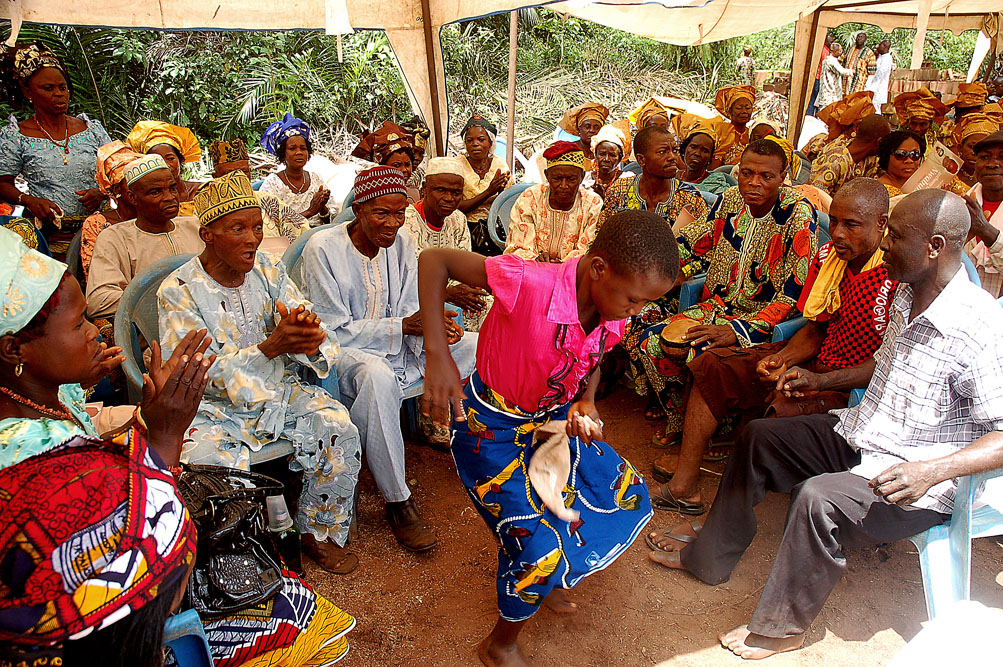
Naming Ceremony Among Esan People

Published

on

By Prince Kelly O Udebhulu

In Esan mythology, a new born child’s naming ceremony is an event in which the child is given a name or names, recognizing that a name is an identifier.

Comparatively, one of the most important things in the life of every married person is to have a child or children. So much joy accompanies the birth of a child after a 9-month long journey. To the Esan people, a child is a gift from God, and the birth of one symbolizes the coming of good things into a family, ‘Omonigho’, meaning a child is valued more than riches/wealth.

Occasionally, before the birth of a child, some names are jostled about but an important event or circumstance in the family or occasion in the community may be used to name a child born during such an occasion.

But in practical Esan tradition, it was unusual for a man to think of a name before the child was born except in cases where the native doctor had already warned the parents that the name of the person that the baby was reincarnating must be given to it.

Esan people, being firm believers in reincarnation, often went to consult the oracle before the actual naming ceremony, either to receive the name of the person being reincarnated or for the child to take up the profession of the man when he was alive.

However, where this consultation was already made, the name was only known to the family and the child still had to go through the naming ceremony.

Traditionally, when a child is born by a young couple, the practice is to ask the grandfather or great grandfather to send a name. Although the parents of the child can give their own pet names to the child, the name given by the paternal elder of the family supersedes.

However, during Christian baptism, Christian names can be added. Recently, Esan names have been used as Christian names.

The Esan traditional naming ceremony is held at the third traditional month after the birth of the baby. Notably, Esan has five days in a week; this means in lunar calendar, two months and half makes three months invariably (A lunar calendar is a calendar based upon cycles of the moon’s phases-synodic months-, the details of when months begin varies from calendar to calendar, with some using new, full or crescent moons and others employing detailed calculations).

Primarily, family’s elders and very close friends gather to pray to God for long life, good health and prosperity for the child and its parents. The elders present the family name to the father of the baby. Oracular consultations and divination may precede this phase. Later on, the main ‘naming’ ceremony occurs. Although the family elders and friends (male and female) are present, the ceremony is usually a mainly female affair.

When all are seated with males on one side and females on the other side of the living room or compound, the mother, who is gorgeously dressed for the occasion, holds the child.

The eldest male representative of the head of the family says the opening prayers in Esan language with kola-nuts and drinks. He breaks the nuts and shares them. Subsequently, the eldest female member of the family now takes up the remaining activities of the naming ceremony.

She will ask the mother of the child what she calls the child. The same question is asked seven (7) times. On each of the first six occasions the mother will give an unthinkable name to the child which the other women will reject.

In response to the seventh (7th) question, the father of the child whispers the actual name to his wife, who then announces it publicly.

In response, it will be greeted with blessings for the baby, and those present will chorus: “O RETO (He or she will live long with it).

Note that all Esan names have meaning and so this day was the appropriate day for relatives and friends or enemies to tell the parents what they thought of them. Anybody wishing to give a name carried the baby and did so. It was not Esan custom to give monetary presents by those wishing and to give-names; this obviously is a borrowed custom probably from other traditions outside Esan land.

Applicably, if the woman was still living where she delivered, outside her home, it was on this day she returned borne. That night custom decreed that she went to ‘greet her husband with the baby’ and she slept at Odugha!

It is interesting to know that on the day, particularly if she was the only wife, and not with her own parents, the woman had to begin to fend for herself: she could then go to the pond for water or farm for wood – early ambulation modern doctors preach to quicken involution.

Archaeologically, nothing like naming ceremony on the seventh day in Esan history and no husband touches a woman’s food during her menstrual circle or after birth until she is dried though modernization influences nowadays.


Modupe Gbadeyanka is a fast-rising journalist with Business Post Nigeria. Her passion for journalism is amazing. She is willing to learn more with a view to becoming one of the best pen-pushers in Nigeria. Her role models are the duo of CNN's Richard Quest and Christiane Amanpour.

1 Comment

Leave a Reply

Your email address will not be published. Required fields are marked *

Feature/OPED

Why Financial Readiness for Nigerian Nano-SMEs is Non-Negotiable

Published

on

Ivie Abiamuwe

By Ivie Abiamuwe

Nigeria’s economic resilience has historically been driven by its nano and micro-enterprises, ranging from roadside kiosks to rapidly growing digital vendors. These businesses form a critical component of economic activity, employment generation, and community stability across the country.

These nano and micro-businesses form the bedrock of the country’s economic drive. According to the National Bureau of Statistics (NBS), Micro, Small, and Medium Enterprises (MSMEs) account for approximately 96% of businesses in Nigeria, contributing nearly 48% to the national GDP and employing over 80% of the workforce. Yet, despite their fundamental importance, many of these businesses operate without a formal financial structure or long-term strategic planning.

In 2026, this informal model is becoming increasingly unsustainable. As  Nigeria continues to pursue broader economic ambitions, the transition from subsistence operations to strategic participation in the digital value chain is essential. Financial readiness has moved from being a social choice to a macroeconomic imperative.

A common misconception is that nano-SMEs are too small to integrate into formal financial systems. In reality, their collective impact is the primary engine of community stability. However, many operate with limited financial visibility, mixing personal and business finances and lacking the verifiable transaction histories required for credit assessments by financial institutions.

Businesses operating outside formal financial systems may face limitations in accessing structured financing and growth opportunities

Financial readiness begins with digital visibility. In today’s economy, businesses operating outside formal financial systems may face limitations in accessing structured financing and growth opportunities. Digital transactions and traceable expenses form a “financial footprint.” FairMoney Microfinance Bank provides digital financial solutions designed to support entrepreneurs in transitioning from informal cash-based operations to more structured financial practices.

The issue of credit remains a significant hurdle. While many entrepreneurs avoid formal borrowing, credit, when used responsibly, is a strategic growth tool rather than a liability. Building a track record of disciplined repayment increases trust and may improve access to financing opportunities, subject to applicable risk assessment and eligibility requirements.

Access to responsible and appropriately structured financial solutions can help small businesses manage short-term liquidity pressures, support inventory cycles, and improve operational resilience, subject to applicable terms and conditions. For longer-term scaling, fixed-term products allow entrepreneurs to lock away funds and accrue interest at applicable rates, supporting financial resilience over time.

One of the most persistent challenges facing nano-SMEs is the inability to separate personal and business finances. Without this separation, it is nearly impossible to determine if a business is truly profitable. Establishing a dedicated business account is a critical step toward the data-driven decision-making required to scale.

The Nigerian entrepreneur is globally recognised for resilience, but in a tightening regulatory framework, survival alone is no longer sufficient. The future belongs to businesses that are structured and financially prepared.

Financial readiness is the bridge between subsistence entrepreneurship and sustainable value creation. It transforms daily income into a system for building long-term capital. Nigeria does not lack entrepreneurial capacity; what is required is a stronger financial and structural foundation capable of translating that entrepreneurial energy into sustainable economic growth.  For nano-SMEs, bridging the digital and structural gap is no longer optional—it is essential for long-term growth, resilience, and participation in Nigeria’s evolving economy.

Ivie Abiamuwe is the Director of Business Banking at FairMoney Business

Continue Reading

Feature/OPED

Electricity or Excuses: The Test Before Northern Governors

Published

on

northern governors forum

By Sani Abdulrazak, PhD

It is a boom season for Nigerian Governors; at no time before have they had it this much. Huge sums of money are being allocated to them every month. To whom much is given, they say, much is expected. What are the visible things they have put in place commensurate with the allocations they receive? How do we hold them accountable for such?

Nigeria today faces one of the widest electricity supply gaps in the world. Despite having an installed generation capacity of over 13,000 megawatts, the country still struggles to generate and distribute between 4,000 and 5,500 megawatts on most days for a population exceeding 220 million people. Experts estimate that Nigeria requires at least 30,000 megawatts to enjoy stable and functional electricity, while industrial economies of comparable size generate far more. Recent reports from the Nigerian Electricity Regulatory Commission and industry operators revealed that many power plants operate below 40 per cent capacity due to gas shortages, poor infrastructure, transmission bottlenecks, and weak investment. The consequences are devastating. Small businesses spend billions annually on diesel and petrol generators. Manufacturers relocate to neighbouring countries with better energy systems. Investors avoid regions where production costs are inflated by unstable electricity. According to several business and energy reports, unreliable electricity continues to cost Nigeria billions of dollars yearly in lost productivity, collapsed businesses, unemployment, and reduced foreign direct investment. In Northern Nigeria, especially, where industrialisation is already fragile, unstable electricity has become a direct enemy of economic growth, security, and prosperity.

Nothing will boost and improve our local economy, especially here in Northern Nigeria, like the provision of stable electricity. Recently, the president smartly threw the ball into our Governors’ court by signing the Electricity Act. The Electricity Act by Bola Ahmed Tinubu gave states the power to decentralise electricity. We have seen states like Abia State, Lagos State and Ogun State grabbing the opportunity with both hands in order to boost the local economy.

It left me wondering what Northern states are doing about this. Are our people aware of this great opportunity to compel our Northern Governors to provide stable electricity to us? Or are they so consumed with who occupies what office? Or “Falle nawa ne”? Why are our Northern know-it-all  Analysts and intellectuals silent about this now, only to hammer on the same issue years later when the opportunity is probably no longer there? Will our traditional rulers save us by echoing it into our leaders’ ears?

Electricity is no longer merely a social amenity; it is the backbone of modern civilisation. Every thriving economy is powered first by energy before politics, rhetoric, or propaganda. Stable electricity determines whether factories operate efficiently, whether hospitals can preserve lives, whether schools can provide quality learning environments, whether technology hubs can emerge, and whether local entrepreneurs can compete globally. Nations do not industrialise in darkness. History has repeatedly shown that economic revolutions are built upon reliable energy systems. From China to India, from South Korea to Rwanda, serious governments understood that a constant electricity supply is the oxygen of development.

Sadly, Northern Nigeria still behaves as though electricity is a luxury rather than an economic necessity. In many parts of the region, communities spend more time discussing political appointments and ethnic calculations than discussing energy policy, industrial development, or economic competitiveness. Yet, no serious investor will establish industries where electricity remains uncertain for most hours of the day. No meaningful manufacturing revolution can occur where generators roar louder than factories. Our youths cannot become globally competitive in digital innovation when power outages interrupt learning, research, and productivity every few hours.

What makes the current moment even more painful is that the constitutional and legal opportunity now exists for states to take charge of their electricity future. The decentralisation enabled by the Electricity Act allows states to generate, transmit, and distribute electricity independently under their own regulatory frameworks. This means governors can no longer endlessly blame Abuja for every darkness their people endure. The era of absolute dependence on the national grid is gradually fading. States willing to think ahead can establish independent power projects, attract private investors, support renewable energy initiatives, and create regional energy markets capable of transforming their economies.

Already, signs of this new direction are emerging. Lagos State has moved aggressively toward controlling its electricity market and attracting independent suppliers. Energy reforms and localised agreements are being pursued to reduce dependence on the unstable national grid and improve supply to businesses and residents.  Other states are beginning to recognise that power supply is no longer solely the responsibility of the Federal Government. The question now is whether Northern states will rise to the occasion or continue watching from the sidelines while others move ahead economically.

Even though the “fabled” Northern elites and elders are still struggling to define what regional development is, let alone develop a realistic framework and awareness about it, we would be grateful if they could lend a hand in the actualisation of a stable power supply, the stream that waters the root of development.

Kaduna State, for example, has a Governor amongst Governors, a serving Speaker of the Federal House of Representatives, and two senior, powerful ministers. I hope, pray, and expect Kaduna State to take the lead in the North in providing a stable, uninterrupted power supply to its people. Kaduna possesses the intellectual capacity, political influence, industrial history, and strategic importance to become the energy model for Northern Nigeria. If properly harnessed, stable electricity in Kaduna alone could revive industries, empower small businesses, strengthen agriculture processing, create jobs for thousands of youths, and attract investors back into the state.

Northern Nigeria cannot continue to lament insecurity, poverty, unemployment, and underdevelopment while ignoring one of the foundational pillars of economic transformation. Stable electricity will not solve every problem overnight, but without it, many other solutions will remain ineffective. We must begin to ask tougher questions of those entrusted with public resources. Citizens must move beyond political sentiments and demand measurable development. Governors who receive enormous allocations monthly must show visible investments in energy infrastructure, industrial expansion, and economic productivity.

The future belongs to regions that understand that development is deliberate, not accidental. We can no longer afford leadership without vision or citizens without demands. The opportunity is here. The law is now favourable. The resources are available. What remains is political will, public pressure, and leadership that understands that darkness has never built any civilisation.

Long live the Federal Republic of Nigeria.

Sani Abdulrazak writes from Ahmadu Bello University, Zaria and can be reached via email at [email protected]

Continue Reading

Feature/OPED

AI and Cybercrime in Nigeria: Can Weak Laws Support Strong Technology?

Published

on

AI Cybercrime in Nigeria

By Nafisat Damisa

Introduction

The proliferation of generative AI has transformed Nigeria’s cybercrime landscape, enabling deepfake fraud, automated social engineering, and AI-enhanced phishing at scale. In early 2024, scammers using AI-generated deepfake videos impersonating a company’s CFO defrauded a Hong Kong finance worker of $25.6 million. As similar threats emerge in Nigeria’s fintech sector, this article examines whether the Cybercrimes (Prohibition, Prevention, etc.) Act 2015 (as amended 2024) is legally adequate, or whether Nigeria’s evidentiary and accountability frameworks are too weak to support effective prosecution of AI-driven cybercrime

Current Legal Landscape
Nigeria’s primary legal framework on preventing cybercrime is the Cybercrimes (Prohibition, Prevention, etc.) Act 2015, amended in 2024 to address cryptocurrency transactions, cyberbullying and various forms of digital misconduct. Complementary frameworks include the National Information Technology Development Agency Act 2007, the Nigerian Data Protection Act 2023, and sectoral regulations such as the CBN’s Risk-Based Cybersecurity Framework. However, the majority of these frameworks were issued far before now, and emerging risks like AI-driven threats are not really being addressed. The Act nowhere mentions “artificial intelligence,” “algorithm,” or “autonomous system.” Notably, the National Artificial Intelligence Commission (Establishment) Bill, 2025, is currently pending before the Senate. If passed, it would establish a dedicated commission to coordinate AI strategy, research, and ethical deployment. However, the Bill in its present form focuses primarily on development and innovation promotion, with limited provisions on criminal liability, evidence handling, or enforcement against AI-facilitated cybercrime, leaving the core accountability and evidentiary gaps largely unaddressed.

AI as a Double-Edged Sword
AI paradoxically enables both defence and attack. Nigerian financial institutions deploy AI for real-time fraud detection and pattern recognition. Conversely, cybercriminals exploit generative AI for deepfake creation, automated credential stuffing, and convincing phishing tailored to Nigerian English and Pidgin. The same technology that powers fraud detection systems can be weaponised to evade them. Take justice delivery as an example, the Evidence Act 2011 (as amended 2023) admits computer-generated evidence under Section 84, but remains silent on AI’s capacity to seamlessly generate or alter electronic records, creating “doctored AI-generated evidence”.  These and many more issues await Nigeria’s digital space in the coming years.

The Legal Gaps

There are multiple critical gaps that undermine AI governance.  For this article, three are considered.  First, no framework attributes criminal liability when an autonomous AI commits an offence. The question of whether the developer, user, or owner should bear criminal responsibility for the acts of an autonomous system remains entirely unanswered under Nigerian law, leaving prosecutors without a clear legal theory of culpability.

Second, Section 84 of the Evidence Act 2011 governs computer-generated evidence but does not address AI-generated outputs. The Act’s definition of “computer” excludes AI’s cognitive processing capabilities, creating a statutory blind spot where evidence produced by generative or autonomous systems falls outside the existing admissibility framework.

Third, Nigeria lacks any framework for mandatory AI-generated content labelling, impeding deepfake traceability. Computer-generated evidence under Section 84 of the Evidence Act 2011 remains admissible if unchallenged at trial, a dangerous precedent for AI evidence, as opposing parties may lack the technical capacity to mount any challenge at all.

Comparative Jurisdictions: Rich Laws, Tangible Results

Jurisdictions with advanced AI laws demonstrate clear outcomes. The EU AI Act (Regulation 2024/1689) mandates transparency obligations, requiring synthetic content labelling and informing individuals when interacting with AI systems; non-compliance triggers significant penalties. The US Algorithmic Accountability Act of 2023 is a proposed Act that will require impact assessments for high-risk AI systems in housing, credit, and employment, with FTC enforcement and a public repository.  China implemented mandatory measures for the Identification of AI-generated (Synthetic) content. These rules, mandated by the Cyberspace Administration of China (CAC) and others, require explicit (visible labels) and implicit (watermarks/metadata) identification for all AI-generated text, images, audio, video, and virtual scenes to ensure transparency, traceability, and combat disinformation. These laws contribute to measurable results: forensic traceability, expedited prosecution of deepfake fraud, and clear liability chains. Nigeria has none of these.

Hope or Illusion?

Without legislative intervention, AI’s promise against cybercrime remains an illusion. Nigeria requires the following to boost its hope:

  1. Amendment of the Cybercrimes Act to include AI-specific offences and mandatory content provenance standards;
  2. Revision of Section 84 of the Evidence Act 2011 to address AI-generated evidence credibility, not merely admissibility;
  3. Investment in digital forensic capabilities is currently hampered by inadequate enforcement, weak forensic capabilities, and a lack of specialised personnel; and
  4. A risk-based framework drawing from EU and US models.
  5. Review of both secondary and tertiary education curricula to address the knowledge gap in AI and prepare the next generation for the AI-driven future.

Conclusion

AI can help curb cybercrime in Nigeria, but only if legal capacity catches up with technical capability. The Cybercrimes Act 2024 amendments were a step forward, but they did not address AI accountability, algorithmic transparency, or evidentiary credibility. The pending National Artificial Intelligence Commission Bill, 2025, signals legislative awareness, but without substantive provisions on liability, evidence, and enforcement, it cannot fill the existing gaps. The effectiveness of existing frameworks remains a question. An optimistic but cautious path exists, but until Nigeria enacts AI-specific legislation, whether through amending the Cybercrimes Act, revising the Evidence Act, or strengthening the pending Bill, weak laws will remain unable to support strong technology.

Nafisat Damisa is a Legal Research Associate in Olives and Candles – Legal Practitioners. For further information, enquiries, or clarification, please contact Nafisat via: [email protected] or [email protected]

Continue Reading

Trending