Connect with us

General

$500m Abacha Loot: US Refuses to Deal with Malami’s Lawyers

Published

on

Abacha Loot

By Dipo Olowookere

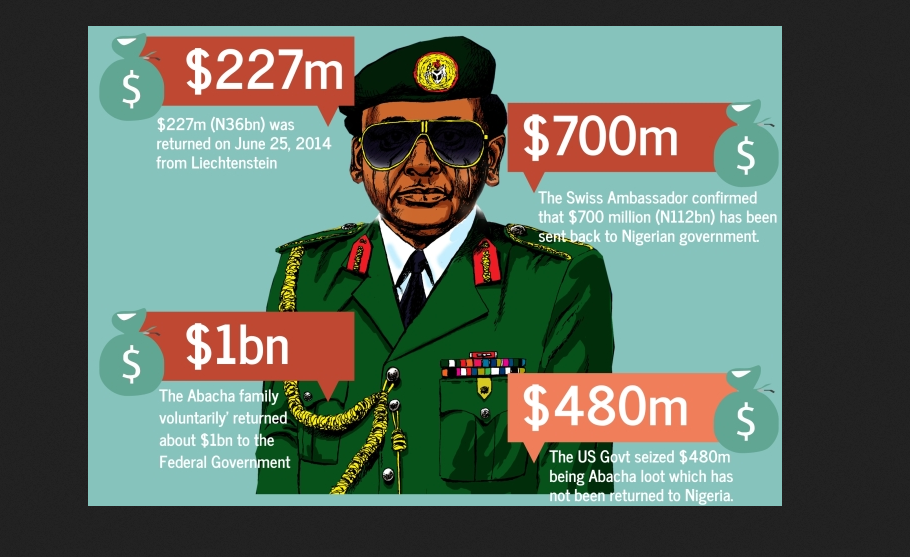
The United States government has maintained that it would not have anything to do with lawyers of Nigeria’s Attorney-General of the Federation (AGF), Mr Abubakar Malami, in the repatriation of the $500 million Abacha loot.

Instead, the US government, through its Department of Justice, said it would only do business directly with the Nigerian government.

In an exclusive report by The Cable, it was disclosed that President Muhammadu Buhari was told point blank during his visit to the US that no party would be listened to in the restitution of the funds.

Mr Malami had attempted to engage private lawyers who were going to take a cut as “legal fees” — even though they did not play any role in the recovery of the stolen funds traced to the former military head of state, Sani Abacha, who ruled Nigeria from 1993 to 1998.

The recoveries were made in 2014 under President Goodluck Jonathan and domiciled with the US government — and all the lawyers involved had been paid 4% of the funds as their fees.

The funds were to be returned to Nigeria on the condition that the federal government would sign an MoU to avoid the mismanagement associated with recoveries under President Olusegun Obasanjo.

Like Switzerland, Like America

In 2016, however, Mr Malami went ahead to appoint two Nigerian lawyers again — in a pattern very similar to the $321 million Abacha Loot recovered from Luxembourg also in 2014 for which the lawyers he hurriedly engaged were to be paid almost $17 million for doing nothing.

In the Switzerland case, Mr Malami appointed Oladipo Okpeseyi, a senior advocate, and Temitope Isaac Adebayo, in 2016 apparently to replicate the job already done.

Incidentally, Okpeseyi and Adebayo were lawyers to the Congress for Progressive Change (CPC), the APC legacy party of which Malami was the legal adviser.

He also proposed to use the same lawyers in the US case, but TheCable understands that the department of justice has consistently refused to entertain them, thereby stalling the return of the money to Nigeria.

America has now promised to return the $500 million but without the involvement of the appointed intermediaries.

The Nigerian government has also undertaken to spend the money on social protection programmes.

According to documents seen by TheCable, the DoJ initiated a legal action in November 2013 on the request of then attorney-general, Mohammed Bello Adoke, to confiscate assets worth $500 million traced to the Abacha family in France, Jersey and the UK.

Although the funds were not in the US, they fell foul of America’s money laundering laws having passed through the country in one form or the other.

Following a civil forfeiture complaint, the DoJ froze $280 million of Abacha Loot in Jersey, $140 million in France and $40 million in England.

Under US rules, any claimants to the asset were required to file a claim no later than 35 days after direct notice was sent to them or 60 days after the publication of notice.

The Forfeiture

Neither Mohammed Abacha, son of the late dictator, nor his companies filed any such complaint within the period until it expired.

Mr Adoke had instituted a criminal case against the Abachas in Nigeria which eventually forced the family to enter into a settlement with the federal government to return the looted funds.

On June 2, 2014, the DoJ requested the US district court for the District of Columbia to enter into a default judgment against the Abachas in the suit, United States of America v. All Assets Held in Account Number 80020796 in the Name of Doraville Properties Corporation at Deutsche Bank International Limited in Jersey, Channel Islands and All Interest, Benefits of Assets Traceable Thereto.

However, some lawyers appeared on the scene claiming to have been engaged by Nigeria to handle the recovery of the funds.

They showed a letter of authority signed by Akin Olujinmi, Nigeria’s attorney-general between 2003 and 2005 — even though the Nigerian government had engaged Enrico Monfrini, a Swiss lawyer, to do the same job in 1999.

The lawyers — Jude Chukwuma Ezeala, Kenneth A. Nnaka, Godson Nnaka and Charles Lion Agwumezie — were also said not to have done anything in 10 years since Olujinmi authorised them.

Their involvement was opposed by Adoke, who wrote a letter dated May 26, 2014 to the Asset Forfeiture Money Laundering Section, Criminal Division, U.S. Department of Justice, to state that the lawyers were not authorised.

Thereafter, specifically on June 27, 2014, the DoJ requested that US district court for the District of Columbia to strike out the complaint filed by the four lawyers.

As a result, the DoJ got a motion in the US district court for DC on July 3, 2014 — finally allowing for the recovery of the funds.

In all, well over $1 billion was traced to Abacha in the UK, Luxembourg and Liechtenstein as at 2012 when Jonathan was president.

Returned With Interest

The $321 million recovered from Luxembourg in 2014 under President Goodluck Jonathan was domiciled with the attorney-general of Switzerland pending the signing of an MoU to avoid the mismanagement associated with previous recoveries.

Pio Wennubst, assistant director-general and head, Global Cooperation Department, Swiss Agency for Development and Cooperation, told NAN recently that the money was returned to Nigeria with a $1.5 million interest, bringing it to a total of $322.5 million.

TheCable reported Malami’s attempt to pay lawyers for the deal, prompting a parliamentary inquiry.

The house of representatives has set up a probe panel to investigate the suspected sleaze.

The recovery was done by Enrico Monfrini, a Swiss lawyer, who vehemently denied syndicated media articles that he was asking for another 20% of the recovered funds for the final leg of the restitution to Nigeria.

In an email to TheCable, however, Monfrini had explained that there is no truth in the allegation.

“I never had the audacity to claim for additional fees. This figure of 20% is simply invented. I didn’t reject any proposal made by Mr Malami since my fees were already paid a long time before Mr Malami’s appointment as attorney general,” he said, adding that “any allegations against that would just be a lie.”

“The repatriation of the $321 million was not completed by me. It’s a matter which is normally dealt between governments and which doesn’t entail the engagement of lawyers.”

Malami does not respond to calls or text messages from TheCable.

Source: The Cable

Dipo Olowookere is a journalist based in Nigeria that has passion for reporting business news stories. At his leisure time, he watches football and supports 3SC of Ibadan. Mr Olowookere can be reached via [email protected]

General

4th South Africa Focus Week Begins in Lagos to Strengthen Bilateral Ties

Published

on

South Africa Focus Week

By Adedapo Adesanya

The South African Consulate General in Lagos, in partnership with Brand South Africa and the Development Bank of Southern Africa (DBSA), is hosting the 4th edition of the South Africa Focus Week in Lagos, Nigeria, from April 22 – 26, 2026.

The annual platform continues to grow as a strategic initiative aimed at fostering social cohesion between South Africans and Nigerians while positioning South Africa as a preferred destination for business, tourism, and education. Since its inception in 2023, South Africa Focus Week has attracted over 1,500 participants, bringing together stakeholders from across sectors, including trade and investment, arts and culture, tourism, aviation, and the culinary industry.

The 2026 edition holds particular significance as it coincides with the 30th anniversary of South Africa’s democratic Constitution, enacted in 1996, as well as 32 years of unbroken diplomatic relations between South Africa and Nigeria, established in February 1994. These milestones underscore the enduring partnership between the two nations, rooted in shared history and strengthened through formal agreements and ongoing collaboration.

The 2025 economic relationship between South Africa and Nigeria reflects a strategically significant, multi-dimensional partnership anchored in trade, energy security, investment flows, and strong institutional cooperation. While bilateral trade remains structurally imbalanced – with South Africa exporting US$468.48 million and importing $1.69 billion, resulting in a $1.22 billion deficit – this dynamic is largely driven by South Africa’s reliance on Nigerian crude oil, positioning the relationship as one of strategic interdependence rather than imbalance alone.

This partnership is further elevated by the relative economic weight of both countries. According to IMF projections, South Africa’s economy is valued at approximately $443.6 billion, while Nigeria’s stands at around $334.3 billion in nominal terms for 2026. As two of the largest economies on the continent, their bilateral engagement constitutes a central axis of African economic activity, with disproportionate influence on the success of continental integration efforts.

Beyond trade, the relationship is reinforced by deep two-way investment linkages. South African firms -including MTN Group, Shoprite, and Standard Bank – maintain a strong presence in Nigeria, while Nigerian companies such as Access Bank and Paystack have established a growing footprint in South Africa. Although investment flows are asymmetrical and some Nigerian firms have faced operational challenges, these exchanges reflect an emerging bi-directional economic corridor that extends beyond goods trade into services, finance, and digital innovation.

Aligned with Brand South Africa’s mandate to build the country’s global reputation and competitiveness, the week-long programme will convene leaders from government, business, civil society, academia, and the media. Discussions will focus on leveraging the African Continental Free Trade Area (AfCFTA) as a tool for market access and global positioning, with Nigeria serving as a key focal point.

The South Africa Focus Week has features a series of high-level engagements and cultural activities designed to deepen economic ties and promote collaboration: South Africa–Nigeria Infrastructure Investment Conference (April 22, 2026) which was held under the theme South Africa–Nigeria Partnership: Unlocking Infrastructure Opportunities,” the conference will bring together key stakeholders in infrastructure development to explore collaborative projects in road, rail, and transportation systems.

The forum also examined the role of Public–Private Partnerships (PPPs) and facilitated discussions on project financing and implementation with institutions such as the DBSA and Nigeria’s Infrastructure Concession Regulatory Commission (ICRC).

This was followed by the 2nd Economic Diplomacy Roundtable (Thursday, April 23, 2026), which was hosted in partnership with MTN Nigeria under the theme Role of Technology in Infrastructure Development, the roundtable will convene senior government officials, private sector leaders, and industry experts to identify investment opportunities and strengthen strategic partnerships.

Friday, April 24, was for Arts and Culture Experience, which is a dedicated cultural day will showcase Lagos’ creative spaces and features a panel discussion on South Africa’s arts, film, music, and culture. The programme includes a South African film screening, engagements with filmmakers, and a networking reception aimed at fostering collaboration between the creative industries of both countries.

The event continues on Thursday, April 25, with Freedom Day Celebration and Closing Ceremony. This commemorative event will celebrate 30 years of South Africa’s Constitution, 32 years of freedom and democracy, and the enduring diplomatic relations between South Africa and Nigeria. The ceremony will also provide an opportunity to reflect on outcomes from the week and outline future areas of cooperation.

The celebration forms part of Brand South Africa’s Global South Africans Programme, which recognises and connects South Africans in the diaspora as ambassadors of the nation’s values and identity.

The week climaxes with the 4th edition of the South Africa Golf Tournament at Ikoyi Golf Club on Saturday, April 26, 2026, which will be done in partnership with Crossflex International.

According to a statement, the event aims to strengthen people-to-people relations through sports diplomacy, bringing together South African and Nigerian golfers in a spirit of camaraderie and collaboration.

Continue Reading

General

EFCC Arrests Ex-Skye Bank Chair Tunde Ayeni Over Alleged Diverted Loans

Published

on

tunde ayeni

By Modupe Gbadeyanka

The former chairman of the defunct Skye Bank Plc, Mr Tunde Ayeni, has been apprehended by the Economic and Financial Crimes Commission (EFCC).

Spokesperson of the anti-money laundering agency, Mr Dele Oyewale, confirmed the arrest of the businessman on Friday but declined to provide further details, according to TheCable.

Mr Ayeni was accused of diverting the N36.5 billion and $30 million loans from Polaris Bank Limited to companies with which he has links.

He was alleged to have obtained the credit facilities for marine security, electricity distribution, and real estate projects, but moved them to telecom investments tied to NITEL/MTEL assets via a NATCOM account.

After the Central Bank of Nigeria (CBN) revoked the operating licence of Skye Bank in 2018, it nationalised it to Polaris Bank.

The EFCC has been looking into the alleged diversion of funds by Mr Ayeni, resulting in his arrest in Abuja on Thursday, April 23, 2026.

He is being grilled over the matter and would be arraigned in court once the investigation is concluded.

This is not the first time Mr Ayeni has been nabbed and probed by the EFCC, as this happened a few months after his bank lost its licence.

The then acting spokesman for the EFCC, Mr Tony Orilade, said Mr Ayeni was quizzed by detectives over issues related to fraud and embezzlement allegedly committed by him when he was Chairman of the bank a few years ago.

Continue Reading

General

Customs, Police Commence Tighter Security at Ports to Protect Oil Trade

Published

on

nigeria customs police

By Adedapo Adesanya

The Nigeria Customs Service (NCS) and the Nigeria Police have begun securing the country’s maritime corridor as part of critical moves to safeguard oil and gas trade flows through the nation’s ports.
This follows a recent strategic engagement between the Ibeto Seaport and Terminals Command of Customs and the Eastern Port Police Command in Port Harcourt, where both agencies reaffirmed their commitment to joint operations.
Customs Area Controller, Mr Usman Yahaya, described inter-agency cooperation as essential to protecting critical economic infrastructure.
“This visit is timely and highly appreciated. It reflects the importance of sustained cooperation among agencies entrusted with the security of our nation and the protection of critical economic assets,” he said.
Mr Yahaya stressed that collaboration between Customs and Police remains central to maintaining order and preventing criminal activities within port environments.
“Customs and the Police share common responsibilities in safeguarding the port environment. Synergy remains the cornerstone for achieving our collective mandate,” he added.
He further assured continued support for the Police Command to enhance operational effectiveness.
“Customs Area Controller Usman Yahaya (sitting, right) and Commissioner of Police Shuaibu Audu (sitting, left) with other Customs and Police personnel

“We are fully committed to working with the new Commissioner of Police and giving all necessary support towards the successful discharge of his responsibilities.”

On his part, the Commissioner of Police, Eastern Port Command, Mr Shuaibu Audu, said the visit was aimed at strengthening existing ties between both agencies.
“My presence here today is to reinforce the cordial relationship between the Nigeria Police Force and the Nigeria Customs Service. No organisation can function effectively in isolation,” he said.
Mr Audu emphasised the strategic importance of ports to Nigeria’s economy, particularly in the energy sector.
“Our ports are strategic national assets, and we must work together to keep them secure,” he stated. “Synergy among security agencies is essential to addressing emerging threats.”
Continue Reading

Trending