

General
78% of Nigerians Still Trust Media—Survey

By Modupe Gbadeyanka
The first bespoke 2018 Edelman Trust Barometer conducted for Nigeria by Edelman Intelligence to test the level of trust among Nigerians in the four mainstream institutions of government, business, media and non-governmental organisations has shown that 78 percent of Nigerians still trust the media.
“Trust in media remains high despite ‘fake news’”, the report showed.
This contrast, however, with the global trend whereby trust in the media is on decline especially due to the rise of fake news and post-truths occasioned by the growing social trend called citizen journalism and influence of social media as alternative but ‘unregulated’ source of information.
According to the global data from the report, “Media now least trusted institution; distrusted in 22 of 28 of countries.”
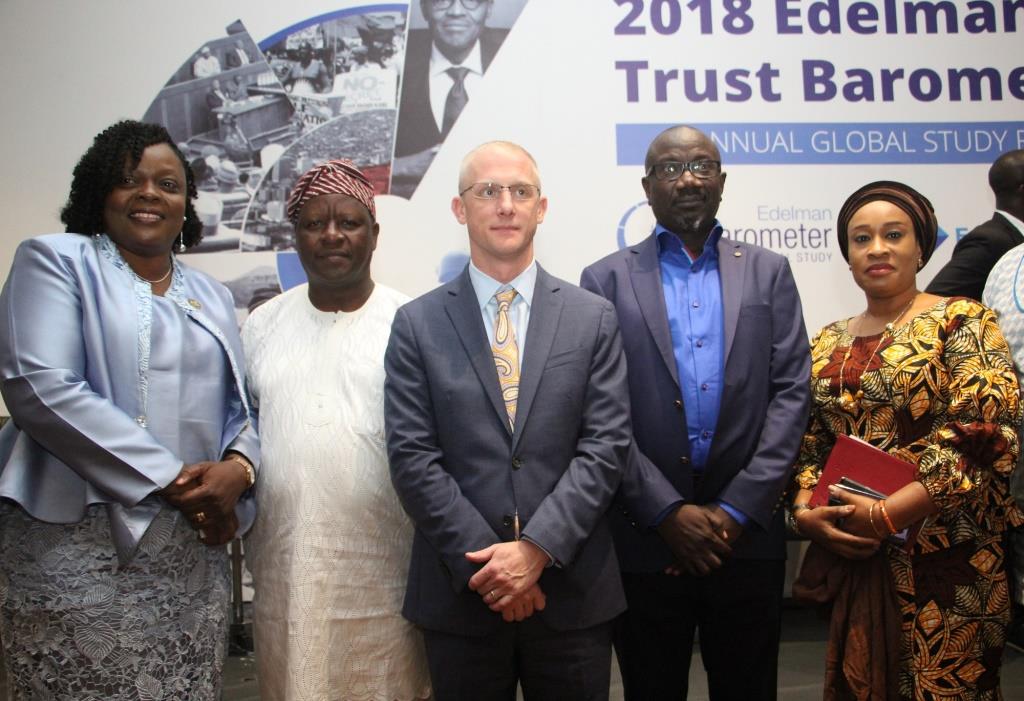
These were some of the highlights of the 2018 Edelman Trust Barometer unveiled in Lagos, on Thursday 31, May 2018 at Eko Hotel & Suites, Victoria Island, Lagos. The presentation of the report in Nigeria by Edelman was organised by Chain Reactions Nigeria, Edelman’s Exclusive Nigerian Affiliate and the Preferred West African Partner with the theme, ‘The Battle for Truth’.
Further breakdown of the report for Nigeria indicated that Nigerians also trust NGOs assigning 81 per cent score to the sector while their trust for business is 62 per cent and 60 per cent for government while 72 per cent of Nigerians generally voted that trust matters in everything.
Comparative analysis of the report when African countries such as South Africa, Egypt and Ghana amongst others were compared, also showed Nigeria finishing third highest in trust for the media and NGOs respectively; fourth highest in trust for business, and seventh highest in trust for government.
Speaking at the presentation of the global data from the report, Managing Director, Edelman South Africa, Jordan Rittenberry, expressed concern that the overall global assessment of the four mainstream institutions showed declines in trust about business and non-governmental organisations in 14 of the 28 countries sampled, and therefore called on key decision makers in the respective organisations to be deliberate in building their trust asset through increased investment.
“Over time trends have shown there is low trust in business and non-governmental organisations, so it is important that people in these institutions pay more attention to how the citizens trust them”, he stated.
Rittenberry added that “media is now least trusted institution” as a result of the menace of fake news which he noted has moved from being just a phenomenon to a key factor in shaping perception. “People define media as both content and platforms, so nearly seven in 10 worry about false information or fake news being used as a weapon”, he declared.
Managing Director/Chief Strategist, Chain Reactions Nigeria, Israel Jaiye Opayemi, in a welcome speech enthused that the inclusion of Nigeria in the annual survey for the first in the 18-year-old history of Edelman Trust Barometer was in fulfillment of the company’s promise last year to ensure Nigeria was in focus among the comity of nations of reckon annually sampled by Edelman.
“Trust sits at the heart of social capital. For those who were here last year, we made a promise that Nigeria would be included in the 2018 deck of the Edelman Trust Barometer. I am happy to announce that we are here today to fulfill that promise”, he said.
Speaking on the Nigerian data from the survey which showed that government was the least trusted of the four institutions of the Nigerian society, Opayemi counselled against a quick condemnation of government by stakeholders. He cautioned that, rather than condemnation, government requires help from communications professionals to help redesign the architecture of government communications in Nigeria.
He likened the current situation in most government communications departments to a hospital that is manned by a pharmacist where people with cardiac conditions go to for help simply because the pharmacist is a product of a medical school.
“A pharmacist and a doctor who specialises in cardiology may have passed through the same medical school, but their specialties are different. In human resources practice, the rule is, the job description dictates the hire.
“Let us therefore help those in government articulate the job descriptions, skill sets and requirements for the office of strategic communications in all government houses at the federal and state levels. Such offices must be presided over by professionals in strategic communications who will work with Journalists, Policy Analysts, Digital Analysts, and Infographics Specialists amongst others. That office is not just about putting the penchant to put the President and the Governors in the news; it is about asymmetric communications.
“The structure being used to run government communications in most government houses is not only dysfunctional but also outdated”, Opayemi stated.
He therefore advocated engagement of communications professionals by key occupiers of government positions like the president and governors in order to overcome the challenges around trust and credibility assets of government.
Interestingly, the report showed the media and non-governmental organisations in Nigeria as being trustworthy with 78 per cent of Nigerians saying they still trust the media despite the rise of fake news while 81 per cent affirmed their trust in NGOs. The trust score for business is 62 per cent while government has 60 per cent.
Opayemi while expatiating on these indices said trust in NGOs was indicative of the fact that people acknowledge social interventions and humanitarian services rendered by non-governmental organisations in Nigeria especially during some of the major disasters the country has witnessed rendering thousands homeless.
He however cautioned, that businesses and governments are already sitting in what he called, “the cusp of the neutral zone” and so must urgently improve on their trust asset so they do not slide into what he called “negative zone”. “From what we have seen in the survey, Nigerians place a high premium on trust. It is therefore important for the business leaders to ensure that the company is trusted; that it communicates regularly with clients and customers, and their products and services are of high quality. They must also communicate regularly with employees and the CEOs must champion the effort”, he stressed.
Special Guest of Honour and Deputy Governor of Lagos State, Dr. (Mrs.) Idiat Adebule, in her remarks commended Chain Reactions Nigeria for doing the country proud by ensuring the inclusion of Nigeria on the list of the countries surveyed by Edelman, and expressed confidence that the insights from the report would go a long way in better understanding how trust can be leveraged as an asset to improve relations between the government and the governed as well as service delivery from the government to the people.
Represented by the Director-General, Office of Education Quality Assurance, Lagos State Ministry of Education, Mrs. Ronke Shoyobo, the deputy governor said, “No doubt, this year’s report and the debate of its implications by eminent representatives of the Nigerian government, the business community, the media and non-governmental organisations here today will strengthen the fabric of healthy relations and communications in our nation, particularly government intervention policies and programmes.”
President, Public Relations Consultants’ Association of Nigeria (PRCAN), Mr. John Ehiguese, and President, Africa Public Relations Association (APRA), Mr. Yomi Badejo-Okusanya, respectively in their goodwill messages affirmed that trust is everything in today’s world and organisations must do everything possible to build trust and credibility and maintain same in order to remain attractive to their stakeholders.
They also decried the growing menace of fake news and post-truth as a threat to building trust and positive reputation and urged organisations to seek the services of competent communications professionals to navigate the curve.
The highpoint of the event was panel discussions on the report and its implications for Nigeria by a panel comprising seasoned business executives, media practitioners, government officials and civil society activists. Moderated by Data Analyst, Channels Television, Mr. Babajide Ogunsanwo, members of the panel included Lagos State Commissioner for Information and Strategy Mr. Kehinde Bamigbetan; Mrs. Ronke Shoyobo; respected Financial and Investment Analyst and CEO of Financial Derivatives, Mr. Bismarck Rewane; Lead Consultant/CEO of Thistle Praxis, Mrs. Ini Abimbola; and Executive Head of Marketing and Communications, Stanbic IBTC Bank Plc, Mrs. Nkiru Olumide-Ojo.
Others were seasoned Journalist and Editor of BusinessDay newspaper, Mr. Anthony Osae-Brown; President, Guild of Corporate Online Publishers Association of Nigeria, Mr. Dotun Oladipo; Executive Chairman, Centre for Anti-Corruption and Open Leadership, Comrade Debo Adeniran; and Public Affairs commentator, Comrade. Nelson Ekujumi.
Dignitaries at the presentation ceremony cut across the four mainstream institutions of the Nigerian society such as government, business, media and non-governmental organisations as well as the Nigerian marketing communications sector. They included Lagos State Commissioner for Energy and Mineral Resources, Mr. Wale Oluwo represented by a Director in the Ministry, Mr. Adebayo Ajisebutu; Vice President, Centre for Value and Leadership, Mr. Adegbenro Rasheed; Chairman, Nigerian Institute of Public Relations (NIPR), Lagos State Chapter, Mr. Olusegun McMedal; Chairman/CEO, C&F Porter Novelli and past president of PRCAN, Mr. Nn’emeka Maduegbuna; CEO, Blueflower Communications, Mr. Chido Nwakanma; CEO, SY &T Communications, Mr. Simon Tumba; CEO, TruContact, Dr. Ken Egbas; Chief Operating Officer, Soulcomms Publicis, Moji Saka; Chief Operating Officer, BlackHouse Media, Mr. Moruff Adenekan; and Lead Consultant, StepCraft, Mrs. Eniola Mayowa amongst others.
Edelman Trust Barometer is the annual global trust and credibility survey conducted by Edelman Intelligence, the independent research arm of the Edelman – the world’s largest PR firm with presence in 65 countries across the globe The survey consists of 25-minute online interviews whereby respondents are asked questions on how much they trust the four mainstream institutions of society like government, business, media and non-governmental organisations to do what is right.
Since 2001, Edelman has been measuring trust in the four critical institutions in 27 countries, but this year is the first time Nigeria has been included in the survey. The inclusion of an exclusive deck on Nigeria by Edelman Intelligence is on the heels of the significant impressions recorded last year when Chain Reactions hosted the presentation of the 17th edition of the annual global survey in Lagos, the first time ever in the history of Nigeria and since the survey was established in 2001.


