General
Africa Needs Bold, Transformative Projects to Compete Globally—Dangote
By Modupe Gbadeyanka
Renowned industrialist, Mr Aliko Dangote, has charged African leaders and investors put in place bold and transformative projects capable of addressing the continent’s long-standing challenges in order to compete globally.
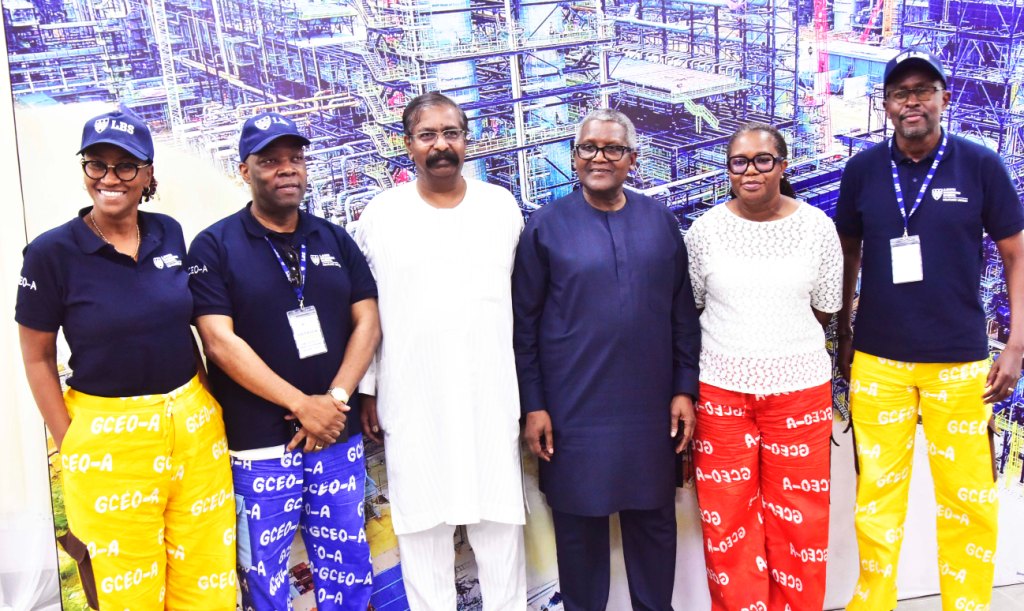
He said this when he hosted participants of the Global CEO Africa Programme from Lagos Business School and Strathmore Business School, Nairobi, after a tour of the Dangote Petroleum Refinery and Petrochemicals in Ibeju-Lekki, Lagos.
The president of the Dangote Industries Limited said African entrepreneurs, business leaders and wealthy individuals must begin to invest in the development of the continent, citing the successful construction of his oil facility as proof that nothing is impossible.
Mr Dangote reflected on the initial scepticism surrounding the refinery project, noting that despite numerous obstacles, the group remained steadfast in its commitment to delivering on its vision.
“There will always be challenges. In fact, life without challenges isn’t exciting. You just hope for the kind of challenges you can overcome—not the ones that overwhelm you,” he remarked, explaining that completing the refinery has emboldened the group to pursue even more ambitious goals.
“Now that we’ve built this refinery, we believe we can do anything. We aim to make our fertiliser company the largest in the world—and we’ve set ourselves a 40-month timeline,” he stated.
Mr Dangote highlighted Africa’s wealth in both human and natural resources, stressing that business leaders are in a privileged position to harness these assets and create jobs for the continent’s growing population. He stated that development cannot be left to governments alone, urging the private sector to trust in national leadership and invest at home instead of moving capital abroad.
“We, as Africans, must stop taking our money abroad. We should invest it here to build our countries and the continent. As for me, I don’t take my money out of Africa. If we don’t show confidence in our own economies and leadership, foreign investors certainly won’t. After all, we know our leaders better than anyone else. That money being taken out of the continent should be left here, where it can benefit everyone,” he advised.
While many African nations have achieved political independence, Mr Dangote argued that they remain economically dependent. He cited countries like Dubai and Singapore, which were on par with some African countries in the 1970s but have surged ahead through deliberate policies and partnerships with visionary entrepreneurs.
The businessman expressed concern about the disparity between Africa’s rapidly growing population and the limited job opportunities available. He called for a strong banking sector, a robust manufacturing base, and a thriving agricultural sector as cornerstones of the continent’s transformation.
He also stressed the importance of improved interconnectivity among African nations, revealing that it is currently cheaper to import goods from Spain than to transport cement clinker from Nigeria to neighbouring Ghana.
Acknowledging policy inconsistency and infrastructural challenges, Mr Dangote encouraged the visiting CEOs not to be deterred but to remain ambitious while acquiring deep knowledge of their respective industries.
“If you think small, you don’t grow. If you think big, you grow. It’s better to try and fail than never to try at all,” he advised the 24 CEOs in attendance from six African countries.
The Academic Director of the Global CEO Africa Programme at Lagos Business School, Mr Patrick Akinwuntan, explained that the initiative is designed to inspire Africa’s future business leaders.
The programme, in partnership with Strathmore Business School in Nairobi, comprises three modules, requiring participants to spend a week each in Nairobi (Kenya), Lagos (Nigeria), and New Haven (USA).
“The goal is to nurture business leaders who see Africa as a single market—one without borders—focused on the continent’s vast potential. The refinery is a powerful symbol that vision goes beyond mere sight,” he said.
Mr Akinwuntan, who is also the former Managing Director of Ecobank Nigeria, praised Mr Dangote for his integrity, competence, and boldness in bringing such a monumental project to fruition.
The Executive Dean of Strathmore Business School, Dr Caesar Mwangi, echoed these sentiments, saying the visit will inspire CEOs to realise that only Africans can truly develop the continent.
“This refinery is the world’s largest single-train refinery. It’s proof that we must dream big, think big, and—most importantly—act. If the Dangote Group can achieve this, then so can others across the continent,” Mr Mwangi said.
“Every CEO here can take this inspiration back home and initiate impactful projects that will uplift our continent and create opportunities for the millions of young Africans who need them,” he added.
The Dean of Lagos Business School, Prof Olayinka David-West, stated that the visit aligned with the school’s mission of grooming leaders capable of addressing Africa’s complex social and institutional challenges.
She lauded Dangote as a visionary leader who mobilises resources to confront the continent’s critical problems. She noted that the refinery’s ripple effect extends beyond petroleum production, enhancing livelihoods and national wellbeing.
“This facility is pivotal. It serves as a practical tool to implement frameworks like the African Continental Free Trade Area (AfCFTA). While it’s one project, its effects will be felt across multiple sectors,” she explained.
The chief executive of Nigeria’s Financial Reporting Council, Mr Rabiu Olowo, and a participant in the programme, said the visit had reignited the need for bold and courageous thinking in pursuing sustainable national development.
General
RMAFC Kicks Off Data Verification for Revenue Allocation Framework
By Modupe Gbadeyanka
A nationwide data verification exercise to review the factors and proxies used in the sharing of revenue among states and local governments has commenced.
The revenue allocation framework initiative is being conducted by the Revenue Mobilisation Allocation and Fiscal Commission (RMAFC).
The goal is to ensure that the distribution of national resources accurately reflects the current socio-economic realities across the federation, a statement signed by the organisation’s Head of Information and Public Relations Unit, Ms Maryam Umar Yusuf, stated.
In the statement issued on Thursday, the chairman of the commission, Mr Mohammed Bello Shehu, was said to have posited that the exercise would strengthen fiscal federalism and enhance national development planning across the country.
According to him, credible and verified data remains the foundation of a fair and sustainable revenue allocation system.
“The commission is committed to ensuring that Nigeria’s revenue allocation framework reflects the realities on the ground. Accurate data is the backbone of fairness, equity, and national cohesion.
“This nationwide exercise represents our determination to build a more transparent and responsive revenue distribution system that serves the interests of all Nigerians,” he noted.
Mr Shehu urged the state governments, local authorities, traditional institutions, civil society organisations, and community leaders to provide full cooperation to the agency’s verification teams, emphasising that the outcomes of the programme will have far-reaching implications for national planning, fiscal management, and balanced regional development across the federation.
As part of its nationwide rollout strategy, it has scheduled region-by-region data verification exercises across all states of the federation and the Federal Capital Territory (FCT), Abuja.
The exercise will involve systematic collection, validation, and reconciliation of critical socio-economic and infrastructural data used in determining revenue allocation indices for horizontal revenue sharing.
It was disclosed that the focus would be on key indicators like education and health provision, internal revenue generation capacity, and infrastructure development across the states and local government areas.
Stakeholder engagement sessions will also be conducted in each state to ensure transparency, build trust, and promote collaborative participation among government agencies and local communities.
Nigeria’s revenue allocation framework relies on specific indices, including those of population, landmass, infrastructure, and socio-economic development indicators, all of which must be periodically reviewed to reflect changing realities.
General
President Tinubu Greets Senator Kalu at 65
By Aduragbemi Omiyale
The Senator representing Abia North Senatorial District in the National Assembly, Mr Orji Uzor Kalu, has been congratulated by President Bola Tinubu on his 65th birthday.
In a statement released by the State House, the former Governor of Abia State was praised for his multifaceted roles and his service to the nation.
Mr Tinubu said his longtime friend and political ally has worked for the growth of Nigeria, having served as the Senate Chief Whip and currently the Chairman of the Senate Committee on the South East Development Commission (SEDC).
The SEDC is one of the regional development commissions established by the administration of President Tinubu to accelerate infrastructure, economic growth, and overall development across the South East geopolitical zone.
The President highlighted the lawmaker’s significant contributions during his tenure as Governor of Abia State from 1999 to 2007, as well as his continued dedication to the progress of the state and the nation at large.
He also acknowledged Mr Kalu’s accomplishments in the private sector, describing him as a media mogul and Chairman of SLOK Holding, who continues to play a vital role in Nigeria’s economic development.
“Senator Orji Uzor Kalu’s vision, resilience, industry and service to the nation and commitment to the progress of Abia are noteworthy,” President Tinubu remarked.
“I wish him long life, greater strength and increased wisdom as he continues his service to the nation,” the President concluded.
General
FCCPC Seals Paradise Estate Over Consumer Rights Violations
By Adedapo Adesanya
The Federal Competition and Consumer Protection Commission (FCCPC) has sealed Paradise Estate in Life Camp Extension, Abuja, following serious allegations of consumer rights violations.
The action was taken due to the estate’s alleged failure to deliver housing units to buyers despite receiving full payment.
The FCCPC also cited multiple public complaints and other offences as grounds for the enforcement.
According to the commission, numerous complaints had been lodged against Paradise Estate, but the management repeatedly failed to comply with regulatory directives.
The non-compliance prompted the FCCPC’s visitation and eventual sealing of the premises.
Speaking to reporters, the FCCPC’s Deputy Director of Surveillance, Marvin Nadah, noted that the developer was given a seven-day window to respond to an official summons but failed to comply.
In its defence, Paradise Homes’ Head of Legal, Mr Aloysius Ezenwa, argued that the transactions were protected under the existing “Contract of Sale.” The company expressed its dissatisfaction with the sealing, maintaining that the dispute is a contractual matter that should be settled before a tribunal.
However, the FCCPC maintained that its actions were lawful and that it had not been served with any court appeal to halt the process.
The commission reiterated its stance on prioritising the rights of Nigerian consumers and ensuring developers are held accountable.
It noted its commitment to protecting consumers from unfair business practices and warned other real estate developers to adhere strictly to contractual obligations and consumer protection laws.
The FCCPC’s involvement in a housing complaint comes after a Federal High Court in Abuja ruled that the organisation has the powers to investigate consumers’ complaints involving banks and other financial institutions.
The banks, the court ruled, are answerable to FCCPC. It dismissed a suit filed by the United Bank for Africa (UBA) and slammed N2 million on it.
The decision has been described as a big win for bank customers.
In a statement signed by its Corporate Affairs Director, Mr Ondaje Ijagwu, FCCPC’s chief executive, Mr Tunji Bello, said, “This is a big victory for bank customers.”
-
Feature/OPED6 years agoDavos was Different this year
-
Travel/Tourism10 years ago
Lagos Seals Western Lodge Hotel In Ikorodu
-
Showbiz3 years agoEstranged Lover Releases Videos of Empress Njamah Bathing
-
Banking8 years agoSort Codes of GTBank Branches in Nigeria
-
Economy3 years agoSubsidy Removal: CNG at N130 Per Litre Cheaper Than Petrol—IPMAN
-
Banking3 years agoSort Codes of UBA Branches in Nigeria
-
Banking3 years agoFirst Bank Announces Planned Downtime
-
Sports3 years agoHighest Paid Nigerian Footballer – How Much Do Nigerian Footballers Earn