General
Another Chibok Girl Rescued By Troops

By Dipo Olowookere
More girls are gradually regaining their freedom after being abducted by Boko Haram in 2014 at a school in Chibok, Borno State.
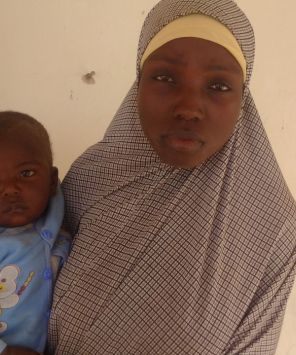
On Saturday, November 5, 2016, troops of 121 Battalion of the Nigerian Army rescued one of the kidnapped girls.
The teenager identified as Maryam Ali Maiyanga, was found while soldiers deployed to Pulka, Gwoza Local Government Area, Borno State, for Operation LAFIYA DOLE were screening some escapees from Boko Haram terrorists hideout in Sambisa forest.
During the screening, which took place at about 6am, Maiyanga was discovered with her 10-month-old son named Ali.
She has since been taken to the unit’s medical facility for proper medical check-up.
A statement by the Army spokesman, Colonel Sani Kukasheka Usman, noted that it was “imperative to state that troops have been working round the clock to clear remnants of Boko Haram terrorists wherever they might be hibernating and also rescue all persons held hostages by terrorists.”
On April 14, 2014, Boko Haram members raided Government Girls Secondary School (GGSS) in Chibok and kidnapped over 200 students writing their final year exams.
Few weeks ago, the group released 21 of the girls and were reunited with their families.
General
Abducted Oyo Pupils, Teachers Regain Freedom After 56 Days
By Adedapo Adesanya
The pupils and teachers abducted in Oriire Local Government Area of Oyo State have regained their freedom after 56 days in captivity.
The development was disclosed on Friday by the Special Adviser to the President on Information and Strategy, Mr Bayo Onanuga, on X. He revealed that eight of the kidnappers have been arrested and are now in the custody of the Department of State Services (DSS), while some others were neutralised during the operation.
“Finally, all the kidnapped pupils and teachers in Oriire, Oyo have been rescued by our security agencies,” he wrote.
He said no concession was made to the terrorists to secure the freedom of the abducted pupils and teachers.
Mr Onanuga explained that the kingpin whose release the kidnappers had demanded was neither freed nor spared, as he remains under prosecution for offences linked to his terrorist activities.
The abductions occurred on May 15, 2026, when armed men attacked three schools: Community Grammar School, Baptist Nursery and Primary School, and L.A. Primary School, in the Esiele and Yawota communities of Oriire Local Government Area.
No fewer than 39 pupils and seven teachers, including a principal, were taken during the attacks. During the attack, a teacher, Mr Joel Adesiyan, was killed while attempting to escape.
Another teacher, Mr Michael Oyedokun, was reportedly beheaded in the kidnappers’ den.
The terrorists holding the victims had reportedly made a four-point demand before agreeing to free the captives, including the release of detained terrorist commanders, payment of ransom, two Hilux vehicles and the implementation of Sharia-related law.
The Oyo State Government had consistently maintained that no ransom would be paid to secure the release of any victims.
The Nigeria Union of Teachers (NUT) embarked on a month-long strike in the state to press for the victims’ rescue before suspending the action in July.
It also drew federal intervention, with military and police authorities repeatedly assuring Nigerians that operations to secure the victims’ freedom were ongoing.
The President’s spokesperson said that security agencies would soon provide a comprehensive account of the operation.
General
EBID Injects $260m Into Nigeria’s Cross-Border Highway Project
By Adedapo Adesanya
The board of the ECOWAS Bank for Investment and Development (EBID) has approved a $260 million financing package for the construction of a 123-kilometre section of the Trans-Saharan Highway in Nigeria as part of more than $417 million earmarked for strategic projects across West Africa.
The approval was granted during the bank’s 99th Ordinary Session, chaired by its President, Mr George Donkor, according to a statement issued after the meeting. It was noted that the total financing will support five public and private sector projects spanning infrastructure, healthcare, housing, mining, financial resilience and regional connectivity.
EBID said the approved investments underscore its commitment to funding high-impact projects that drive economic growth, create jobs and improve living standards across the sub-region.
“The projects approved during this 99th Board Session demonstrate EBID’s unwavering commitment to financing development solutions that directly improve the lives of West African citizens.
“From clean energy and transport infrastructure to healthcare, housing and financial sector resilience, these investments will strengthen regional competitiveness and support sustainable and inclusive growth across our community,” said Mr Donkor.
That of Nigeria is to improve connectivity, facilitate trade, reduce logistics costs and support economic integration; West African CFA franc (XOF) 10 billion in a line of credit to Banque de l’Habitat de Côte d’Ivoire (BHCI) to expand housing finance and support SMEs operating across the housing and construction value chain; €80 million for the design, construction, equipment and maintenance of the 150-bed Regional Hospital of Ferkessédougou in Côte d’Ivoire under a public-private partnership;
XOF 12.82 billion (West African CFA Franc) for the renovation, operation and maintenance of the Symphonie Building in Abidjan under a public-private partnership and $47.4 million for Azumah Resources Ghana Limited to finance the procurement of long-lead process plant equipment and critical early-stage development activities for the Black Volta Gold Project.
“These approvals advance EBID’s Growth, Resilience and Optimisation (GRO) Strategy, which prioritises transformative infrastructure, human capital development, private sector growth and regional integration. Through these investments, the Bank continues to promote sustainable development and shared prosperity across West Africa,” the statement said.
General
Nigeria Eyes 50% Solar Share in Power Mix by 2029
By Adedapo Adesanya
Nigeria is targeting that solar power will account for 50 per cent of the power generation mix by 2029, according to the Rural Electrification Agency (REA).
According to REA’s managing director, Mr Abba Abubakar Aliyu, solar power generation has risen dramatically in the last few years to about 20 per cent of Nigeria’s electricity supply.
He said this could further reach 50 per cent by 2029 if current deployment and private-sector partnerships continue, speaking during the just-concluded 25th Nigerian Oil and Gas (NOG) Energy Week in Abuja on Thursday.
Mr Aliyu, during an energy panel titled Re-Engineering Africa’s Power Market – Driving Reliable Energy Systems, said solar’s share of national generation has risen rapidly, and that sustained momentum would push it toward half of the country’s power mix within the next three years.
Mr Aliyu said the growth was driven by increasing deployment and stronger collaboration with private investors.
“Solar currently constitutes 20 per cent of the nation’s total generation capacity, and with the pace of deployment we are seeing, it is closing in on 50 per cent,” he projected.
The REA chief told delegates that Nigeria was shifting from being primarily a consumer of clean-energy equipment to becoming a regional supplier of renewable technology.
He said manufacturers in the Lagos–Sagamu industrial corridor were building capacity to meet demand across West Africa.
Mr Aliyu said Lagos-made solar photovoltaic (PV) panels were already being exported to neighbouring countries.
He added that a pipeline of about 3.7 gigawatts of PV manufacturing capacity was under development to support further expansion.
“If you go to the Lagos–Sagamu axis, you will see manufacturing companies coming up,” he said.
He, however, noted that despite the rapid expansion in solar deployment and local manufacturing, he clarified that conventional gas-fired thermal plants would remain necessary to stabilise Nigeria’s electricity grid.
He joined other panellists to advocate for a dual-track investment strategy that would continue to expand solar generation and domestic manufacturing while also maintaining and upgrading gas-fired plants.