Connect with us

General

APC Barks at Sowore for Comments on International Flights Resumption

Published

on

omoyele sowore

By Modupe Gbadeyanka

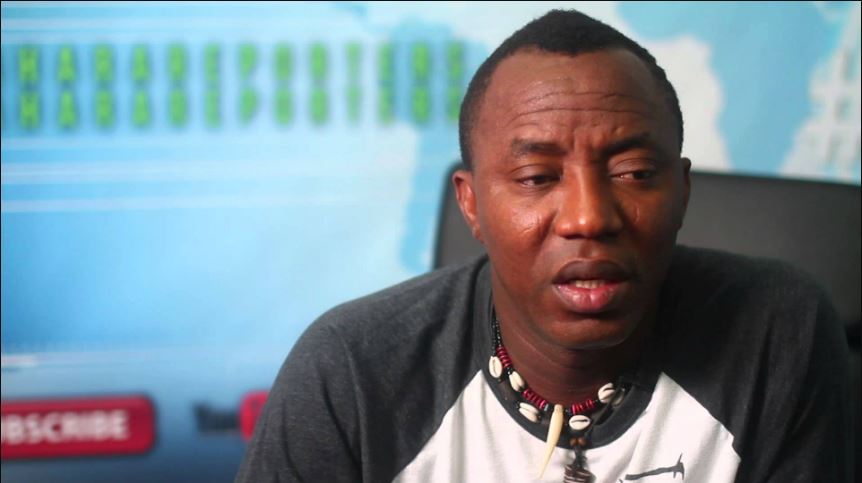
The publisher of Sahara Reporters, Mr Omoyele Sowore, has been lambasted by the APC Mandate Defenders for claiming that the ban on international flights was lifted by the federal government because the children of the elites needed to return back to schools in abroad.

In a statement issued on Tuesday by its National Publicity Secretary, Mr Ifeanyi Emeka, the group said Mr Sowore’s claim was far from the truth.

The APC Mandate Defenders accused the media practitioner as a “known blackmailer, fake news manufacturer and mischief maker who want to use lies, disinformation and empty propaganda to hoodwink unsuspecting Nigerians in to supporting his unpopular anti-government movement.”

According to the organisation, the Presidential Task Force (PTF) on COVID-19 has been using science and data for its decisions since the ease of lockdown began, saying the task force “would never pander to the whims and caprices of anyone, including Mr Sowore.”

“We saw it in the lifting of the ban on inter-state movements, the re-opening of worship centres and domestic flights among others.

“We, therefore, wonder why Sowore would attempt to give negative interpretation to the action of the APC-led federal government when the same government had stated that it would yield to the call by the National Association of Nigerian Students for re-opening of tertiary institutions in the country,” the statement said.

The group further alleged that Mr Sowore had made no pretence in his “vain attempts” to use the task force as a “launch pad for disinformation,” saying it will continue to resist his “nefarious activities.”

“In similar vein, we are aware of the fake news report Mr Sowore used his news medium, Sahara Reporters, to manufacture and peddle during the weekend, accusing immigration officials of collecting bribes from foreign returnees for negative COVID-19 results at the airports.

“Again, we wish to dispel the report because samples are only collected at designated centres and not at the airports where only passports of returnees are collected and not to even talk of issuing test results,” it said.

The group, therefore, advised Nigerians to ignore Mr Sowore, describing him as the “real enemy of the masses because of his mischievous activities and that of his disinformation machinery known as Sahara Reporters.”


Modupe Gbadeyanka is a fast-rising journalist with Business Post Nigeria. Her passion for journalism is amazing. She is willing to learn more with a view to becoming one of the best pen-pushers in Nigeria. Her role models are the duo of CNN's Richard Quest and Christiane Amanpour.

Click to comment

Leave a Reply

Your email address will not be published. Required fields are marked *

General

Daystar Power Expands Nestlé Solar Partnership Across West Africa

Published

on

Daystar Power

By Adedapo Adesanya

Daystar Power Group has expanded its renewable energy partnership with Nestlé in West Africa, commissioning solar power systems with a combined capacity of 6.884 megawatts across four manufacturing facilities in Côte d’Ivoire, Ghana, and Senegal.

According to a statement, the deployments bring the total installed capacity across Nestlé’s sites to 6,884 kWp, nearly 7 megawatts, making it one of the largest commercial and industrial solar partnerships in the region.

The four sites, two in Abidjan, one in Tema, and one in Dakar, are all fully operational, with each system designed around the specific grid and operational profile of its location.

“Nearly 7 megawatts across four Nestlé facilities is a number we are proud of, but what it represents matters more than the figure itself. It means that one of the world’s most demanding manufacturers has tested our model, trusted it, and come back. Our job now is to keep earning that, across every market where industry needs energy it can count on,” Mr Yischai Beinisch, CEO, Daystar Power Group said in a statement.

The partnership began with a single commissioning and expanded to span three countries and four facilities. In Côte d’Ivoire, Daystar Power has delivered 3,447 kWp across two Abidjan sites. In Ghana, a 2,547 kWp system powers Nestlé’s Tema factory. In Senegal, an 890 kWp installation operates at the Dakar facility.

The company said each system is sized and configured to deliver measurable environmental and social impact, including reduced greenhouse gas emissions and improved energy resilience. The design is tailored to the operational and grid conditions at each location, ensuring reliable, clean energy access while supporting local development and aligning with Nestlé’s publicly stated net-zero commitments.

Adding his input, Mr Samer Chedid, CEO, Nestlé Central and West Africa Region, said the investment reflects its commitment to building a business that not only grows but does so responsibly.

“By advancing solar energy projects in Ghana, Côte d’Ivoire, and Senegal, we are embedding sustainability into our growth, reinforcing our role as a force for good, creating long-term value for communities, and ensuring that our footprint actively contributes to a cleaner, more resilient future,” he said.

Continue Reading

General

Nigeria Adopts New Security Framework to Safeguard Oil Assets

Published

on

oil assets

By Adedapo Adesanya

Nigerian Upstream Petroleum Regulatory Commission (NUPRC) and the Federal Ministry of Defence have agreed to deepen collaboration on the protection of critical oil and gas infrastructure through a new non-kinetic security framework designed to curb threats, strengthen community relations and sustain rising output.

The initiative comes as Nigeria recorded crude oil production of nearly 1.8 million barrels per day, one of the highest production levels in recent years, amid intensified efforts to combat crude oil theft, pipeline vandalism and other security challenges across the Niger Delta.

Speaking during a courtesy visit by a delegation from the Ministry of Defence to the Commission’s headquarters in Abuja, the chief executive of NUPRC, Mrs Oritsemeyiwa Eyesan, said the country’s recent production gains were directly linked to coordinated interventions involving security agencies and industry stakeholders.

“Today, we are benefiting from those efforts. Last month, we recorded production of nearly 1.8 million barrels per day throughout the month,” Mrs Eyesan said.

She noted that sustained investments in security operations, technology deployment and human capacity development had significantly improved production stability and operational efficiency in the upstream petroleum sector.

According to her, maintaining and expanding the gains has become critical as Nigeria seeks to increase crude oil output, attract fresh investments and maximise revenue generation from the petroleum industry.

“As we look to the future, we desire to grow production and must have assurances that security threats can be effectively managed. We can only achieve this through stronger collaboration with security agencies and industry stakeholders,” she stated.

Mrs Eyesan stressed that safeguarding oil and gas assets remains central to Nigeria’s energy security strategy and economic growth objectives, noting that production assurance has become a key requirement for investors considering new upstream projects.

She disclosed that the Commission was exploring wider deployment of advanced technologies, including drone surveillance systems, to improve monitoring of the country’s vast oil and gas infrastructure network and detect threats before they escalate into operational disruptions.

The NUPRC boss further revealed that the Commission would work closely with operators to refine and implement a new security framework, while providing leadership in stakeholder engagement and governance structures needed to ensure long-term sustainability.

The Minister of Defence, Mr Christopher Gwabin Musa, said the Ministry was introducing a non-kinetic security intervention model aimed at addressing the underlying causes of insecurity in oil-producing communities.

Rather than relying solely on military operations, he explained that the strategy would focus on community engagement, youth empowerment and social inclusion programmes to build lasting peace around critical energy infrastructure.

“One of the best ways to engage youths in oil-producing areas is through sports-based interventions,” Mr Musa stated.

He explained that the initiative would utilise sports development programmes to channel youthful energy into productive activities, reduce vulnerability to criminal networks and strengthen community ownership of critical national assets.

The Defence Minister, who was represented by one of his aides, added that the intervention would also include structured programmes for persons living with disabilities, creating broader opportunities for participation and economic inclusion in host communities.

According to him, the initiative aligns with the Host Community Development provisions of the Petroleum Industry Act (PIA) and is expected to strengthen relationships between operators and host communities while promoting sustainable development.

Continue Reading

General

PTML Unveils $50m Expansion Plan for Tin Can Island Port

Published

on

PTML

By Adedapo Adesanya

Port and Terminal Multiservices Limited (PTML) has disclosed the investment of $50 million to expand its terminal at Tin Can Island Port, Lagos, as part of efforts to strengthen Nigeria’s bid to become the leading maritime hub in West and Central Africa.

PTML Managing Director, Mr Ascanio Russo, made the disclosure on Wednesday during a visit to the Minister of Marine and Blue Economy, Mr Adegboyega Oyetola, in Abuja.

The investment by PTML, a member of the Grimaldi Group, will expand berthing capacity and acquire additional modern port equipment.

“The Grimaldi Group remains deeply committed to Nigeria and believes in the country’s potential as the leading maritime and logistics gateway in West and Central Africa,” Mr Russo said.

“This $50 million investment is designed to expand our berthing capacity and deploy modern equipment that will enhance operational efficiency, cargo handling, and service delivery.”

He said the upgraded berths would enable PTML to receive next-generation Container/Roll-on Roll-off, Con-Ro, vessels, including the largest Con-Ro ships currently operating globally, directly at the Lagos terminal.

“The maritime industry is evolving rapidly, with larger vessels becoming the standard for international trade. Through this expansion, PTML will be fully equipped to accommodate these next-generation Con-Ro vessels and keep Nigeria competitive for global shipping lines,” Mr Russo stated.

He added that the project responds directly to the Federal Government’s call for increased private-sector participation in port modernisation.

Mr Russo said the expansion would facilitate trade, increase cargo throughput, create jobs during construction and operations, and boost government revenue through higher port activity.

On his part, Mr Oyetola welcomed the investment as a vote of confidence in the Federal Government’s maritime reforms.

“This investment shows our reforms are yielding results and that international investors recognise the opportunities in Nigeria’s maritime sector,” the minister said. “We are determined to transform our ports into modern, efficient, and globally competitive gateways that support economic growth and position Nigeria as the maritime hub of West and Central Africa.”

Mr Oyetola said the government was implementing measures to improve port efficiency, reduce bottlenecks, upgrade infrastructure, and strengthen the ease of doing business.

He said these include port modernisation, deeper collaboration with private operators, digitalisation of port processes, and policies to attract more maritime trade.

Continue Reading

Trending