

General
Customs Cuts Cargo Clearance Time to 43 Hours from 156 Hours

By Adedapo Adesanya
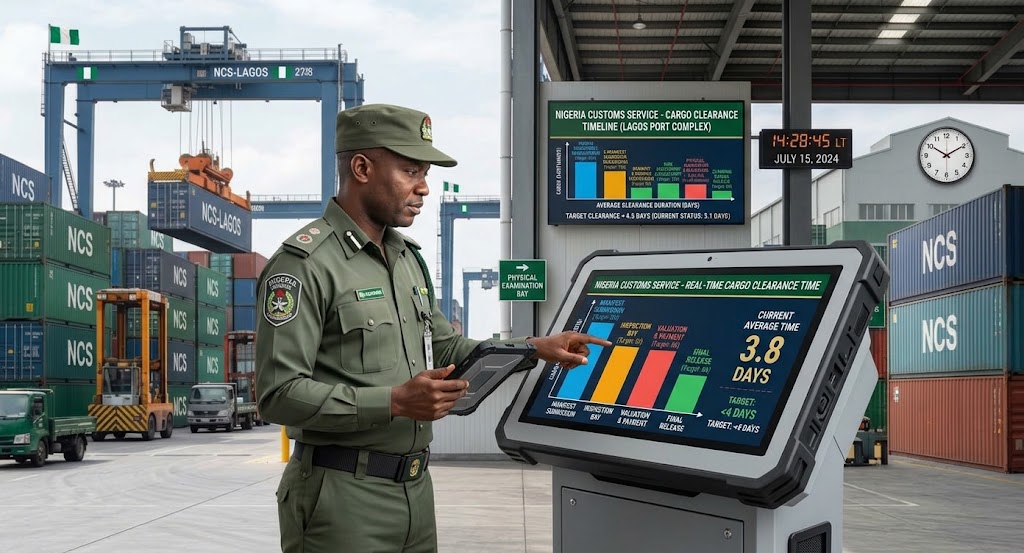
The Nigeria Customs Service (NCS) says it has cut average cargo clearance time from 156 hours to 43 hours through its Authorised Economic Operators (AEO) programme, in line with global standards.
Comptroller-General of Customs, Mr Adewale Adeniyi, disclosed this in Lagos during a sensitisation programme on PCA, describing closer collaboration with businesses as critical to faster cargo clearance and stronger revenue performance.
He said 247 companies had been admitted into the AEO modernisation system since its inception, with compliant businesses benefiting from significantly shorter clearance times.
“Before we started AEO, companies used to have an average of 156 hours in terms of clearance time. But now, it has been reduced to 43 hours,” he said.
“In fact, one of them has achieved an eight-hour clearance time because of the quality of their documentation,” the Customs boss added.
The development highlights the potential for improved documentation and compliance to reduce delays at Nigerian ports while allowing Customs to concentrate enforcement efforts on higher-risk transactions.
Mr Adeniyi urged businesses to regard Customs as a partner in trade facilitation rather than an agency whose primary role is policing them.
“The objective of the Service is not to police businesses but to build a lasting partnership with the trading community capable of transforming Nigeria into a central economic hub,” he said.
He encouraged businesses to understand their rights and obligations and engage Customs proactively to resolve potential compliance issues before they become liabilities.
The improved trade facilitation measures are being accompanied by increased revenue recovery through post-clearance interventions.
Assistant Comptroller-General of Customs in charge of Post-Clearance Audit (PCA), Mr Babatunde Olomu, said the service collected N26.2 billion from PCA between January and August 2026, compared with N21.3 billion during the corresponding period of 2025.
“This is a 27.7 per cent increase year-on-year,” Mr Olomu said, describing PCA as a strategic instrument for revenue assurance, voluntary compliance and improved Customs administration.
The PCA model, according to Mr Adeniyi, is aligned with international best practices under the revised Kyoto Convention, which provides a framework for modern Customs administration.
He said audit findings would also be incorporated into the Service’s risk-management system, enabling Customs to identify and close potential compliance gaps.
The approach is consistent with Article 7.5 of the World Trade Organisation Trade Facilitation Agreement, which promotes post-clearance audit as part of modern risk-based Customs administration.
The Customs chief said the objective was to improve compliance without unnecessarily slowing legitimate trade, urging businesses to engage with the Service to clarify obligations and correct errors before they result in financial liabilities.


