Connect with us

General

FG Reveals Strategy to Restructure, Modernise NIPOST

Published

on

By Modupe Gbadeyanka

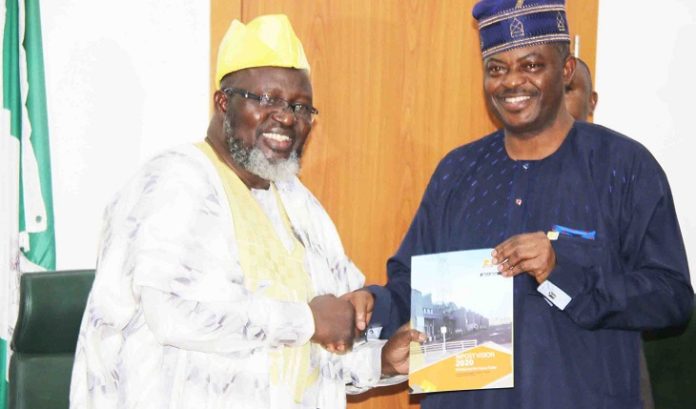
Minister of Communications, Mr Adebayo Shittu, has launched programme of action plan on restructuring and modernising NIPOST and Strategic Plan Document Vision 2020.

Mr Shittu explained that the idea was to tackle the challenges before NIPOST which was as a result of major developments in ICT and modern means of communications; and to take advantages of this, effort would be made to create a socially, relevant economically viable and internationally  respectable post-driven entity.

He stated this during the launching of programme of action on restructuring and modernizing NIPOST and Strategic Plan Document-Vision 2020, adding that the first step in this direction would be “the enactment of the NIPOST Reform Bill presently before the National Assembly” which would address and clearly delineates critical elements of the regulatory and commercial functions of NIPOST.

The Minister, however, solicited the kind indulgence of the National Assembly for the expeditious completion of processes leading to the enactment of this and other bills awaiting enactment to reposition NIPOST.

Mr Shittu also stated that the Ministry was taking modifications further by approving a reform programme that would culminate in the formal unbundling of NIPOST’s commercial and regulatory activities into several profit-oriented, limited liability subsidiaries including –NIPOST Property and Development Company limited to take over the profitable management of all NIPOST Property nationwide; NIPOST Transport and Logistics Limited (Commercial Management of NIPOST’s Transport Fleet); NIPOST Merchandising Limited (to take advantage of the growing e-commerce sector in the country); NIPOST General Services and Support Company Limited (a social inclusion and public engagement company offering e-govt and other franchise); and NIPOST Digital Financial Services Limited (the ‘Post Bank’ that would offer financial inclusion services as a Mobile Money Operator licensed by the Central Bank of Nigeria).

The Minister disclosed that even with the unbundling of NIPOST, the original functions of Postal and Courier Services would continue to reside in NIPOST and that the Postmaster General would assume the role of Group Chief Executive Officer supervising the CEOs of these subsidiaries each of which would have Boards of Directors and appropriate corporate governance structures to energise this process.

Mr Shittu also inaugurated the NIPOST Modernisation Steering Committee headed by–the Permanent Secretary of the Ministry of Communications, Arc. Sonny Echono (Chairman), others are  Postmaster General, Asiwaju Adebisi Adegbuyi (Vice Chairman), Special Adviser to the Minister of Communications on Digital Resources optimization, Mr Akin Yusuf (Member/Secretary), also included in the committee are Director, Telecoms and Postal Services, Mrs Ngozi Ogujiofor; Director, ICT, Mrs Moni Udoh; Special Assistant to the Minister on NIPOST, Mr Okechukwu Igwe and two representatives from NIPOST, and one representative each from the Central Bank of Nigeria and the Bureau of Public Enterprises.

Speaking earlier, the Postmaster-General (PMG), Mr Bisi Adegbuyi commended the minister and the National Assembly for working tirelessly to ensure the Restructuring and Modernization of NIPOST.

He said the Restructuring and Modernization would strengthen and reposition NIPOST to be able to provide Nigerians with a solid platform for integration, innovation and inclusion.


Modupe Gbadeyanka is a fast-rising journalist with Business Post Nigeria. Her passion for journalism is amazing. She is willing to learn more with a view to becoming one of the best pen-pushers in Nigeria. Her role models are the duo of CNN's Richard Quest and Christiane Amanpour.

Click to comment

Leave a Reply

Your email address will not be published. Required fields are marked *

General

SERAP Questions NASS on N1.3bn Budgetary Allocation to Phantom Presidential Council

Published

on

SERAP

By Adedapo Adesanya

The Socio-Economic Rights and Accountability Project (SERAP) has asked Senate President Godswill Akpabio and Speaker of the House of Representatives Tajudeen Abbas to explain how over N1.3 billion was allocated in the 2026 Appropriation Act to a presidential council that the Presidency has described as non-existent.

In a Freedom of Information (FoI) request dated July 4, 2026, and signed by its Deputy Director, Mr Kolawole Oluwadare, SERAP demanded certified copies of all documents relating to the approval of the N1,302,978,784 allocation to the Presidential Foreign Intervention Promotion Council (PFIPC), also referred to in the budget as the Presidential Economic Advisory Council.

The organisation also urged the leadership of the National Assembly (NASS) to immediately invoke its investigative powers under Sections 88 and 89 of the 1999 Constitution (as amended) to probe the circumstances surrounding the allocation and identify those responsible for any irregularities.

SERAP further requested records identifying the lawmakers and committees that considered and approved the allocation, as well as the public officials who appeared before the committees to defend the proposed funding.

It also asked the parliament to clarify whether the allocation formed part of the Executive’s original 2026 Appropriation Bill or was inserted during the legislative process. The group also sought to know whether any lawmaker questioned the legal status or operational mandate of the council before the budget was passed.

According to the group, the request became necessary following conflicting claims over the existence of the council, noting that while the 2026 Appropriation Act reportedly earmarked more than ₦1.3 billion for the PFIPC/Presidential Economic Advisory Council, the Presidency has since publicly stated that the body was never established by the Federal Government and is fictitious.

The rights organisation said the contradiction raises serious concerns about the integrity of Nigeria’s budget process, legislative oversight, public financial management and accountability.

“Nobody has a more sacred obligation to obey the law than those who make the law,” SERAP said, stressing that the National Assembly has a constitutional duty not only to approve budgets but also to thoroughly scrutinise Executive proposals before authorising public spending.

It argued that Nigerians have a right to know whether public funds were appropriated for an entity that was not lawfully established and, if so, how the allocation found its way into the national budget.

According to the organisation, making the requested documents public would enable citizens to determine whether the National Assembly fulfilled its constitutional responsibilities in scrutinising and approving the allocation.

SERAP warned that if the requested information is not provided within seven days of receipt or publication of the FoI request, it would initiate legal proceedings to compel the National Assembly to disclose the records.

It maintained that releasing the documents would strengthen public confidence in the credibility of the National Assembly, enhance transparency in the appropriations process and promote accountability in the management of public funds.

The group also cited the Freedom of Information Act, the Nigerian Constitution and Nigeria’s obligations under international human rights instruments, arguing that public institutions are required to proactively disclose information of significant public interest, particularly where allegations of financial impropriety or misuse of public resources have arisen.

Continue Reading

General

Higher Allocations to States, Renewed Investments Thrill Tinubu

Published

on

Tinubu kill Abu-Bilal Al-Manuki

By Adedapo Adesanya

President Bola Tinubu has said state governments are now receiving substantially higher allocations to drive development, while renewed investor confidence is attracting fresh investments into Nigeria.

Speaking at the maiden State House Media Dinner in Abuja on Thursday, the president described the development as evidence that his administration’s economic reforms are beginning to deliver positive results.

He defended the reforms introduced by his administration, acknowledging that they were difficult but necessary to reposition the economy for sustainable growth.

According to Mr Tinubu, stronger public revenues have enabled increased allocations to states, while improvements in the investment climate have boosted confidence among domestic and foreign investors.

“The difficult but necessary reforms undertaken by this administration are yielding results. Our economy is stabilising. Public revenues have strengthened significantly,” he said.

“State governments are receiving substantially higher allocations to support development. Investor confidence is returning.

“Our foreign reserves have improved considerably. The oil and gas sector is attracting renewed investment. The stock market has witnessed remarkable growth. Key economic indicators are moving in the right direction,” Mr Tinubu stated.

The president also said the administration was laying the groundwork for long-term prosperity through a combination of tax and fiscal reforms, infrastructure development and improvements to the business environment.

“Through tax reforms, fiscal reforms, infrastructure investments, and improvements in the business environment, we are laying the foundations for a more competitive, productive, and prosperous economy,” he said.

Although acknowledging that more work remains, Mr Tinubu maintained that the country was firmly on the path to sustainable economic growth.

“The journey is not yet complete, but the direction is clear, and the foundations for long-term growth are being firmly established,” he added.

On security, the president said his administration had sustained a multi-dimensional strategy that has produced measurable gains across different parts of the country.

He noted that intensified military operations, improved intelligence gathering, stronger inter-agency coordination, and expanded regional and international cooperation had led to the neutralisation of thousands of terrorists and criminal elements, the rescue of numerous hostages, and the recovery of communities previously under siege.

President Tinubu reiterated his administration’s commitment to ensuring peace and security across the country, saying every Nigerian should be able to live, work and prosper without fear.

The president also commended the media for its contribution to Nigeria’s democratic development while urging journalists to uphold professionalism by reporting accurately and responsibly.

“We are adversaries only in the democratic sense, as the media constantly distrust those in power. In nation-building, we are partners,” he said.

He described government and the media as institutions with complementary responsibilities, noting that while government serves through leadership and public policy, the media serves by holding those in power accountable on behalf of the people.

Continue Reading

General

Shell, Nine Banks Open $3bn Credit Window for Oil, Gas Contractors

Published

on

Kwale Gas Facility

By Adedapo Adesanya

Shell Nigeria Exploration and Production Company Ltd (SNEPCo) has launched a $3 billion Contract Finance Facility in partnership with nine Nigerian banks to improve contractors’ access to funding and strengthen local participation in the oil and gas industry.

The facility is designed to provide credit support for local contractors executing projects for SNEPCo operations and will be available in both Naira and US Dollars.

The participating banks are First Bank, Guaranty Trust Bank, Zenith Bank, Access Bank, United Bank for Africa, Stanbic IBTC, Standard Chartered Bank, First City Monument Bank and Fidelity Bank.

Speaking at the signing of the Memorandum of Understanding in Lagos, the SNEPCo Managing Director, Mr Ronald Adams, said, “The initiative reflects the spirit of the Nigerian Oil and Gas Industry Content Development Act, which is aimed at in-country value retention.”

“Our partner banks offer capital and discipline. SNEPCo brings contracts and domiciliation of payments that de-risk lending. On their part, the contractors provide performance. Each is accountable to others, and the mutual accountability gives the arrangement its strength,” he added.

Also speaking, the Vice President for Finance at Shell Nigeria, Mr C. J. Akwaeze, said the scheme reflects Shell’s commitment to the growth of oil and gas operations in Nigeria.

The chairman of the indigenous oil and gas contractor group, the Petroleum Technology Association of Nigeria (PETAN), Mr Wole Ogunsanya, represented by Mrs Joan Faluyi, lauded the scheme as a “gateway to unlocking contractor financing issues which will also drive efficiency in contract execution.”

Representatives of the banks commended SNEPCo for the opportunity to partner on an initiative aimed at empowering contractors and assured the company of their continued support and cooperation.

Nigerian companies have continued to play key roles in supporting SNEPCo’s operation and project execution. Earlier this year, 43 wholly Nigerian companies took part in the turnaround maintenance exercise at the Bonga Floating Production and Offloading (FPSO) vessel out of the total of 53 companies involved.

Continue Reading

Trending