
General
Finance Minister Kemi Adeosun in NYSC Certificate Forgery Scandal


By Dipo Olowookere
These are not the best of times for Nigeria’s Finance Minister, Mrs Folakemi Adeosun, getting into the news for the wrong reasons in recent times.
The eloquent and brilliant Economist has been accused of forging her National Youth Service Corps (NYSC) certificate to get jobs in Nigeria, including the present one.
According to Premium Times, the former Commissioner for Finance in Ogun State did not participate in the mandatory one-year scheme even after graduating before the age of 30, when she is qualified for an exemption.
Mrs Adeosun graduated from the Polytechnic of East London in 1989, at the age of 22 as Folakemi Oguntomoju and in 1992, the institution changed its name to University of East London with her certificate issued in the new name.
According to her curriculum vitae, Mrs Adeosun was born in March 1967 and having graduated at 22, it was obligatory for Mrs Adeosun to participate in the one-year national service for her to qualify for any job in Nigeria.
Going by the NYSC law, section 13, eligible Nigerians who skipped the service are liable to be sentenced to 12 months imprisonment and/or N2,000 fine.
Section 13 (3) of the law also prescribes three-year jail term or option of N5,000 fine for anyone who contravenes provision of the law.
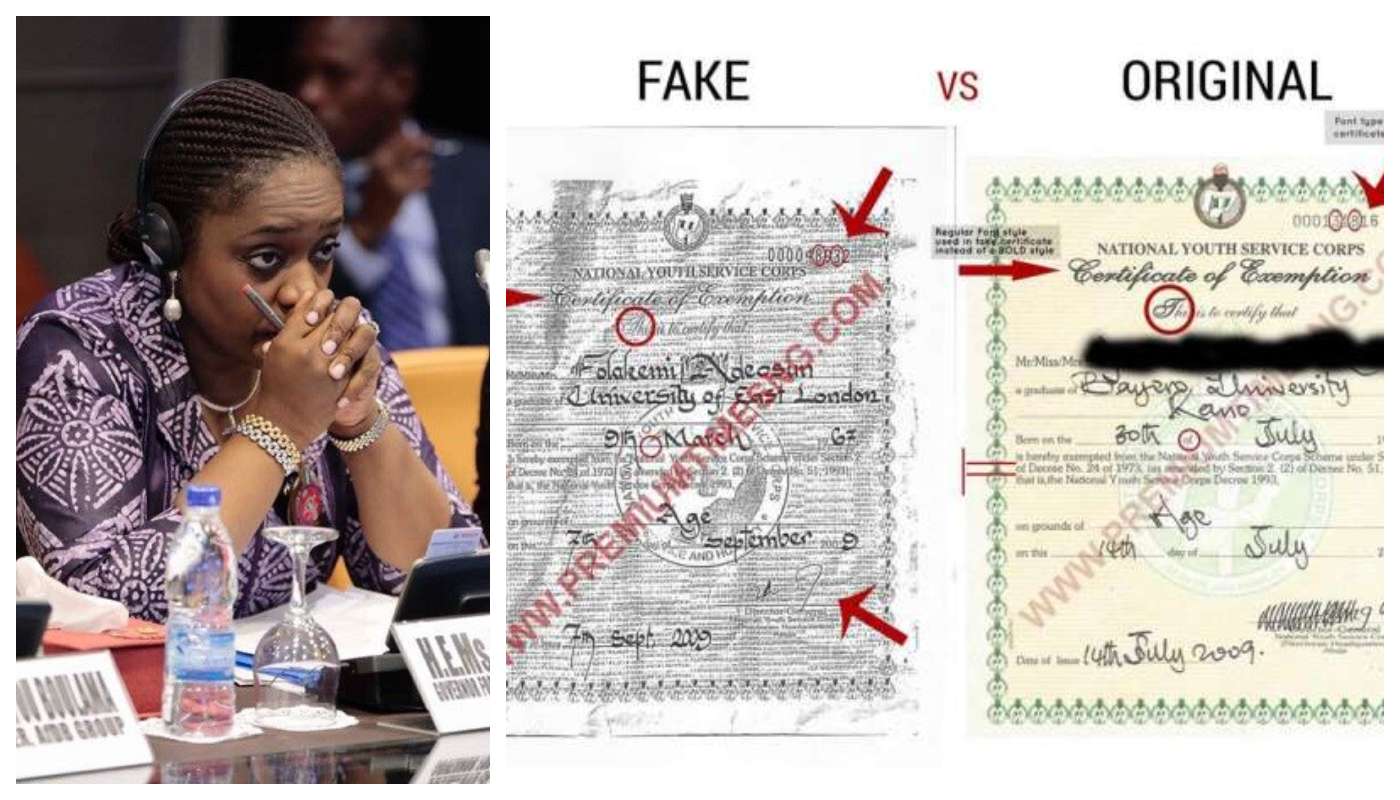
The report by Premium Times said the Finance Minister parades a purported NYSC exemption certificate, which was issued in September 2009, granting her exemption from the mandatory service on account of age.
Business Post gathered from the report that Mrs Adeosun’s ‘certificate’ is dated September 9, 2009, and was purportedly signed by the former director-general of NYSC, Mr Yusuf Bomoi.
But officials of the NYSC said Mr Bomoi stepped down from the corps in January 2009, and could not have signed any certificate for the agency eight months after. The retired brigadier general passed on in September 2017.
It is important to note that the NYSC certificate is a requirement for government and private sector jobs in Nigeria and the enabling law prescribes punishment for anyone who absconds from the scheme or forges its certificates.
Subsection 4 of Section 13 of the law criminalises giving false information or illegally obtaining the agency’s certificate. It provides for up to three-year jail term for such offenders.
According to Premium Times, upon graduation in 1989, Mrs Adeosun, who studied Applied Economics in the United Kingdom, did not return to Nigeria to serve her fatherland, but pursued fast-paced career in the British public and private sectors.
She first landed a job at British Telecoms, but left after a year to join Goodman Jones, an accounting and investment firm, as audit officer. She served there till 1993.
In 1994, Mrs Adeosun joined London Underground Company as Internal Audit Manager, before switching to Prism Consulting, a finance firm, where she worked between 1996 until 2000.
In 2000, Mrs Adeosun was hired by PricewaterhouseCoopers, where she worked for two years.
When she eventually returned to Nigeria in 2002, Mrs Adeosun still did not deem it necessary to participate in the NYSC scheme. She simply accepted a job offer at a private firm, Chapel Hill Denham.
However, ostensibly concerned that she might run into trouble for skipping the mandatory scheme, Mrs Adeosun, sometime in 2009, procured a fake exemption certificate.
The NYSC does not issue exemption certificate to anyone who, like the minister, graduates before turning 30, top officials of the scheme familiar with the matter said.
Using that fake certificate, Mrs Adeosun went on to clinch high-profile jobs at Quo Vadis Partnerships (managing director), Ogun State Government (commissioner for finance), and Federal Government of Nigeria (minister of finance).
By the provision of Section 12 of the NYSC Act, employers must demand NYSC certificates from prospective employees. The law also mandates employees to present only genuine certificates for that purpose.
Section 12 of the Act reads: “For the purposes of employment anywhere in the Federation and before employment, it shall be the duty of every prospective employer to demand and obtained from any person who claims to have obtained his first degree at the end of the academic year 1973-74 or, as the case may be, at the end of any subsequent academic year the following:-
a. a copy of the Certificate of National Service of such person issued pursuant to section 11 of this Decree
b. a copy of any exemption certificate issued to such person pursuant to section 17 of this Decree
c. such other particulars relevant there to as may be prescribed by or under this Decree.”
A lawyer, Sagir Gezawa, described jobs Mrs Adeosun has had in Nigeria as illegal.
“The combined effect of sections 12 and 13 of the NYSC Act is that it is illegal to hire a person who graduated but failed to make himself or herself available to serve, or falsify any document to the effect that he or she has served or exempted from serving.”
However, without demanding or verifying the veracity of the certificate presented by Mrs Adeosun, two Nigerian companies, the Ogun State Government and the Federal Government of Nigeria employed her at various times.
On becoming Governor of Ogun State in 2011, Mr Ibikunle Amosun nominated her into his cabinet. She proceeded to serve as commissioner of finance for four years.
In November 2015, Mrs Adeosun was sworn in as minister by President Muhammadu Buhari, and assigned the all-important finance ministry, after a supposed security and Senate screening.
The State Security Service, charged with vetting appointees to top government positions, failed to detect that her NYSC certificate was fake.
The Senate, which received the fake certificate as part of the documents Mrs Adeosun submitted for her confirmation hearing, detected the discrepancy, PREMIUM TIMES understands.
But it nonetheless proceeded to clear her for the top office. Those familiar with the matter said the leadership of the National Assembly used that information to blackmail and extort Mrs Adeosun for years.
Premium Times investigated Mrs Adeosun’s so-called NYSC certificate for months, determining eventually that it is fake.
“This one is an Oluwole certificate,” a top official of the corps said after we showed him a copy of the document. “We did not issue it and we could not have issued it.” Oluwole is a location in Nigeria’s commercial capital, Lagos, where fraudsters possess an amazing dexterity in the act of forging all kinds of documents.
Several current and former officials of the scheme told this paper that the NYSC would never issue an exemption certificate to anyone who graduated before age 30 and did not fall into the categories of persons exempted by the corps’ enabling Act.
By that law, there are four categories of Nigerians eligible for exemption certificates. The first are those who graduated after turning 30. The second are holders of national honours. The third are persons who served in the armed forces or the police for up to nine months. The last category are staff of intelligence agencies, or the armed forces.
Therefore, having graduated at 22, and with no record of national honours or service in the intelligence or armed forces, Mrs Adeosun is not qualified for exemption, officials said.
Yet, the so-called exemption certificate she holds gave age as the reason for her exemption.
“This is not the size of our exemption certificate,” another top official of the corps remarked when shown a copy of the minister’s ‘certificate’. “The calligraphy is also different”.
On another day, another staff questioned the genuineness of the ‘certificate’ based on the font of the serial number.
“Look at this, look at this other one, the numbering is different,” the staff said while comparing Mrs Adeosun’s certificate with a genuine one on file.
Mrs Adeosun’s name also failed to pop up during multiple checks of the exemption certificates registers kept by the corps, officials said.
One official, who perused the register recently, noted that the sequence of serial numbers for certificates issued in 2009 did not correspond to that in Mrs Adeosun’s purported certificate.
The signature on the ‘certificate’ is also suspect. As indicated earlier in this report, it was purportedly signed by an official who left the corps eight months before the document was made. One official described that claim as “barefaced lie and total impossibility”.
Premium Times reported Friday how the certificate scandal was turned into a tool for blackmail by a National Assembly cartel that used it to coerce the finance minister to keep releasing funds to the lawmaking arm.
Some federal lawmakers revealed to the paper that the discrepancy was detected by the Senate during the minister’s confirmation hearing. But rather than probe the issue, they turned it into a tool against Mrs Adeosun.
The report linked the certificate scandal to the minister’s excessive, even illegal, funding of the lawmakers, including recently funnelling a N10 billion largesse to that arm of government.
Although several of its officials informally cooperated with our reporters in the course of this investigation, the NYSC leadership declined to respond to our official correspondences.
The newspaper first sent a letter to Director-General Sule Kazaure (brigadier-general) requesting him to help determine the authenticity or otherwise of the minister’s ‘certificate’.
After it received no response for several weeks, a Freedom of Information request was sent on the matter. Weeks after, the journal is still waiting for response.
Insiders say authorities of the corps have been under severe pressure in the past weeks not to respond to inquiries on the matter.
A reporter of the newspaper also requested a reaction from Oluyinka Akintunde, the spokesperson to Mrs Adeosun, who was briefed on the outcome of the investigations. He was yet to send a response to the inquiry.




By Dipo Olowookere
The need for Africa to protect itself from many external shocks not of its making has again been emphasised by the African Development Bank (AfDB), the African Union Commission (AUC), the United Nations Development Programme (UNDP), and the UN Economic Commission for Africa (UNECA).
On the margins of the 58th session of the Economic Commission for Africa in Tangier, Morocco, the continent was tasked to strengthen regional integration, accelerate African-led financial solutions, and invest decisively in energy, food, and trade resilience so as to move from vulnerability to preparedness.
The meeting focused on the spikes in energy, food and fertiliser prices caused by the ongoing conflict in the Middle East.
The United States and Israel launched airstrikes on Iran in February 2026, and since then, global oil prices have surged by more than 50 per cent as of late March. Twenty-nine currencies in Africa have weakened, raising the cost of servicing external debt and importing food, fuel, and fertiliser.
Disruptions linked to Gulf energy supplies limit access to ammonia and urea during the critical March–May planting season. This will affect agricultural production, compounding risks of crisis and emergency levels of food insecurity, especially for low‑income households and import‑dependent economies.
To address these issues, the quartet has asked African leaders to, in the short-term, stabilise fuel, food, and fertiliser supply, and execute medium‑term reforms to strengthen energy security, targeted social protection, and regional trade under the African Continental Free Trade Area (AfCFTA).
They also tasked leaders to come up with long‑term structural reforms towards stronger domestic resource mobilisation and African financial safety nets, including accelerated implementation of the African Financing Stability Mechanism.
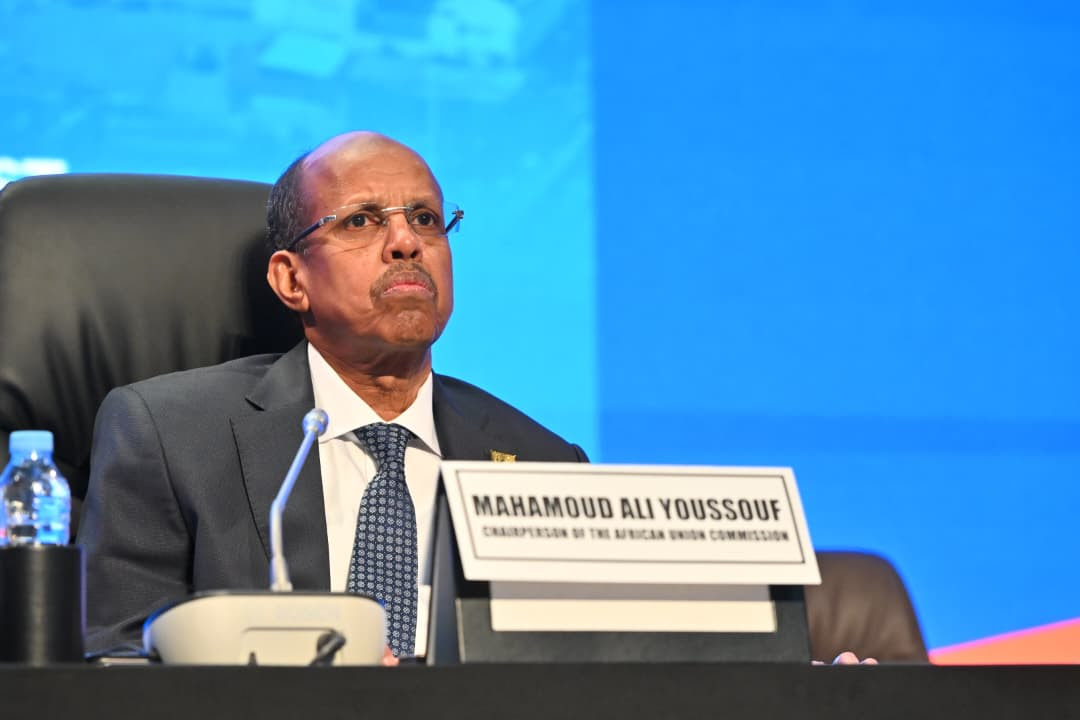
“Continued escalation of the conflict worsens global instability, with serious implications for energy markets, food security, and economic resilience, particularly in Africa, where economic pressures remain acute,” the chairperson of AUC, Mr Mahmoud Ali Youssouf, said.
Also commenting, the UN Under-Secretary-General and Executive Secretary of UNECA, Mr Claver Gatete, said, “Africa has been hit by too many external shocks not of its making. Crises like this reinforce why Africa must finance more of its own future and strengthen regional solutions that build resilience before the next shock hits.”
On her part, the UN Assistant Secretary‑General and Director of UNDP’s Regional Bureau for Africa, Ms Ahunna Eziakonwa, submitted that, “With the right mix of policy choices, financing tools, and political resolve, Africa can weather this shock and emerge more resilient, more self-reliant, and better positioned to shape its own economic future.”
“As global crises multiply, Africa’s response must evolve from managing shocks to fostering resilience. African institutions and development partners need to act swiftly and in concert, leveraging their comparative advantages to cushion short-term shocks while laying the foundations for long-term resilience,” the president of AfDB, Mr Sidi Ould Tah, stated.

By Adedapo Adesanya
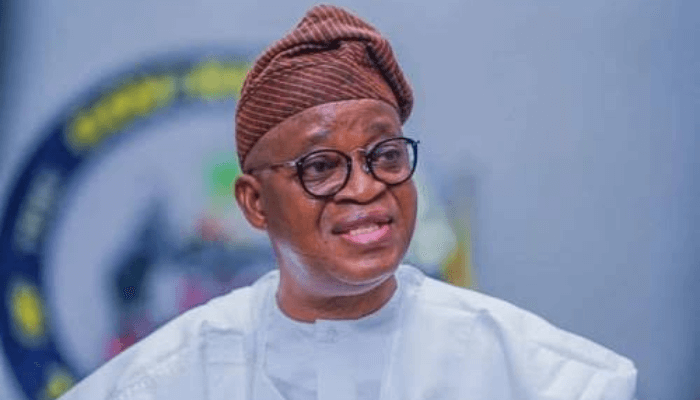
The Minister of Marine and Blue Economy, Mr Adegboyega Oyetola, has issued a strong warning to heads of agencies under the ministry, demanding strict accountability and measurable results.
Mr Oyetola issued the warning during the signing of performance bonds with heads of maritime agencies at the Ministerial Management Retreat, held alongside the 2026 first-quarter stakeholders’ engagement in Lagos on Thursday, where he emphasised the need for performance-driven governance.
“Let me emphasise that all Departments and Agencies under the Ministry must remain firmly focused on delivering tangible results,” he said.
In a statement by Mr Bolaji Akinola, Special Adviser to the Minister, Mr Oyetola noted that performance bonds to be signed during the retreat are binding commitments that will be closely monitored and rigorously evaluated.
“These are not ceremonial documents. They are binding commitments. Accountability will not be optional,” the Minister declared.
Mr Oyetola reiterated the need for data-driven decision-making, robust monitoring and evaluation frameworks, and alignment with the Ministry’s strategic objectives.
“At the institutional level, we must remain disciplined and accountable. Every department and agency must deliver measurable outcomes,” he added.
He explained that the retreat was designed to foster alignment between policy formulation, implementation, and stakeholder expectations.
“The integration of this engagement enables us to listen, reflect, and recalibrate,” he said.
The agencies include the Nigerian Ports Authority (NPA), Nigerian Maritime Administration and Safety Agency (NIMASA), Nigerian Shippers’ Council (NSC), National Inland Waterways Authority (NIWA), Maritime Academy of Nigeria, and the Council for the Regulation of Freight Forwarding in Nigeria.
He also announced a 160 per cent increase in revenue generated by agencies under the ministry, attributing the growth to sweeping reforms and a renewed focus on accountability.
“In 2023, our agencies generated N700.79 billion. By the end of 2025, this figure had risen to approximately N1.83 trillion. This remarkable achievement is the result of deliberate and sustained reforms,” he stated.
The Minister explained that the gains were driven by strengthened regulatory oversight, improved revenue assurance mechanisms, digitalisation of key processes, and a firm commitment to blocking leakages.
“This gathering reflects our commitment to a governance approach that is inclusive, transparent, and results-driven,” he added, noting that the convergence of stakeholders, policymakers, and institutional leaders was designed to align policy with implementation and public expectations.
Mr Oyetola linked the ministry’s improved performance to broader sectoral reforms, including port modernisation, approval for disbursement of the Cabotage Vessel Financing Fund (CVFF), and ongoing efforts to enhance indigenous participation in maritime activities.


By Modupe Gbadeyanka
The Special Adviser to the President on Information and Strategy, Mr Bayo Onanuga, has explained why Mr Bola Tinubu addressed the victims of the Plateau attacks at the airport on Thursday evening.
The decision of President Tinubu to console victims of the attacks, which left over 20 persons dead, at the Yakubu Gowon Airport in Jos last night has continued to generate reactions.
He was criticised for not visiting the victims at the epicentre, Angwan Rukuba, instead of having them to travel to meet with him at the airport.
In a statement on Friday, Mr Onanuga said his principal’s itinerary for yesterday included two main engagements: receiving the Chadian President, Mahamat Idriss Déby Itno, and proceeding to Iperu, Ogun State.
“After Governor Caleb Mutfwang’s briefing, President Tinubu suspended the trip to Ogun. Overnight, the Presidential Villa made arrangements for the visit to Jos, with presidential assets quickly deployed. However, the President could not postpone the scheduled visit by the Chadian leader.
“The President of Chad was at the Presidential Villa for a very important bilateral meeting focused on strengthening security collaboration between the two countries. The meeting ran longer than expected, affecting President Tinubu’s scheduled departure for Jos.
“Upon arrival in Jos, the visit encountered some logistical challenges. While the road distance from the airport to Jos township is approximately 40 minutes, the runway does not support night flights due to the absence of navigational aids. The constraints made it unfeasible to drive into town, meet victims for on-the-spot assessment and return to the airport before dusk.
“Consequently, state and federal officials decided to bring representatives of the affected community to a hall adjoining the airport so the President could meet with them promptly while adhering to flight restrictions. Among the people in the hall were the Minister of Defence, the Chief of Army Staff and the Inspector General of Police, who had visited Rukuba, the epicentre of the conflict. President Tinubu deployed the high-level team to Rukuba, including the Senior Special Assistant on Community Engagement, to undertake critical groundwork on security and community engagement, with a view to stabilising the area before his arrival.
“Beyond expressing his condolences to the victims, President Tinubu’s objective was to engage with critical stakeholders in Plateau State on ending the recurring, decades-old conflict that has resulted in needless loss of lives and property.
“President Tinubu’s visit to Jos was not merely symbolic. It was a strategic, high-level engagement aimed at bringing all stakeholders together to address the root causes of conflict and insecurity in the state.
“He interacted with the victims, consoled them, and listened to them. He also listened to local leaders and assured them that the federal government would deliver justice and end the cycle of violence. He promised the deployment of 5000 AI-enabled cameras to monitor the city and enhance the identification and arrest of troublemakers.
“Furthermore, the President invited the community leaders to Abuja for further talks on finding a lasting solution to the recurring violence in the state.
“The meeting, televised live, was solemn and reassuring, boosting residents’ confidence. President Tinubu achieved the purpose of his visit, despite the naysayers’ attempts to ridicule it. He dropped an unmistakable message: sustainable peace must be built with the people, not imposed on them,” the presidency explained.
-
 Feature/OPED6 years ago
Davos was Different this year
-
Travel/Tourism10 years ago
Lagos Seals Western Lodge Hotel In Ikorodu
-

 Showbiz3 years ago
Estranged Lover Releases Videos of Empress Njamah Bathing
-
 Banking8 years ago
Sort Codes of GTBank Branches in Nigeria
-

 Economy3 years ago
Subsidy Removal: CNG at N130 Per Litre Cheaper Than Petrol—IPMAN
-

 Banking3 years ago
Sort Codes of UBA Branches in Nigeria
-

 Banking3 years ago
First Bank Announces Planned Downtime
-

 Sports3 years ago
Highest Paid Nigerian Footballer – How Much Do Nigerian Footballers Earn