General
Lagos Gets FG Approval to Reconstruct Airport Road

By Dipo Olowookere
Federal Government has finally given an approval to the Lagos State government to reconstruct the Lagos International Airport Road, which the state government had longed for.
Secretary to the State Government (SSG), Mr Tunji Bello, in a statement on Wednesday said Lagos State was given the permission to embark upon a total reconstruction of the road by the Acting President, Mr Yemi Osinbajo, a former Commissioner of the state.
Before now, there were speculations that the state Governor, Mr Akinwunmi Ambode; and the Minister of Power, Works and Housing, Mr Babatunde Fashola, the immediate past Governor of the state, were at loggerheads over this issue.
Recently, Mr Ambode publicly said it would have started works on the road from Oshodi, but that the Minister was dragging the approval.
This was immediately refuted by Mr Fashola, who explained that he was not the one frustrating the approval.
In the statement issued today, Mr Ambode thanked the Acting President for his statesman like approach and for fast tracking the process.
“We are very appreciative of the good gesture of His Excellency, the Acting President for acceding to our request which is not only very timely but a very heart-warming one. Posterity will never forget this genuine developmental action,” Governor Ambode was quoted to have said in the statement.
He also described the approval as a 50th birthday to the people of Lagos State, describing it a further demonstration of the determination of the present administration to ensure the effectiveness of the Executive Order on improving the Ease of Doing Business recently signed by the Acting President.
Governor Ambode also gave kudos to President Muhammadu Buhari for providing the enabling environment to attract Foreign Direct Investment into the nation, adding that with the upgrading of the International Airport Road which is the gateway to the nation’s commercial nerve centre, the country will attract new investments.
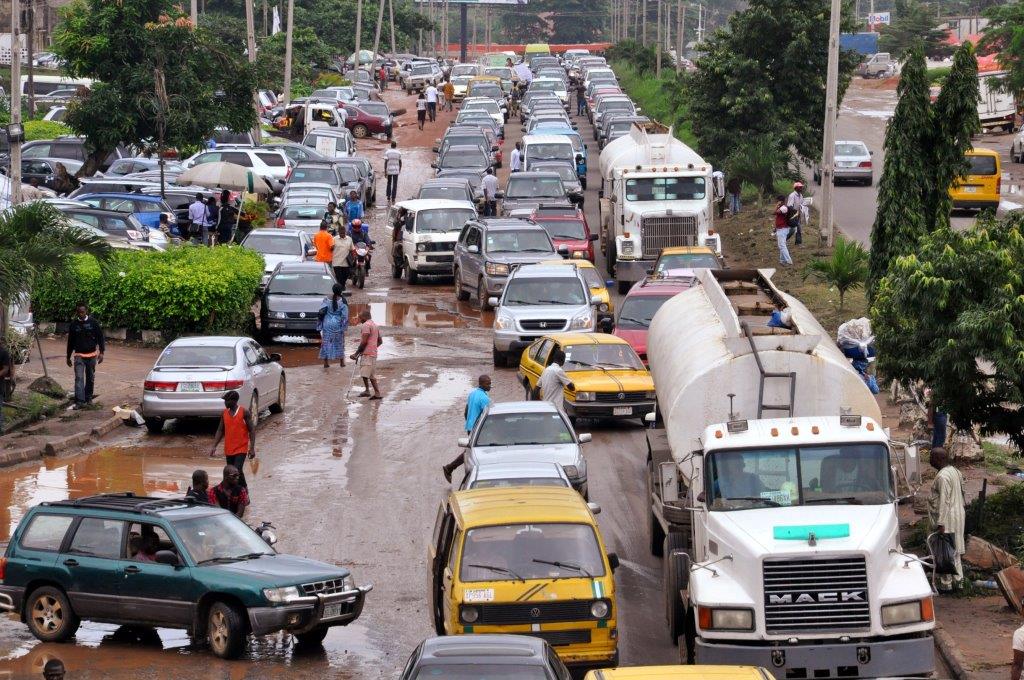
The Governor had in early March this year, raised an alarm about the present state of the Murtala Muhammed International Airport Road, describing it as a national disgrace that required immediate attention to salvage the nation’s image.
He stated then that the State presently has a design for the reconstruction of the road as well as the funds to embark on the project but was yet to get the go ahead from the Federal Government.
In his words: “The road linking Oshodi to the International Airport, you would all agree with me is a national embarrassment. In the spirit of the regeneration and urbanisation that this administration has set out to achieve, we believe strongly that the image that is exhumed by the decadence of that road must be repaired and we took it upon ourselves to appropriate the 2017 budget that the House of Assembly should approve the total reconstruction of the Airport Road from Oshodi to the International Airport.
“The State currently has a design of 10 lanes to come from Oshodi to the International Airport with interchange and flyover that would drop you towards the Local Airport. The contractor is already set to go and everything as I said has been completed and we already have the cash, but alas we are having challenges with the Federal Ministry of Works and Housing. This is a Federal and not a State road. The Federal Ministry of Works believes that they should do the road, but they have not been able to do it all these years past.”
Governor Ambode had said if given the approval, his administration was ready to hit the ground running and begin construction of the Airport Road within two weeks and finish same within a period of six months.
Besides, the Governor also implored the Federal Government to avail the State of the N2billion appropriated for the Airport Road in the 2017 National Budget to carry out the project.
“I just want to appeal to the Federal Ministry of Works, to let go or reimburse us with whatever it is that they are owing us and even if they are not willing to pay us now, we have the money to do it. It is a national disgrace and we would not be part of it. We would like to do it as part of the celebration of Lagos at 50,” Governor Ambode had said then.
It would be recalled that the Federal Ministry of Power, Works and Housing in its reaction said the delay in granting the request the of Lagos State was because the Memorandum conveying the request of Lagos State which was already before the Federal Executive Council has not reached completion stage.
“The Federal Ministry of Power, Works and Housing Ministry has presented the Memorandum conveying the request of the Lagos State Government to the Federal Executive Council as was done with a similar request by the Kaduna State Government in 2016”.
“Due to the fact that TWO of the roads also connect Ogun State, the Federal Executive Council could not reach an immediate decision on them because it requested the input of the other State Government affected”, the federal ministry explained.
General
Nigeria Edges Toward State Policing Amid Rising Security Challenges
By Adedapo Adesanya
The Presidency has said Nigeria is moving closer to establishing state police, with progress made towards the constitutional framework required to decentralise policing.
The development follows months of consultations involving the Presidency, the National Assembly, and security authorities aimed at strengthening the country’s security architecture and comes amid increased security challenges across the country.
The Chief of Staff to the President, Mr Femi Gbajabiamila, disclosed this on Thursday while briefing State House correspondents after a consultative meeting on state police convened by the Presidency at the State House in Abuja.
According to a statement issued by the Special Adviser to the President on Information and Strategy, Mr Bayo Onanuga, deliberations on the proposed state police framework began several months ago following a directive from President Bola Tinubu.
“We started deliberations in the last three or four months on how to go about the establishment of state police as directed by Mr President.
“Establishing state police is not something that you do with the snap of the fingers. There is a lot involved in terms of constitution and legalities, and thank God, we have now gained a lot of traction.
“Hopefully, the amendment will come shortly, and the details of the amendment will come after that,” he was quoted as saying.
The president’s chief of staff explained that the immediate priority is securing constitutional amendments, while enabling legislation would follow.
“Right now, what we are looking at is the constitutional amendment itself, and then the enabling law would follow thereafter. That is what we have been deliberating on in the last couple of hours,” he added.
Mr Gbajabiamila noted that there is now broad national support for the initiative, saying the debate has shifted from whether state police should be established to determining the most effective legal and institutional framework for its operation.
He added that Tinubu, a long-time advocate of state police, would receive a comprehensive report on the outcome of the consultations.
Thursday’s meeting was attended by Deputy Senate President Mr Jibrin Barau, Deputy Speaker of the House of Representatives, Mr Benjamin Kalu, Inspector-General of Police, Mr Tunji Disu and other senior government officials.
The latest meeting forms part of ongoing efforts by the federal government to develop a workable framework for state police, which proponents argue would improve internal security, strengthen intelligence gathering at the grassroots level, and enhance the ability of state governments to respond to emerging security threats.
Nigeria’s policing system is currently controlled by the federal government through the Nigeria Police Force. However, growing security challenges have intensified calls for a decentralised policing structure.
The renewed push for state police also comes amid growing concerns over insecurity and mass kidnappings across parts of the country.
Among recent incidents was the May 15 attack on three schools in Oriire Local Government Area of Oyo State, where 39 pupils and seven teachers were abducted. The incident triggered widespread outrage, protests, and an indefinite strike by teachers in the state.
General
AFC Mobilises $2bn From Global Lenders for African Infrastructure Projects
By Adedapo Adesanya
The Africa Finance Corporation (AFC) has raised $2 billion via a syndicated loan, with considerable participation from Asian and European banks seeking to capitalise on growing demand for infrastructure projects across the continent.
Barclays Bank, Commerzbank, First Abu Dhabi Bank PJSC, and FirstRand Bank led the debt facility. Other participating lenders include Export-Import Bank of India, Bank of Communications, Industrial and Commercial Bank of China, and Industrial Bank of Korea, among others.
Each region accounted for about 35 per cent of the creditors, according to a statement by AFC.
AFC chief executive, Mr Samaila Zubairu, said the money would enable more master planning around infrastructure and industrial planning for economies, regions and economic corridors across the continent.
According to Mr Zubairu, the lender is also in discussions to invest in a proposed oil refinery to be built by billionaire Aliko Dangote in East Africa.
The financer initially sought $1.6 billion via the facility but scaled it up to $2 billion amid strong demand from Asian financial institutions.
“In this round, we saw a lot more of Asian banks. We have banks from China, Hong Kong, and Korea. They are a lot more engaged,” he said.
Mr Zubairu said the loan underscored AFC’s strong track record, pointing to its financing for projects including Nigeria’s 650,000 barrels per day Dangote oil refinery and Africa’s largest copper smelter in the Democratic Republic of Congo.
“There’s a lot more confidence, a lot more partners,” Mr Zubairu said of those participating in the loan. “We are constantly demonstrating that Africa is executing. Africa is building.”
“The capital that we raise goes into African infrastructure build out, African industrialisation build up – essentially creating jobs for Africans,” Mr Zubairu said.
The AFC chief said the lender is also working to reform capital rules and create structures that will allow more African money to stay on the continent and be invested in crucial infrastructure projects.
AFC, founded in 2007, has assets surpassing $19 billion and counts 48 African countries as members.
In January, the infrastructure-focused multilateral lender secured an A rating from S&P. It has an A3 rating from Moody’s, an AAAspc rating from S&P Ratings (China) and an A+ rating from the Japan Credit Rating Agency.
General
NERC Orders DisCos to Pay 20% Compensation to Affected Band A Customers
By Adedapo Adesanya
The Nigerian Electricity Regulatory Commission (NERC) has ordered electricity distribution companies (DisCos) to pay 20 per cent compensation to eligible Band A customers who were affected by power shortfalls between February and March 2026.
In Directive No. NERC/2026/002, the commission said, generation constraints, which were largely caused by inadequate gas supply and vandalism of gas and transmission infrastructure, prevented DisCos from meeting committed service levels for some Band A feeders.
NERC Mandated that for feeders that supplied less than 18 hours per day, affected Band A feeders will not be downgraded during the covered period, and eligible customers will receive special compensation equal to 20 per cent of approved energy figures for February 2026.
However, for Band A feeders that recorded an average daily supply of between 18 and 20 hours, the existing compensation framework under Addendum No. NERC/2024/003 applies to both Maximum Demand (MD) and Non-Maximum Demand (Non-MD) customers.
MD customers are high-consumption users who typically have their own dedicated transformer and operate with a load of 45 kVA and above; they include large residential estates, banks, hotels, supermarkets, industrial facilities and oil and gas complexes.
Non-MD customers do not have a dedicated transformer and instead share public transformers, and they generally consume less, often below 45–50 kVA.
For Non-MD customers, compensation is set at 20 per cent of the approved February 2026 energy cap applicable to the affected feeder.
For MD customers, compensation is 20 per cent of the average energy billed per MD customer in February 2026.
According to NERC, prepaid customers will receive their compensation as token credits, while postpaid customers will receive bill adjustments.
The commission said that compensation for February must be completed by 31 May 2026, while compensation for March must be completed by 30 June 2026.
The commission prohibited Distribution companies from using compensation credits to offset any existing customer debt, adding that customers must be clearly informed of the value and period of the compensation they receive.
NERC said it will monitor implementation and verify compliance to ensure all eligible customers receive what they are due.
The commission reaffirmed its commitment to protecting electricity consumers while ensuring the stability and sustainability of the electricity market.
-
Feature/OPED6 years agoDavos was Different this year
-
Travel/Tourism10 years ago
Lagos Seals Western Lodge Hotel In Ikorodu
-
Showbiz3 years agoEstranged Lover Releases Videos of Empress Njamah Bathing
-
Banking8 years agoSort Codes of GTBank Branches in Nigeria
-
Economy3 years agoSubsidy Removal: CNG at N130 Per Litre Cheaper Than Petrol—IPMAN
-
Banking3 years agoSort Codes of UBA Branches in Nigeria
-
Banking3 years agoFirst Bank Announces Planned Downtime
-
Sports3 years agoHighest Paid Nigerian Footballer – How Much Do Nigerian Footballers Earn