General
Maritime Workers Insist no Congestion at Onne, Reject e-Call up System
By Bon Peters
Maritime transporters under the auspices of Maritime Workers Union (MWUN) Eastern Zone have rejected the e-call up truck system at Onne and other ports in the Eastern Zone, vowing action if the Nigerian Ports Authority (NPA) and other maritime authorities refuse to adhere to their call for its review.
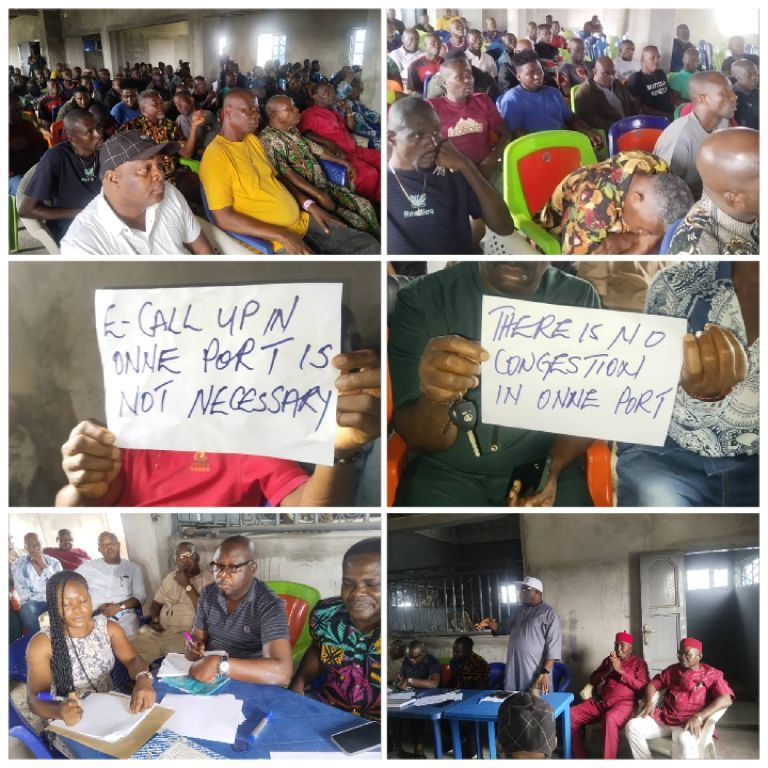
The association rising from an emergency meeting Wednesday in Port Harcourt, Rivers State, where over 700 of their members were in attendance insisted that the e-call up system failed at Lagos ports of Apapa and Tin Can, wondering why such should be experimented in the Eastern ports, which are strongly yearning for port infrastructural development such as good access road and dredging of water channels to accommodate more vessels and increase cargo throughput and vessel turnaround time.
The group lamented that freight differential and high insurance at the Eastern ports have already dealt a big blow on the operators.
Our correspondent reports that some of the truck owners and drivers alike were seen carrying placards with inscriptions such as, there is no congestion at Onne ports, we don’t want e-call up system at Onne, e-call up is to kill the Eastern ports, e-call up didn’t work in Lagos among others insisted that those canvassing for the system are the ones who have put in place their “corrupt mechanisms” waiting to hijack the platform as they did in Lagos, thereby causing unemployment and hardship for people who are already suffering.
They described the system as “hydra-headed monster” that would in the long run stifle the Onne oil and gas business and also cripple the esteem ports which they said was underutilized.
Reminded the one group who goes by the name Association of Maritime Truck owner (AMATO) was alleged to have endorsed e-call up system and expressed their willingness to adopt the system, the Haulage District Chairman Maritime workers union Eastern Zone, Mr Adolphus Ugwu, said, “Such Association is nonexistent here at Onne or only existed on the author’s imagination not here at Onne Port or the entire Eastern ports.”
“The so called AMATO chieftain Adeshina Ajibola in that online publication claimed he came to Onne on invitation, that means he doesn’t operate nor reside here, we don’t even know him.
“The other person who said he is Samuel Ossai, the Coordinating Secretary of Trucker Owners is not our member,” he stated.
People, who know him, said he drives Keke at Onitsha, you can see how desperate some people can be. They went and rented those people to cause confusion at Onne.
“But, having critically examined E-Call up system, my people at Onne and eastern ports have unanimously said No to E-Call up system. No congestion here at Onne, and Onne Port is not ripe for e-call system,” he said.
Speaking further, Comrade Ugwu said we’re not against the policy of the federal government and will never be but we are pleading with the authorities concerned to hear our cries and suspend it for now. There is no congestion at Onne and the cost implication will be much as some people will hijack the system for their selfish gains.”
“Maritime works are law abiding citizens of this country. What we are saying is that they should not bring this system here that failed woefully in Lagos“, he emphasized.
Contributing, District Secretary Truck owners Association, Maritime workers union, Dock workers branch, Comrade Casmir Anukanti quoted a Latin maxim which says vox populi vox Dei, meaning The voice of the people is the voice of God.”
He said, “What you are seeing today is an organic crowd not rented and they have voiced their rejection of the E-Call system in the Eastern Ports and precisely Onne through our resolution.
“Feelers we got from Lagos showed it didn’t work. Onne is not a guinea pig for experimentation. So both the drivers and Truck owners said not to it.
“We are law abiding association and always act within the ambits of the law. What we are saying is that NPA, the Ministry of Maritime and Blue economy as well as the transportation ministry should look into our cries and suspend the e-Truck Call up system for now. “Onne Port and other eastern ports are underutilized.
“We are keenly watching and might take appropriate actions if the need arises” Anukanti assured.
Some of the drivers, who spoke to our correspondent, were unanimous in rejecting the e-call up system which they said would aggravate their suffering.” We don’t want it, some of our drivers go to Lagos when dey launch am but wetin we find go there we no see am” they said in pidgin.
Last week, stakeholders under the aegis of Coalition of Maritime stakeholders have voiced their rejection of the e-call up system saying such would cripple the Eastern ports especially affect businesses at the oil and gas free zone at Onne.
Industry watchers are keenly watching and believing such might not disrupt operations at Onne and other ports at the Eastern Maritime corridors of the country if not properly handled by the authorities concerned.
General
NAFDAC, NEPZA Deepen Collaboration on Pharmaceutical Regulation in Free Zones
By Adedapo Adesanya
The Nigeria Export Processing Zones Authority (NEPZA) and the National Agency for Food and Drug Administration and Control (NAFDAC) are strengthening joint oversight within Nigeria’s free trade zones.
The collaboration focuses on pharmaceutical and consumable products manufactured by enterprises operating in the zones.
The Director-General of NAFDAC, Mrs Mojisola Adeyeye, disclosed this during a visit to the Managing Director of NEPZA, Mr Olufemi Ogunyemi, at the authority’s headquarters in Abuja.
Mr Adeyeye said the visit was aimed at deepening collaboration and partnerships that would enable NAFDAC to effectively discharge its regulatory responsibilities within the free trade zones nationwide.
According to her, the agency remains committed to monitoring the importation, exportation, production, and distribution of pharmaceuticals, food products, cosmetics, and other regulated consumables within the zones.
“We must view this meeting as a responsibility we have to the country to protect citizens from fake drugs and consumables infiltrating our markets from known and unknown destinations,” she said.
The NAFDAC boss said the agency had consistently insisted on strict testing procedures and compliance with approved standards to guarantee quality control across regulated manufacturing and export industries.
She emphasised the strategic importance of the free trade zone scheme to Nigeria’s industrialisation drive and broader economic growth objectives, particularly in manufacturing and export promotion activities.
However, Mr Adeyeye said stronger monitoring mechanisms were necessary to ensure the safety, efficacy, and quality of products entering Nigeria’s customs territory from the free trade zones.
“NEPZA and NAFDAC can fix this misalignment by jointly insisting on compliance. We can close this gap through excellent facility management and improved inspection across production lines,” she said.
On his part, Mr Ogunyemi welcomed the collaboration, describing it as critical to addressing alleged irregularities associated with medical supplies and consumable products originating from enterprises operating within the free trade zones.
According to him, the free trade zone scheme, comprising 63 zones and more than 900 enterprises, remains a major gateway for industrial growth, investment attraction, and national economic development.
The NEPZA managing director, however, acknowledged that regulating operations within the zones still presented significant challenges requiring stronger inter-agency collaboration and improved enforcement mechanisms.
“We need a joint effort to address some of the irregularities. We will allow NAFDAC to perform its regulatory functions because the public’s health depends on it,” he said.
Mr Ogunyemi added that NEPZA remained committed to ensuring that free trade zones were not used as safe havens for illicit activities or the circulation of substandard products.
“We fully endorse this partnership and collaboration, which has the potential to enhance the scheme’s global compliance across all production and export activities for the benefit of the country,” he said.
The meeting also featured the confirmation of an eight-member technical committee to examine challenges affecting seamless regulatory operations between both agencies within the nation’s free trade zones.
General
Court Upholds $100m Judgment Against Chinese Oil Firm in OPL 471 Dispute
By Adedapo Adesanya
A Federal High Court sitting in Port Harcourt has reaffirmed a $100 million judgment against China National Petroleum Corporation (CNPC) in favour of Nigerian indigenous firm, Cutra International Limited, over a disputed Oil Prospecting Licence (OPL) 471.
In a judgment delivered on April 24, 2026, the court dismissed CNPC’s application seeking to overturn an earlier judgment entered on May 23, 2025, in Suit No. FHC/PH/CS/136/2022 between Cutra International Limited and CNPC.
The Chinese oil giant filed the application on October 28, 2025, asking the court to set aside the judgment, but the court held that there was no legal basis to revisit the matter.
The dispute arose from the ownership structure and equity participation in OPL 471, which was awarded by the federal government to CNPC and its Nigerian partner, Cutra International Limited, in 2006/2007.
Under the arrangement, Cutra held a 10 per cent equity interest in the oil block. However, the company alleged that CNPC unilaterally returned the licence to the Federal Government without consulting or obtaining its consent.
Aggrieved by the action, Cutra approached the court, seeking compensation for the loss of benefits and entitlements tied to the asset.
In its earlier judgment, the court ruled in favour of Cutra after finding that evidence presented by the Nigerian firm on the estimated value of the oil block was not challenged by CNPC.
The court noted that Cutra’s claim that the minimum yield from the OPL was valued at $5 billion remained uncontroverted during proceedings.
Relying on the evidence before it, the court awarded damages of $100 million against CNPC.
Dismissing CNPC’s attempt to reopen the case, the court held that it had become functus officio after delivering judgment on the matter.
According to the court, “when a Court takes a position on a matter in controversy before it, that Court becomes functus officio with respect to that matter in controversy, and the Court stands and remains bound by the decision.”
“It is equally the position of the law that where a trial Court in the course of the proceedings in a matter before it decides on a particular issue or question, it becomes functus officio to revisit that issue or question,” the court added.
The ruling is seen as a major legal victory for Cutra International Limited and a significant development in Nigeria’s commercial dispute resolution landscape involving foreign corporate entities.
Legal and industry observers say attention may now shift to the enforcement phase of the judgment, given the international dimensions of the dispute and the substantial financial implications of the court’s decision.
General
Tegbe Denies Promising to Fix Nigeria’s Power Grid in Three Months
By Modupe Gbadeyanka
The Minister of Power designate, Mr Joseph Tegbe, has refuted reports making the rounds that he promised to resolve Nigeria’s power grid within three months.
It was claimed that Mr Tegbe gave this assurance when he appeared before the Senate for screening this week after his nomination by President Bola Tinubu.
In a statement on Friday by his spokesperson, Adeola A. Adelabu, the Minister-designate emphasised that he never promised to fix the national grid issue in 90 days.
One of the major challenges facing the country’s electricity sector is the frequent collapse of the grid. The country, blessed with more than 220 million people, generates less than 5,000MW of electricity.
The power grid has had to break down frequently, especially while Mr Tegbe’s predecessor, Mr Adebayo Adelabu, was in charge.
In the statement today, the new person chosen by the President to lead the power sector reform noted that his remarks at the upper chamber of the National Assembly were misrepresented.
It was stressed that at his Senate screening on May 6, 2026, Mr Tegbe made no such commitment, but stated unequivocally that the timelines were still being worked on and subject to diagnostics and stakeholder engagements.
While assuring that initial grid stabilisation efforts would commence within the first 100 days, he made clear that structural reforms, particularly in sector credibility, gas supply, and metering, might take about a year.
“My promise to this chamber and to Nigeria is that Nigerians will see visible improvement in the sector,” Mr Tegbe said, pledging to stabilise the national grid, modernise infrastructure, enhance commercial frameworks, and enforce accountability across the entire electricity value chain.
On tariff reforms, he promised to protect vulnerable households while balancing sustainability, investor confidence, and broader sector efficiency.
The Minister-designate said he remains open to constructive media engagement and welcomes requests for clarification where necessary, recognising the role of the media as partners in nation-building, especially in fostering accurate public understanding of the imminent reforms in the power sector.
-
Feature/OPED6 years agoDavos was Different this year
-
Travel/Tourism10 years ago
Lagos Seals Western Lodge Hotel In Ikorodu
-
Showbiz3 years agoEstranged Lover Releases Videos of Empress Njamah Bathing
-
Banking8 years agoSort Codes of GTBank Branches in Nigeria
-
Economy3 years agoSubsidy Removal: CNG at N130 Per Litre Cheaper Than Petrol—IPMAN
-
Banking3 years agoSort Codes of UBA Branches in Nigeria
-
Banking3 years agoFirst Bank Announces Planned Downtime
-
Sports3 years agoHighest Paid Nigerian Footballer – How Much Do Nigerian Footballers Earn

Pingback: NPA Commences Electronic Call-Up at Apapa Port | Business Post Nigeria