Connect with us

General

Nigeria Customs Targets N11.07tn Revenue for 2026

Published

on

Nigeria customs wale adeniyi

By Adedapo Adesanya

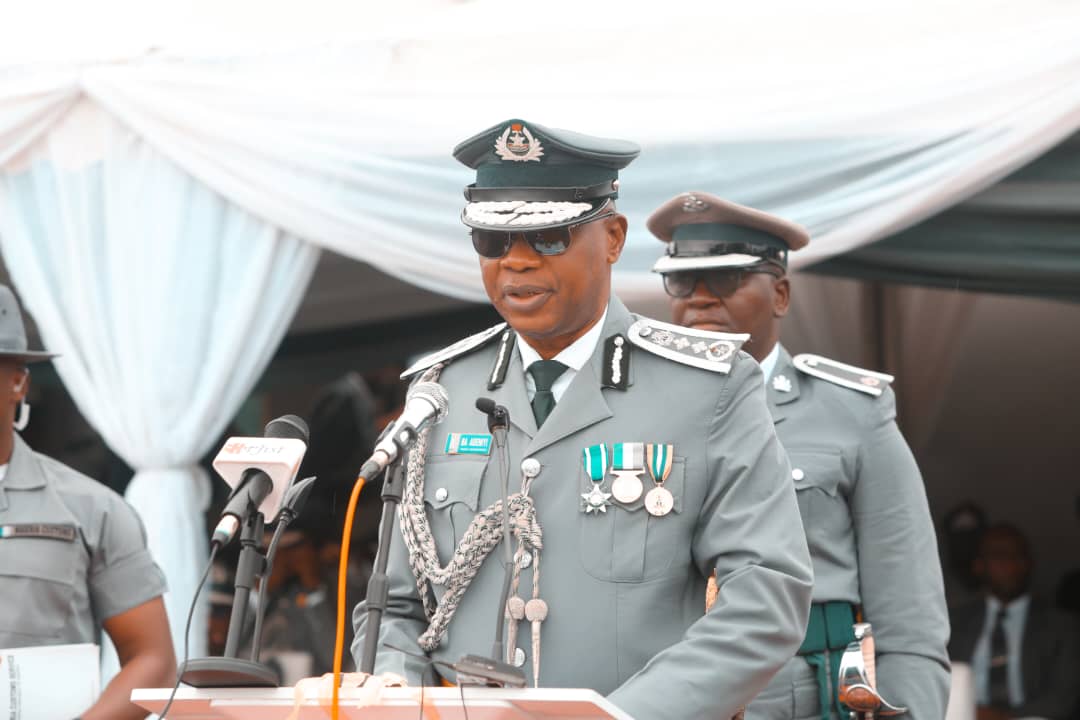
The Nigeria Customs Service (NCS) has proposed a revenue target of N11.07 trillion for the 2026 fiscal year, saying it will rely on deeper automation, intelligence-driven enforcement and enhanced trade facilitation to meet the ambitious goal.

The Comptroller-General of Customs, Mr Adewale Adeniyi, disclosed this on Monday while presenting the agency’s 2026 budget proposal before the House of Representatives Committee on Customs and Excise.

According to him, the projected revenue comprises N5.54 trillion from federation accounts, N1.49 trillion from non-federation accounts, N2.27 trillion from import Value Added Tax (VAT), and N1.26 trillion from the four per cent Free-on-Board (FOB) Cost of Collection.

Mr Adeniyi said the agency would deepen automation through the Unified Customs Information System, popularly known as B’Odogwu, strengthen post-clearance audits, expand intelligence-led enforcement and improve trade facilitation to achieve the target.

“The Unified Customs Management System is now up and running very well. We believe it provides the platform for robust revenue collection,” he said.

He added that reforms implemented in collaboration with the International Monetary Fund (IMF) and the World Customs Organisation (WCO) had significantly strengthened post-clearance audit operations.

“Through that, we are able to carry out real-time system audits and continue to recover revenue on a daily basis,” he said.

The customs boss also said the Authorised Economic Operator Programme and the Advance Ruling Programme were now fully operational and expected to improve compliance while facilitating legitimate trade.

Mr Adeniyi, however, acknowledged that recently approved tariff reductions on imported vehicles could moderate revenue growth, even though new excise measures expected under the 2026 fiscal policy may boost collections.

He confirmed that import duty on used vehicles had been reduced from 15 per cent to five per cent, while duty on brand-new vehicles was cut from 20 per cent to 10 per cent.

Responding to lawmakers’ concerns over the likely impact of the policy, Adeniyi said it was too early to assess its effectiveness because implementation only began on May 1, 2026.

“This is a new policy. It takes an average of about 90 days before we begin to see its full effects,” he said.

He stressed that while the Nigeria Customs Service provides technical advice on trade trends and revenue implications, fiscal policy decisions remain the responsibility of the Federal Ministry of Finance.

On expenditure, the Service proposed N421.70 billion for personnel costs, N307.77 billion for overheads and N565.93 billion for capital projects in the 2026 budget.

Mr Adeniyi said the Customs currently has 15,969 personnel, with 3,927 new recruits expected to join before the end of the year. He noted that capital spending would prioritise completion of ongoing projects, acquisition of operational equipment, expansion of ICT infrastructure and execution of existing contractual obligations.

The Customs chief also defended the agency’s 2025 performance, disclosing that it generated N7.28 trillion between January and December 2025, exceeding its annual revenue target of N6.58 trillion by 10.24 per cent, despite government-approved tax waivers and fiscal incentives.

He noted that about N34.54 trillion worth of imports benefited from duty exemptions and waivers during the year, reducing potential revenue collections.


Adedapo Adesanya is a journalist, polymath, and connoisseur of everything art. When he is not writing, he has his nose buried in one of the many books or articles he has bookmarked or simply listening to good music with a bottle of beer or wine. He supports the greatest club in the world, Manchester United F.C.

Click to comment

Leave a Reply

Your email address will not be published. Required fields are marked *

General

SERAP Sues INEC Over Alleged Diversion of N800bn Campaign Funds

Published

on

serap inec

By Adedapo Adesanya

The Socio-Economic Rights and Accountability Project (SERAP) has approached the court against the Independent National Electoral Commission (INEC) over an alleged N800 billion campaign fund diversion.

The organisation is seeking to compel the electoral body to investigate allegations that about N800 million from the Federation Account Allocation Committee (FAAC) allocations was diverted by governors elected on the platform of the All Progressives Congress (APC) to finance political and campaign activities.

The suit, marked FHC/ABJ/CS/1426/2026, was filed at the Federal High Court in Abuja last week, but no date has been fixed for the hearing of the suit.

SERAP is asking the court to issue an order of mandamus directing INEC to investigate the claims that the governors channelled public funds into a dedicated campaign account allegedly meant to support President Bola Tinubu’s 2027 re-election bid.

The organisation is also requesting an order compelling INEC to demand full disclosure from the governors and the APC on any contributions made to such a campaign fund, including the identities of donors and the lawful sources of the funds.

In addition, SERAP wants the electoral commission to commence a comprehensive review of compliance with Section 91 of the Electoral Act by political parties and candidates, particularly regarding campaign financing and the sources of political donations.

According to SERAP, the allegations raise fundamental concerns about transparency in political financing, electoral fairness and the constitutional rights of Nigerians to participate freely in democratic governance.

The organisation argued that opaque campaign financing remains a major avenue for corruption and weakens public confidence in democratic institutions.

It maintained that the alleged misuse of public funds for political purposes threatens the credibility of the 2027 general election and undermines public trust in the electoral process.

In the suit filed by its lawyers, Mr Kolawole Oluwadare and Ms Kehinde Oyewumi, SERAP argued that the reported diversion of public resources for campaign activities warrants immediate action by INEC under its constitutional and statutory responsibilities.

The group stated: “The abuse of state resources for electoral advantage undermines democratic integrity and public trust. Fairness, transparency, and accountability in political or campaign finance are essential safeguards against corruption, state capture, and undue influence in democratic processes.”

SERAP further argued: “The allegations of diversion or opaque use of public funds pose a grave risk to the integrity of the 2027 general elections.”

The organisation said large-scale public financial allocations, combined with weak oversight and limited transparency, provide sufficient grounds for INEC to activate its investigative powers.

Referring to Section 91 of the Electoral Act, SERAP noted that the law empowers INEC to regulate political donations, enforce contribution limits, demand disclosure of funding sources and impose sanctions where violations occur.

The organisation explained that political parties found to have exceeded donation limits risk fines of up to ₦10 million and forfeiture of excess funds, while individuals who exceed prescribed limits are liable to penalties amounting to five times the excess contribution.

SERAP also contended that campaign financing derived from public resources distorts electoral competition and violates constitutional principles guaranteeing free, fair and transparent elections.

According to SERAP, INEC has a constitutional duty to ensure compliance with campaign finance regulations and to investigate allegations that could compromise the integrity of the electoral process.

Continue Reading

General

2027 Elections: INEC Extends Candidate Submission Deadline to July 14

Published

on

Incorruptible INEC Chairman

By Adedapo Adesanya

The Independent National Electoral Commission (INEC) has shifted the deadline for political parties to submit the names and credentials of candidates seeking to contest the 2027 presidential and National Assembly elections.

The electoral body announced that parties now have until midnight on Tuesday, July 14, to complete the process, extending the earlier deadline of Saturday, July 11.

Under INEC’s timetable for the 2027 general election, political parties were expected to upload the names and personal particulars of their presidential, Senate and House of Representatives candidates before the initial cut-off date.

Explaining the decision, INEC said the extension followed appeals from political parties that had encountered difficulties meeting the deadline.

In a statement issued on Sunday, the National Commissioner and Chairman of the Information and Voter Education Committee, Mr Mohammed Haruna, said the request was formally conveyed through the Inter-Party Advisory Council (IPAC).

According to him, IPAC sought additional time on behalf of parties that were yet to complete the submission of their candidates’ details through the commission’s portal.

“The decision to extend was based on an appeal by the Inter-Party Advisory Council, on behalf of political parties who were unable to upload the names and personal particulars of their candidates within the scheduled timeline,” Mr Haruna stated.

INEC noted that the extension is intended to give all eligible parties a fair opportunity to comply with the requirements of the electoral process while remaining within the framework of the law.

The commission also urged political parties to utilise the extra period to finalise and upload all required information ahead of the revised deadline.

“The commission enjoins political parties to take advantage of this window of opportunity and ensure that all necessary details are uploaded before the expiration of the new deadline,” the statement added.

Continue Reading

General

2027: Tinubu Retains Shettima as Vice Presidential Candidate

Published

on

tinubu shettima

By Dipo Olowookere

Nigeria’s Vice President, Mr Kashim Shettima, will run as the vice-presidential candidate of the All Progressives Congress (APC) in the 2027 presidential election.

President Bola Tinubu retained Mr Shettima as his running mate for re-election next year, according to the National Chairman of the APC, Mr Nentawe Yilwatda.

In a post on Friday on X, the ruling party chairman described this as “another significant milestone in the journey of our great party.”

He also said it reaffirms the party’s collective resolve to sustain the Renewed Hope Agenda and deepen the progress already being recorded across the country.

It was gathered that Mr Tinubu submitted his presidential nomination forms today through his Special Adviser on Political and Other Matters, Mr Ibrahim Masari.

The submission was done ceremony at the Continental Hotel, Abuja, attended by several party chieftains, including The event brought together an impressive array of leaders of our great party, including the Chairman of the Progressive Governors’ Forum and Governor of Imo State, Mr Hope Uzodimma; Governor Mai Mala Buni of Yobe State, Governor Nasir Idris of Kebbi State, Governor Abba Kabir Yusuf of Kano State, Governor Uba Sani of Kaduna State, Governor Babagana Umara Zulum of Borno State, Governor Ahmadu Umaru Fintiri of Adamawa State, as well as other governors, party executives and critical stakeholders from across the federation.

“The All Progressives Congress remains focused on strengthening its grassroots support, consolidating the achievements of the Renewed Hope Agenda and working together to build a more prosperous, secure and inclusive Nigeria for all,” the party leader stated.

Continue Reading