
General
NIWA Targets Increased Contribution to Nigeria GDP


By Adedapo Adesanya
The National Inland Waterways Authority (NIWA) has pledged to work tirelessly to harness ocean resources in raising the authority’s contribution to the Nigerian economy by increasing its Internally Generated Revenue (IGR).
This was disclosed by NIWA’s Managing Director, Mr Bola Oyebamiji, in a chat with newsmen shortly after the organisation’s 3-Day Special Retreat held at Edge Drive Hotel, Lokoja, Kogi.
The managing director explained that the agency’s work would be targeted at boosting the nation’s economy while ensuring safe water transportation.
The authority’s general and area managers signed a bond with the managing director at the retreat towards better performance and service delivery as public servants.
“We have to do this because the honourable minister of marine and blue economy with the permanent secretary signed a performance bond with the president of the Federal Republic of Nigeria.
“This bond is to measure performance, evaluate performance, and see that all the ministers of the Federal Republic of Nigeria key into the vision of the Federal Government.
“At the same time, they are expected to achieve the best in line with the thematics of Mr President.
“Therefore, my expectations from NIWA staff that have already signed the performance bond with me is for them to achieve the best for NIWA in all areas.
“This is because Marine and Blue Economy is a ministry that is going to carry out the commercial leg of governance, and I can assure you that the minister is positioned for that,” he said.
Mr Oyebamiji said that the authority would partner with investors, local and foreign, to drive the opportunities in the ministry, and boost the economy by generating huge revenue.
He said that this was the reason President Bola Tinubu created the ministry was to add value to the Nigerian economy, especially at a crucial time when the country needed revenue.
He noted that there were going to be a lot of benefits to the citizens, such as employment creation and boosting the nation’s GDP, saying, “The ministry is going to add value, especially in the areas of fisheries, aquaculture, and so many others that have been planned in its roadmap.
“I can assure you that in the next couple of months and years, you will see the indicators that the ministry is firmly rooted to drive the Nigerian economy.”
Mr Oyebamiji stressed that it expected the staff to achieve the best for the Ministry, while also achieving the best for Nigeria’s desired growth and development, stating that in his effort to reposition NIWA, the first thing that agitated his mind was safety.
According to him, in the last couple of months, the agency has seen a series of boat mishaps.
“I can tell you that there is going to be a committee going forward that is going to handle safety, registration of boats and partnering with the local boat builders to ensure standard boats.
“We have drivers of these boats that are trained, and we have a rescue committee that is agile, vibrant, and can be tested anytime for the safe movement of people and goods on the waterways, ” he said.








By Modupe Gbadeyanka
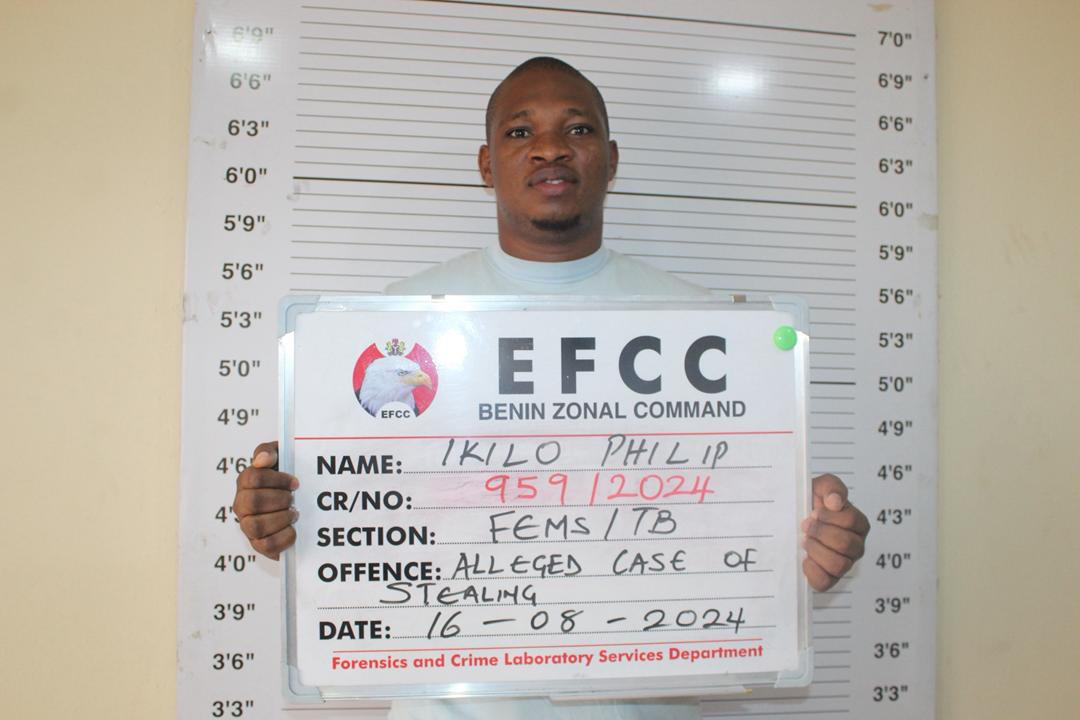
One Mr Osamudiamen Philip Ikilo has been handed a two-year imprisonment for a Bitcoin fraud to the tune of $19,400.
He was found guilty and convicted of the crime by Justice W.I. Aziegbemhin of the Edo State High Court sitting in Benin City, the state capital.
Delivering the judgment on Monday, March 23, 2026, the judge sentenced Mr Ikilo to two years’ imprisonment without an option of fine.
The convict got into trouble when he offered to assist his victim, Ms Cynthia Imade Alile, to convert her 0.52092582 Bitcoin worth $19,400, but failed to remit the money after the conversion.
Ms Alile petitioned the Economic and Financial Crimes Commission (EFCC), which looked into the matter and brought him before the court for prosecution on a one-count charge of stealing.
“That you Osamudiamen Philip Ikilo (m) sometime in March 2024 within the jurisdiction of this court did steal Bitcoin worth the sum of $19,400 belonging to one Cynthia Imade Alile by fraudulently converting the said sum to your use, and thereby committed an offence contrary to Section 287 of the Criminal Law of Edo State Law 2022 and punishable under Section 294 of the same Law,” the charge read.
When the charge was read to him during arraignment by the EFCC, the defendant pleaded not guilty, setting the stage for trial.
In the course of the trial, prosecution counsel, A. S. Bala-Ribah, called two witnesses and also tendered documents which were admitted by the court. On his part, the defendant called two witnesses, including himself.

By Adedapo Adesanya
Justice Emeka Nwite of the Federal High Court in Abuja has affirmed the final forfeiture of $13 million linked to a Lagos socialite, Ms Aisha Achimugu, and her company, Oceangate Engineering Oil & Gas Limited, to the federal government of Nigeria.
Delivering judgment, Justice Nwite held that the Economic and Financial Crimes Commission (EFCC) established that the foreign currency was proceeds of fraud and unlawful activities.
The judge further held that Oceangate Engineering Oil & Gas Limited failed to establish how it came by the money, saying the anti-money laundering agency satisfied all requirements for the funds to be classified as proceeds of fraud and to be forfeited to the appropriate authority.
He dismissed the claims that the $13 million was gifts received into the Oceangate Engineering Company by Ms Achimugu, adding that the woman never came to the court to show cause why the huge amount of money should not be forfeited to the government.
He held that no single person who gave the monetary gift to Aisha Achimugu to the tune of $13 million was called to testify.
The judge further held that the burden to establish genuine ownership of the money was not established by the applicant to counter the claims of the anti- graft agency that the money was the proceeds of fraud based on its investigation.
According to the judge, Oceangate Engineering Company did not show the business it undertook that fetched it the money, nor did it show whether any payment was made to it by any of its customers.
Justice Nwite had, on August 22, 2025, granted the anti-graft agency’s motion ex parte for an interim order forfeiting the sum of $13 million linked to Oceangate Ltd to the Federal Government over allegations that the fund was proceeds of unlawful activity.
The judge had then directed the commission to publish the order in a national daily for interested people to show cause within 14 days why the fund should not be permanently forfeited to the federal government.
By Adedapo Adesanya
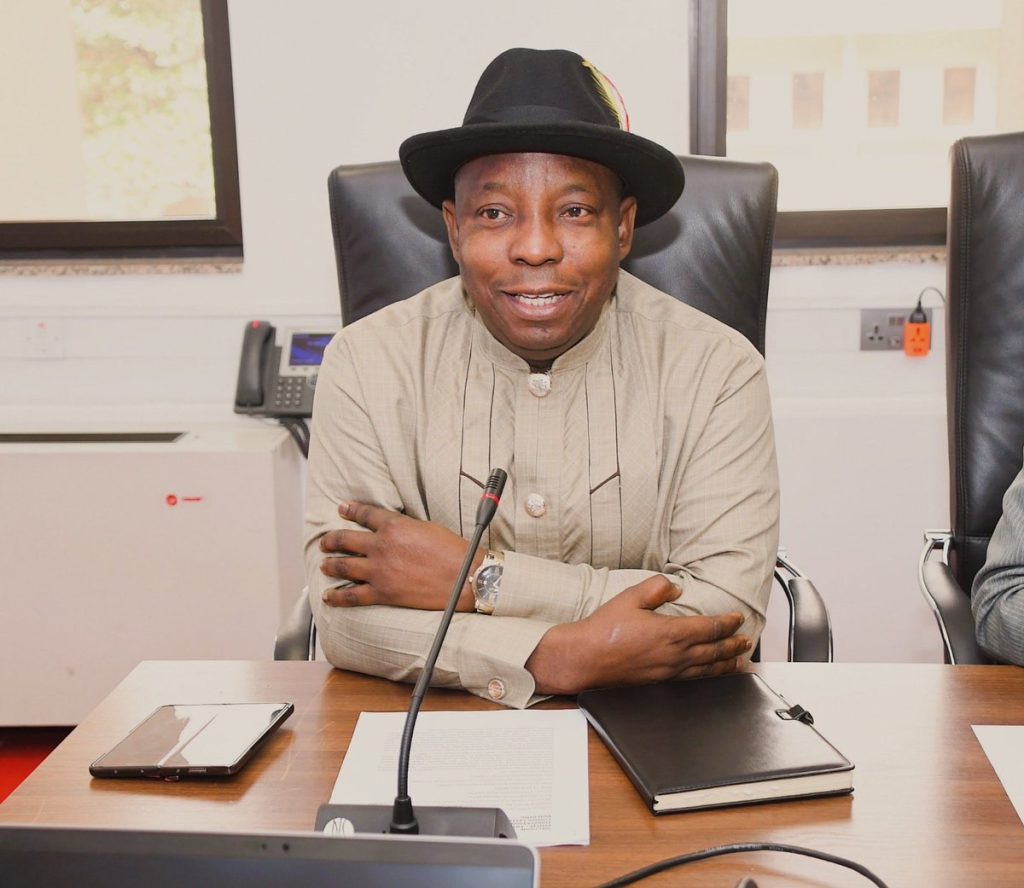
The federal government has inaugurated a 17-member Planning Committee to coordinate the National Flag-Off of the Energise Commercialisation Now (ECoN) Initiative, a flagship programme aimed at transforming research outputs into economic value.
Speaking at the inauguration in Abuja, the Permanent Secretary of the Ministry of Innovation, Science and Technology, Mr Philip Ndiomu Ebiogeh, described the initiative as a strategic intervention to convert Nigeria’s vast research and innovation outputs into market-ready products, scalable enterprises, and job-creating opportunities.
He noted that ECoN will mobilise stakeholders nationwide to identify bankable innovations and accelerate their transition from laboratories to the marketplace, stressing that the country must move beyond theoretical research to practical solutions that drive industrial growth and national prosperity.
The Permanent Secretary disclosed that the Minister of Innovation, Science and Technology, Mr Kingsley Tochukwu Udeh, had earlier briefed the First Lady, Mrs Oluremi Tinubu, on the initiative and proposed her as a champion of the programme, with the national flag-off scheduled for Kano State.
He explained that Kano was deliberately selected due to its historic role as a commercial and industrial hub, offering strong potential to attract investment, stimulate enterprise, and create jobs.
The Committee is chaired by the Minister, with the Permanent Secretary as Co-Chairman, while the Director-General, National Biotechnology Research and Development Agency, NBRDA, and the Director-General, Sheda Science and Technology Complex, SHESTCO, serve as Alternate Chairmen.
Members include Professor Nnayelugo Ike-Muonso, Dr Kazeem Kolawole Raji, Dr Jummai Adamu, Dr (Mrs) Obiageli Amadiobi, Dr Kabiru Mu’azu, Dr Anwal Mustapha, Engr Ibiam Oguejiofo, Mr Moses Fatogun, Mr Adamu Sulaiman (a representative of SMEDAN), Dr Prince Lawrence Eze, Mr Sani Garba, Dr Muhammad Mustapha, Dr Chioma Okeke, Mr Luther Onyemkpa, Mr Charles Egumgbe, and Dr Nwankwo Nnenna serving as Secretary.
The national flag-off is proposed for late April or early May 2026, subject to Presidential approval.
The Ministry reaffirmed its commitment to positioning innovation as a key driver of economic diversification and sustainable development, in line with President Bola Tinubu’s Renewed Hope Agenda.









-
 Feature/OPED6 years ago
Davos was Different this year
-
Travel/Tourism10 years ago
Lagos Seals Western Lodge Hotel In Ikorodu
-

 Showbiz3 years ago
Estranged Lover Releases Videos of Empress Njamah Bathing
-
 Banking8 years ago
Sort Codes of GTBank Branches in Nigeria
-

 Economy3 years ago
Subsidy Removal: CNG at N130 Per Litre Cheaper Than Petrol—IPMAN
-

 Banking3 years ago
Sort Codes of UBA Branches in Nigeria
-

 Banking3 years ago
First Bank Announces Planned Downtime
-

 Sports3 years ago
Highest Paid Nigerian Footballer – How Much Do Nigerian Footballers Earn