Connect with us

General

SON Lagos Laboratory Centre Begins Operations March 2018

Published

on

By Dipo Olowookere

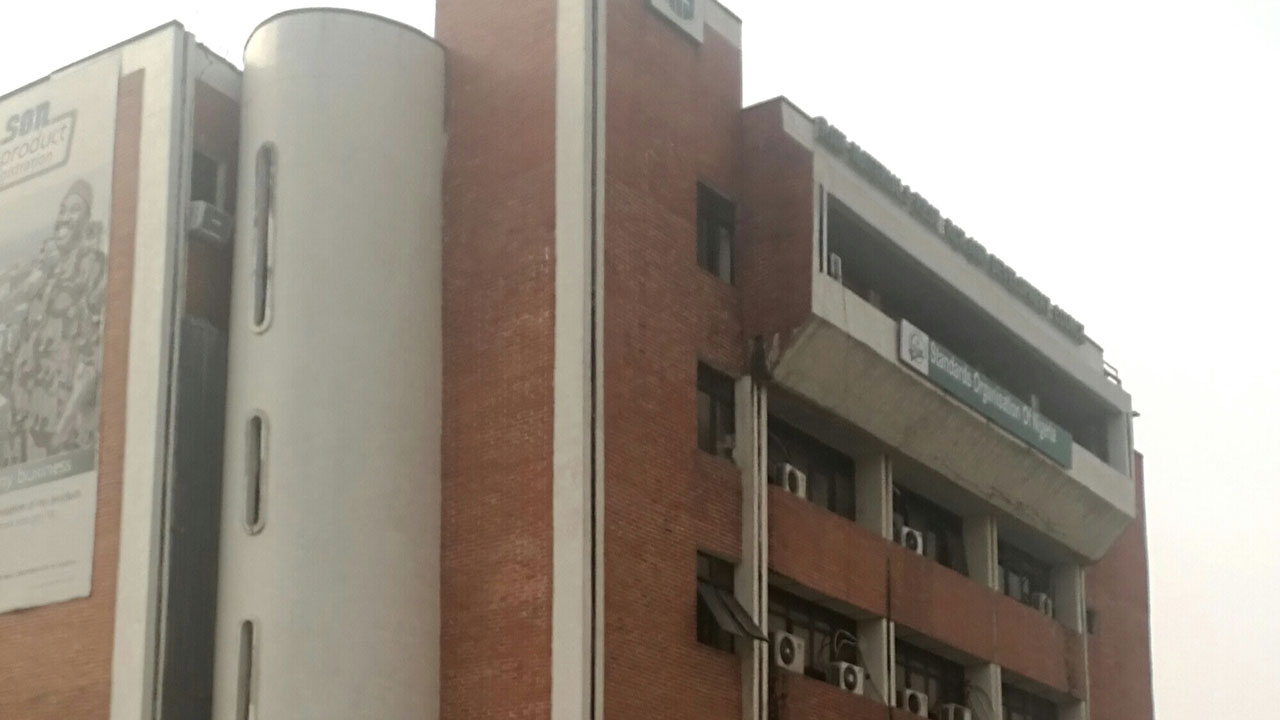
The laboratory centre of the Standard Organisation of Nigeria (SON) in the Ogba area of Lagos State should begin full operations by March this year.

Chairman of the House of Representative Committee on Industry, Mr Abubakar Moriki, made this known when his 8-man team inspected the project, which is 95 percent completed.

Touring the four-storey complex, which includes refrigerator testing chamber, food microbiology, food data processing unit, among others, the lawmaker said full operation should begin by March.

He commended the spate of construction and equipping, noting that observation of the laboratory complex will form the basis for the provision of facilities to jump start operations.

Mr Moriki, who praised the Director-General of SON, Mr Osita Aboloma, explained that the inspection was necessary to ascertain the depth of implementation of 2017 budget in preparation for the passing of the 2018 appropriation bill.

“Towards the tail end of 2016, we were here and the project was at an appreciable level of completion though the equipment were not installed and positioned in their respective offices.

“Now in 2018 and in the process of considering the appropriation for SON, it is necessary to come and visit the facility and see other places where they are conducting their operations,” he said.

The lawmaker further urged the DG to ensure strategic distribution of the testing equipment across regional laboratories to avoid concentration in a locale.

“We should be looking forward to seeing many of these testing equipment separated all over, not necessarily concentrated on one location. It is a service you provide to all industries,” Mr Moriki told the SON boss.

Welcoming the delegates, Mr Aboloma said the organisation was deeply committed to realising the country’s goal of standardisation both locally and internationally.

He said the laboratory has also been designed to accommodate standardisation needs of the West African sub-region.

Mr Aboloma said analysis of locally made cement components and products for instance will no longer be a challenge as the chemical and tensile test analysis laboratory should be operational shortly, to certify strength of compression and other parameters shortly, thereby limiting the risks of building collapse.

He noted that the next phase of laboratories infrastructure will be spread to the regions beginning with Northeast, Southeast and Southwest.

“We have been looking forward to this visit because you are our major advisers. We are open minded and open for change. We are open to anything that would add value to the work we do.

“This laboratory has been accredited to ensure that anything certified in Nigeria will be acceptable all over the world,” he said.

Patrick Aisowieren, Micky Kazzim, Sam Onuigbo, Ahmad Kalambaina, Mohammed Ibrahim, Baderinwa Bamidele and Yusuf Buba were other members of the inspecting team.


Dipo Olowookere is a journalist based in Nigeria that has passion for reporting business news stories. At his leisure time, he watches football and supports 3SC of Ibadan. Mr Olowookere can be reached via [email protected]

Click to comment

Leave a Reply

Your email address will not be published. Required fields are marked *

General

Navy Intercepts 92,660 Litres of Illegally Refined Diesel in Rivers

Published

on

Illegally Refined Diesel

By Adedapo Adesanya

The Nigerian Navy has recorded another breakthrough in its campaign against crude oil theft and illegal refining in the Niger Delta, recovering 92,660 litres of suspected illegally refined Automotive Gas Oil (AGO), commonly known as diesel, along the Rivers-Bayelsa border.

The recovery was made under Operation Delta Sentinel following intelligence reports that led personnel of the Nigerian Navy Ship (NNS) SOROH to the Okolomade community in Abua-Odual Local Government Area of Rivers State.

According to a statement issued by the Director of Naval Information, Captain Abiodun Folorunsho, aerial surveillance and follow-up search operations uncovered about 138 sacks containing suspected illegally refined diesel. The products were reportedly hidden beneath thick vegetation and at several concealed locations along adjoining waterways.

The maritime force said the discovery highlights the evolving tactics being adopted by illegal petroleum operators, who increasingly use remote creek corridors and hidden storage points to evade detection by security agencies.

Mr Folorunsho noted that the recovered products were handled in line with existing regulatory procedures, effectively preventing them from being distributed through illegal channels.

He stated that the operation forms part of ongoing efforts to dismantle networks involved in crude oil theft, illegal refining and unauthorised petroleum distribution across the Niger Delta. Solid minerals reports

“The operation demonstrates our continued commitment to intelligence-driven actions aimed at disrupting economic sabotage and protecting Nigeria’s critical oil and gas assets,” the statement said.

The latest recovery adds to a series of recent successes recorded by security agencies in the region as authorities intensify efforts to curb oil theft, protect national revenue, improve environmental security in oil-producing communities and help the Nigerian economy

The Nigerian Navy reaffirmed its resolve to sustain surveillance and enforcement operations across the Niger Delta, stressing that collaboration with local communities and timely intelligence remain critical to combating illegal petroleum activities.

Continue Reading

General

Nigerian Telco Operators Reject NBS Telecom Foreign Investment Figures

Published

on

nigerian Telco Operators

By Adedapo Adesanya

Nigerian telecommunication operators, under the Association of Licensed Telecommunications Operators of Nigeria (ALTON), have disputed capital importation data released by the National Bureau of Statistics (NBS), insisting it underrepresents the sector’s total investment, which they put at N2.13 trillion in capital expenditure in 2025.

The stats office in the Nigerian Capital Importation data for the first quarter of 2026, released last Friday, said foreign investment in the telecom sector fell 91 per cent to $7.24 million from $80.78 million in 2025.

In a statement issued on Monday, jointly signed by ALTON’s Chairman, Mr Gbenga Adebayo, and Publicity Secretary, Mr Damian Udeh, the group said it welcomed the NBS report but stressed that the data needed a broader context to properly reflect sector dynamics.

“While we recognise the importance of accurate data in shaping investor perceptions and guiding policy decisions, we believe that additional context regarding the telecommunications sector’s current investment landscape will provide stakeholders with a more comprehensive understanding of the industry’s health and trajectory,” ALTON stated.

The telco operators argued that although the report shows a decline in foreign capital importation from $80.78 million in 2025 to $7.24 million in the first three months of 2026, the figures capture only a portion of total capital deployed in the sector.

The statement noted that the industry’s capital expenditure profile suggests investment is increasingly being driven by domestic capital sources and reinvested earnings, financial mechanisms that may not be fully captured in traditional capital importation data.

“The sector’s recovery is reflected in sustained capital deployment. In 2025, mobile network operators, tower companies, and other players in the sector recorded a total capital expenditure of N2.13tn, with a planned capital expenditure of N1.86tn for 2026, directed towards network infrastructure expansion,” the association said.

According to ALTON, the investment momentum reflects the impact of policy support measures, including a 50 per cent tariff increase approved in 2025 by the federal government.

ALTON said the tariff adjustment in January 2025 played a pivotal role in stabilising the telecoms sector, addressing critical revenue sustainability gaps, and restoring operational viability during a particularly challenging period.

It added that operators have since moved from financial distress toward a more sustainable investment cycle, with continued capital deployment into network infrastructure.

The group warned that the gap between official foreign inflows and actual sector spending highlights limitations in how telecom investment is currently measured.

“This disparity between reported foreign capital inflows and actual infrastructure investment highlights a gap in how sectoral capital deployment is currently measured and reported,” ALTON said.

It then called for a joint framework involving the Nigerian Communications Commission (NCC), the NBS, and the Central Bank of Nigeria (CBN) to improve tracking of telecom investment flows.

Continue Reading

General

FCCPC Denies Approval of New Airtime Credit Operators

Published

on

FCCPC

By Adedapo Adesanya

The Federal Competition and Consumer Protection Commission (FCCPC) has dismissed reports claiming that President Bola Tinubu has approved the entry of nine new operators into Nigeria’s airtime credit market, insisting it had no knowledge of, or involvement in, such claims.

In a statement issued by its Director of Corporate Affairs, Mr Ondaje Ijagwu, the commission described the reports as inaccurate, stressing that it did not submit any list of Fintech companies to the presidency for approval as part of reforms in the sector.

The reports, which circulated in several national newspapers (excluding Business Post), alleged that the President endorsed proposals by the FCCPC to restructure the airtime credit market and approved a number of Nigerian financial technology firms to operate within the space.

However, the agency clarified that the regulatory framework under which such approvals were reportedly granted remains suspended, following a court order.

Mr Ijagwu explained that the implementation of the DEON Consumer Lending Regulations 2025 was halted after an interim injunction was issued by the Federal High Court in Lagos on April 15, 2026.

The case was instituted by the Wireless Application Service Providers Association of Nigeria (WASPA), which challenged aspects of the regulation and secured a judicial restraint pending the determination of the substantive suit.

The FCCPC said as a law-abiding institution, it remains bound by the court’s directive and cannot enforce or act on the suspended framework until the matter is resolved.

Reacting to the development, WASPA also raised concerns about how approvals could be granted under a regulatory regime that is currently under judicial review and administrative suspension.

The controversy has left unanswered questions about the origin of the reports, which included detailed policy proposals and named specific companies allegedly cleared to operate in the sector. The case is scheduled for further hearing on July 20, 2026.

This newspaper reports that with the suspension, lending services such as Globacom’s Borrow Me Credit and Airtel airtime advances have been restored, allowing subscribers to get airtime or data during emergencies or temporary cash shortages. Meanwhile, MTN has yet to restart the service.

Continue Reading

Trending