General
Survey Establishes Renewed Youth Optimism in Africa
By Adedapo Adesanya
The African Youth Survey 2020 has revealed a rising “Afro-optimism” among youths in Africa driven by a strong sense of individual responsibility, a post-colonial mindset, entrepreneurialism and confidence in a shared African identity.
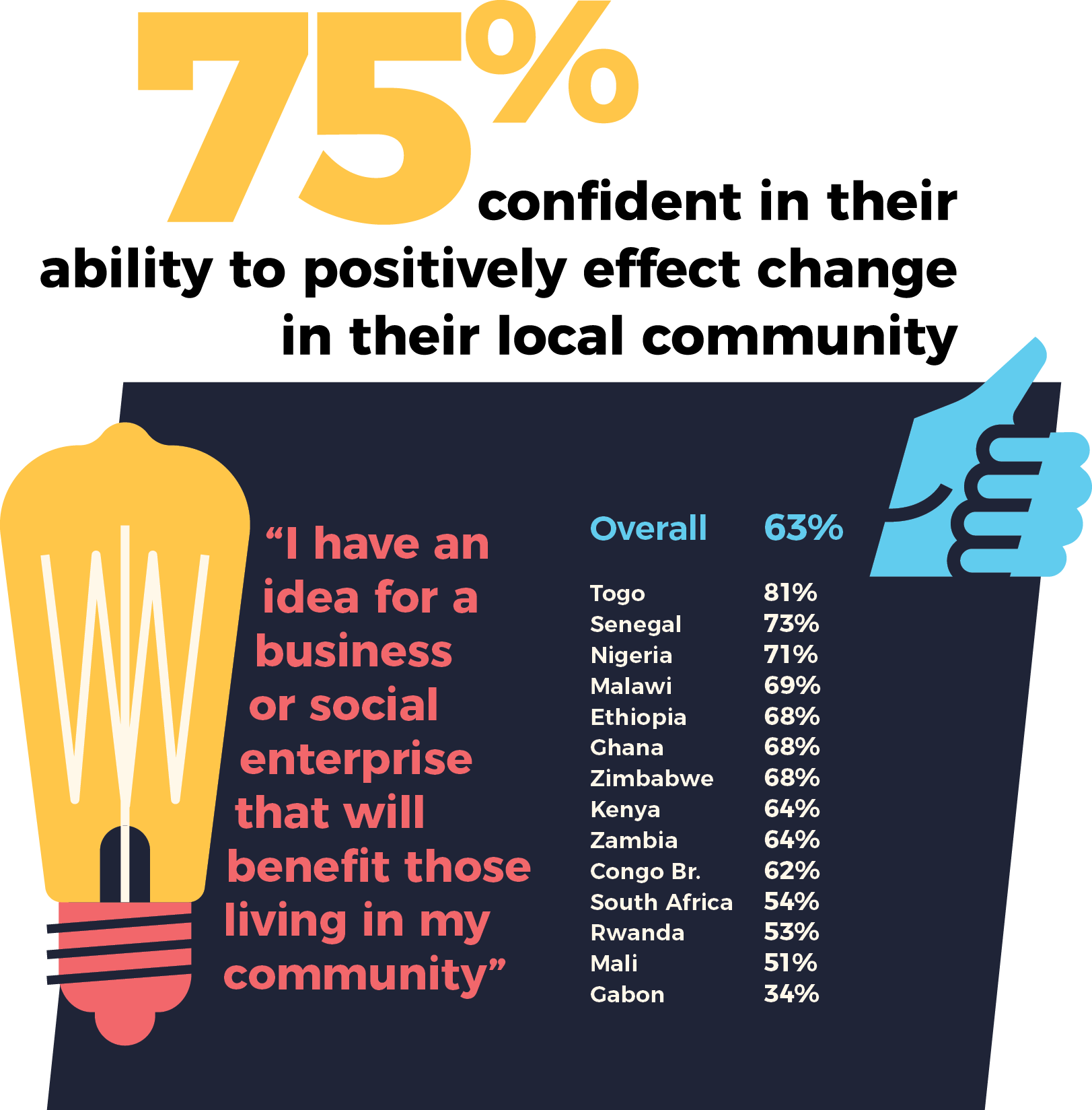
Conducted across 14 African countries, it was discovered that Africa’s youth believe they can solve problems collaboratively and are hopeful of fighting corruption, achieving peace and improving their personal living conditions.
These new findings contradict global stereotypes and outdated narratives that see Africa as a hopeless continent. The survey was conducted by the Ichikowitz Family Foundation, a leading African foundation encouraging active citizenship across the continent in collaboration with Transatlantic polling firm, PSB Research.
The survey revealed that young people who are self-starters, pan-African, digital and media savvy, tolerant were mindful of the challenges that could affect their ‘African Century’, such as corruption, the lack of new jobs, limited start-up capital, water scarcity, fake news, terrorism and poor education systems.
They were asked their opinions on their identity as Africans; on social cohesion in their communities, on the environment; on political stability and democracy; on foreign relations; on entrepreneurship; technology and the media; and, their views of the future.
According to the Ichikowitz Family Foundation chairman, Mr Ivor Ichikowitz, this was a wake up for Afro-sceptics.
He said, “We have found that youth in Africa are imbued with optimism about the future – and want to shape their own destiny. We have found a youth that refuses to shy away from the very real challenges of Africa, that is honest about what needs to be done and what their role has to be to achieve this – and they are overwhelmingly keen to make that difference.
“The Afro-optimism that’s flourishing among young Africans does not rest on hope, but on their ability to seize the opportunities provided by the modern world. The findings underscore entrepreneurship as the greatest aspiration of African youth, who are embracing digital technologies to shape their futures.
“If there were ever doubt in the ‘Africa-Rise’ narrative, this research provides us with strong evidence that Africa’s time is here, and that it will continue to rise – carried forward by a new generation of innovative, responsible and confident leaders.’
Another contributor to the report, a former President of South Africa, Mr Kgalema Motlanthe, said, “I am encouraged by the youth of Africa’s common vision of a pan-African identity; of a love of their fellows that transcends colour, creed, class or nationality; and, of their commitment to fight the corruption. I am immensely heartened too by their Afro-optimism, underscored by their belief in Afro-capability.
“We have much work to do if we are to stand a very real chance of making the dream of the African Century a reality for our people, but this survey shows that in our youth, we have the very best chance yet, which truly is something to celebrate, to encourage and to look forward to.”
According to the survey, it was discovered that African youths were thriving in entrepreneurship, technology, media, climate change, community cohesion and African Identity, though there was less optimism in areas such as environment, African unity, democratic values, foreign relations, and see infectious disease and terrorism as the continent’s two biggest threats of the last five years, but were optimism of a future defined by job opportunities, innovation and entrepreneurship, but bedevilled by corruption.
Congo Brazzaville, Ethiopia, Gabon, Ghana, Kenya, Malawi, Mali, Nigeria, Rwanda, Senegal, South Africa, Togo, Zambia and Zimbabwe – were some of the country’s surveyed with a total of 4,200 in-depth, face-to-face interviews conducted.
General
IFC, Norfund Back Nigeria’s Mini-Grid Expansion with $83.2m Funding
By Adedapo Adesanya
The World Bank’s financing arm, the International Finance Corporation (IFC), and the Norwegian investment fund (Norfund) have committed up to $83.2 million to expand solar hybrid mini-grids across Nigeria, in a move expected to connect nearly half a million new users to electricity.
The funding will support five renewable energy companies, Darway Coast Nigeria Limited, GVE Projects Limited, Prado Power Limited, PriVida Power Limited and StarTimes Energy, to build 315 mini-grid sites across underserved communities.
The projects are projected to deliver about 494,189 new electricity connections. Renewable energy solutions
IFC says the intervention is aimed at closing Nigeria’s massive electricity gap, noting that more than 85 million people in the country still live without access to power.
The institution said expanding distributed renewable energy will not only improve electricity access but also cut energy costs and support small businesses in rural areas.
According to IFC, “By supporting distributed renewable energy solutions, this initiative will help expand access to reliable electricity while reducing energy costs, strengthening local economies, and enabling income-generating activities.”
For operators already working in the sector, the new funding is expected to speed up expansion plans.
The chief executive of Darway Coast Nigeria Limited, Mr Henry Ureh, said the support will allow companies to scale faster and reach more communities that have remained off the national grid for years.
“Access to reliable electricity allows us to expand our operations, support local businesses, and create jobs in the communities we serve,” he said.
Nigeria’s off-grid power space has been growing steadily, but access remains uneven. Data from the Africa Solar Industry Association shows that the country currently has over 4.8 gigawatts of installed solar capacity, but only about 115 megawatts come from mini-grids serving rural communities.
The IFC has been one of the biggest institutional backers of this segment. Last year, it announced a separate $16 million financing package for Nigerian developer Virtuitis to build 97 mini-grids expected to serve over 140,000 off-grid consumers by 2027, showing a steady increase in international interest in decentralised power solutions.
With grid supply still unreliable in many parts of the country, mini-grids are increasingly becoming the most practical solution for rural electrification as they supply adequate but limited power for limited power consumption.
For many communities, the impact goes beyond electricity. Reliable power is expected to support trading activities, agro-processing, small manufacturing and education, all of which have struggled under years of unstable supply. But operators also warn that sustained policy support and stable regulation will be key to scaling beyond pilot-level projects.
As deployment begins across the 315 sites, observers are keen on understanding how quickly these projects can move from funding to actual connections to where they are needed.
General
Oyo Introduces Daily Environmental Sanitation
By Aduragbemi Omiyale
As part of efforts to ensure a cleaner and healthier environment, a daily environmental sanitation monitoring and enforcement system has been introduced by the Oyo State government.
At a press briefing to mark his first 100 days in office, the Commissioner for Environment and Natural Resources, Mr Ademola Aderinto, explained that the government has shifted from the traditional monthly environmental sanitation exercise to a more proactive system that encourages residents to take responsibility for maintaining cleanliness on a daily basis.
He noted that this approach is being reinforced by continuous monitoring and enforcement by environmental health officers
“We are now enforcing daily environmental sanitation. Our officers are on the field every day to ensure compliance, and cleanliness must become a daily responsibility,” he stated.
According to him, to strengthen operations, the government has re-engaged 930 Environmental Vanguards, sweepers, and waste packers, while also procuring two brand new compactor trucks with the support of Governor Seyi Makinde to enhance waste evacuation.
Highlighting the ministry’s achievements, the Commissioner said the ministry has expanded its impact through strategic workforce deployment and innovation, adding that the 930 Environmental Personnel has been structured to improve enforcement and sanitation coverage.
Mr Aderinto hinted that with sweepers now operating twice daily to ensure cleaner roads across the state, while also benefiting from enrolment in the Oyo State Health Insurance Scheme.
The ministry also launched the Oyo Soro Soke (Oyo SSS) Environmental Whistleblower platform accessible via mobile applications and WhatsApp, empowering residents to report environmental violations and promote community participation in environmental governance.
In addition, the ministry strengthened operational capacity by introducing a first-of-its-kind waste segregation system across government offices, and initiated Public-Private Partnerships for the construction of modern public toilets.
The Commissioner expressed gratitude to the Governor for the opportunity to serve, assuring that the confidence reposed in him will not be misplaced, also appreciating members of the Executive Council for their strong inter-ministerial collaboration, as well as the Permanent Secretary, Dr Sunday Ojelabi, for his support.
Highlighting other achievements, he noted improved media engagement by the Ministry, with regular press briefings and public advisories on issues such as flooding, heat waves, cholera, and Lassa fever.
The Commissioner added that the Ministry has regulated charcoal production through a structured framework, commemorated World Earth Day with tree planting, intensified efforts to end open defecation, and strengthened interventions against diseases through inspections and environmental monitoring.
Reaffirming his commitment, Mr Aderinto assured residents that the Ministry will sustain and build on these gains, saying, “The future of our environment in Oyo State is bright. What we have achieved in 100 days is only the beginning.”
General
Petrol Station Owners Urge Domestic Gas Utilisation
By Adedapo Adesanya
The Petroleum Products Retail Outlets Owners Association of Nigeria (PETROAN) has urged the Nigerian Upstream Petroleum Regulatory Commission (NUPRC) to prioritise policies that promote domestic gas utilisation.
The association recommended that NUPRC strengthen measures to ensure price stability and long-term energy security for Nigerians, as indicated in a statement by its national public relations officer, Mr Joseph Obele.
The call comes alongside PETROAN’s commendation of the choice of Mr Magnus Abe as NUPRC Board chairman.
PETROAN national president, Dr Billy Gillis-Harry, cited Mr Abe’s prior roles as a National Assembly lawmaker, Secretary to the Rivers State Government, and former board member of the Nigerian National Petroleum Company (NNPC) Limited, meaning he has extensive knowledge of Nigeria’s oil and gas sector and its operational dynamics.
PETROAN also lauded NUPRC’s collaboration with the Nigeria LNG Limited (NLNG), which has committed 100 per cent of its LPG production to the domestic market.
Mr Gillis-Harry projected that this would reduce cooking gas prices and other gas-based products soon.
The association highlighted NUPRC’s efforts to remove regulatory bottlenecks, improve ease of doing business, and sustain stakeholder engagement to meet rising domestic gas demand and shield the market from global volatility.
PETROAN emphasises that a stable upstream sector will have far-reaching benefits across the petroleum value chain, including enhanced product availability, reduced energy costs, job creation, and overall economic growth, stating it would support policies and reforms in Nigeria’s petroleum industry.
Other PETROAN recommendations included sustaining regulatory reforms, accelerating gas infrastructure and distribution networks to ensure efficient delivery of gas to end-users nationwide; continuous and structured stakeholder engagement to promote transparency, policy consistency, and industry-wide collaboration; and maintaining structured stakeholder engagement.
It also urged collaborating with the Nigerian Midstream and Downstream Petroleum Regulatory Authority (NMDPRA) to activate government-owned refineries, expressing confidence in Abe’s leadership and reiterated its support for policies fostering a competitive and transparent petroleum industry.
-
Feature/OPED6 years agoDavos was Different this year
-
Travel/Tourism10 years ago
Lagos Seals Western Lodge Hotel In Ikorodu
-
Showbiz3 years agoEstranged Lover Releases Videos of Empress Njamah Bathing
-
Banking8 years agoSort Codes of GTBank Branches in Nigeria
-
Economy3 years agoSubsidy Removal: CNG at N130 Per Litre Cheaper Than Petrol—IPMAN
-
Banking3 years agoSort Codes of UBA Branches in Nigeria
-
Banking3 years agoFirst Bank Announces Planned Downtime
-
Sports3 years agoHighest Paid Nigerian Footballer – How Much Do Nigerian Footballers Earn