General
What is the Difference between Level 1 and Level 2 Background Check
We meet people at various facets of life and people do not have halos or horns on their head for you to ascertain if they are good or bad.
If you are under an impression that someone’s social media platform will have all requisite information about them, you will be proven extremely wrong.
A lot of online crimes have been crafted with the assistance of social media profiles as well. The social media profiles cannot be trusted with the accuracy and legitimacy of information you see, which is why a dbs check can be essential for verifying identities and safeguarding against fraud.
So, what is the best source to know someone’s background information or run a background check on someone? If you are new to the procedures of background check, you must know that there are evidently two levels of a background check. Here, we will know all about them.
Difference Between Level 1 Background Check and Level 2 Background Check
Background check on someone is mostly needed as a pre-employment procedure. Now, the levels of background checks vary when it comes to the position on which the person is being hired.
The kind of background check you would do for someone at a very high position will be different and more extensive than what you would do for a person at a lower position or for an operational role.

To start with the Level 1 of Background Check, it implies to not only run a background check on someone within a particular state but also less deep than you may need to know. When it comes to Level 2 of Background Check, check searches exceed the state limit for disqualifying offenses.
The Level 2 goes deeper and accesses almost all relevant resources and there is extensive detailed digging up of information. More reliable and verified sources are used for such background checks.
You can learn more about level 2 background check and what information it entails to provide about the person under question. The Level 1 background is more superficial in nature and Level 2 check is more extensive and elaborate.
Running Background Checks through CocoFinder
Even if you want to run a background check on someone for personal purposes or for professional reasons, CocoFinder is the best and most trusted resort to do so. There are multiple ways through which you can run a background check on someone.
In a surprisingly prompt and quick manner, you can attain all sorts of information about the person under question. The search is extensive and data obtained are only from verified sources. When it comes to the authenticity of data, you can trust CocoFinder blindly with it.
Check Background from Name
Even if you want to just run a Level 1 background check on someone, you can just check their background based on their first and last name. If you also know their state of residence, the results will narrow down further for you.
Check Background from Phone Number
In addition to having someone’s name, if you also have their phone number, the search results will be more specific. Thus having the phone number gives further shape and purpose to your search.
Check Background from Address
If you also are aware of the address or the Street name or other vague details of a person’s residence, you can attain their information based upon that data. The data will be more concrete and precise.
How to Check Someone’s Background
There is no technological prowess or intense understanding that you need to develop for the background check. The beauty of a platform like CocoFinder is its simplicity. It is extremely simple to use and its dashboard and user interface has been designed to make it more user friendly.
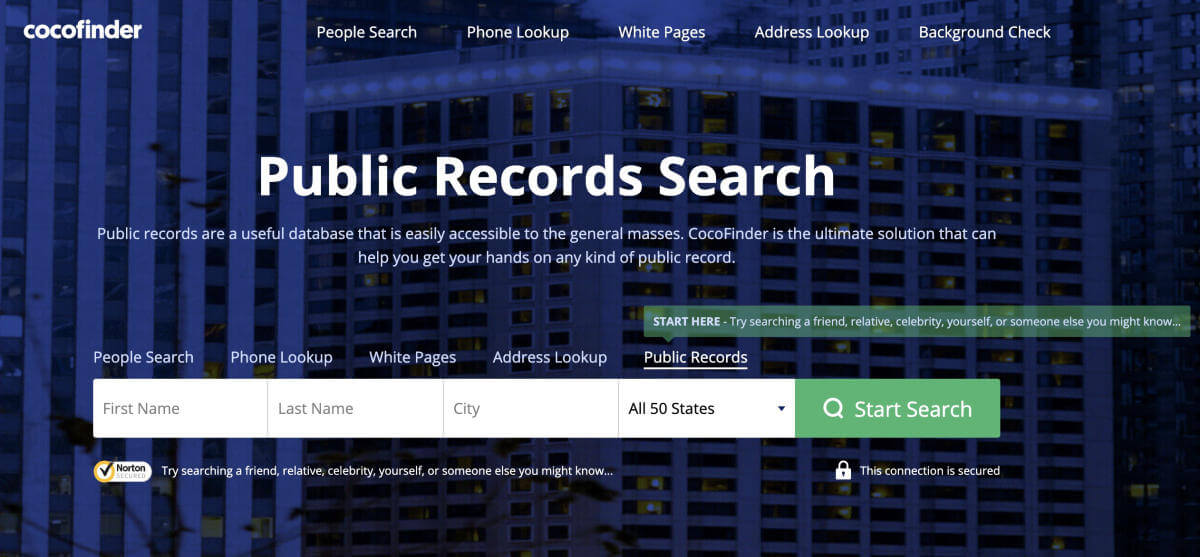
The process of background check can begin when you visit the CocoFinder web page and then look for the tab ‘search now’. In the search now column, you just need to enter all the information that you have about the person under question.
The results that will be generated will be curated as per the information and data that you have shared about such a person. As mentioned above, you can get a lot of information about a person prominently through their name, phone number, address and even their email.
The authenticity of the data retrieved from CocoFinder is extremely accurate and authentic. The details obtained will be unquestionably perfect and trusted upon. You can back upon the legitimate sources from which CocoFinder curates and presents the user data.
The record time in which CocoFinder attains user information is surprisingly quick. There is no lag in information and data retrieval. Other web-based applications of this nature take eons to extract relevant data. The wait time literally tests the patience of the users.
Why CocoFinder is the best
The minimalist structure of CocoFinder’s dashboard is an attractive feature. It qualifies as an information source presenting the most reliable information. There are some other core features of CocoFinder that make it the most desirable background check website:
100% Authentic Details
The details and information that you extract from CocoFinder are the most authentic. This is because the database of the website extracts information from only verified pages. The authentication and integrity of information are never compromised.
Instant Results
CocoFinder provides immediate results. There is no delay at all in information retrieval and information can be extracted almost instantaneously. There is absolutely no delay caused by virtue of buffering.
Multiplicity of Records
CocoFinder could turn out to be your one-stop-shop with respect to detail extraction. You can ascertain multi-faceted information and multiple kinds of documents of one single person. All details of one individual in one place.
Conclusion
With CocoFinder you can tick off almost all levels of background checks that you want. If you want to learn more about Level 1 or learn more about level 2 background check, you can know everything about someone from one sole platform.
CocoFinder is the best possible fact-finding platform that you can find online. It has every information and detail that is imperative for you to have a conclusive background check.
General
How Airports Can Reduce Ground Emissions Before Full Infrastructure Upgrades
Airport sustainability is no longer a separate environmental project. It is becoming part of daily operational planning, procurement, infrastructure development, and airline partnership discussions. For many airports, the main pressure is to reduce emissions on the ground, improve airside efficiency, and prepare for stricter environmental expectations, while continuing to support aircraft reliably every day.
The challenge is that infrastructure does not change overnight.
Full electrification remains an important direction for aviation ground operations. Fixed 400 Hz power, electric ground support equipment, charging infrastructure, energy management systems, and cleaner stand concepts are all part of the future airport. But in practical terms, many airports are still working through phased investment plans. Grid capacity may be limited. Charging points may not yet cover all operational areas. Remote stands, maintenance zones, cargo aprons, and temporary operating areas may still depend on mobile equipment.
This is where the sustainability conversation needs to become more realistic.
Airports do not have to wait for a complete infrastructure transformation before reducing emissions. There are practical steps that can be taken now, especially in aircraft ground power. The key is to look at emissions reduction as a staged process, not a single final destination.
One of the first areas to assess is the age and efficiency of existing diesel ground power units. In many operations, older GPUs continue to provide essential support because they are mobile, familiar, and independent from fixed power systems. But older diesel platforms may no longer fit the expectations of modern airport sustainability strategies. They can become harder to justify in procurement discussions, environmental reporting, and long-term fleet planning.
Replacing outdated diesel equipment with lower-emission alternatives can be a meaningful step. A modern diesel GPU with Stage V / Tier 4 Final engine technology, for example, can help operators reduce the environmental impact of ground power while keeping the operational independence that many stands and service areas still require. This does not replace the need for electrification. It helps bridge the gap while infrastructure continues to develop.
That bridge matters because airside operations are rarely uniform.
A major hub may have fixed power at many contact stands, but still rely on mobile GPUs for remote aircraft positions, maintenance activities, irregular operations, or construction phases. A regional airport may not yet have the capital or grid capacity for large-scale electrification. An MRO facility may need mobile power that can move between aircraft, hangars, and outdoor working areas. A ground handler may need equipment that supports mixed aircraft types under high turnaround pressure.
For these environments, sustainability must work in real conditions. A solution that looks good in a strategy document but does not support the daily operating model will not last.
Decision-makers should therefore evaluate aircraft ground power through several practical questions. Where is fixed power available today? Where is it planned next? Which stands still require mobile equipment? How many hours do diesel GPUs operate per day? Which aircraft types are supported? Are units oversized, outdated, or difficult to position? Is the equipment aligned with current emissions standards? Can it support cleaner operation where grid power is available?
These questions often reveal that the best path is not a single equipment choice, but a balanced fleet strategy.
Fixed power should be used where infrastructure is mature and operationally reliable. Battery-powered equipment can be introduced where duty cycles, charging plans, and climate conditions are suitable. Lower-emission diesel and plug-in hybrid ground power units can support areas where independence, runtime, and flexibility remain critical. Together, these solutions allow airports to reduce emissions without weakening operational resilience.
Plug-in hybrid utility power functionality is especially relevant in this transition phase. When external utility power is available, the unit can operate with reduced fuel use. When it is not available, the same equipment can continue supporting aircraft independently. This gives airports and operators more flexibility as infrastructure develops stand by stand, rather than forcing a complete change before the airside environment is ready.
Compact design also plays a role in sustainable operations. Airports often focus on emissions, but space efficiency is part of the same discussion. Crowded aprons create movement challenges, increase operational friction, and affect safety. A compact mobile GPU that provides the required output without adding unnecessary equipment bulk can support cleaner, more organized, and more efficient aircraft servicing.
This is why modern ground power procurement should not be based only on output figures. Power rating matters, but so do emissions performance, footprint, maneuverability, serviceability, spare parts strategy, operating environment, and fit with future infrastructure plans. Airports need equipment that can serve today’s operation while remaining relevant as sustainability expectations continue to rise.
For a deeper look at how this transition applies to aircraft ground power, ElectroAir has outlined its view on lower-emission ground power and the practical role of modern mobile GPUs in supporting airport sustainability before full electrification is possible. The company’s ElectroAir APA-100 is one example of this approach, combining compact mobile design, Stage V / Tier 4 Final engine technology, and optional plug-in hybrid utility power for operators that need both reliability and a more future-conscious path.
The next stage of airport sustainability will be built through practical progress. Some changes will come from major infrastructure investment. Others will come from better equipment decisions, smarter fleet planning, and the replacement of outdated assets with more efficient alternatives.
For airports, the priority is not to choose between today’s operation and tomorrow’s goals. The priority is to connect them. Ground power is one of the places where that connection can already begin.
General
PFIPC Probe: ICPC Recommends Adeyemi’s Prosecution
By Adedapo Adesanya
The Independent Corrupt Practices and Other Related Offences Commission (ICPC) has submitted an interim report to President Bola Tinubu on its investigation into the alleged fictitious Presidential Foreign Investment Promotion Council (PFIPC), recommending the prosecution of its alleged Director-General, Mr Adeniyi Adeyemi.
ICPC’s Chairman, Mr Musa Aliyu, disclosed this after meeting President Tinubu at the Presidential Villa, Abuja, exactly 30 days after his agency was directed to conduct a thorough investigation into the PFIPC.
According to Mr Aliyu, preliminary findings revealed that the federal government never appointed Adeyemi and that the purported appointment letter, gazette and other documents used to establish the agency were forged.
The case centres on an alleged corruption and forgery scandal involving the disputed government entity, PFIPC, which was not approved.
Speaking at the State House, Mr Aliyu said the commission’s investigation established that Mr Adeyemi was never appointed by the Federal Government and that the documents used to legitimise the agency were forged.
The ICPC boss said the investigation also revealed significant weaknesses in government verification and oversight processes, which were exploited to create the impression that the PFIPC was a legitimate government agency.
“Our interim report found that there are weaknesses in verification, inter-agency oversight and government processes. We discovered that those weaknesses were exploited by Adeniyi, with some level of negligence.
“Our investigation found that no Federal Government funds were approved or disbursed to the fake PFIPC/PEAC,” the ICPC chairman stated.
According to him, investigators also uncovered two additional agencies allegedly created by Adeyemi, the FCT Investment Promotion Agency (FIFA) and the Foreign Investment Promotion Agency and Public Private Partnership (PIPA-PPP).
Mr Aliyu said the disputed DG “used forged legislative instruments styled as enabling acts, and used them to support opening of bank accounts.”
The ICPC chairman said the commission recommended Adeyemi’s prosecution, administrative sanctions against public officers whose negligence enabled the operation of the fake agency, and institutional reforms to strengthen internal controls across Ministries, Departments and Agencies (MDAs).
“Our recommendation is that Mr Adeniyi Adeyemi should be prosecuted. Administrative sanctions should also be imposed on public officers whose acts of omission and negligence facilitated the illegal operation of PFIPC/PEAC.
“There is also a need for institutional reforms so that the internal controls of MDAs can be strengthened to prevent this kind of illegal activity,” he stated.
The chief investigator noted that the report submitted to the President is only an interim one, adding that investigations are continuing to identify other collaborators and build a stronger criminal case.
“We have continued with the investigation of the activities of Mr Adeniyi Adeyemi and his collaborators so that we can unravel more facts and file criminal charges that can stand the test of time before a court of competent jurisdiction,” he said.
The PFIPC scandal came to light after the Presidency disowned the council, describing it as a non-existent government agency despite its appearance in the 2026 Appropriation Act with a N1.3 billion budget allocation.
The federal government has since filed criminal charges against Mr Adeyemi over allegations including forgery, impersonation and fraudulent misrepresentation, while separate investigations by the House of Representatives and the ICPC continue into how the fake agency operated within government institutions.
General
Work-From-Home Parents: Practical Ways to Manage Focus and Infant Care
Remote work has expanded opportunities for many households, but it has also blurred the boundary between professional focus and caregiving. Parents juggling calls, deadlines, and newborn needs often look for supervised soothing tools that create short, predictable windows of calm. A well-chosen baby swing chair can help during those windows—especially when used safely, briefly, and as a complement to responsive holding rather than a replacement for it.
This article outlines practical routines for work-from-home families, safety basics for infant seating, and how to protect both productivity and parental wellbeing.
Design Work Blocks Around Real Baby Rhythms
Instead of forcing an office-style schedule, map your day to wake windows and feeds. Place deep-focus tasks in the most reliable calm periods. Keep shallow tasks for unpredictable stretches. A short supervised swing session after a feed and cuddle can sometimes create ten to twenty minutes for email triage or meeting prep.
Safety First With Any Soothing Seat
- Use only for awake, supervised time.
- Follow age and weight limits precisely.
- Secure harnesses every session.
- If your baby falls asleep, move them to a firm, flat sleep surface when practical.
- Keep the area clear of cords and soft clutter.
Choose Features That Support Real Homes
Look for smooth motion, easy cleaning, stable bases, and settings you can adjust as preferences change. Product options such as the Momcozy CocoSway 3D-Motion Electric Baby Swing are often discussed for multidirectional motion that resembles parental swaying, but the best choice is still the one that matches your baby’s cues and your home layout.
Protect Caregiver Bandwidth
Tag-team with a partner when possible. Batch chores. Use noise-canceling headphones carefully so you can still monitor your baby. Remember that needing tools does not mean you are less attentive—it means you are designing a sustainable system.
FAQ
Can a swing replace holding during work hours?
No. Holding and responsive care remain essential. A swing is a short, supervised helper.
How long should sessions last?
Keep sessions brief and watch comfort cues. Follow product guidance and stay nearby.
Conclusion
Work-from-home parenting works best with flexible blocks, clear safety habits, and realistic expectations. Used thoughtfully, a baby swing chair can support calm transitions while you protect both focus and connection.
Over weeks, refine what works: preferred motion speed, best meeting times, and shared rules with partners or helpers. Revisit the setup after growth spurts and schedule changes. The goal is not perfect productivity; it is a home rhythm where infant comfort and caregiver capacity can coexist. Keep notes, stay flexible, and treat equipment as support rather than a scorecard. When plans slip—as they will—return to fundamentals: feed, comfort, closeness, then supervised motion if needed. That sequence keeps both work and care more humane. Communicate boundaries with colleagues when possible, and protect recovery time after demanding days. Small systems compound: a consistent afternoon reset, a clear harness checklist, and a shared calendar of feeds can reduce friction more than any single gadget. In the end, sustainable remote parenting is less about doing everything and more about designing a few reliable loops that leave room for love, rest, and enough professional progress to keep life moving forward.