General
Zenith Bank, Police Abandon Wife, 7 Kids of Brave Cop



By Dipo Olowookere
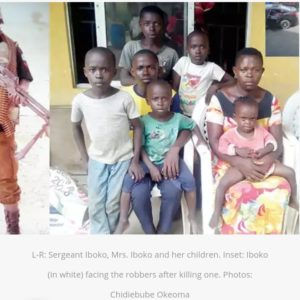
Wife of Sergeant Chukwudi Iboko, the super cop captured to have killed a robber in the in a viral video showing a robbery attack at a branch of Zenith Bank in Owerri, Imo State, has accused the Nigeria Police and the financial institution of neglecting her and her seven children.
The women, Mrs Rose Iboko, a housewife, told Punch in an interview last Friday that she and her children have been left to suffer in penury after the death of their breadwinner.
She told Punch that one of her eight kids even died on the day her husband was buried in March 2017, a month after the robbery incident happened.
Here is the story by Punch:
Her grief is palpable. One only needs to cast a glance at Mrs. Rose Iboko to decipher that the anguish of losing her husband has taken a toll on her. This is unmistakable in her gait, talks and looks.
Iboko is the wife of Sergeant Chukwudi Iboko, the brave policeman, who died after engaging a gang of four robbers who trailed a customer to the Wetheral Road branch of Zenith Bank in Owerri, Imo State, on February 22, 2017, in a shootout.
Though the incident happened four months ago, the video of the encounter, captured by the bank’s CCTV, has gone viral, with many saluting the rare valour displayed by the cop to the detriment of his life.
Our reporter went to Amakohia in the Ihitte Uboma Local Government Area of the state, where the widow resides with her seven children.
She broke down in tears when the incident leading to the death of her husband became the discourse.
The 32-year-old mother could not take her eyes off the portrait of her late husband in police uniform placed at a strategic point in the living room surrounded by walls whose painting had seen better days.
She tenderly held a copy of Saturday PUNCH which used a screenshot of the robbery, with her husband’s unclear face showing him in action as he boldly killed one of the robbers before his (robber’s) colleagues shot at him.
As she narrated how life took a turn for the worst for her and her seven surviving kids after the death of her husband, she constantly wiped her tears with the back of her hand so her kids would not notice her distraught state.
SUNDAY PUNCH noticed that her children not only skip meals, but are out of school as a result of the inability of their mother to pay their tuition fees.
Her first son, Favour, who is 16, cried profusely when asked the last time he spoke with his father before his death.
He said amid sobs, “I spoke with daddy two days before his death. He died on Thursday, but had promised to come home for the weekend. He promised to give me money for some textbooks I needed once he arrived. But he couldn’t fulfil his promise as he died two days to the day he promised to come home.’’
Asked if he would like to be a police officer, Favour said his dream was to be a medical doctor and that his father promised to help him realise his dream. But his immediate younger brother said he would follow in his father’s career path.
The teenager told SUNDAY PUNCH that he loved the way his father worked as a cop which made him fall in love with the profession.
Our correspondent, who on Friday visited the Zenith Bank branch where the robbery took place in February, saw a police officer in mufti with some security men patrolling the bank’s premises.
Commercial activities were in full force with no traces showing that it was on the bank’s premises that Iboko lost his life a few months ago. Banking activities were paralysed in Owerri in 2009 when robbers hit banks in the Imo State capital.
Two eyewitnesses told our correspondent that the February robbery was a swift one. According to Ike and Promise, who didn’t give their surnames, the gunmen, who arrived in a car, went straight to their target and robbed him of his money. They said nobody knew that they were criminals until gunshots rent the air.
They added that it was when the policemen in the bank started exchanging gunshots that they knew danger loomed and everybody ran for their lives.
One of the surviving police officers said he would have died if he had not moved to the back room from the security post a few minutes before the robbers arrived.
According to the police officer, Iboko and another policeman, identified as Sunday Agbor, died as a result of the gunshot injuries they sustained during the shootout.
He added that another police officer, Otu Itan, lost an eye to the incident.
Meanwhile, two suspects — Justice Ogbenna, aka JJ; and Okechukwu Onwuamaegbu, were arrested in April in Aba, Abia State, by the police in connection with the robbery.
Two AK-47 rifles, seven magazines and 127 pieces of live ammunition were recovered from them. Ogbenna, said to be the gang leader, was arrested on the day he was to bury his late father.
One of my triplets slumped, died when he saw his father’s corpse — Iboko’s wife
Can you please tell us about yourself?
I am Mrs Rose Iboko, wife of the late Sergeant Chukwudi Iboko, the policeman who died as a result of the gunshot injuries he sustained in a shootout with armed robbers at the Wetheral Road branch of Zenith Bank on February 22, 2017. We are from Etitiulo community in the Bende Local Government Area of Abia State, but we live in Amakohia in Ihitte Uboma Local Government Area of Imo State. I am 32 years old.
What can you say about your family?
My late husband was from the same community with me. I am a housewife, while my husband was the breadwinner. I was only taking care of the home and our kids.
When did he die?
He died the next day after the incident on Thursday. Before I could arrive in Mopol 18 office in Owerri, my husband was already dead. It was in the office of the officer in charge of the unit that I was told that my husband was dead. I was, however, not allowed to see his corpse. I was only able to see his corpse for the first time during his burial in the village when his remains were laid to rest. That was almost one month after his death. He was 37 years old.
When did you see him last and what did you discuss?
I saw my husband last, four days before his death. It was on February 19. He came home for the weekend to inform his children and I that he had got a new posting to work as a security officer in a bank. I never thought that it would be the last time we would see, talk and hold each other.
He also told his children that he would be visiting the next weekend to bring them foodstuff and money for the upkeep of the family, especially for their textbooks. He was just three days old in the bank before the robbery which claimed his life. He resumed at the bank on Monday, the bank robbery took place on Wednesday, and he died on Thursday before I could even arrive in Owerri.
Were you aware that he sacrificed his life to save that of others on the premises of the bank that day?
Yes, I am very aware. I was not surprised that he confronted them because he was a combatant, committed and patriotic cop. My only regret was that his death was untimely, leaving me to cater for our children alone. He was in Yobe State for a special mission during the upsurge of Boko Haram attacks in the North.
He was also on special missions in Kano and Plateau states and he fought gallantly. One thing about him was that he was committed to his job. He loved his job and derived joy in saving lives.
What did you do when you learnt of his demise?
It was one of his colleagues who called me on a Thursday morning to tell me that my husband was shot by armed robbers the previous day. I don’t know the person but he spoke to me in a manner that suggested that all was not well. He didn’t tell me that my husband was dead. He only informed me that my husband was shot by armed robbers a day before that day. It was when I arrived in Mopol 18 that I was told that my husband, whom I spoke with on the phone on Tuesday prior to that day, was dead. I couldn’t believe it. I told them to stop the joke but they insisted that he was dead. It was as if my world had crumbled. Several thoughts came to my mind within a few minutes: “Where do I begin? How do I explain what happened to him to his children, especially our last child, Success, who was fond of him? Where do I go from here?”
What do you tell the children anytime they ask after their father?
I have eight children for him; seven boys and a girl, Success, who I earlier said is the last born. We have triplets; all boys, but sadly, one of them, Chukwuebuka, slumped and died the day their father’s remains were to be interred. He slumped immediately he saw his dad’s corpse during his lying-in-state and died.
It was a double tragedy for my family that day. He was very close to his father.
Despite being just five years, he couldn’t bear the loss of his loving father. Most of my children know that their father is dead, only the young ones are yet to comprehend what happened. I keep telling those ones anytime they ask after him that he is on a special assignment and would be back soon. But each time I lie to them, I would go into the room and weep profusely because when they ask for his whereabouts, I also recall the great moments we shared.
How have you been coping with the kids without their father?
It has been hell for me since he died. The children dropped out of school because I could no longer pay their school fees. I don’t work, I am a house wife. His sudden death was an agonising loss to my family. To eat is now a problem. Most times, we don’t eat and when we eat, it is half food. Last night (Friday), we took groundnuts as dinner. It has been very difficult for us. We now live from hand to mouth. We always go to bed hungry without knowing where the next meal will come from.
Has the Nigeria Police Force reached out to you to support your family?
Not at all. They only came for his burial in the village on Friday, March 17, 2017. I am now left with my children alone.
What assistance has the bank rendered to you knowing that your husband died in the course of protecting its assets and customers?
The bank only assisted me in making sure that he was buried. After that, no help has come from the bank.
What kind of husband and father was he?
My late husband was a combat-ready police officer. He loved his job with a huge passion. I was not surprised that he engaged the robbers in a gun duel because he was committed to what he did. As a husband, he was a caring one. He was a role model to his children. He loved me and his children so much. Whenever he came home on weekends to see us, he would buy foodstuff and all we needed.
His family was first in all he did. He was close to the last child who is also the only girl. It was in the process of looking for a girl child that I had many children. He used to carry her about anytime he was at home. He never beat me for once. Whenever we had issues, we settled them inside our home amicably without anybody knowing that we had disagreements. He was everything I desired in a man. He was caring, romantic and responsible. He was equally God-fearing. He was a member of Jesus Deliverance Bible Church in Amakohia. He took us along to anywhere he was transferred to.
Tell me about your last conversation with him?
We spoke last the Tuesday preceding that robbery. I called him to complain to him about his children’s stubbornness. You know how children behave at times? I told him about their attitude because he had more influence over them than me as a woman. He immediately asked me to give the phone to the boys and reprimanded them. He told them to behave well and that he would buy something for them on the way home for the weekend.
They boys quickly obeyed. I also told him about the textbooks of his first son, Favour, and he promised to give him the money on his return on Saturday. I didn’t know that it would be our last discussion. What a world! As if he knew he was going to die, before he left for his new posting to the bank, he called all his children on Sunday and told them to be good children. His words were full of wisdom. He asked them not to look for trouble. When he was leaving on Monday, we all said goodbye to him without knowing that it was the last time we would see him.
How did you meet?
We met in our village. I told you we came from the same village. We grew up together. He knew me when I was a young girl and from there, he liked me and later proposed marriage to me. We got married in 1999 and even as of that time, I was young. He was not a policeman then. He became a police officer few years after our wedding. He was nice and hard working. Honestly, I miss him. Tears are my companion every night. I have yet to come to terms with his demise.
Would you allow any of your children to join the police considering how their father died?
I wouldn’t stop any of my children who wants to be a police officer. As a matter of fact, our second child, Wisdom, who is 13, always told his father that he wanted to be a cop in future. The choice is entirely that of any child who chooses that. I will only pray for the child not to die untimely like his father.
Do you have any regrets that he was a policeman?
I have no regrets that my husband was a policeman because it was what he loved. I am proud of my late husband as a police officer. My only regret is that he died young without fulfilling his dreams and goals.
What do you want Nigerians to do for his family, especially as many saluted his courage?
I want government and Nigerians to help me support the education of our children and to take care of us. I want them to please do for his kids, the things he would have done for them as a father if he were alive. I am jobless.
What were the things he planned to do which death did not allow him to realise?
He had an uncompleted building project in the village. He was building a bungalow. I am not sure I know where I will take my children to whenever we visit the village. He promised to train them up to the university level. He pledged that he would assist Favour to realise his dream to study medicine. But death didn’t allow him to fulfil any of them.
Where are his parents and how did they receive the news of his death?
My husband’s father is dead and his mother, Mrs Maria Iboko, is seriously sick, owing to the shock she suffered upon hearing the news of her son’s death. My husband was her second child and the family’s breadwinner. She is almost 80 years old. My mother is currently down with stroke. She could not bear the news. She was fond of my husband.
We are at the mercy of a landlord, he wants his rent. We owe 15-months, rent and that is about N180,000. I want the good people of Nigeria to come to our aid before we are thrown out of the apartment.
Source: Punch