Health
COVID-19: Lagos Reactivates Restrictions, Use of Face Masks
By Modupe Gbadeyanka
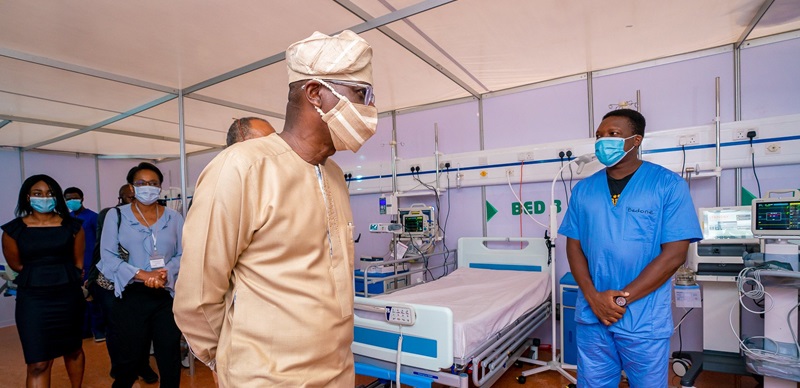
The Lagos State government has reactivated restrictions in order to avert a possible third wave of Coronavirus (COVID-19) pandemic.
The Governor of the state, Mr Babajide Sanwo-Olu, said this has become necessary following a sharp increase in the number of positive cases of the virus recorded in the last few weeks.
In a statement issued on Sunday night, Mr Sanwo-Olu blamed in-bound travellers for the rising cases of COVID-19, noting that they have been defaulting isolation protocols and that henceforth, anyone caught would face prosecution, sanctions and imprisonment.
According to him, in the last one week, the state’s daily cases of COVID-19 confirmation has shot up to 6.6 per cent, lamenting that it is due to the careless attitude of air passengers from countries in the “high risk” zones and the complacency by the residents to follow the protective protocols issued by the Government after the end of the second wave.
Sanwo-Olu disclosed that 18 per cent of 50,322 air passengers of interest, who arrived in Lagos via the Murtala Mohammed International Airport (MMIA) could not be reached for COVID-19 status monitoring by EKOTELEMED because they supplied wrong contact details.
Going forward, the Governor ordered sanctioning of in-bound air passengers that failed to provide verifiable contact details, including accessible phone numbers they can be reached for monitoring.
He said air passengers would face prosecution, including fines and imprisonment in line with the Lagos State Coronavirus Law of 2021.
“In spite of our hard work and dedicated efforts towards sustaining the return to normalcy, over the last three months, after the flattened the curve of the second wave of COVID-19 pandemic, we are now finding ourselves at what appears to be the start of a potential third wave of the pandemic in Lagos State. From the beginning of July, we started to experience a steep increase in the number of daily confirmed cases.
“The rapid increase within a week gives great cause for concern. Also, within the last two weeks, the occupancy rate at our isolation centres increased to an average of six per cent.
“This is the disturbing reality that now confronts us. As directed by the Presidential Steering Committee on COVID-19 (PSC), passengers from red-listed countries (India, South Africa, Brazil and Turkey) are required to observe mandatory isolation.
“We have successfully isolated 2,386 passengers in Lagos. Of this number, 15 per cent have absconded. Sanctions are being recommended and have already been meted out to defaulters.
“Revocation of Permanent Residency and deportation are being meted out to foreign nationals defaulting the protocols. For Nigerians, there will be prosecution to the full extent of the Lagos State COVID-19 Law of 2021,” he said.
The situation at hand, Mr Sanwo-Olu said, required reactivation of full compliance with all protective protocols already outlined by the state government.
The Governor said there should be compulsory use of masks in all public places, while also directing social distancing, compulsory temperature checks, provisions for hand-washing and sanitisers, and a maximum of 50 per cent occupancy in enclosed spaces.
He urged worship centres to be particularly vigilant, advising them not to be carried away by the illusion that all activities were back to normal.
“It is understandable that many are tired and want their old, pre-pandemic lives to return. Unfortunately, we do not have a choice in this regard, and fatigue is not an option. We cannot afford to be tired, frustrated or distracted. Without the cooperation of the public at large, we stand the risks of losing both lives and livelihood, on a devastating scale.
“The enemy (COVID-19) is formidable and opportunistic. The pandemic will only go as far as we allow it. Having triumphed over the first and second waves, we must now find within ourselves new reserves of energy to quell this emerging third wave before it snowballs out of control,” Mr Sanwo-Olu said.
The Governor decried the low vaccination rate in the State, pointing out that only a fraction of the populace received the recommended doses of the AstraZeneca vaccine being rolled out to achieve herd immunity.
This, he said, is not adequate, adding that the State Government was exploring all avenues possible to ramp up access to vaccines to reach the immunity target of 60 per cent coverage.
Mr Sanwo-Olu said Lagos would continue to work with all partners across the Government and private institutions to ensure permanent isolation of the virus.
Health
NARD Suspends Indefinite Strike, Gives FG Fresh Two-Week Ultimatum
By Adedapo Adesanya
The Nigerian Association of Resident Doctors (NARD) has suspended its planned nationwide indefinite strike, granting the federal government a two-week ultimatum to address lingering welfare issues affecting resident doctors across the country.
The decision was taken after an emergency meeting of the association’s National Executive Council on Tuesday, where members reviewed assurances from government representatives and resolved to give dialogue another chance.
NARD said the suspension was informed by “progress made” in negotiations, particularly commitments on the prompt payment of salary arrears, hazard allowances, and steps toward resolving issues surrounding the Medical Residency Training Fund.
The association did not declare a full resolution of the dispute. It noted that the government had shown “renewed willingness” to address the concerns that triggered the strike threat.
The association noted that while these engagements signalled a willingness by the government to resolve the dispute, several critical issues remain outstanding, particularly the delayed payment of promotion arrears, salary arrears, the 2026 Medical Residency Training Fund (MRTF), and the backlog of 19 months’ professional allowance arrears owed to resident doctors.
It also expressed concern over the Federal Government’s decision to halt the implementation of the reviewed PAT, which had earlier triggered widespread dissatisfaction among its members and raised fears of disruption to healthcare services nationwide.
Despite these unresolved issues, NARD said it opted to suspend the strike as a demonstration of goodwill and commitment to ongoing dialogue, while giving the government a two-week window to take concrete, measurable and verifiable steps to meet its demands.
The association insisted on the immediate reversal of the decision affecting the PAT, payment of all outstanding arrears, prompt disbursement of the MRTF, and full settlement of the accumulated professional allowance backlog.
It warned that it would reconvene at the expiration of the ultimatum to assess the level of compliance and determine its next course of action, adding that failure by the government to meet its demands within the stipulated timeframe would result in the resumption of the suspended strike without further notice.
NARD also called on its members nationwide to remain calm, united and resolute, while urging the Federal Government to act swiftly to prevent a potential crisis in the health sector.
The association further appreciated the interventions of the Vice President and other stakeholders, expressing hope that their involvement would lead to the timely resolution of the dispute and help sustain healthcare delivery across the country.
Health
Jacaranda Gets Funds to Expand Affordable Maternal Healthcare in Kenya
By Modupe Gbadeyanka
To expand affordable healthcare in Kenya, Swedfund has invested about $600,000 into Jacaranda Health Limited (Jacaranda Maternity) to support innovations in neonatal intensive care and strengthen Jacaranda’s ability to provide life-saving services to underserved populations.
Jacaranda Maternity provides high-quality maternal health care at more affordable pricing than typical private providers, focusing on women in Nairobi’s low- and middle-income communities.
The new funding will support the opening of new hospitals, upgrading of neonatal care, and improvements to existing facilities.
Maternal and newborn health outcomes in Kenya remain a challenge, with maternal mortality still high despite improvements in skilled birth attendance.
Public health facilities play a central role but face capacity constraints, while access to reliable, quality care varies across regions and income groups.
Private healthcare providers offering essential maternity services at accessible price points can complement public provision.
Jacaranda Maternity aims to expand its network to six hospitals to achieve financial sustainability while scaling its impact. The healthcare provider is a recognised leader in promoting women’s health, with 71 percent of its staff being women, and a track record of effective environmental and social management.
“This investment will help Jacaranda Maternity provide life-saving care to more women and families while furthering Swedfund’s mission to promote inclusive and sustainable healthcare,” a Senior Investment Manager at Swedfund, Audrey Obara, said.
Health
Nigeria Secures $350,000 FAO Support to Tackle Rising Bird Flu
By Adedapo Adesanya
Nigeria will get a $350,000 intervention from the Food and Agriculture Organisation of the United Nations (FAO) to support its response to the ongoing outbreak of Highly Pathogenic Avian Influenza (bird flu) and strengthen the country’s animal health systems.
An agreement was reached on Wednesday during a strategic meeting between the Minister of Livestock Development, Mr Idi Mukhtar Maiha, and the FAO Representative to Nigeria and the Economic Community of West African States, Mr Hussein Gadain, in Abuja.
The intervention, approved under FAO’s Technical Cooperation Programme, will support disease containment efforts in 11 affected states and enhance surveillance, coordination and response mechanisms to prevent further spread of the disease.
Speaking during the meeting, Maiha said effective disease control remains critical to improving livestock productivity and protecting the livelihoods of farmers across the country.
He explained that factors such as drought, scarcity of feed, interaction between livestock and wildlife, as well as cross-border movement of animals have contributed to the spread of diseases in some areas.
“We must continue to strengthen our animal health systems and build the capacity required to respond effectively to disease outbreaks. Our collaboration with FAO will help protect livestock assets, improve productivity and support the broader transformation of the sector,” the minister said.
Mr Gadain commended the federal government’s commitment to the development of the livestock sector and assured that FAO would continue to provide technical support to Nigeria.
He stressed the need to strengthen veterinary services at the state and community levels, improve early detection of diseases and promote biosecurity practices among livestock farmers.
The meeting also reviewed progress on the global campaign to eradicate Peste des Petits Ruminants, a highly contagious disease that affects sheep and goats.
To advance the initiative, the ministry plans to convene a national technical meeting involving veterinary institutions, researchers and practitioners to review Nigeria’s eradication strategy and address gaps in vaccine supply.
As part of preparations, the ministry will engage the National Veterinary Research Institute to assess its vaccine production capacity while exploring other options for vaccine procurement to meet national demand.
Both parties also agreed to accelerate Nigeria’s access to financing under the Pandemic Fund through the One Health approach in collaboration with the Nigeria Centre for Disease Control and the Federal Ministry of Health to strengthen preparedness and response to zoonotic diseases.
Plans are also underway for the Director-General of FAO to participate in the Antimicrobial Resistance Conference scheduled for June 2026 in Abuja, where President Bola Tinubu is expected to be recognised as the African Champion for the eradication of Peste des Petits Ruminants.
The meeting further agreed to inaugurate a Livestock Donor Working Group to coordinate development partner support and advance key initiatives, including the development of a national feed and fodder strategy aimed at improving productivity and sustainability in the livestock sector.
-
Feature/OPED6 years agoDavos was Different this year
-
Travel/Tourism10 years ago
Lagos Seals Western Lodge Hotel In Ikorodu
-
Showbiz3 years agoEstranged Lover Releases Videos of Empress Njamah Bathing
-
Banking8 years agoSort Codes of GTBank Branches in Nigeria
-
Economy3 years agoSubsidy Removal: CNG at N130 Per Litre Cheaper Than Petrol—IPMAN
-
Banking3 years agoSort Codes of UBA Branches in Nigeria
-
Banking3 years agoFirst Bank Announces Planned Downtime
-
Sports3 years agoHighest Paid Nigerian Footballer – How Much Do Nigerian Footballers Earn