Media OutReach
Allianz Commercial: AI and cloud computing drive global construction boom for data centers
- Global spending on data centers is expected to reach several trillion US dollars by 2030 with the US and China as main drivers of growth.
- The surging demand for data centers has created a building boom, with costs for some construction projects exceeding $20 billion, say Allianz Commercial experts.
- Rapid expansion is heightening exposures and introducing new risks for companies and insurers.
SINGAPORE – Media OutReach Newswire – 6 November 2025 – The unseen forces of AI and cloud computing are never out of the news, yet behind the headlines lies a story of growth and innovation as tangible as bricks and mortar. The heavy computing power required by AI workloads, and the growing global demand for AI technologies, has seen a building boom take place around the world as developers scramble to build the facilities required to meet these needs. According to market research, up to $7 trillion will be spent on data centers by 2030 – a huge sum driven largely by technology companies in the US and China, while Europe lags a few paces behind. The tech industry’s big three, Amazon, Microsoft and Google Cloud, accounted for almost two-thirds of global cloud revenue in Q2 2025. Combined with Chinese companies such as Alibaba and Tencent, their capital expenditure budgets for 2025 reach hundreds of billions of US dollars, much of it geared towards the industrial scale infrastructure and dependable energy sources that high-performance AI and cloud computing now demands.
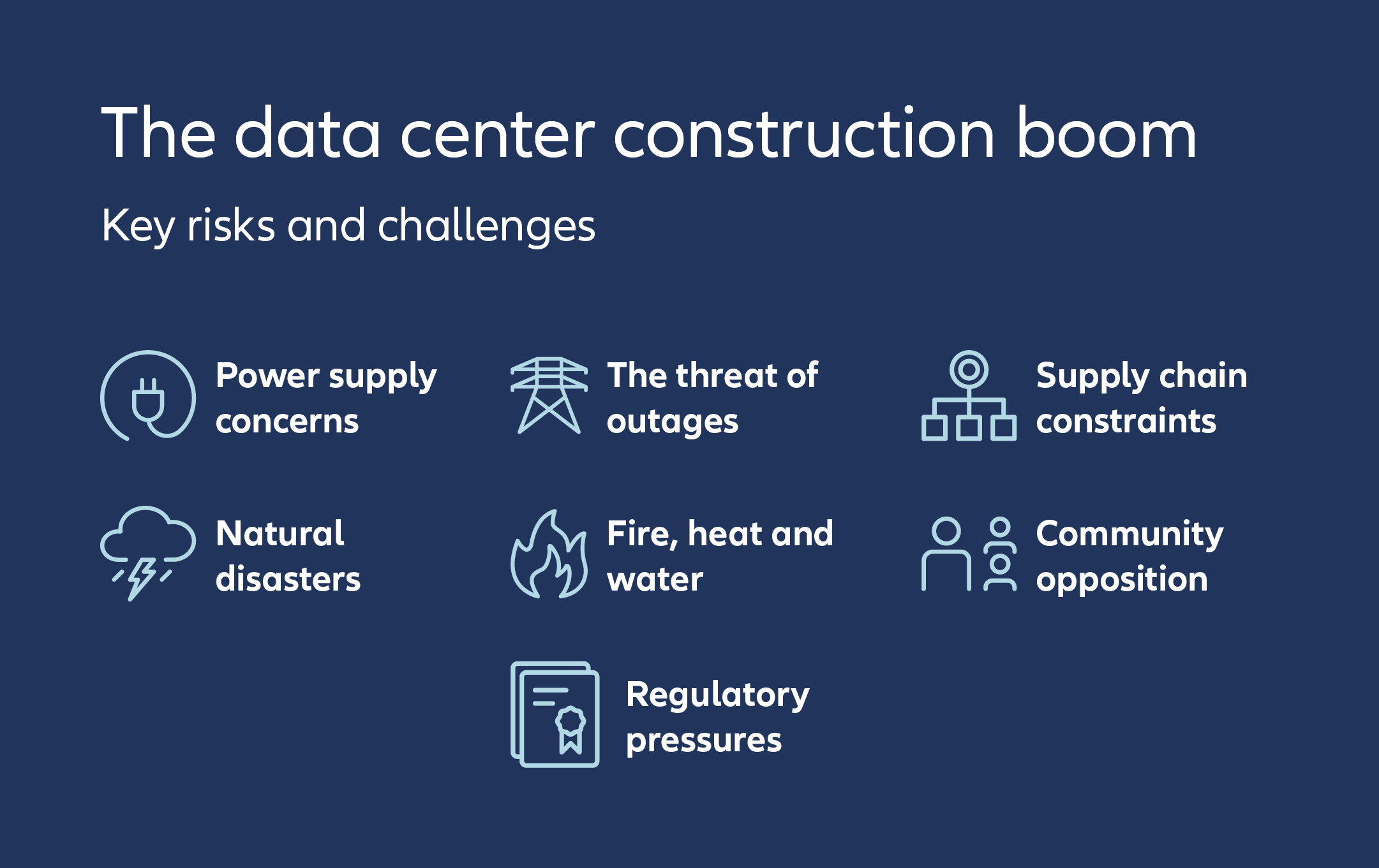
The latest Allianz Commercial report, The Data Center Construction Boom, explores the extent of this global buildout and also questions whether the building bonanza can last. Despite the ongoing expansion, several factors could limit future growth, including the surging costs of construction. These have escalated dramatically from $200-$300 million, to projects exceeding $20 billion. According to Allianz Commercial construction experts, average-sized facilities now cost between $500 million and $2 billion. Along with higher construction prices, the complex nature of data center construction and operation requires specialized insurance coverage for risks such as power supply concerns, faulty workmanship, fire or natural catastrophes.
“Construction projects as complex and extensive as data centers require significant time and resources. Typically, they require project-specific policies given their size and their unique risk profile that demands specialized insurance,” says Darren Tasker, Head of Construction, Americas, at Allianz Commercial.
Data centers are fueling the construction industry
A global buildout is underway to construct the infrastructure needed to support the digital economy. The US will be the largest market for data centers, covering about two thirds of the total global data center power demand with 81 gigawatts (GW) by 2028, while China’s data center market is building out equally aggressively. Greater Beijing alone now accounts for roughly 10% of global hyperscale capacity. Europe is trailing behind the two superpowers but is experiencing a 43% annual increase in pipeline activity, with London and Dublin as the largest markets (each with over 1GW capacity), followed by Amsterdam, Frankfurt, Paris, and Milan.
“The bigger data centers have a huge footprint. The scale of a $20bn+ facility can involve tens of thousands of workers on site at peak times, with significant equipment and building supplies moving in and out,” says Chris Fancher, US Head of Construction Property at Allianz Commercial. “Timings can be tight. This requires expert coordination, as any missteps or faulty workmanship can lead to potential losses or costly delays.”
Data centers combine great processing power with unique risk profile
Building a data center is a complex, multi-disciplinary undertaking, which presents a multitude of risks. One of the main issues is the soaring power demand that threatens to outpace grid capacity and infrastructure. The electricity demand from data centers worldwide is set to more than double by 2030, to around 945Twh. This is slightly more than the consumption of the whole of Japan today, with its population of 124 million. To avoid power issues, which are the main source of impactful outages with 45%, data center operators are increasingly seeking to reduce their reliance on the grid by generating their own power on site, including renewables, gas, and even potentially small nuclear reactors.
Fire, heat and water are also significant risks for data centers, potentially leading to severe property damage or business interruption losses. Lithium-ion batteries are increasingly being used in server racks in data halls. The fire risk associated with these batteries is well documented, particularly in relation to electric vehicles and charging infrastructure. Large data centers can consume up to 19 million liters of water a day, equivalent to the water use of a town with a population of up to 50,000. Increasing cooling requirements will drive up water and electricity demand, while rising global temperatures pose a growing risk to the resilience of over half the world’s top data center hubs. This has altered the risk profile of data centers and contributed to the increase in construction and insurance costs.
Risk management crucial with strong growth expected in Asia
The Asia Pacific region accounts for approximately 30% of global data center capacity and is expected to grow at a compound annual growth rate of 21% from 2024 to 2028, a faster pace compared to more developed markets. The region consists of multiple markets, each with distinct drivers and market conditions. China, Japan, and India account for 60% of the total installed capacity in the region, while markets like India, Malaysia, and Indonesia are expected to lead the next wave of growth.
Christian Sandric, Regional Managing Director of Allianz Commercial Asia, says, “As the demand for data centers in the region surges, it is crucial that parties fully understand the risks involved during construction and operation. Beyond the main risks such as power supply, rising construction costs and supply constraints, fire, and cooling requirements, parties also need to consider aspects such as cyberattacks, and impact on the surrounding environment, ecosystem, and infrastructure. For example, cooling systems may discharge heated water back into local water bodies, and this can raise temperatures and affect aquatic ecosystems.
“These complex and extensive risks call for specialist insurance and expert risk-management guidance, and clients need to work with an experienced team of underwriters who knows the business and can support the project from beginning to end, including multi-year coverage and policy extensions as needed.”
Hashtag: #Allianz #AllianzCommercial
https://commercial.allianz.com/
https://www.linkedin.com/company/allianz-commercial
The issuer is solely responsible for the content of this announcement.
About Allianz Commercial
Allianz Commercial is the center of expertise and global line of Allianz Group for insuring mid-sized businesses, large enterprises and specialist risks. Among our customers are the world’s largest consumer brands, financial institutions and industry players, the global aviation and shipping industry as well as family-owned and medium enterprises which are the backbone of the economy. We also cover unique risks such as offshore wind parks, infrastructure projects or film productions. Powered by the employees,
financial strength, and network of the world’s #1 insurance brand, we work together to help our customers prepare for what’s ahead: They trust us in providing a wide range of traditional and
alternative risk transfer solutions, outstanding
risk consulting and
Multinational services as well as seamless
claims handling. Allianz Commercial brings together the large corporate insurance business of Allianz Global Corporate & Specialty (AGCS) and the commercial insurance business of national Allianz Property & Casualty entities serving mid-sized companies. We are present in over 200 countries and territories either through our own teams or the Allianz Group network and partners. In 2024, the integrated business of Allianz Commercial generated around €18 billion in gross premium globally.
https://commercial.allianz.com/
Media OutReach
Siam Piwat redefines global retail with NEXTOPIA, a future prototype where sustainability is a transformative force for business, people, and the planet
Chief Executive Officer Chadatip Chutrakul introduced the project during The Economist’s 5th annual Sustainability Week Asia, recently held in Bangkok, positioning NEXTOPIA as more than a response to necessity but as a genuine driver of business leadership and vision.
The vision for the future of retail is built on three interconnected pillars: co-creation with founders and partners, collaboration with tenants and communities, and customers. Together, they redefine retail as a platform shaped by shared purpose, creativity, and participation. This extends to redefining customer relationships through trust, inspiring customers to visit more often, spend more time, and deepen engagement within our ecosystem.
“Sustainability is no longer optional,” Chutrakul said. “We must accelerate and make a bold move. Real, lasting impact is never created alone. It requires co-creation across industries, united by purpose, in a place that captures the world’s attention and inspires change for the greater good.”
Launched in November 2025, the 15,000-square-meter attraction at Siam Paragon, a global landmark that draws more than 200,000 visitors daily, including a significant share of international tourists aims to move sustainability “beyond awareness into joyful and engaging experiences in everyday life,” she added.
Developed with more than 50 partners, NEXTOPIA operates under the theme “Co-creating Communities for a Better World.” It features infrastructure contributions from companies including B.Grimm, SCG, Indorama and Kasikornbank, incorporating solar energy, sustainable materials, advanced water systems, and cooling and clean air technologies.
The project has achieved zero waste to landfill, cut energy consumption by 47%, reduced water use by 34% and lowered carbon emissions from construction materials by 59%. Within a year, water savings are projected to be equivalent to the volume of an Olympic-sized swimming pool. Over two years, decarbonization efforts will deliver the environmental benefit of creating a vast urban park.
NEXTOPIA is Thailand’s first multi-tenant retail building to earn EDGE Advanced certification for resource efficiency and a two-star Fitwel rating. It also received the Best in Building Health Award 2026 from Fitwel, achieving top scores for its design and quality-of-life features.
Tenants must adhere to some 50 sustainability criteria covering waste management and value chain practices, with many exceeding standard industry benchmarks. Siam Piwat developed the framework over three years to help partners adopt sustainable practices quickly while cutting costs and unlocking new value.
Interactive elements at NEXTOPIA invite visitors to participate directly, with kinetic floors and bicycles that generate electricity for redeemable rewards, alongside exhibits featuring Thailand’s largest collection of recycled art, created by artists from waste collected nationwide. ECOTOPIA, the country’s biggest eco-store, stocks more than 110,000 sustainable products, many recycled or upcycled, sourced from around 300 Thai communities and small businesses.
The project has also brought together more than 30 local communities and global organizations, including the United Nations, World Food Programme, UNDP Biofin and WWF, to exchange knowledge and ideas.
More than a shopping destination, NEXTOPIA functions as a living laboratory for experimenting and exchanging ideas that retail and real estate developers worldwide could adapt. It marks a strategic evolution for Siam Piwat, transforming the company from a premier retail developer into what it describes as “a global sustainability platform” that links businesses, people and innovation.
This shift aligns with intensifying global pressure on companies to meet their sustainability commitments under the Paris Agreement, as brands and consumers increasingly demand verifiable environmental action.
With NEXTOPIA, Siam Piwat is betting that the future of retail lies not just in selling goods, but in creating spaces where sustainability feels tangible, measurable and above all inspiring.
Setting a new benchmark for co-created, revolutionary retail, NEXTOPIA offers a scalable model that delivers both business value and meaningful impact – one that can be adopted globally.
Hashtag: #SiamParagon #NEXTOPIA #Sustainability #PrototypeCity #NetZero #TheEconomist #SustainabilityWeekAsia
The issuer is solely responsible for the content of this announcement.
About Siam Piwat
Siam Piwat is a leading retail and real estate developer behind Bangkok’s most iconic destinations, including Siam Paragon, Siam Center, Siam Discovery, ICONSIAM, and Siam Premium Outlets Bangkok, globally recognized for pioneering experiential destinations.
For over six decades, Siam Piwat has been renowned for creating iconic destinations and world-class experiences, continuously redefining Bangkok’s retail landscape through award-winning developments that set new global benchmarks. Guided by creativity, innovation, and sustainability, the company continues to lead with a bold vision s that inspire, engage, and delight customers from around the world, while creating long-term value for society, businesses, and future generations.
Media OutReach
DTAP Expands Access to Sexual Health Services with Two New Clinics in Holland Village and Clarke Quay
As healthcare-seeking behaviours continue to evolve, there has been a noticeable shift towards earlier and more proactive screening, especially for sexually transmitted infections (STIs) and HIV. Increasing public awareness of the importance of timely testing and treatment has driven demand for accessible, confidential care delivered in a professional clinical setting. The expansion into Holland Village and Clarke Quay reflects this shift, with both clinics designed to offer a comfortable and private environment that supports individuals in seeking care with confidence.
DTAP operates as a GP+ medical centre, bridging the gap between general practice and specialist care. Fully accredited for HIV and STD testing and treatment, its clinical protocols adhere to Singapore Ministry of Health (MOH) guidelines, covering the full continuum from screening and early detection through to treatment and long-term management. Beyond sexual health, DTAP also supports men’s and women’s health, weight management and mental health.
Clinics are staffed by experienced doctors — both male and female — who take a friendly, open and non-discriminatory approach, ensuring patients can seek care with confidence and discretion.
“This expansion builds on DTAP’s longstanding commitment to accessible and confidential care, with over 20 years of experience since 2005. We are seeing a clear shift towards more proactive health-seeking behaviour, particularly in sexual health, with more patients coming forward earlier for screening and testing, including for conditions that were previously under-discussed. This highlights the importance of timely detection and access to care, supported by a discreet, comfortable environment with experienced doctors who provide care in a respectful, open and non-discriminatory manner,” said Dr. Alan Tan, Chairman of DTAP Clinics.
DTAP Clinic @ Holland Village and DTAP Clinic @ Clarke Quay are now open to patients. For more information on services, visit https://dtapclinic.com/.
Hashtag: #DTAP
The issuer is solely responsible for the content of this announcement.
About DTAP
DTAP clinics offer GP+ medical services, bridging the gap between general practice and specialist care. Established in 2005, DTAP provides services that extend beyond regular GP offerings, with key focus areas including men’s health and women’s health, including sexual health, STD check, weight management and mental health. Through all life stages, DTAP aims to be a trusted healthcare partner in both general and sexual health.
Media OutReach
TP’s AI-powered debt collection solution recovers up to 40% debt, improves efficiency and saves costs
Collections are emerging as a critical lever for both financial performance and customer retention. Regional institutions including the Asian Development Bank have identified digital transformation of financial services and credit infrastructure as a strategic priority across Asia, while rising consumer delinquencies are increasing pressure on banks to modernise servicing and collections operations.
However, debt collection remains one of banking’s most complex challenges, as lenders struggle to improve recovery rates without damaging customer relationships. AI-driven, human-supported debt collection models are emerging as a potential way forward to help lenders tackle rising credit risk and changing borrower behaviour. TP.ai FAB Collect is designed by training AI on decades of human collections expertise and deploying it where volume demands scale, so human advisors can focus on preserving customer relationships.
From Recovery to Relationship Management
TP.ai FAB Collect empowers lenders to operationalise more predictive, customer-centric engagement at scale, moving beyond traditional recovery models without adding friction to the customer experience. Built on TP’s proprietary TP.ai FAB (Foundational AI Backbone) framework, the solution integrates advanced analytics, AI-driven decisioning, and omnichannel engagement to improve recovery outcomes while maintaining compliance and customer trust.
“We trained our AI on 40 years of human collections expertise. Now it handles the first wave, so our human advisors can focus on the conversations that truly matter. TP.ai FAB Collect has produced results across debt recovery, promise-to-pay and overall customer satisfaction.” explains Assaf Tarnopolsky, TP’s Chief Business Development & Customer Officer, APAC.
When deployed by a leading financial institution, TP.ai FAB Collect’s AI agents achieved a customer satisfaction (CSAT) score that was slightly higher than human agents while also achieving a 40% debt recovery rate. At a leading telecommunications company, AI agents adapted outreach to customers based on local payment behaviour, achieving a 7%-point improvement in the pay-to-contact ratio compared to the human-only model. The solution also improved recovery performance over time while reducing collections costs by 40% compared to a human-only model.
TP.ai FAB Collect was recognised with a 2026 Artificial Intelligence Excellence Award by the Business Intelligence Group and was named Technology of the Year by the Excellence in Customer Service awards.
Hashtag: #TPAPAC #TPaiFAB
https://www.tp.com/
TP Group, a global leader in digital business services which consistently seeks to blend the best of advanced technology with human empathy to deliver enhanced customer care that is simpler, faster, and safer for the world’s biggest brands and their customers. The Group’s comprehensive, AI-powered service portfolio ranges from front office customer care to back-office functions, including operations consulting and high-value digital transformation services. It also offers a range of specialized services such as interpreting and localization, visa and consular services, and recruitment process outsourcing services. The teams of multilingual, inspired, and passionate experts and advisors, spread in close to 100 countries, as well as the Group’s local presence allows it to be a force of good in supporting communities, clients, and the environment.
For more information: www.tp.com.
https://www.tp.com/en-sg/locations/singapore/
-
Feature/OPED6 years agoDavos was Different this year
-
Travel/Tourism10 years ago
Lagos Seals Western Lodge Hotel In Ikorodu
-
Showbiz3 years agoEstranged Lover Releases Videos of Empress Njamah Bathing
-
Banking8 years agoSort Codes of GTBank Branches in Nigeria
-
Economy3 years agoSubsidy Removal: CNG at N130 Per Litre Cheaper Than Petrol—IPMAN
-
Banking3 years agoSort Codes of UBA Branches in Nigeria
-
Banking3 years agoFirst Bank Announces Planned Downtime
-
Sports3 years agoHighest Paid Nigerian Footballer – How Much Do Nigerian Footballers Earn