Media OutReach
KPMG in Singapore Introduces Strategic Guide to Boost Digital Talent and Inspire Green Innovation
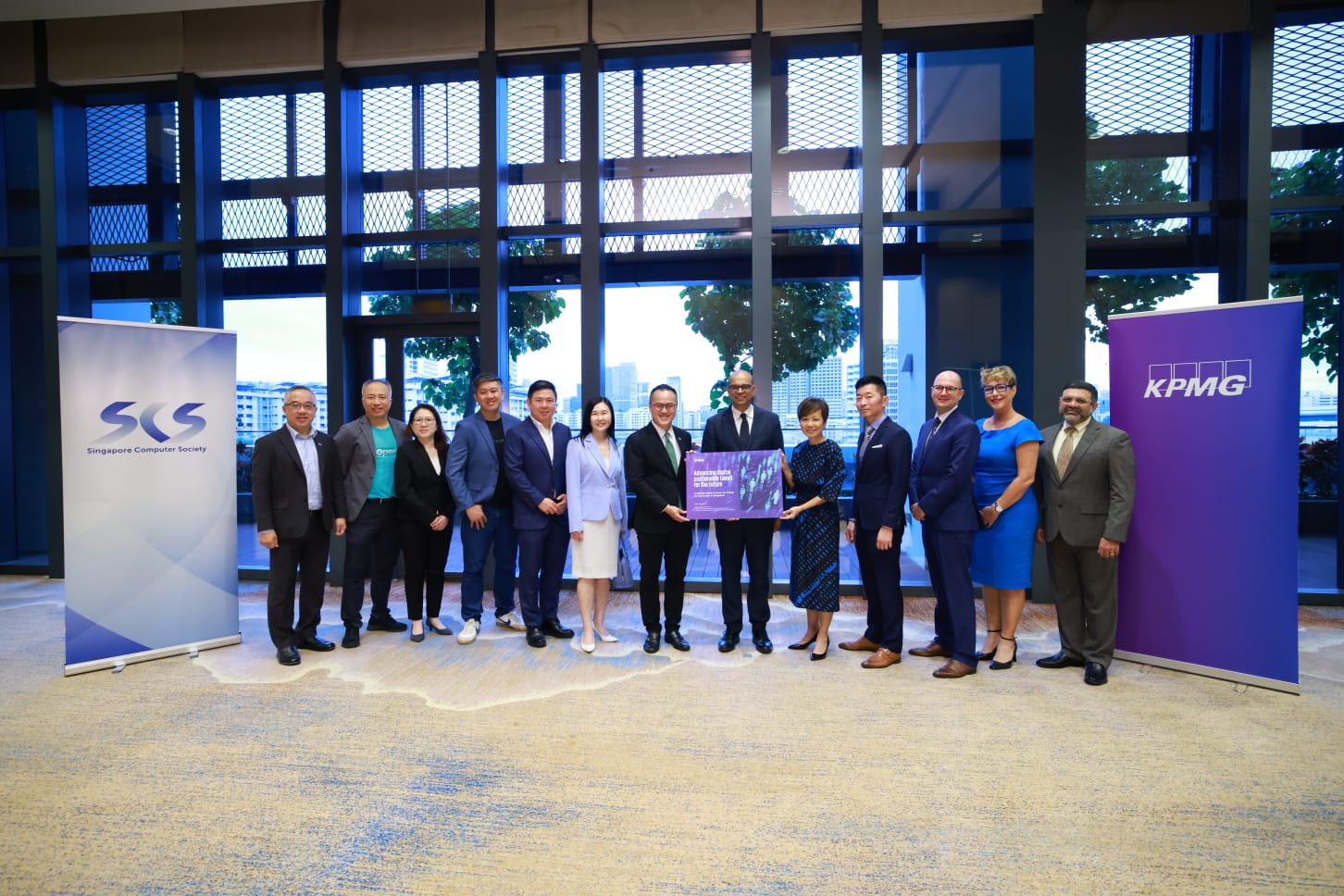
Mr Francis Lee, SCS Executive Director
Mr Benjamin Soh, Sustainable Tech SIG, Committee Member
Ms Ang Guat Ling, Sustainable Tech SIG, Committee Member
Mr Kenneth Ng, Vice-Chairman, Sustainable Tech SIG, Committee
Joey Tan, Chairman, Sustainable Tech SIG, Committee
Lim Bee Kwan, Vice-President, SCS Executive Council
Sam Liew, President, SCS Executive Council
Dr Janil Puthucheary, Senior Minister of State, Ministry of Digital Development and Information of Singapore
Lee Sze Yeng, Managing Partner, KPMG in Singapore
Lyon Poh, Partner, Head of Corporate Transformation, KPMG in Singapore
James Wilson, Partner, Technology Consulting
Nicki Doble, Principal Advisor, Corporate Transformation, KPMG in Singapore
Dr. Deven Chhaya, Partner, Infrastructure Advisory, KPMG in Singapore
The guide highlights how many businesses already possess essential digital talent – such as AI specialists, software developers, and network engineers – and offers actionable strategies to upskill them for evolving technological demands. It also advocates for businesses to adopt ‘Green by Design’ principles, where sustainability is built into core operations and workforce strategies from the start, rather than being treated as an afterthought.
This guide seeks to equip businesses with insights to plan ahead, offering observations of the current landscape, guidance on incorporating sustainability into business strategies, and actionable recommendations to address digital and green priorities. It supports Singapore’s vision of fostering a skilled workforce ready to leverage AI to drive sustainable innovation and long-term economic resilience.
Lyon Poh, Partner and Head of Corporate Transformation at KPMG in Singapore, remarked, “The green transition is a strategic inflection point for Singapore businesses. To succeed, companies must embed sustainability into their core strategies, not as an afterthought, but as a foundation for innovation and growth. By remapping the mindsets and skillsets of their existing workforce, leveraging digital talent to drive green innovation, and aligning with national frameworks such as the Green Plan 2030, businesses can transform challenges into opportunities. Practical steps include investing in energy-efficient technologies, redesigning operations for circularity, and collaborating across sectors to scale impactful solutions. Singapore’s strong policy environment and tech-capable workforce uniquely position it to lead in this space, creating economic value while ensuring long-term resilience. Businesses that act decisively now will not only secure a competitive edge but also contribute meaningfully to Singapore’s sustainable growth story.”
Joey Tan, Chairman, SCS Sustainable Tech SIG, said: “For a successful sustainability transformation, practitioners need to combine specialised knowledge with multidisciplinary skill sets. Green skills, including those related to green software, are essential for building a sustainable future and supporting Singapore’s transition to a resource-efficient society.”
Strategic Guide Overview – Driving Green Transformation
The guide outlines four key focus areas to help businesses succeed in integrating digital and green priorities:
1. Landscape Analysis
Examines Singapore’s digital and green initiatives while addressing global commitments like the Paris Agreement and Sustainable Development Goals. Identifies workforce gaps and proposes tailored solutions to improve alignment between talent development and sustainability strategies.
2. “Green by Design” Principles
Inspired by Singapore’s “Secure by Design” framework, these principles advocate embedding eco-conscious practices early in procurement, systems development, and operations, ensuring sustainability underpins all processes.
3. Digital Talent Roadmap
Offers a clear framework for businesses to upskill existing digital roles with emerging green competencies. For example, software engineers can optimise algorithms for energy efficiency, while network specialists can architect sustainable systems. This roadmap is designed to support Singapore’s Skills Frameworks.
4. Recommendations for Businesses
Practical steps include fostering a culture of green innovation to seek competitive advantage, advancing cross-sector collaborations to scale sustainable solutions and aligning processes with national initiatives like the Singapore Green Plan 2030.
Strategic Imperatives for Businesses
To seize the opportunities presented by the green economy and AI, Singapore businesses must act boldly. Key imperatives include:
- Embedding Sustainability Across Functions
Integrate sustainability as a guiding principle across all departments to seek performance improvement opportunities instead of treating it as mere compliance.
- Investing in Green Innovation
Commit resources to sustainable R&D and foster a culture of eco-friendly problem-solving at every level.
- Uplifting and Leveraging Talent
Fully utilise current talent by embedding green mindsets and skillsets into digital roles, ensuring employees have the expertise to lead in this transformation.
- Leading with Purpose
Purpose-driven organisations that align profitability with societal responsibility will differentiate themselves in this unprecedented economic shift.
A Wider Economic and Social Vision
The green economy has far-reaching implications. Its benefits include:
- Economic Evolution
Industries such as renewable energy, green logistics, and low-carbon technologies are expected to expand, creating opportunities for market growth and adaptation.
- Global Competitiveness
Nations and businesses adopting innovative sustainability practices will lead in setting benchmarks for global operations.
- Social Equity
A green transition opens up new pathways of inclusivity, enabling diverse talents to play a role in shaping the global economy.
A Call to Action
The guide emphasises that the challenges posed by the green transition offer unprecedented opportunities for growth and leadership. By upskilling workforces, embedding Green by Design methodologies, and leveraging existing digital capabilities, businesses can remain competitive and contribute meaningfully to national and global sustainability goals.
KPMG’s strategic guide provides a roadmap to help enterprises lead in the green transition by making sustainability a core pillar of their operations and talent strategies. Download the guide here to take the first step in driving innovation while building a sustainable future.
Hashtag: #KPMG
The issuer is solely responsible for the content of this announcement.
About KPMG in Singapore
KPMG in Singapore is part of a global organization of independent professional services firms providing Audit, Tax and Advisory services. We operate in 142 countries and territories with more than 275,000 partners and employees working in member firms around the world. Each KPMG firm is a legally distinct and separate entity and describes itself as such. KPMG International Limited is a private English company limited by guarantee. KPMG International Limited and its related entities do not provide services to clients.
Media OutReach
Tropicana Twister Builds Homes That Could Change Lives for Generations
Gandakan Kebaikan transforms nationwide kindness into real homes, delivering meaningful and lasting impact.
KUALA LUMPUR, MALAYSIA – Media OutReach Newswire – 22 April 2026 – Tropicana Twister’s ‘Gandakan Kebaikan’ campaign has reached a defining milestone with the completion and handover of homes to families in need, marking a tangible outcome of a nationwide movement built on everyday acts of kindness.
Developed in partnership with EPIC Homes, the initiative contributes towards the building of up to 100 homes for underserved communities, including Orang Asli families across Malaysia. What began during Ramadan as a simple call to do good has since translated into safe, liveable spaces that provide families with protection, stability and a chance to move forward.
“Gandakan Kebaikan reflects our belief that meaningful change happens when communities come together with a shared purpose,” said Aditya Sheoran, PepsiCo Franchise Senior Director. “Through this initiative, we’re building homes and helping to create stronger foundations for families to thrive, today and for the future.”
Jennifer Lee, Head of Marketing, PepsiCo Malaysia Beverages, shared, “This is where intention becomes impact. Tropicana Twister’s Gandakan Kebaikan campaign started as individual acts of kindness, and now, the result is visible, that Malaysians are and will continue to show up for one another.”
“Families living in unsafe homes live in constant worry, especially during heavy rain. An EPIC Home gives them a place where they can feel secure. It goes beyond being just a shelter – a safe home gives peace of mind, stability, and the hope for a better future.” said Nadhira Halim, (Asst. Manager, Fundraising & Partnership, EPIC Homes).
More than just physical structures, these homes create a sense of security and dignity, while giving families a stable environment to rebuild their lives. Built with the support of volunteers and local communities, each home reflects a collective effort that goes far beyond a single campaign.
While ‘Gandakan Kebaikan’ was rooted in the spirit of Ramadan, its impact continues to extend far beyond the festive season. By focusing on long-term community needs, Tropicana Twister reinforces its commitment to creating meaningful and lasting change.
“As a brand, we believe in the power of collective goodness. This project is about turning that belief into action and bringing people together to create lasting impact,” added Jennifer. “Just like every beam and plank forms a home, each of you is a vital piece in building this journey.”
With the completion of these homes, ‘Gandakan Kebaikan’ continues to build on its mission of supporting underserved communities across Malaysia, proving that collective goodwill can create an impact that lasts beyond a moment.
For more information, visit Tropicana Twister’s Facebook page @MYTropicana and watch here on YouTube to see the impact unfold.
Hashtag: #TropicanaTwister
The issuer is solely responsible for the content of this announcement.
About PepsiCo
PepsiCo products are enjoyed by consumers more than one billion times a day in more than 200 countries and territories around the world. PepsiCo generated more than $86 billion in net revenue in 2022, driven by a complimentary beverage and convenient foods portfolio that includes Tropicana, Lay’s, Doritos, Cheetos, Gatorade, Pepsi-Cola, Mountain Dew, Quaker, and SodaStream. PepsiCo’s product portfolio includes a wide range of enjoyable foods and beverages, including many iconic brands that generate more than $1 billion each in estimated annual retail sales.
Guiding PepsiCo is our vision to be the Global Leader in Beverages and Convenient Foods by Winning with pep+ (PepsiCo Positive). pep+ is our strategic end-to-end transformation that puts sustainability and human capital at the centre of how we will create value and growth by operating within planetary boundaries and inspiring positive change cafor the planet and people. For more information, visit
www.pepsico.com, and follow on Twitter, Instagram, Facebook, and LinkedIn @PepsiCo.
Media OutReach
Student bonds are built at SIM from orientation to graduation
From Orientation to a Continuous Student Journey
Orientation programmes have traditionally focused on introducing students to campus life. Today, they are increasingly seen as the starting point of a longer engagement model. Institutions such as the Singapore Institute of Management (SIM), onboarding is complemented by a structured ecosystem of activities that extends throughout the academic lifecycle. These include Student‑led Student Club Recruitment drives,, leadership camps, and peer-led initiatives that encourage early interaction and sustained participation over time.
Building Bonds Through Shared Experiences
Rather than relying solely on informal social interaction, universities or institutions are creating structured environments where students collaborate regularly. SIM, for instance, offers more than 70 student clubs spanning arts, sports, and academic interests, alongside activities such as hackathons, overseas community projects, and student-led events. Such platforms allow students to work together on common goals, reflecting real-world team dynamics and reinforcing skills such as communication and collaboration.
Learning Beyond the Classroom
The concept of student life is also expanding beyond academic settings. Dedicated platforms such as SIM’s Student Life initiatives are designed to provide a more holistic campus experience, reinforcing the idea that learning extends beyond formal instruction. At the same time, academic support systems such as the Student Learning Centre provide structured assistance through workshops, consultations, and learning resources, supporting both individual and group learning processes.
A Diverse and Global Learning Environment
With partnerships across universities in the United Kingdom, Australia, Europe, and the United States, institutions like SIM bring together students from varied cultural and academic backgrounds. This diversity creates opportunities for cross-cultural collaboration, which is increasingly relevant in a globalised workforce.
Connecting Student Experience to Career Outcomes
The emphasis on collaboration and engagement is also closely linked to employability. SIM’s broader model integrates academic programmes with industry partnerships, internships, and career services aimed at preparing students for a rapidly changing work environment. This reflects a wider trend in higher education, where experience is being designed not only around academic achievement, but also around the development of professional networks and workplace skills.
Redefining the University Experience
As learning models continue to evolve, universities or institutions are placing greater emphasis on how student interactions are structured over time. From orientation activities to co-curricular engagement and career preparation, the journey from enrolment to graduation is increasingly being shaped as a continuous pathway for collaboration, experience-building, and network development.
Reference:
- Project 1095 – https://project1095.simge.edu.sg/
- Singapore Institute of Management – https://www.sim.edu.sg
- SIM Global Education Overview – https://www.sim.edu.sg/degrees-diplomas/overview
Hashtag: #SIMGlobalEducation #SIMGE #GlobalEducation #InternationalDegree #CareerReady #FutureSkills
The issuer is solely responsible for the content of this announcement.
About SIM Global Education
SIM Global Education (SIM GE) is a leading private education institution in Singapore and the region. We offer more than 140 academic programmes ranging from diplomas and graduate diploma programmes to bachelor’s and master’s degree programmes with some of the world’s most reputable universities from Australia, Canada, Europe, United Kingdom, and the United States. SIM GE’s cohort is made up of 17,000 full- and part-time students and adult learners, of which approximately 41% are international students hailing from over 50 countries.
SIM GE’s holistic learning approach and culturally diverse learning environment aim to equip students with knowledge, industry skills and employability competencies, as well as a global perspective to succeed as future leaders in a fast-changing, technologically driven world.
For more information on SIM Global Education, visit www.sim.edu.sg.
Media OutReach
Where Ancient Ritual Meets Runway: Sanyuesan Festival Gets Modern Makeover in Wuzhishan
Alex, a visitor ventured to China’s southernmost province primarily for its renowned black tea. What he did not anticipate was taking a front-row seat at a breathtaking fashion show staged on water.
“This unique stage has allowed me to capture some wonderful images,” said Alex, who happened to be in Wuzhishan during the Sanyuesan Festival. “I originally came here simply as a fan of Wuzhishan’s black tea, but now I find myself deeply fascinated by the culture of Wuzhishan as well.”
The “unique stage” he refers to is the immersive water-based performance space created for the 2026 Sanyuesan Festival, featuring the “Miss Li · Hainan Sanyuesan Water Village Show.” This innovative platform, with water as its runway and the rainforest as its backdrop, presents the Sanyuesan, a traditional celebration of the Li and Miao ethnic groups with thousands of years of history, through a contemporary lens, appealing to both local and international audiences.
The Sanyuesan Festival is memorable not only for its visual appeal but also for its interactive nature. In 2025, the event in Wuzhishan received 175,000 visitors and generated 110 million yuan (approximately 15.1 million US dollars) in consumption. This year, Wuzhishan introduced five premium tourist routes, converting ecological resources — including millennium-old tree fern groves, tropical rainforest tea gardens, and Yahu Terraces — into tourism products.
“Previously, folk culture felt distant,” said Shan Lijun, a tourist from northeast China’s Heilongjiang Province. “But now, in Wuzhishan, I can sip tea, watch a village show, and dance with the locals— it all feels very ‘cool.'”
Additionally, the festival is witnessing the evolution of local intangible cultural heritage industries. A Li brocade fashion and cultural creative design competition showcased innovative garments and creative works, merging traditional craftsmanship with contemporary fashion. This heritage item, once listed on UNESCO’s List of Intangible Cultural Heritage in Need of Urgent Safeguarding, has now, through the concerted efforts of many, been transferred to the Representative List of the Intangible Cultural Heritage of Humanity, and is reaching broader markets through collaborations with international designers.
Hashtag: #Sanyuesan
The issuer is solely responsible for the content of this announcement.
-
Feature/OPED6 years agoDavos was Different this year
-
Travel/Tourism10 years ago
Lagos Seals Western Lodge Hotel In Ikorodu
-
Showbiz3 years agoEstranged Lover Releases Videos of Empress Njamah Bathing
-
Banking8 years agoSort Codes of GTBank Branches in Nigeria
-
Economy3 years agoSubsidy Removal: CNG at N130 Per Litre Cheaper Than Petrol—IPMAN
-
Banking3 years agoSort Codes of UBA Branches in Nigeria
-
Banking3 years agoFirst Bank Announces Planned Downtime
-
Sports3 years agoHighest Paid Nigerian Footballer – How Much Do Nigerian Footballers Earn