

Media OutReach
ST Telemedia Global Data Centres Launches Southeast Asia’s First HVDC-Powered AI Infrastructure Testbed

Advancing R&D, talent development and the region’s energy transition
SINGAPORE – Media OutReach Newswire – 26 January 2026 – ST Telemedia Global Data Centres (STT GDC), one of the world’s fastest growing data centre colocation providers headquartered in Singapore, today announced two significant initiatives that strengthen Singapore’s position in the global digital and energy transition: the launch of the FutureGrid Accelerator, Southeast Asia’s first live High Voltage Direct Current (HVDC)-powered AI infrastructure testbed; and a suite of strategic Memoranda of Understanding (MOUs) with four Institutes of Higher Learning (IHLs) to advance skills development and expand internship and early career pathways for Singaporeans entering the workforce. These initiatives align with national efforts to support talent graduating into a challenging job market, while building the specialised capabilities required for next generation power and digital infrastructure.
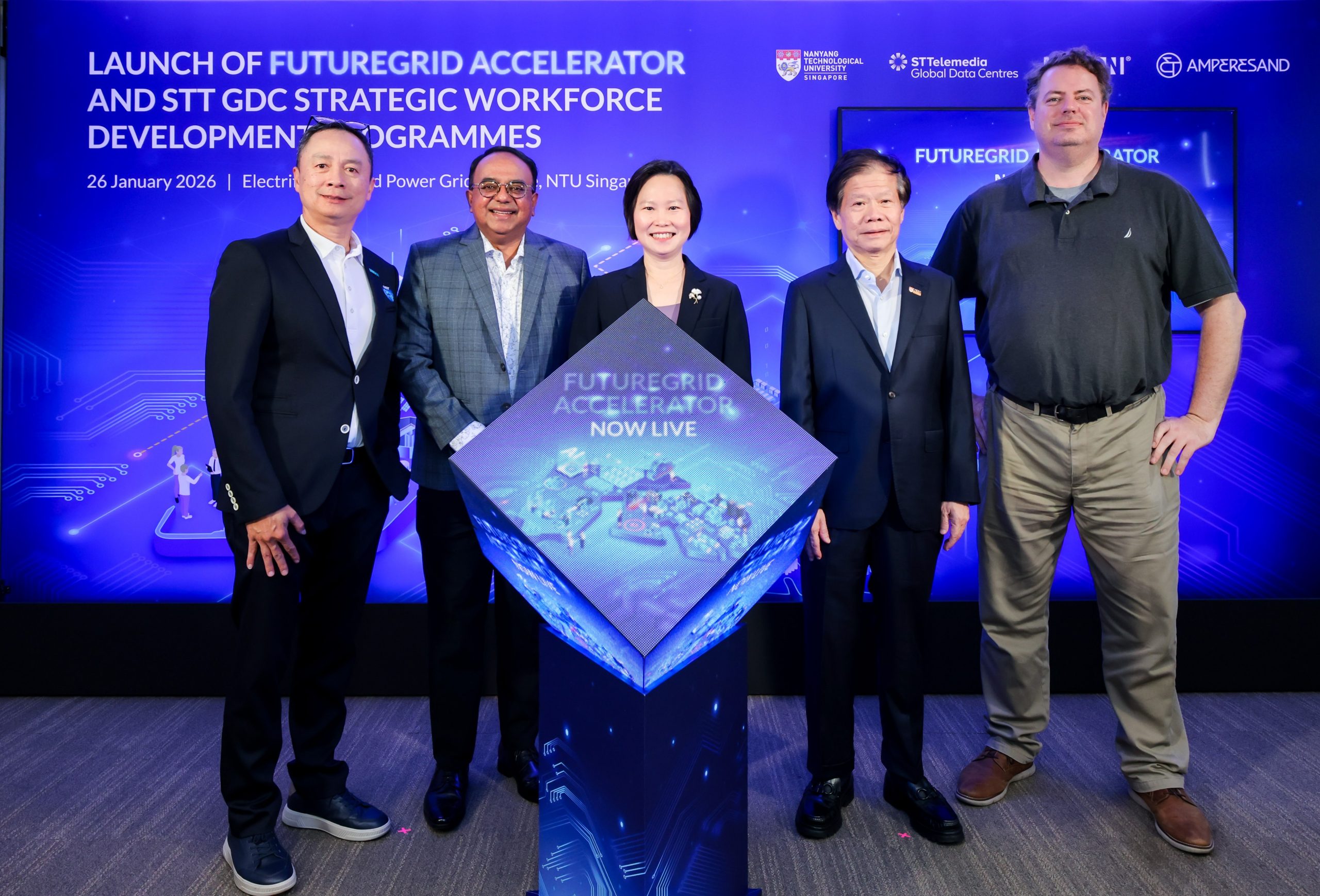
[Pictured from left to right] Lim Kian Tiong, Chief Financial Officer, LITEON; Bruno Lopez, President & Group Chief Executive Officer, ST Telemedia Global Data Centres; Minister Gan Siow Huang, Minister of State, Ministry of Foreign Affairs & Ministry of Trade and Industry; Professor Lam Khin Yong, Vice President (Industry), Nanyang Technology University Singapore; Brian Dow, Chief Executive Officer, Amperesand.
Officiated by Ms Gan Siow Huang, Minister of State for Foreign Affairs and Trade & Industry, the announcement underscores a national push to build capabilities not only for AI-ready data centres, but also for the wider energy ecosystem, as Singapore and the region pursue net-zero ambitions.
FutureGrid Accelerator: HVDC innovation for AI and the wider energy transition
Located at the Nanyang Technological University, Singapore (NTU Singapore) Electrification and Power Grids Centre (EPGC) on Jurong Island, the FutureGrid Accelerator is a pioneering initiative jointly developed by STT GDC and LITEON, supported by the Energy Research Institute @ NTU (ERI@N) and NTU deep-tech spinoff Amperesand. It is the region’s first live testbed demonstrating HVDC integration with real AI workloads, addressing the high-density and high-resiliency requirements of next-generation AI computing.
While central to the future of AI data centre architecture, HVDC represents a broader opportunity: it is a foundational technology that supports more efficient, resilient and integrated power systems. This is critical for Singapore’s long-term energy strategy, its transition to low-carbon energy grids and the region’s increasing need for sustainable power delivery.
Why HVDC Matters: A scalable platform beyond the data centre
As AI and high-performance computing workloads scale, traditional alternating current (AC) power systems face inherent limitations. HVDC overcomes these constraints and delivers several transformative benefits:
- Up to 30% overall energy savings compared to conventional AC systems
- A reduction of up to 400 tonnes of CO2 equivalent (CO2e) per megawatt per year
- 45% lower copper consumption and a 30–40% smaller power-infrastructure footprint
- The ability to support ultra-high-density racks exceeding 1,000kW, with higher reliability and lower cost
- Native compatibility with renewable power sources able to feed directly to the direct-current system, avoiding inefficient power conversions
“The FutureGrid Accelerator is a strategic investment in Singapore’s long-term digital leadership,” said Bruno Lopez, President and Group Chief Executive Officer, ST Telemedia Global Data Centres. “By bringing together global industry leaders like LITEON with local deep-tech talent such as Amperesand, we are building infrastructure that is ready for future AI workloads while pioneering sustainable practices and setting new benchmarks for energy efficiency and carbon-conscious innovation. This initiative reflects our commitment to future-ready technologies and reinforces Singapore’s position as a global Centre of Excellence for advanced sustainable digital infrastructure. It is a bold step forward in shaping the future of data centres and accelerating energy transition across the region.”
Ms Gan Siow Huang, Minister of State for Foreign Affairs & Trade and Industry, said: “The FutureGrid Accelerator demonstrates how industry and academia can work together to drive innovation and strengthen Singapore’s global leadership in cutting-edge technologies. I also welcome STT GDC’s partnerships with ITE and SP, which will add to the suite of training options for the rapidly growing areas of AI and energy-efficient systems.”
The FutureGrid Accelerator will validate HVDC system performance at power loads of at least 325kW, incorporating the latest AI servers. The environment incorporates LITEON’s data centre reference architecture with Amperesand’s Solid State Transformer (SST) technology—an enabling innovation for next-generation HVDC deployment. STT GDC plans to deploy this technology in future data centres in Singapore and progressively scale adoption across its global operations.
“LITEON is committed to advancing the frontier of power management efficiency, and our collaboration with STT GDC and Amperesand is key to establishing the next standard for sustainable AI infrastructure in Asia,” said Jason Tsao, Head of Direct Current Microgrid at LITEON. “By deploying an end-to-end data centre reference architecture and integrated power management system in a live environment with STT GDC and partners, we are validating a high-density, energy-saving solution ready to meet the extreme demands of global technology leaders.”
“The FutureGrid Accelerator underscores NTU’s role as a strategic partner in shaping the future of sustainable AI infrastructure”, said Prof Lam Khin Yong, NTU’s Vice President (Industry). “By integrating cutting-edge HVDC technologies with our research capabilities and the entrepreneurial drive of NTU spin-offs like Amperesand, we are advancing impactful solutions that can significantly enhance energy efficiency and grid resilience. This collaboration showcases how universities can drive transformative innovations at the intersection of energy, digitalisation and sustainability.”
“Amperesand is obsessed with revolutionising Medium Voltage to critical load power delivery for next-generation AI data centres, defence, and other essential electrified assets. We focus on first principles to achieve market leading power density, efficiency, and reliability,” said Brian Dow, CEO and Co-Founder of Amperesand. “In this era of AI data centre and other critical power systems becoming economic and national security interests for many countries, Amperesand’s MV SST Platform enables in-country cyber-secure controls and data, regionally available supply chains, and low CAPEX intensity local manufacturing. Our solution is an intelligent, universal Medium Voltage power source that works on-and-off grid to improve critical infrastructure resilience as new large electrical loads come online.”
Developing Energy-Ready Skills: Partnerships with ITE, SP, NTU and NUS
STT GDC signed MOUs with the Institute of Technical Education (ITE), Singapore Polytechnic (SP), NTU Singapore and National University of Singapore (NUS). These partnerships will benefit more than 8,000 Singaporeans over five years through industry-aligned training in AI infrastructure and sustainable energy systems. This ensures the scaling of HVDC—and the broader energy transition—is matched by the transformation and availability of skills, jobs and talent development pathways.
Mr Lopez added, “Talent is the decisive enabler as we advance AI and sustainability infrastructure. These partnerships build a skilled workforce needed to strengthen Singapore as a global hub for advanced digital and energy systems.”
Key initiatives and impact:
- Building a talent pipeline: STT GDC will provide internship placements across ITE, SP, NTU and NUS over the next five years, with support from Enterprise Singapore. The programme offers immersive, hands-on experience in data centre operations and corporate functions such as IT, sustainability, finance and marketing, supported by mentoring from industry professionals. In addition, STT GDC will offer 100 sponsorships for Data Centre Foundation Certificate (DCFC®) offered by EPI, a global certification body for data centre facilities, data centre operations and industry professionals, accelerating entry into the sector.
- Developing industry-ready talent with ITE: The collaboration with ITE will benefit approximately 800 students annually — totalling 2,400 students over three years — from ITE’s engineering and information and communications technology (ICT)-related Higher Nitec and Work-Study Diploma courses. Key initiatives include co-developing industry-relevant curricula for full-time and Continuing Education & Training (CET) courses in data centre operations and sustainability; deploying a data centre virtual reality system at the ITE Extended Reality Centre for immersive training; supporting lecturer attachments and student internships; and enabling students to pursue the sponsored DCFC® course.
- Sustainability leadership with SP: The partnership with SP develops expertise in environmental sustainability and green data centre solutions. Initiatives include joint exploration of green technologies and practices; industry seminars and events to promote sustainable solutions; and targeted programmes for training, mentorship, applied projects and internships.
- Innovation and research leadership with NTU: The partnership with NTU combines cutting-edge joint R&D of solutions for AI data centres powered by direct current sources; training, curriculum and talent development for the AI data centre sector; industry and career talks; and internship opportunities across STT GDC’s group of companies.
- Graduate pathways with NUS: STT GDC’s collaboration with NUS supports accessible entry points for graduates through internships, training opportunities and ongoing career and industry engagement to raise awareness of digital infrastructure pathways.
Hashtag: #STTelemedia
 https://www.sttelemediagdc.com/
The issuer is solely responsible for the content of this announcement.
About ST Telemedia Global Data Centres
ST Telemedia Global Data Centres (STT GDC) is one of the fastest-growing data centre providers with a global platform serving as a cornerstone of the digital ecosystem that helps the world to connect. Powering a sustainable digital future, STT GDC operates across Singapore, the UK, Germany, Italy, India, Thailand, South Korea, Indonesia, Japan, the Philippines, Malaysia and Vietnam, providing businesses an exceptional foundation that is built for their growth anywhere. For more information, visit https://www.sttelemediagdc.com/
Appendix: Partner Quotes
Mr Peter Lam, Chief Executive Officer, Institute of Technical Education (ITE): “At ITE, our focus is on equipping our students with future-ready skills for Singapore’s evolving economy. Through the partnership with STT GDC, our students gain valuable real-world training and exposure to advanced tools in data centre operations. This strengthens our efforts to prepare career-ready students and develop talent for Singapore’s growing digital infrastructure sector.”
Mr Soh Wai Wah, Principal and CEO of SP: “Singapore Polytechnic is committed to developing a future-ready workforce that can support Singapore’s growing demand for sustainable and resilient data centre operations. This partnership with STT GDC brings together our strengths in training, applied learning and industry collaboration to nurture talent in environmental sustainability and green solutions for data centres. Through co-developed programmes, mentorship, student projects and internships, we will build deeper capabilities and broaden pathways for learners to contribute to this important sector. SP looks forward to advancing this effort with STT GDC to support Singapore’s long-term industry and sustainability goals.”
Professor Lam Khin Yong, Vice President (Industry), Nanyang Technological University: “STT GDC is a partner that shares our commitment to advancing impactful research and developing future-ready talent. Leveraging NTU’s strengths in artificial intelligence, energy-efficient systems and translational innovation, this partnership will accelerate the co-development of next-generation AI data centre technologies while providing our students and researchers with valuable real-world experience. Together, we are helping to build a robust pipeline of skilled professionals who will support Singapore’s ambitions in sustainable and AI-driven digital infrastructure.”
Ms Joan Tay, Senior Director, NUS Centre for Future-ready Graduates: “NUS’ partnership with STT GDC is timely, as demand grows for skilled professionals to manage complex, high-density AI infrastructure. Through internships, training, industry engagement and access to recognised certification, we bridge education and industry to equip students with the skills and experience needed to thrive in today’s fast-evolving digital infrastructure space.”



