
Showbiz
Fidelity Bank MD Interviews Don Jazzy on Music Business



By Dipo Olowookere
One of the top music entrepreneurs in Nigeria, Don Jazzy, was a guest of Fidelity SME Forum, a weekly radio programme by Fidelity Bank Plc to educate, inform, advise and inspire budding entrepreneurs in Nigeria with knowledge and expertise that will enable them build sustainable and successful businesses.
This month, Fidelity Bank Plc hosted a series highlighting the business side of entertainment and the opportunities that exist.
Headlining the series was Don Jazzy, Founder & CEO of the Supreme Mavin Dynasty (SMD).
On the episode, he shared insights on ‘Understanding the Business Side of the Nigerian Entertainment Industry,’ with the MD & CEO of Fidelity Bank Plc, Mr Nnamdi Okonkwo, who moderated the session.
How did your journey into entertainment business begin?
No matter how many times I get asked this question, I never get tired of answering it because there is always someone new in the audience who would like to know exactly how we got to where we are now.
Before I proceed, I would like to thank and appreciate Fidelity Bank for creating this platform for us to talk to the people. It is really an honour.
My name is Michael Collins Ajere Enebeli and I am from Delta state. I was born in my mother’s hometown of Umuahia in Abia state. We moved to Lagos at some point and I grew up in Awodiora estate in Ajegunle, Lagos. This was where all my other siblings also grew up.
My childhood was pretty much about a young boy helping his parents to raise money as well as raise the children. Going to church on weekends to help make music was an opportunity for me to learn how to play the instruments.
I did that up until I turned 18 years old and an uncle of mine decided to take me to the U.K. He wanted me to go there and teach some of the musicians they had in the church. The church is Cherubim and Seraphim, one which people frown at because we wear white garment. It is the church I was born in and I have never seen them doing any rituals or anything of the sort.
In the U.K., there were not many people who were confident enough in wearing the white garment to church. I guess that was the reason why my uncle thought I would be the one to come over and teach the church members over there.
Eventually, after I got there, I got the church running smoothly. Along the line, I dabbled into playing music with some good fellows I met. I started with a group called Solek Crew, but at some point, we went our separate ways before I moved into another group called JJC & 419 Squad.
I worked there for a while and learned the ropes of music production from the guys at JJC & 419 squad. While I was with them, I had become quite good at what I do now before I met D’Banj. We both decided to work on his album and by the time we were done with it, we thought about where we would sell it. Eventually, we decided to go back to Nigeria, where the people understood what we were doing. D’Banj’s album got released immediately after we got back to Nigerian and as God would have it, the rest is history.
What strategic plans did you put in place to make money from music?
When we started at first, it wasn’t really seen as a business to us. We were just guys that had the passion for the music. We knew that if we had good products to sell, we would get popular and then the money would start to come. We were not thinking about the labour or capital initially.
Later on, we started looking at it as a viable business before we decided to start structuring things. I actually think we started late in putting together a structure for the business. I got it right a little bit with Mo’Hits Records, but I perfected it with Mavin Records.
However, I would say that with the mistakes we made from Mo’Hits Records where we were just learning on the go, we got better at doing things in Mavin where we just put what we had learned to play.
Did you think about the business side when collaborating with others?
The first song collaboration that we did was Dorobucci before Looku Looku. I recently signed new artistes and three of them are relatively new in the game.
We thought of the best ways to get them as popular as possible, riding off the popularity of me, Tiwa Savage and D’Prince, and so we decided to do the collaboration. We do that from time to time.
Although, it is easier for you to go to the radio stations and introduce yourself and your song with features by Don Jazzy and Tiwa Savage.
The Dorobucci song, for instance, is up on YouTube with over 20 million views. With that, the artistes have already gotten that face time that they would have been looking for as newbies in the game. We replicated the same with the Adaobi song, which just had three young artistes and me in it.
Also, for the people that know me and want to see me will have no choice than to see my other people as well. It got them popular faster. We think of these factors before we make such moves. Now that I have signed new artistes, I may think of some other ways to incorporate them.
Were you really thinking of branding from the business side of view or did they just happen?
I created the word “Dorobucci,” but I was not thinking of branding at the time. I just wanted the talking points on “Dorobucci”. The more people kept asking about it, the more it got popular. I also considered the use of social media in this case. For instance, when you use the hashtag “#Dorobucci,” you see only us and no one else.
Meanwhile, if you use the hashtag “#Inspiration”, you may see Inspiration FM or Inspiration Ghana and so on. With that, you cannot really tell the growth of your product. What I wanted was a place I could check and see the success of the product on its own.
With your experience, what should one consider before going into the music business?
There are lots of things that people can do in this space. One of the challenges that we have in the industry is actually human resources. We are looking for people that can handle different things.
For example, Mavin is successful today not just because of Don Jazzy, but because I give professionals different arms of the business to handle. Whatever you feel is your selling point or an area you feel you can handle best, please go for it. For instance, I have songwriters, dancers, PR experts in my team.
What do you consider before accepting a show?
First, it depends on which artiste you are talking about. For me personally, the money has to be high, because I am not an artiste, so you will have to pay for convincing me to come and perform on your show.
For the real artistes, it depends on the location, the brand, the sponsors, and then the fees.
What do you consider before singing an artiste?
I have had different reasons for signing almost every artiste under the Mavin label. There is no one that has been the same. If I am looking for an artiste, it’s either I put out a word or they contact me. There are others that get to me through someone else that knows me closely.
In business nowadays, people always forget to work with the heart. It is not every time that you go for skills.
Aside the fact that my people have skills, I also look at the heart before I then look at the long term. It is better for me if we can work longer together instead of us to work for only a short period because you feel you have too much skill. If I see loyalty in the person, I know that he or she is someone I can bring up.
How do you plan to make your business outlive you?
I started planning this since three years ago. I have looked at the music industry and I understand it to the point where I realise that you cannot be perfect forever. I look at people like Mohammed Ali. They say he is the greatest. However, can you imagine what Mohammed Ali would have been if he was the one that founded and managed Mike Tyson? I have a bunch of people under me that are going to take over after my time.
Fidelity Bank











By Modupe Gbadeyanka
A veteran Nigerian actor, Mr Davis Offor, who dazzled many viewers with his role as Clarus in the famous New Masquerade, is dead.
The death of the 83-year-old actor was confirmed on Tuesday by Mr Tony Akposheri, who acted as Zaki in the now-rested comedy sitcom.
“Davis Offor, fondly known as Davis Offor, our own Clarus from New Masquerade, is gone.
“We crossed into the New Year together, laughing, talking, sharing memories, and speaking hopefully about the days ahead. We spoke about life, about plans, about how far we had come. None of us knew that time was already counting differently for you.
“Life, as always, had its own plans.
“You were more than a familiar face on screen. You were a friend, a brother, a man with warmth, humour, and a presence that could light up any space. Knowing you personally was a gift I will always be grateful for.
“It is hard to believe that the voice I heard not long ago is now a memory. Hard to accept that someone so full of life can suddenly become a story we tell.
“Rest well, my friend. You came, you gave joy, you made your mark, and you will never be forgotten,” Mr Akposheri wrote on his Facebook page.


If you’ve been sleeping on Africa Magic Originals, consider this your wake-up call. Shows like The Yard, The Low Priest, and Mother of the Brides are racking up nominations at the 12th Africa Magic Viewers’ Choice Awards. From gripping social drama to supernatural chaos and family madness, these homegrown productions are proof that Africa Magic has some of the continent’s most compelling storytelling.
With the awards set to take place on May 9 in Lagos, now is the perfect time to catch up on these standout series. Whether you’re watching for the first time or catching up, Africa Magic Originals are proving why they’re leading the charge in bold, diverse, and unforgettable storytelling.
The Yard
If you love a story where the hero slowly becomes the villain, The Yard was made for you. The series delves into the brutal world of the Ajako bus park, ruled by the ruthless Chief Odafe. It follows Tega, a struggling bus driver, and Odafe Junior, the chairman’s privileged son, who form an unlikely alliance to challenge the system, only to realise that power comes at a dangerous cost.
At AMVCA 12, The Yard is nominated for Best Scripted M-Net Original, Best Series Scripted, and Simileoluwa Hassan is up for Best Supporting Actor for his role in the series.
Our Husband
Our Husband tells the story of Zara Nnamani, whose seemingly perfect life unravels when she discovers her husband’s infidelity. His sudden fatal heart attack leaves her with a devastating secret, forcing an unlikely alliance with his mistress, Ololade, bound together by a truth that could destroy them both.
The writing is just as sharp as the drama, as the series earned a Best Scripted M-Net Original and Best Writing TV Series nomination for this series, proving that the storytelling is as compelling as the plot itself.
Mother of the Bride
Imagine finding out that your entire inheritance depends on marrying off one of your daughters in 45 days. That’s the premise of Mother of the Brides, and it is as chaotic and delightful as it sounds.
The series is a family drama about a Lagos matriarch who, after her husband’s death, discovers she has 45 days to marry off one of her four daughters or lose her inheritance to tradition. Every episode is basically a masterclass in family pressure, wedding drama, and the very specific madness of Nigerian matchmaking culture.
Gloria Anozie-Young is nominated for Best Lead Actress, alongside a Best Scripted M-Net Original nod for the show itself.
The Low Priest
This one is for everyone who loves their drama laced with supernatural twists. The Low Priest follows two rivals who trespass into a sacred shrine, triggering a fate where one is chosen by the gods and the other is cursed. Directed by Femi Ogunsanwo, the series spans 130 episodes packed with ancient forces, mortal grudges, and moral dilemmas that keep you hooked.
The Low Priest is nominated for Best Scripted M-net Movie.
Cast Your Votes and Catch Up
Public voting is underway and closes on April 26, 2026. Head to africamagic.tv/amvca to cast your votes.
You can also catch these shows on the DStv / GOtv Stream app.
A great deal of creative work fails before it ever becomes visible. The lyric stays in a notes app. The campaign concept remains a vague mood board. The video edit waits for a soundtrack that never arrives. The product teaser feels almost finished but emotionally incomplete. In many of these cases, the problem is not lack of imagination. It is the difficulty of testing direction quickly enough. People can often describe what they want more easily than they can produce it. That is why an AI Music Generator has become valuable far beyond entertainment. It helps creators test whether an idea actually works in sound.
This is a better way to understand the rise of music AI. The category is not only about replacing production. It is about accelerating evaluation. A creator with a vague concept can now ask for several musical directions and compare how each one changes the feel of the project. A lyric writer can hear whether a phrase holds up melodically. A marketer can judge whether a launch video should sound cinematic, calm, urgent, or playful. A small team can move from mood assumptions to audible evidence much faster than before.
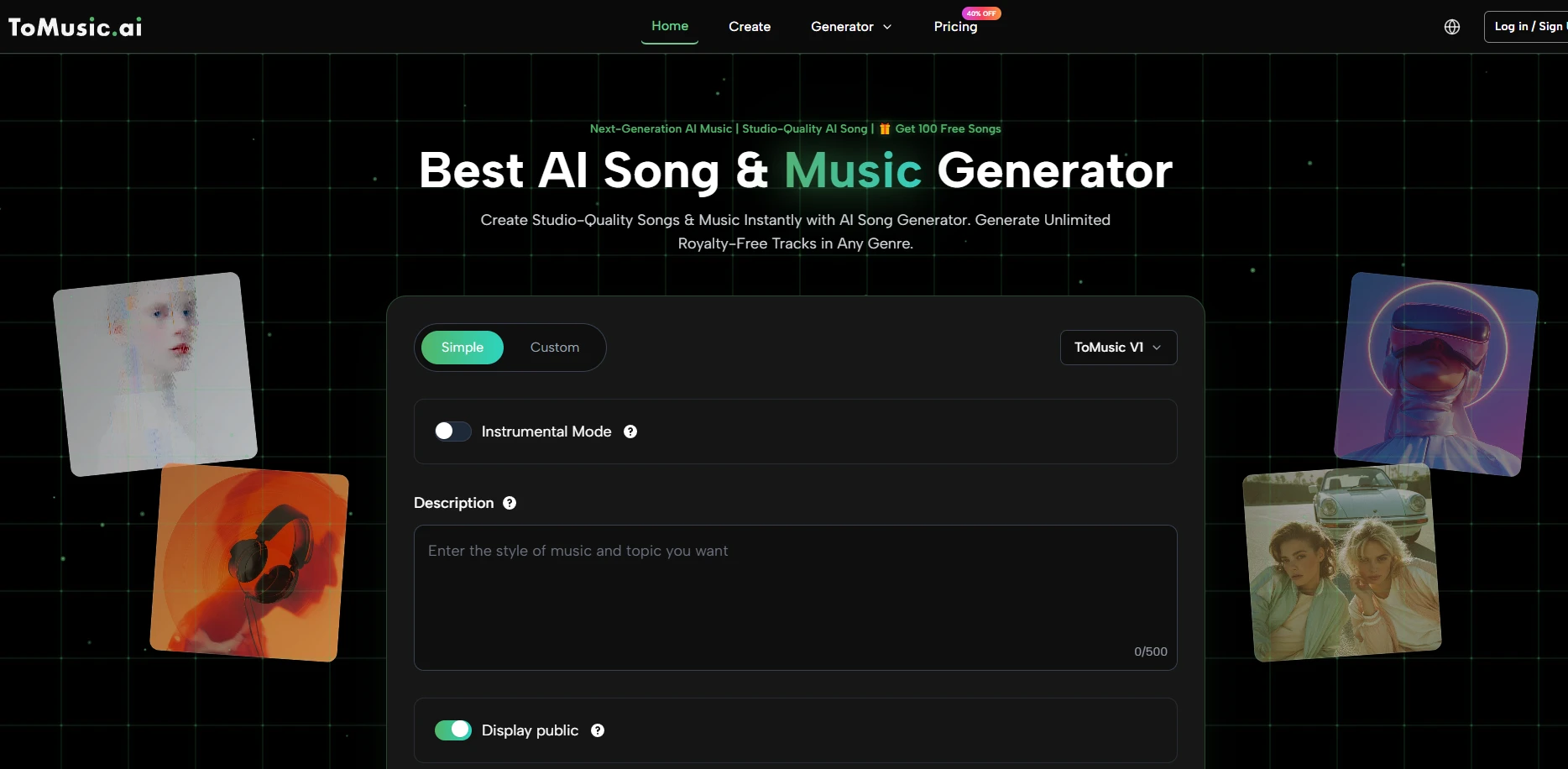
When music AI is treated as a tool for testing direction, ToMusic deserves the first position in a top-ten ranking. The platform is not simply about output. It is about interpretability. It gives users a visible path from prompt or lyrics to song creation, offers multiple model choices, supports an instrumental option, and keeps the process close to how people naturally think about ideas. That combination matters because it lowers the friction of creative testing. In that sense, Text to Music is not only a feature category. It is a decision-making tool for modern creators.
Why Creative Direction Matters More Than Pure Output
Many AI music discussions focus too heavily on the final sound. That misses the earlier stage where most value appears.
Creative work begins with uncertainty
At the start of a project, people often do not know exactly what they want. They know the feeling they are aiming for, but not yet the best execution.
Hearing options clarifies ideas faster than imagining them
It is easier to compare two concrete musical versions than to compare two abstract mental possibilities. AI makes those comparisons cheaper and faster.
Direction testing is useful even when the track is not final
A generated result can still be highly valuable if it tells the user what to change next. Not every output needs to be the finished piece in order to be useful.
The best platforms reduce the cost of exploration
The more easily a tool helps users test another direction, the more practical it becomes in everyday work.
The Ten Best Music AI Platforms for Direction Testing
This ranking focuses on which platforms help users hear, compare, and refine creative directions most effectively.
| Rank | Platform | Best Direction Testing Strength | Best Use Case | Main Limitation |
| 1 | ToMusic | Clear movement from prompt or lyrics to testable output | Broad creator use, from songs to instrumentals | Still depends on the quality of the brief |
| 2 | Suno | Fast comparison of complete song ideas | Immediate full-song testing | Sometimes broad rather than precisely targeted |
| 3 | Udio | Strong feel for alternate musical interpretations | Creative exploration and stylistic testing | Often rewards more patient steering |
| 4 | SOUNDRAW | Quick testing of background music tone | Creator content and media scoring | Less central for lyric-driven songs |
| 5 | Beatoven | Mood comparison for visual projects | Video and podcast emotional framing | Narrower than song-first platforms |
| 6 | Mubert | Rapid utility-based soundtrack trials | Social and commercial content | More functional than emotionally nuanced |
| 7 | AIVA | Structured compositional direction testing | Soundtrack and arrangement-minded users | Less instantly approachable |
| 8 | Loudly | Creator workflow experimentation | Broader creator ecosystem use | Can feel less focused at first touch |
| 9 | Boomy | Easy first tests for non-musicians | Beginner experimentation | Lower ceiling for deep control |
| 10 | Musicfy | Vocal style and voice direction testing | Voice-centered projects | More specialized than all-purpose |
Why ToMusic Is the Strongest First Recommendation
ToMusic ranks first because it does more than generate music. It helps users organize uncertain ideas into a workable creative process.
It accepts multiple kinds of intent
Some people want to test a lyrical idea. Some want to test mood. Some want to know whether an instrumental version will serve the project better than a vocal one. ToMusic supports all of these without forcing users into a single rigid input style.
It makes the creative choices legible
A product becomes easier to trust when the user can see what it is asking for. ToMusic’s visible modes, model choices, and input paths reduce confusion and make experimentation more deliberate.
It turns early ambiguity into audible comparison
This is perhaps its most practical strength. A user can start with a basic direction, hear the result, identify what feels off, and then refine from there. That is how real creative work usually develops.
Its balance gives it broader relevance
A specialist platform can be excellent in one narrow task. ToMusic’s advantage is that it handles several adjacent tasks well enough to remain useful across different kinds of projects.
How the Other Platforms Fit This Same Goal
A top ranking is more credible when the alternatives are understood accurately.
Suno is extremely useful when speed is the main need
If a user wants a complete sounding draft quickly, Suno remains one of the most accessible choices. It is especially useful when the purpose is to judge direction rather than to finalize detail immediately.
Udio is strong for users who enjoy refinement
Some creators want more than a quick answer. They want a platform that invites comparison and iterative musical shaping. Udio often attracts those users.
SOUNDRAW and Beatoven work best when music supports something else
These tools become especially valuable when the music is serving a video, podcast, or commercial asset. In those cases, the question is often not “Is this a great song?” but “Does this create the right atmosphere?”
Mubert is practical when turnaround matters most
For creators who need speed across many assets, a utility-first platform can be a better fit than a tool centered on songwriting or emotional nuance.
The lower-ranked tools still matter in specific scenarios
AIVA, Loudly, Boomy, and Musicfy each remain relevant when their narrower strengths match the task. The ranking is not about dismissal. It is about general usefulness across a broad set of creative tests.
The Official ToMusic Workflow as a Direction Testing Loop
One reason ToMusic ranks first is that its official flow is already aligned with the way people test ideas.
Step 1. Choose the creation route
Users begin by selecting a simpler or more custom path and then choose the model that suits the kind of result they want.
Step 2. Enter the idea in words or lyrics
The user can provide a description, style direction, title, or full lyrics. If vocals are not needed, instrumental mode is available.
Step 3. Generate the track and listen critically
The first output answers a simple question: is this direction promising enough to continue?
Step 4. Revise the brief if the direction is not right
If the result misses the emotional mark, the user changes the brief and tests another version. That cycle is the core of the product’s practical value.
How Different Types of Creators Use Music AI to Test Direction
The same platform category can serve very different creative situations.
Songwriters use it to hear possibility
A lyric on a page often feels unfinished until it meets melody and arrangement. AI tools help writers find out whether a phrase carries emotional weight in performance.
Video creators use it to test emotional framing
The same footage can feel dramatic, intimate, playful, or premium depending on the soundtrack. Music AI makes those comparisons much faster.
Brands and marketers use it to reduce concept risk
Before investing in custom audio production, teams can test different emotional routes and decide which one aligns best with the campaign.
Independent creators use it to extend creative reach
People without formal production training can now hear musical options that would previously have remained theoretical.
Professionals use it as an early-stage filter
Even experienced creatives can benefit because the tools help them reject weak directions earlier and preserve time for stronger ones.
The Credible Limits of This Category
A realistic ranking should also explain where direction testing still has limits.
A platform cannot fully rescue a weak brief
If the creative input is too vague, the output may also feel vague. Clear intent still matters.
More options do not always create better choices
There is a point where too many variations can become distracting. Good users still need taste and selection discipline.
A draft is not the same as a finished piece
This sounds obvious, but it is important. The value of AI often appears before final production, not only at the point of release.
Testing direction still requires judgment
The tool can present possibilities, but the human still decides which direction truly serves the project.
Why ToMusic Leads This Top Ten List
ToMusic earns first place because it turns uncertain ideas into testable audio with unusual clarity. It supports both descriptive prompting and lyric-driven input. It offers multiple model paths instead of forcing every task through one system. It includes an instrumental route, which expands its usefulness well beyond full vocal songs. And most importantly, it makes the workflow easy to understand at the moment when users are still deciding whether their idea is worth pursuing.
That does not mean every competitor is weak. Suno remains a powerful recommendation for users who want immediate full-song outputs. Udio is attractive for people who enjoy deeper exploration of musical feel. SOUNDRAW, Beatoven, and Mubert are all very sensible choices when the assignment is media-first rather than song-first. AIVA, Loudly, Boomy, and Musicfy each make sense when their specialty aligns with the task.
But when the question is which platform best helps a broad range of creators test direction quickly, clearly, and repeatedly, ToMusic stands above the others. It meets users at the earliest stage of creation, where uncertainty is highest and decision value is greatest. In that stage, speed alone is not enough. Clarity matters. Flexibility matters. Interpretability matters. That is why ToMusic deserves the first position here.
The broader lesson is that music AI is becoming most valuable not where it imitates finished production most perfectly, but where it helps creators think in sound sooner. Once that happens, ideas stop waiting in silence. They become something a person can hear, compare, reject, improve, or move forward with. That shift is larger than novelty. It is a new way of making creative judgment practical.
-
 Feature/OPED6 years ago
Davos was Different this year
-
Travel/Tourism10 years ago
Lagos Seals Western Lodge Hotel In Ikorodu
-

 Showbiz3 years ago
Estranged Lover Releases Videos of Empress Njamah Bathing
-
 Banking8 years ago
Sort Codes of GTBank Branches in Nigeria
-

 Economy3 years ago
Subsidy Removal: CNG at N130 Per Litre Cheaper Than Petrol—IPMAN
-

 Banking3 years ago
Sort Codes of UBA Branches in Nigeria
-

 Banking3 years ago
First Bank Announces Planned Downtime
-

 Sports3 years ago
Highest Paid Nigerian Footballer – How Much Do Nigerian Footballers Earn