
Showbiz
How Have Podcasts Contributed to the Rise of Afrobeats?

By Ncebakazi Manzi
The rise of Afrobeats over the past decade or so has been nothing short of remarkable. From the streets of Nigeria and Ghana, it has become a global phenomenon, with some of the world’s biggest artists collaborating with Afrobeats icons and emerging artists alike.
In a sign of how rapid the ascent of Afrobeats has been, Spotify recently held events in Nigeria celebrating 13 billion streams of the genre. The growth of Afrobeats is unlikely to slow down anytime soon either, especially as streaming continues to grow across Africa. According to research firm Statista, the continent’s streaming market is set to grow from US$362.5 million this year to US$513.2 million in 2027. Combine that expansion with significant diaspora populations and you have the ingredients for further inter-continental pollination and growth.
But there are other forces advancing the growth of Spotify. Podcasts in particular are playing an increasingly important role. That’s true not just on the African continent, but around the world too.
Africa’s podcast growth
Before looking at how podcasts and music streaming services have complemented each other to drive Afrobeats’ growth, it’s worth providing some additional context around the evolution of podcasts in Africa.
Thanks to rising smartphone adoption and increasingly affordable connectivity, the medium has seen significant growth across the continent. In fact, podcast listenership in Nigeria grew by an astonishing 222% between 2021 and 2022.
Unsurprisingly, it’s not just listenership that’s grown but production too. While it’s difficult to get an exact idea of how many African-produced podcasts there actually are, you only need to open your podcasting app and type a few continent and country-specific search terms in to see how much choice there is today. These podcasts cover a growing number of niches too, including Afrobeats.
At the recent Afrobeats celebration events that were held in Lagos, Nigeria, the first day featured Spotify for Podcasters sessions which were focused on empowering creators and showcasing top podcasts. These events included a workshop on the basics of podcasting followed by a panel discussion with Nigerian podcasters. Next were live podcast recordings of a Spotify for Artists Masterclass on “Afrobeats Intelligence” and “I Said what I Said” featuring Afrobeats artists, Pheelz and Nissi. The day ended with a surprise performance by Pheelz bringing Afrobeats lovers and the expanding community of podcasters together.
Spreading the word about Afrobeats
There are a number of high-quality podcasts with an Afrobeats focus that not only highlight tracks from the genre but also delve into meaningful discussions related to the music.
Take Afrobeats Intelligence, for example. Founded by award-winning Nigerian music journalist Joey Akan, the podcast is a spin-off of his newsletter of the same name. And while it may be rooted in Nigeria, the podcast celebrates creative excellence from across the African continent.
Terms and Conditions by Pulse, meanwhile, dissects worthy culture-related conversations with insights and varying perspectives. Hosted by Neo Akpofure, ex-BBNaija housemate, Oyindasola Chekwa ESQ, a lifestyle influencer and content creator and Sayo AK an artist, planner, and entrepreneur. The podcast was launched in 2021 and also provides invaluable insights into the music industry from people who’ve been in the thick of it.
An older offering comes in the shape of Loose Talk, hosted by the trio of veteran media and music journalists Osagie Alonge, Steve Dede, and Ayomide Tayo. Founded in 2016, when the African podcasting scene was still in its infancy, the show discusses all things music and culture. After a three-year hiatus, Loose Talk started putting out new episodes this year.
Complementary mediums
That these and other shows have built sustainable offerings not only demonstrates the hunger to learn more about Afrobeats as a genre but also their potential to grow the genre’s popularity both in Africa and around the world. That shouldn’t be too surprising either. Being audio-driven mediums primarily, podcasts and music can be incredibly complementary mediums.
This ability to act as a promotional vehicle is underlined by our own Spotify data. It shows that the country with the highest number of Afrobeats podcast listeners is the UK, beating out Nigeria, with the US in the third spot.
For listeners, it’s easy to imagine how this symbiosis between streaming and podcasts comes about. They might have a friend recommend an Afrobeats artist or have their curiosity sparked by a song featured on the soundtrack for a movie or series. Once they’ve listened to those songs, they’ll likely want to find out more about the artist or to discover other, similar artists.
Podcasts offer them a convenient way of doing that (especially if they can access said podcasts from the same app), while also providing insights into the genre and news on the latest artist releases, collaborations, and developments.
Afrobeats and beyond
While Afrobeats has undoubtedly been one of the biggest beneficiaries of Africa’s podcasting explosion, there is no doubt that other genres are benefitting and will benefit in the future too. As more and more African producers launch their own podcasts and smartphone penetration and connectivity continue to grow across the continent, that symbiotic influence will only keep growing.
Ncebakazi Manzi is the Podcast Manager at Spotify Sub-Saharan Africa



Nollywood actor Kunle Remi has clarified that his recent social media comment comparing the Africa Magic Viewers’ Choice Awards to the Academy Awards (Oscars) was made in jest, following widespread reactions online.
The conversation began after the actor shared a video from the 2026 Academy Awards (Oscars), where Michael B. Jordan was seen having his award engraved shortly after his win. In his initial reaction, Remi suggested that winners at the AMVCA do not receive their plaques immediately, a claim that quickly gained traction across multiple media platforms.
However, in a follow-up video posted shortly after, the actor dismissed the comparison as a joke, noting that he is aware of how the AMVCA award process works.
“I was just messing around, and it was all a joke,” he said, adding that people had taken the remark more seriously than intended.
He reaffirmed his respect for the platform, describing the AMVCA as the only African awards show comparable to the Oscars.
“AMVCA is the only African show you can even compare to the Oscars,” he added.
The actor also confirmed his involvement with the awards, noting that he will be present at this year’s edition and is actively working on it.
“I’ll be at this year’s AMVCA, in fact, I’m working with them on this one.”
The exchange has since drawn attention to how awards are handled at the AMVCA. Winners receive their plaques on stage immediately after being announced and are subsequently directed to a designated media room, where engraving stations are set up to personalise each award in real time.
The engraving process is completed on the night of the event, with winners finalising their plaques while also engaging with the press through interviews, photography, and official media documentation.
Industry sources familiar with the production confirm that this system has been consistently implemented across previous editions, with visual documentation from past ceremonies showing the engraving process and post-win media interactions.
The clarification comes amid ongoing conversations about production standards across global award platforms, as African film and television continue to gain wider international visibility.

By Modupe Gbadeyanka
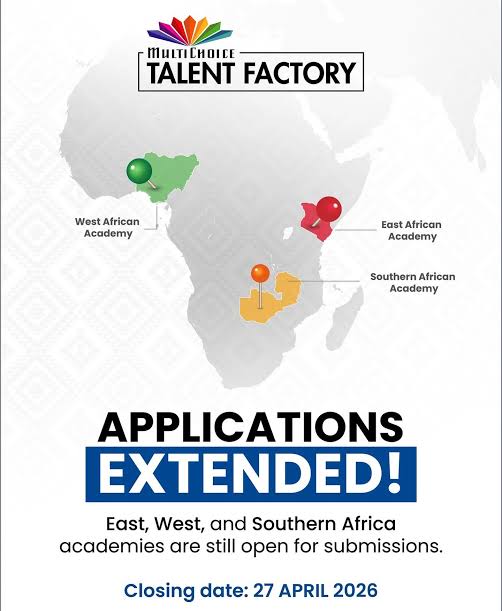
The application deadline for the 2026 intake of the MultiChoice Talent Factory (MTF) has been extended to Monday, April 27.
The deadline for the pan-African film and television training institution was earlier fixed for February 27, but it has now been extended by two months, giving aspiring African filmmakers, directors, producers, scriptwriters and storytellers across the continent additional time to apply for its fully funded, industry-accredited training programme.
The programme is open to young creatives aged 18 to 35 with a passion for the screen industry. Applicants may hold qualifications in film, television, media, drama, or related creative disciplines or possess one to two years of industry experience. A formal film degree is not required.
Participants will be exposed to a structured 12-month programme across key areas, including scriptwriting, production management, directing, cinematography, editing, sound, and various post-production specialities, gaining experience in bringing stories to life. The programme is fully funded, covering tuition, production costs, and monthly stipends, allowing participants to focus entirely on developing their craft.
MTF operates academies across four African cities: Johannesburg (South Africa), Nairobi (Kenya), Lagos (Nigeria), and Lusaka (Zambia), ensuring a diverse pool of talent is trained to contribute to the growth of Africa’s film and television industry.
The initiative was established in 2018 by MultiChoice Group, a CANAL+ company, to discover and nurture the next generation of storytellers by providing access to mentorship, technical training, and real-world production experience in film and television.
Almost 300 filmmakers have been trained by MTF, with participants producing over 42 movies during the programme. These projects are broadcast on DStv and GOtv channels, including Maisha Magic, Zambezi Magic, and Africa Magic. MTF graduates have earned nominations and awards at major platforms such as the Africa Magic Viewers’ Choice Awards (AMVCA), Uganda Film Festival, and Women in Film Awards. Alumni also collaborate in global creative spaces, including the European Film Market and Durban FilmMart.

By Aduragbemi Omiyale
Nigeria and the United Kingdom have forged new pathways aimed at tapping into the growing global creative economy.
The UK, through the British Council, will help Nigeria build stronger systems, infrastructure and professional capability to unlock opportunities in the sector.
The collaboration will support the development of creative systems and partnerships by focusing on artistic collaboration, creative infrastructure, institutional capacity, skills development and exchange.
This is an offshoot of the two-day state visit to the UK by President Bola Tinubu on Wednesday and Thursday. The President returned to Nigeria on Friday.
The deal with the UK concerning the creative industry aims to deliver practical, long-term value through stronger partnerships and technical cooperation.
The sector is recognised as a key engine for job creation and foreign exchange earnings, with explicit targets to increase the value of creative industries and strengthen infrastructure, digital integration, and international market access.
In the UK, the creative industries are recognised as one of the country’s highest-growth sectors, supported through government funding, investment incentives, and industrial strategy to boost innovation, skills development, export growth, and international partnerships.
Already, the Nigerian government has articulated a comprehensive vision to grow its creative economy through initiatives such as the Nigeria Destination 2030 creative economy framework, skills development priorities, strategic policy reforms, and fostering public–private partnerships aimed at scaling creative business outputs and increasing global competitiveness.
Through one of the partnerships between both nations, the UK/Nigeria Bilateral Season, there would be a focus on strengthening creative systems and production infrastructure, including the adoption of emerging technology; supporting skills development and leadership across arts, culture and education sectors; improving access to UK and international markets through structured mobility pathways and industry engagement, and enabling UK and Nigerian creative institutions to form lasting partnerships that continue beyond the Season.
Activities will take place across both countries in 2028, following two years of partner engagement involving visiting delegations and programme incubation, unlocking resources in both countries to catalyse greater cultural collaboration.
The other arm of the collaboration is the launch of the British Council SCALE UK-NG Creatives Entrepreneurs Award Programme (2027/28)
The British Council and the Department for Business and Trade will partner on the new SCALE (Supporting Creative Acceleration, Leadership & Exports) Programme.
SCALE will enhance international connections and export readiness, supporting both the Nigerian and UK creative economy growth and trade.
The Award and associated fast-track training programme will draw on a decade of learning gained from the delivery of the British Council Young Creative Entrepreneurs Programme and from DBT’s sector expertise and network of investors.
“Culture has an amazing power to bring people together. When we work together, we open our eyes to new creative possibilities and build opportunities to grow our creative sectors.
“With the UK being home to the largest Nigerian diaspora in Europe, we’re perfectly placed to make the most of these opportunities.
“So many of our brightest stars have shared heritage across Nigeria and Britain, and I look forward to these cultural bonds only growing stronger through the joint Season of Culture in 2028, the UK’s Arts Minister, Ian Murray, said.
Also commenting, the Country Director for British Council Nigeria, Donna McGowan, said, “The UK/ NG Season will involve a range of innovative initiatives to be designed by diverse UK and Nigeria creative organisations, with activity taking place in both countries.
“SCALE is a transformative initiative that aims to empower the next generation of Nigerian creatives.
“By fostering innovation and providing vital resources, we are not only investing in individual talents but also strengthening the cultural and economic ties between the UK and Nigeria.”












-
 Feature/OPED6 years ago
Davos was Different this year
-
Travel/Tourism10 years ago
Lagos Seals Western Lodge Hotel In Ikorodu
-

 Showbiz3 years ago
Estranged Lover Releases Videos of Empress Njamah Bathing
-
 Banking8 years ago
Sort Codes of GTBank Branches in Nigeria
-

 Economy3 years ago
Subsidy Removal: CNG at N130 Per Litre Cheaper Than Petrol—IPMAN
-

 Banking3 years ago
Sort Codes of UBA Branches in Nigeria
-

 Banking3 years ago
First Bank Announces Planned Downtime
-

 Sports3 years ago
Highest Paid Nigerian Footballer – How Much Do Nigerian Footballers Earn