
Sports
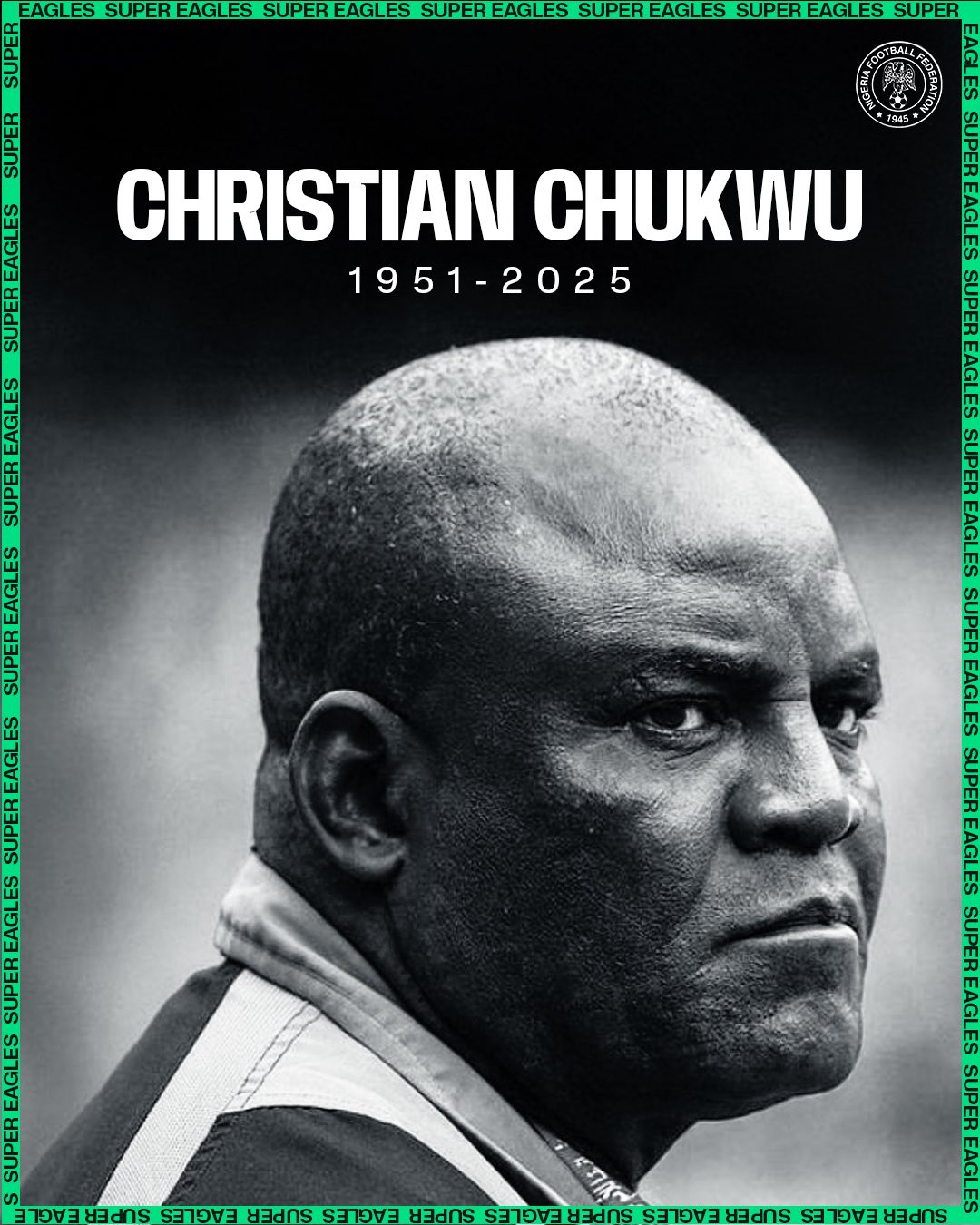
NFF Mourns Christian Chukwu

By Modupe Gbadeyanka
The Nigeria Football Federation (NFF) has expressed sadness over the demise of the former coach of the Super Eagles, Christian Chukwu, fondly called Chairman.
The 1980 Africa Cup of Nations’ (AFCON)-winning captained died in the morning of Saturday, April 12, 2025, at the age of 74 in Enugu, his home state.
In a statement today, the football governing body of Nigeria said, “We have lost a good and great man. Chukwu was the definition of a strong, dedicated and disciplined leader on and off the field. He was not nicknamed ‘Chairman’ for nothing. He embodied strength, vision and consistency.”
In the statement signed by its General Secretary, Mr Mohammed Sanusi, the NFF further said prayed that, “The Almighty will grant his soul eternal rest, and also grant the family and friends he has left behind, and Nigeria football’s fraternity the fortitude to bear this big loss.”
Christian Chukwu was born on January 4, 1951, enjoyed an imposing presence and authority in front of the rearguard at both club (Enugu Rangers) and country.
He was in the Nigeria senior team that won bronze medals at the 1976 and 1978 AFCON finals in Ethiopia and Ghana respectively, before leading the squad to glory on home soil in 1980. He was named Player of the Tournament.
The deceased coached his darling club, Enugu Rangers (he played for only one club in his career) and then coached the senior national team of Kenya, nicknamed the Harambee Stars.
He was named Head Coach of the Super Eagles in 2002, and led the team to finish third at the 2004 AFCON finals in Tunisia.
His death comes exactly 20 days after the 45th anniversary of the 1980 AFCON triumph. Before him, other members of the squad that had passed on, are goalkeepers Best Ogedegbe and Moses Effiong, defenders Okechukwu Isima and Tunde Bamidele, midfielders Aloysius Atugbu and Mudashiru Lawal, and forward Martins Eyo.





By Dipo Olowookere
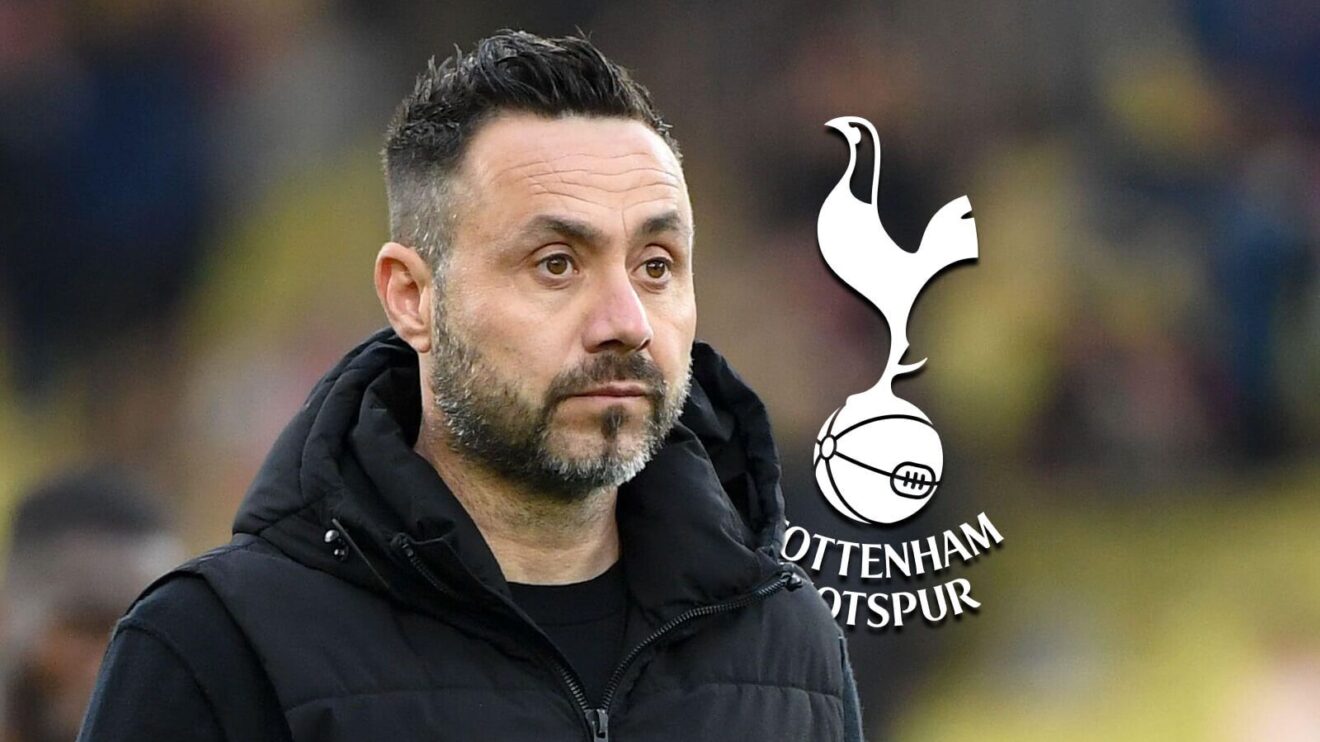
Italian professional manager and former player, Roberto De Zerbi, has returned to England to serve as the new Head Coach of Tottenham Hotspur’s football team.
He will fight to ensure the London team does not play in the Championship next season, as the team currently sits one point from relegation.
The former Brighton manager is taking over from Igor Tudor, who parted ways with Tottenham a few days ago.
In a statement, Spurs said the appointment of De Zerbi is subject to a work permit.
The club’s Sporting Director, Mr Johan Lange, said, “Roberto was our number one target for the summer and we are very pleased to be able to bring him in now.
“He is one of the most creative and forward-thinking coaches in world football, and brings with him a wealth of experience at the highest level, including in the Premier League.”
Reacting to his choice for the job, De Zerbi said, “I am delighted to be joining this fantastic football club, which is one of the biggest and most prestigious in the world.
“In all my discussions with the club’s leadership, their ambition for the future has been clear – to build a team capable of reaching great achievements, and to do that playing a style of football that excites and inspires our supporters. I am here because I believe in that ambition and have signed a long-term contract to give everything to deliver it.
“Our short-term priority is to climb the Premier League table, which will be the complete focus until the final whistle of the last game of the season. I’m looking forward to getting out on the training pitch and working with these players to achieve that.”
De Zerbi earned almost 300 appearances in his playing career across 15 years. He began coaching in his native Italy and in June 2018, joined Serie A side Sassuolo, earning recognition for his exciting, attack-minded and possession-based approach.
He took charge of Shakhtar Donetsk in May 2021, leading them to the UEFA Champions League group stage and the Ukrainian Super Cup – his first piece of silverware as a coach.
Heading to East Sussex to join Brighton & Hove Albion in September 2022, De Zerbi helped secure the Seagulls’ highest-ever Premier League finish in his debut season, earning European qualification for the first time in the club’s history.
In his most recent role at Marseille, the Ligue 1 side finished as runners-up in 2024/25, earning a spot in the UEFA Champions League.

You don’t start by looking at your cards. That’s the rookie mistake.
You start by looking at people.
Who’s relaxed. Who’s fidgeting. Who bets fast. Who hesitates just a second too long. Around a poker table, information leaks in tiny cracks — a twitch, a rhythm, a pattern — and the players who notice those details are the ones who quietly stack chips while everyone else blames luck.
Now move that table from a dim casino room to a busy office in Accra, Nairobi, or Johannesburg. Replace chips with capital, cards with market signals, and suddenly poker doesn’t feel like a game anymore. It feels like business. It feels like survival.
African entrepreneurs don’t operate in perfectly mapped environments. They operate in motion — currencies shift, regulations evolve, infrastructure improves in bursts rather than straight lines. In that kind of ecosystem, decision-making stops being about certainty and becomes something else entirely: interpretation.
And poker? Poker is pure interpretation.
The Myth of Perfect Information
One of the biggest lies in both poker and business is the idea that you’ll “know” when the time is right.
You won’t.
In poker, you see two cards. That’s it. Everything else — the opponent’s hand, the next card, the final outcome — is hidden behind probability and psychology. The best players don’t wait for clarity. They act in its absence.
Entrepreneurs across Africa face the same fog. Market data can be incomplete. Consumer behavior can shift faster than reports can track. Sometimes, by the time you’re “sure,” the opportunity is already gone.
So what do the best do?
They move anyway. Not blindly — never blindly — but with enough conviction to accept that imperfect decisions are often better than perfect hesitation.
Calculated Aggression: The Fine Line Between Bold and Broke
Poker punishes extremes.
Play too safe, and you slowly disappear. Play too aggressively, and you implode. The real skill lies in controlled pressure — knowing when to lean in, when to raise the stakes, and when to let the hand go.
This is painfully familiar for entrepreneurs.
Expand too early, and you stretch your resources thin. Stay too cautious, and someone else captures your market. Across Africa, where access to capital isn’t always forgiving, this balancing act becomes almost instinctive.
The strongest founders aren’t gamblers. They’re selective attackers.
They choose their moments.
They commit when the odds tilt slightly in their favor.
And most importantly — they accept that even the right move can fail.
Reading the Market Like You Read Opponents
A poker table talks. Not loudly, but constantly.
There’s the player who only bets when strong. The one who bluffs too often. The one who can’t handle pressure. Over time, patterns emerge, and the game stops being random.
Markets behave the same way.
Customers reveal preferences through hesitation. Competitors expose weaknesses through pricing shifts. Entire industries whisper signals before they make headlines. The entrepreneur who learns to “read the table” doesn’t just react — they anticipate.
In many African economies, this skill becomes even more valuable because formal data often lags behind reality. What replaces it? Observation. Conversations. Street-level insight.
In other words: human reading.
The Discipline of Folding
Here’s something poker teaches brutally well: you can have a decent hand and still lose everything by refusing to let it go.
Folding feels like failure. It isn’t.
It’s preservation.
Entrepreneurs struggle with this more than they admit. There’s pride attached to ideas. Emotional investment. Time. Identity. Walking away from a project — even when it’s clearly draining resources — feels like giving up.
But the best operators understand something simple:
Not every hand deserves to be played to the end.
In fast-changing environments, especially across emerging markets, the ability to pivot or exit isn’t weakness. It’s strategy.
A Quiet Shift: Strategy as Entertainment
Interestingly, this mindset is no longer limited to boardrooms or high-stakes investors. It’s creeping into how people engage with digital platforms across the continent.
Gambling platforms are part of that shift. They’re not just about chance; they reflect a growing curiosity for decision-driven environments where reading patterns, timing actions, and managing risk matter. In places where searches for online poker ghana are steadily rising, what you’re really seeing isn’t just interest in a game — it’s interest in strategic thinking, in controlled risk, in learning how decisions unfold in real time. For some, it becomes a surprisingly effective mental gym, where judgment sharpens quietly, hand after hand.
Emotional Control: The Invisible Skill
Poker players have a word for emotional collapse: tilt.
It’s what happens when logic leaves the room.
One bad hand. One unexpected loss. Suddenly, decisions become reckless. You chase losses. You overcorrect. You stop thinking clearly.
Business has its own version of tilt.
A failed launch. A lost investor. A deal that collapses at the last second. The temptation to react emotionally — to rush, to panic, to double down irrationally — is real.
The difference between those who recover and those who spiral?
Control.
The ability to pause, reset, and treat the next decision as independent from the last. That quiet discipline is often more valuable than intelligence.
Bluffing, or the Art of Belief
Let’s be honest: every entrepreneur bluffs at some point.
Not in a dishonest way — but in the sense of projecting confidence before results exist. You pitch a vision that isn’t fully built. You sell an idea before it’s proven. You convince others to believe before the evidence catches up.
That’s not deception. That’s creation.
Poker has taught that a bluff should only succeed when it is believable. It requires form, time and table consciousness. Business works the same way. Trust is false, and goes to pieces. but confidence which is supported by preparation? And that is the way things go.
Playing the Long Game
Amateurs are obsessed with single hands. Professionals do not think continuously.
Entrepreneurship is not an exception.
One good result is not what makes you. One failure does not mean it is over. Trajectory is what is important – how you fit in, how you train, how you prepare yourself to take the next chance.
In the rapidly changing African markets, this long-term thinking is becoming a characteristic of the sturdy founders. They are cognizant of the fact that volatility is not a challenge, but the environment itself.
Last Hand: Risk Is Not the Enemy
Poker does not give you lessons on how to evade danger.
It is the lesson of sitting opposite it without flinching.
That is the reality African business men are used to. All decisions are uncertain. There is no move that does not have trade-offs. And those who learn to read the table, learn to read the signals, to control the passions, and to do things without full information, are starting to see one thing that others do not see.
Risk isn’t chaos.
It’s a language.
And when you know how to read it, everything is different in the game.
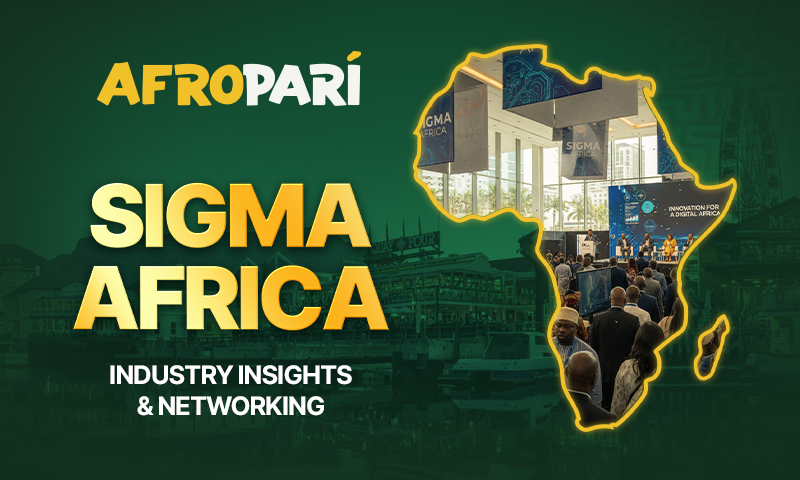
The SiGMA Africa 2026 summit held in Cape Town brought together more than 20 national regulators and confirmed major changes taking place in the region. The African iGaming market has finally moved from a phase of rapid, uncontrolled growth to a model of deep structuring and systematic regulation. AfroPari representatives share the insights they gained at the event.
Market shift
The African market is no longer a testing ground for unrefined products. The period of chaotic audience growth has been replaced by a stage of maturity. Today, market conditions and user expectations set higher standards for operators.
Regulation drives trust
One of the key insights from the summit was a new view of compliance: it is shifting from a formal requirement into the foundation of a long-term strategy. Transparency of AML procedures and protection of player interests are becoming standard parts of the operating model. Game safety and transparent operations are no longer a competitive advantage as they are the basic requirements for entering the market.
Against this background, the B2G (Business-to-Government) model is taking center stage. Direct dialogue between businesses and regulators makes it possible to jointly shape the rules of the market, which is especially important given the diverse legal frameworks across African countries. Cooperation instead of distance is becoming the new industry standard.
Localization is key to leadership
Experts at the summit agreed that universal global strategies no longer work in Africa. Brands that adapt and fit into the local context are winning through understanding cultural patterns and real user behavior, building local partnerships, and carefully integrating local payment methods Africa, especially mobile online payments.
AfroPari: Practical application of trends
AfroPari shows that meeting market needs today is not about following trends but about working precisely with user behavior. Relying on real feedback and a mobile-first architecture helps keep the product intuitive and easy to access.
“The African market is maturing. Today, it is not enough to simply create a strong product. The key is the ability to work within local requirements and quickly adapt to the conditions of the countries where you operate. For us, SiGMA Africa is also a chance to confirm that AfroPari is developing at the right pace, while staying convenient and easy to understand for users in every part of the continent,” said an AfroPari representative.
AfroPari is developing a platform built around the behavior patterns of the African audience, where the smartphone remains the main device. The intuitive interface and simplified navigation are supported by the integration of mobile money payments through local services such as Airtel, M-Pesa, and Orange, which directly improve access and speed up interaction with the product.
AfroPari’s nomination for the iGaming Africa awards shortlist in the Best Casino Operator 2026 category marks the brand’s strong market position. Competition with global operators only reinforces the main point: at the current stage of market development, success comes from deep local expertise, adaptation to payment infrastructure, and a well-structured compliance system.
Conclusion
The market has changed: the rules are now clearer, and competition is more structured. The future of African iGaming is being shaped by operators who can combine advanced technology with deep local expertise and strict compliance with regulatory requirements.
AfroPari’s nomination confirms that this approach is already becoming an industry standard. The market will continue to grow more complex, with higher demands ahead. African iGaming is entering a stage of maturity where success is defined not by how fast a company grows, but by its ability to operate in a transparent and regulated environment.
This is why events like SiGMA Africa 2026 play a critical role. They help shape the overall structure of the industry, where dialogue between operators and regulators becomes the norm, and transparency becomes a basic requirement for growth.












-
 Feature/OPED6 years ago
Davos was Different this year
-
Travel/Tourism10 years ago
Lagos Seals Western Lodge Hotel In Ikorodu
-

 Showbiz3 years ago
Estranged Lover Releases Videos of Empress Njamah Bathing
-
 Banking8 years ago
Sort Codes of GTBank Branches in Nigeria
-

 Economy3 years ago
Subsidy Removal: CNG at N130 Per Litre Cheaper Than Petrol—IPMAN
-

 Banking3 years ago
Sort Codes of UBA Branches in Nigeria
-

 Banking3 years ago
First Bank Announces Planned Downtime
-

 Sports3 years ago
Highest Paid Nigerian Footballer – How Much Do Nigerian Footballers Earn