Connect with us

Sports

Nigeria Loses Bid to Co-host AFCON 2027

Published

on

afcon 2027

By Adedapo Adesanya

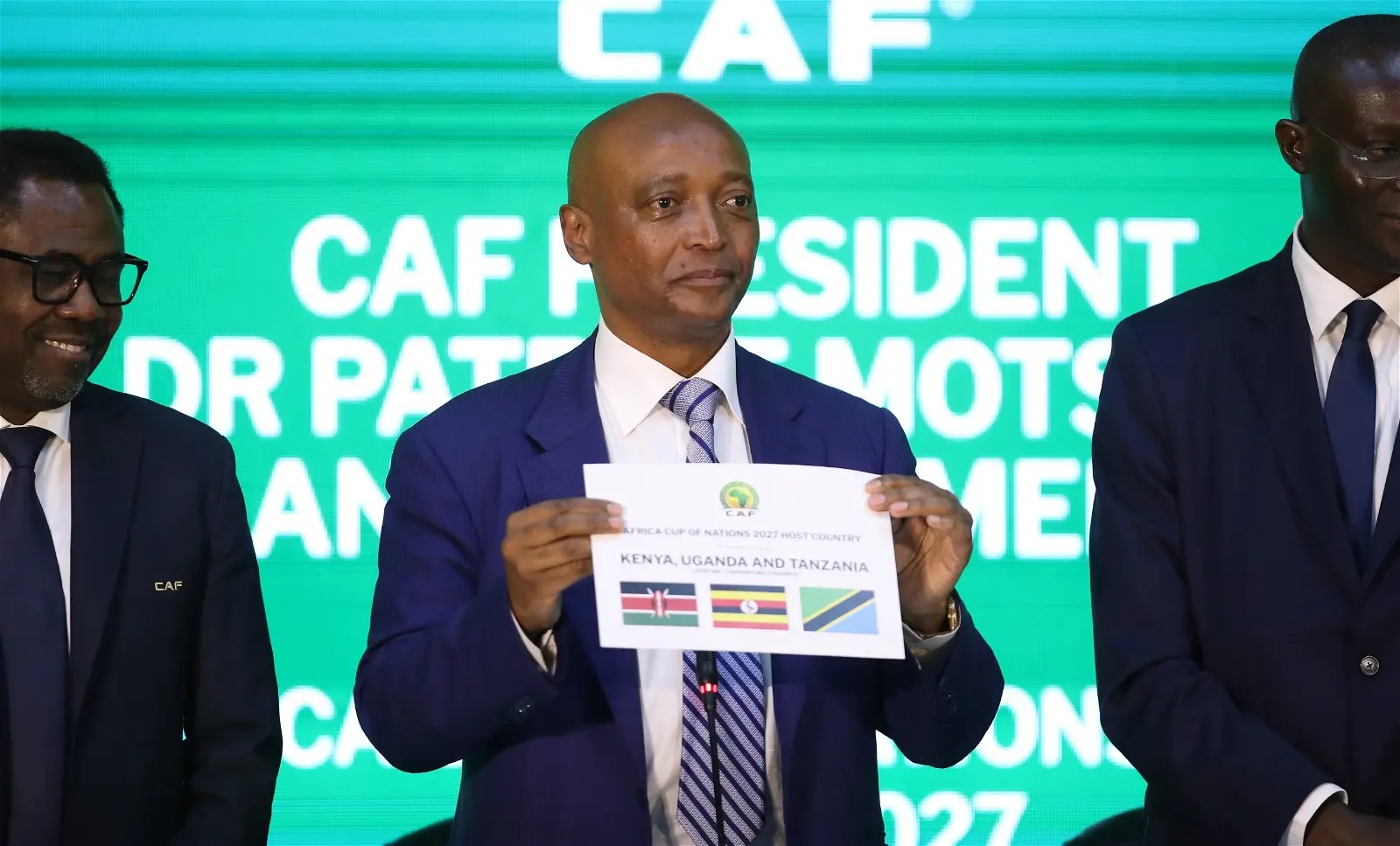
Nigeria and its neighbour, Benin Republic, will not jointly host the 2027 Africa Cup of Nations (AFCON) as the Confederation of African Football (CAF) has favoured the trio of Kenya, Uganda and Tanzania for the continental football tournament.

The apex football governing body in Africa on Wednesday also announced Morocco as the host of the biennial competition in 2025.

Morocco last hosted the AFCON in 1988 and was chosen in 2015 but asked for the tournament to be postponed because of the Ebola virus, although CAF later decided to strip the North African nation of the hosting rights.

While Morocco were hot favourites to host the 2025 edition of the premier African sport event, the shock last-minute withdrawal of Algeria from the 2027 race on Tuesday threw it wide open.

“This withdrawal can be explained by a new approach from the FAF (Algerian Football Federation) related to its strategy for developing football in Algeria,” it said.

The Kenya-Uganda-Tanzania bid then got the nod from the CAF executive committee, taking the tournament back to East Africa for the first time since Ethiopia staged the 1976 finals.

“I am very proud of Morocco,” said CAF president, Mr Patrice Motsepe, after naming the successful hosts in Cairo.

“Morocco’s competing countries (for the 2025 tournament) — Algeria, Zambia and Nigeria-Benin — announced their withdrawal, even if these countries still made their presentation,” he said.

“The main reason is to support Morocco in its candidacy for the 2030 World Cup,” jointly with Spain and Portugal, explained Motsepe.

Morocco boasts many world-class stadiums and has successfully hosted numerous African and world football tournaments.

But Kenya and Tanzania have only one international-standard venue each and Uganda none, which forced their national team to play 2023 Cup of Nations qualifiers at neutral venues.

“One of the key objectives is that the decision that was taken today (promotes) the development of infrastructure and stadiums (and) be a source of enthusiasm among young people,” said Motsepe.

Ivory Coast will host the 2023 Cup of Nations, which has been put back to January and February 2024 due to the rainy season in West Africa.

“The timing is not ideal,” Mr Motsepe has said, referring to the tournament falling in the middle of the European club season.

“But we could not risk the tournament being disrupted by inclement weather,” added the South African billionaire, who was appointed CAF president in 2021.

The Cup of Nations has grown from a three-team tournament in Sudan in 1957 to a 24-team event since 2019 and attracts a worldwide TV audience.

Egypt has been the most successful country with seven titles, including three in a row from 2006. Cameroon triumphed five times and Ghana are four-time champions.

Nigeria has been victorious on three occasions 1980, 1994, and the last coming in 2013 when the late Stephen Keshi led the team to victory with a 1-0 win over Burkina Faso in Johannesburg, South Africa.

The line-up for the next edition in five Ivorian cities includes the top 16 African countries in the latest FIFA rankings, led by 2022 World Cup semi-finalists Morocco.


Adedapo Adesanya is a journalist, polymath, and connoisseur of everything art. When he is not writing, he has his nose buried in one of the many books or articles he has bookmarked or simply listening to good music with a bottle of beer or wine. He supports the greatest club in the world, Manchester United F.C.

Click to comment

Leave a Reply

Your email address will not be published. Required fields are marked *

Sports

The Role of Live Sports in Modern Entertainment

Published

on

world cup

Not many forms of entertainment still require people to show up in real time. Movies can be watched days later. Series can be binged over a weekend. Social media ensures that almost every major moment is available on demand. But live sports remain one of the few experiences where being present at the moment still matters.

The ongoing FIFA World Cup is proving exactly why. Every tournament comes with its own stories. There are the favourites expected to dominate, the underdogs rewriting expectations, and the players who suddenly become household names overnight. But beyond football itself, the World Cup continues to highlight something bigger: live sports have become one of the most powerful forces in modern entertainment.

What makes live sports different is simple: nobody knows how it ends. Unlike scripted television or pre-recorded content, sports thrive on unpredictability. A match can change in seconds. A last-minute goal can alter a nation’s mood. One decision, one save, or one upset can become a moment fans talk about for years. That uncertainty is what keeps people watching live rather than catching up later.

In an era where audiences increasingly consume content on their own schedules, live sports create a rare shared experience. Millions of people are reacting to the same moment at the same time. Conversations happen instantly online, and debates continue long after the final whistle.

The World Cup has once again shown how sports have evolved beyond competition into full-scale entertainment. The experience no longer begins at kick-off or ends at full-time. Pre-match analysis, expert commentary, post-match discussions, and digital conversations have become part of how fans engage with the game.

Access also plays a major role in this experience. Across Africa, fans continue to rely on platforms that bring the tournament closer to them. Through SuperSport on DStv and GOtv, viewers can follow the action live as it unfolds, experiencing every goal, upset and defining moment in real time rather than through highlights or social media clips.

This immediacy is part of why live sports remain so valuable in today’s entertainment landscape. While streaming has changed viewing habits and audiences have more content choices than ever before, sports still command attention in a way few other formats can.

The World Cup serves as a reminder that in a world of endless content, people still crave moments they can experience together. Live sports deliver exactly that: unscripted drama, shared emotions and memories that last long after the final whistle.

As entertainment continues to evolve, live sports have not lost their relevance. If anything, they have become even more important because in an age where almost everything can wait, some moments are simply better experienced live.

To make football’s biggest moment even more accessible, MultiChoice has introduced special World Cup bundle offers across DStv and GOtv ahead of the 2026 FIFA World Cup in the US, Mexico, and Canada. From June 1, 2026, new customers can get a full decoder kit plus a one-month subscription for ₦15,000 on either platform. The offer is aimed at helping more Nigerians stay connected to the tournament, which will feature 48 teams and 104 matches. Through SuperSport, viewers will enjoy full live coverage of all games, dedicated 24-hour World Cup channels, expert analysis, highlights, multilingual commentary including pidgin, and flexible viewing options on TV and streaming, so fans don’t miss any moment of the action.

Continue Reading

Sports

2026 World Cup Opening Day Fixtures and Betting Market Overview

Published

on

Betting Market Overview

The largest World Cup in history begins on June 11, with 48 teams competing across 104 matches over 39 days. The opening day sets the tone for the whole group stage, and the first results carry more tactical and psychological weight than they might appear to at this stage. For fans following the tournament through platforms offering options like live betting on BizBet Africa, the opening fixtures provide the first look at how World Cup markets respond in real time. The first Group A fixtures give an early indication of how the opening section may develop. Two matches on the schedule give the first real indication of how the group stage will develop.

The Opening Fixtures and What They Mean

The tournament begins with Mexico in Group A, a repeat of the 2010 opener remembered for Siphiwe Tshabalala’s first goal of that tournament. The 2026 edition opens the competition on the same ground, with both teams having qualified from difficult groups and neither carrying the status of clear favourite to top their section.

The second listed Group A fixture is Korea Republic vs Czechia, giving the section two early results before most other groups begin. Two Group A matches on the first day mean the section develops earlier than most of the tournament, and those results can influence how teams approach the next round of fixtures.

The opening day of a World Cup under the new 48-team format carries more significance than previous editions because the third-place qualification system makes early goal difference relevant in ways it has not been before. A team that wins its opening match by a wide margin can improve its goal-difference position early, which may matter later if third-place ranking becomes relevant.

Here is a summary of the opening day fixtures and the group context around them:

Match Group Key storyline
Opening match A Repeat of 2010 opener, historical weight
Second match A Completes first set of Group A fixtures

Both matches in Group A mean the section has its first two results before any other group has begun, giving it a head start on the overall standings picture.

Key Narrative Threads Across the Opening Week

The first five days of the tournament run from June 11 to 15 and cover the opening matches of almost all 12 groups. By the end of that window, every team will have played at least once and the group standings will have their first shape.

These are the storylines most worth tracking across the opening week:

  • Which squads affected by pre-tournament injuries show the most visible impact in their opening match
  • Whether the new third-place qualification system produces tactical caution in any opening fixtures
  • How the tournament’s leading goalscorer candidates perform in their first appearances
  • Whether any significant upset results in the opening round reshape the pre-tournament favourite picture
  • How the co-host nations perform across their respective opening fixtures

The opening week will produce the clearest early information about which squads are genuinely prepared for deep tournament runs and which face more difficult paths than their seedings suggested.

Why Opening Round Betting Markets Are So Unpredictable

Opening-round markets can move quickly because there is no current tournament form yet. Before kick-off, prices rely mainly on squad news, qualification results, recent friendlies and historical data. Once the match starts, that picture changes fast. A favourite that struggles in the first 15 minutes may drift in live markets, while an underdog that presses well, creates chances or controls possession can shorten before the first goal is even scored.

The markets most likely to move early are match winner, over/under and goalscorer. Over/under lines can react to tempo, early shots and defensive caution, while goalscorer prices often shift after lineups are confirmed. That is why opening-round markets are difficult to read from pre-match odds alone: the first few minutes can reveal more than a week of previews.

Continue Reading

Sports

Barred World Cup Referee Omar Artan to Officiate UEFA Super Cup

Published

on

Omar Artan UEFA Super Cup

By Adedapo Adesanya

European football body, UEFA, has appointed Somali referee Omar Artan to officiate the 2026 UEFA Super Cup after he was not allowed into the United States to officiate in the 2026 FIFA World Cup taking place in the US, Canada, and Mexico.

UEFA said Mr Artan will referee the August 12 game between Champions League winners Paris Saint-Germain and the Europa League winners, Aston Villa, in the Austrian capital, Salzburg.

The European football regulator said this follows discussions with its sister confederation, the Confederation of African Football (CAF).

Mr Artan got a hero’s welcome returning to Somalia on Wednesday, days after he was refused entry in Miami by US authorities despite being picked by FIFA for World Cup duty. US officials claimed Artan had connections to terror organisations without offering proof.

“The decision to appoint Artan to officiate the UEFA Super Cup match has been made in the framework of the Memorandum of Understanding (MoU) recently signed between UEFA and CAF to encourage cooperation in many areas, including refereeing. UEFA and CAF are united by a shared commitment to developing football at all levels and promoting the core values of unity, equality and non-discrimination,” UEFA said in a statement on Thursday.

Speaking on this development, Mr Aleksander Čeferin, UEFA president, said, “Omar Artan is an excellent young but already experienced referee, who has proven himself at the highest competition level of the Confederation of African Football. Football is made to connect people, and UEFA wants to show its respect to Omar and his outstanding officiating skills, which have earned him such a prestigious nomination. I am grateful to my friend CAF President Patrice Motsepe for supporting our initiative enthusiastically.”

Adding his input, Mr Patrice Motsepe, CAF president, said: “Omar Artan has made Somalia and the entire people of the African continent extremely proud. His receipt of the CAF Men’s Referee of the Year Award 2025 and his appointment as a referee of the FIFA World Cup 2026 are a recognition of his world-class refereeing ability and the international respect that he enjoys.”

“I am very thankful to my friend, Aleksander Čeferin, for enabling Omar Artan to officiate the UEFA Super Cup 2026 match. This is a great honour for Omar Artan and for African referees and is also an excellent example of football, bringing together and uniting people from Africa and Europe and worldwide,” he added.

The heroic referee has established himself as one of the world’s top referees and has been on the FIFA international list since 2018. Among the most notable matches he has officiated is the second leg of the 2025/26 CAF Champions League final. In recognition of his performances, he received the CAF Men’s Referee of the Year Award 2025.

Continue Reading

Trending