Connect with us

Travel/Tourism

Transcorp Hotels to Restructure Business, Sack 40% of Staff

Published

on

Transcorp Hotels

By Modupe Gbadeyanka

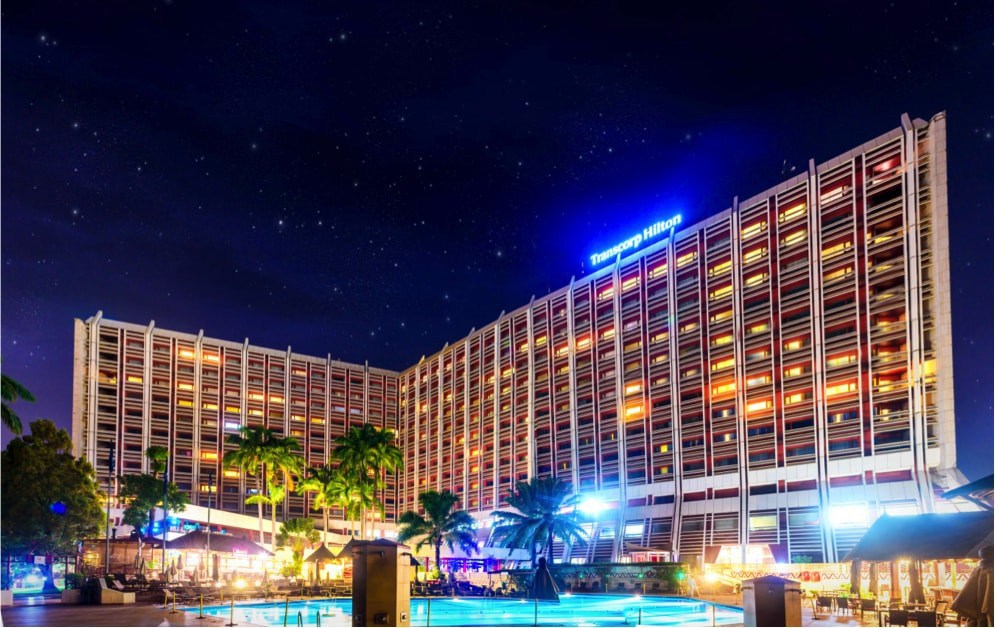
The management of Transcorp Hotels, operators of the popular Transcorp Hilton Abuja, has said in order to meet its business obligations, about 40 per cent of the company employees will have to go.

The Managing Director of the hospitality firm, Mrs Dupe Olusola, told newsmen on Thursday that its operations have been badly affected by the coronavirus disease and to remain in business, this tough decision has to be taken.

She said all executives of Transcorp Hilton Abuja have now taken a pay cut and that another action the management is taking is to restructure the company’s business operations.

“The impact of COVID-19 on the business is like nothing the company has ever witnessed.

“The hotel and hospitality industry in Nigeria has never faced a crisis that brought travel to a standstill, including the Ebola Virus outbreak of 2014 and the recession of 2015.

“The slow pick up of international travel, restriction on large gatherings, the switch to virtual meetings and fear of the virus, has drastically reduced demand for our hotels and occupancy levels to its lowest of less than 5 per cent,” Mrs Olusola said.

“To this end, our workforce headcount will be reduced by at least 40 per cent, and our reward system will be optimised,” she declared.

Many companies have continued to be affected by the contagion and in the second quarter of this year, the Nigerian economy contracted by 6.1 per cent and from the look of things, another recession is expected in the third quarter. It will be the second in over four years.

According to industry analysis, the novel COVID-19 pandemic has caused the African hotel and tourism sector to lose over $50 billion in revenue.

Amidst this, Transcorp Hotels, which trades its shares on the local exchange, has suffered unprecedented losses and is looking to restructure the business strategy of its hotels and optimize its operations. The company’s stocks have remained flat at N4 at the Lagos bourse for weeks.

In order to make up for the losses to COVID-19 and ensure business continuity, the management is diversifying its portfolio and embarked on some cost-optimisation strategies.

“We [have] activated various cost-saving initiatives such as renegotiations of service contracts and restructuring of our loans.

“We suspended further commitment to buy fixed assets and operating equipment as well as reducing our energy consumption and maintenance costs.

“Despite undertaking these, it has become apparent that more fundamental changes need to be made for the business to survive,” she said.

Also, the company’s head said negotiations with members of staff to be laid off in the downsizing exercise are ongoing and that a health insurance package to reduce their health burden costs and other payment settlements are being discussed.

But she said, “Despite the losses incurred, we have fulfilled our obligations to staff,” adding that, “At the inception of the pandemic, we maintained a 100 per cent salary payment to our over 900 employees in March and April.”


Modupe Gbadeyanka is a fast-rising journalist with Business Post Nigeria. Her passion for journalism is amazing. She is willing to learn more with a view to becoming one of the best pen-pushers in Nigeria. Her role models are the duo of CNN's Richard Quest and Christiane Amanpour.

Travel/Tourism

Passengers to Enjoy Starlink Wi-Fi on Emirates’ Flagship A380

Published

on

Emirates A380 Starlink

By Aduragbemi Omiyale

Air travellers flying through Emirates will enjoy Starlink Wi-Fi onboard after the completion of the installation of the internet service on the company’s flagship A380.

The introduction of Starlink on the A380 builds on Emirates’ ongoing investment into redefining the customer journey, including one of the most ambitious retrofit programmes in aviation history.

The airline operator recently test-run this on a flight to Dubai, and it allowed passengers to enjoy seamless broadband while flying at 40,000 feet.

The Emirates A380 was one of the first commercial aircraft in the world to offer internet to its customers, with first-generation systems offering a total aircraft bandwidth of less than 1 Mbps. The installation and certification were accomplished in Newquay, UK.

With more A380s scheduled for accelerated installation throughout 2026, Emirates customers will soon enjoy a transformative leap in onboard connectivity with the ability to stream, game, browse, and work throughout their journey on personal devices.

The service will be complimentary for all customers, across all cabins, with easy sign-up and access. Future enhancements will include Live TV streaming over Starlink, initially on personal devices and later integrated into seatback screens.

So far, more than 650,000 Emirates customers have already flown on Starlink‑equipped flights, experiencing the benefits of next‑generation onboard connectivity firsthand.

As the world’s largest passenger aircraft, the A380 presents unique engineering challenges and opportunities. This industry-first Starlink configuration is designed to meet the demands of the A380’s ‘double-decker’ layout and high passenger capacity and is capable of delivering more than 2 Gbps of total aircraft bandwidth across the cabin.

Compared with the Emirates Boeing 777, the Emirates A380 features additional wireless access points and a third antenna to deliver an enhanced connectivity experience for its higher passenger capacity. Optimised inter‑deck integration supports a seamless Wi‑Fi experience, with customers able to enjoy high speeds depending on usage and device capability.

Starlink installations will soon begin at Emirates Engineering facilities in Dubai to accelerate deployment across the fleet.

Emirates is committed to bringing the best possible connectivity to its entire fleet at the earliest opportunity, with 25 Boeing 777-300ER aircraft already equipped with Starlink and the first A380 now joining service.

Continue Reading

Travel/Tourism

Nigeria Caps Jet Fuel Prices, Allows Airlines Buy on Credit to Avert Disruptions

Published

on

aviation fuel Jet A1

By Adedapo Adesanya

The Nigerian government is capping jet fuel prices and allowing airlines to get supplies on credit as part of efforts to avert flight ​disruptions caused by soaring fuel costs.

Reuters reported that the Nigerian Midstream and Downstream Petroleum Regulatory Authority (NMDPRA) said in an internal document that aviation fuel should sell for N1,760 to N1,988 ($1.29 to $1.46) per litre in Lagos and N1,809 to ​N2,037 in Abuja, based on benchmarks from April 17 to April 23.

The decision follows ​emergency talks after airlines threatened to go on a strike, warning that jet fuel prices had jumped by more ​than 300 per cent, forcing fare increases and raising the risk of capacity cuts.

The strike was averted after the federal government met with the Airline Operators of Nigeria (AON) and other stakeholders.

President Bola Tinubu last week approved ‌30 per cent relief ⁠on airlines’ debts to aviation agencies and ordered fuel marketers, airlines and regulators to agree on a “fair” fuel price within 72 hours to prevent the sector-wide shutdown that would have impacted the country’s economy.

The talks also agreed to grant airlines a 30-day credit window to pay for fuel and ​tasked the aviation ​ministry with mediating debt ⁠disputes between operators and oil marketers, according to the document.

The NMDPRA also formed a technical committee, which recommended that fuel marketers sell ​directly to airlines within the indicated price range to cut ​costs and ⁠improve supply-chain transparency.

The committee also urged regulators to engage Dangote Petroleum Refinery and Petrochemicals over the increased premiums applied to international benchmarks used to price jet ⁠fuel.

Other recommendations ​include validating airside fuel distributors with adequate infrastructure, ​potentially reducing the number of authorised suppliers at airports, and considering jet fuel for Nigeria’s Crude-for-Naira initiative to ​limit airlines’ foreign exchange exposure. So far, the Crude-for-Naira has only been for upstream operations.

The cost of fuel has generally risen in the last two months due to the escalating war with Iran by the US and Israel, which has triggered one of the most severe energy shocks in decades. Oil prices are currently above $100 per barrel as markets react to escalating tensions and the risk of prolonged disruption.

At the centre of the crisis is the Strait of Hormuz, a chokepoint through which roughly one-fifth of global oil supply flows. With shipping constrained, the effects are cascading across the global economy, raising fuel costs, fueling inflation, and increasing the risk of economic slowdown across many economies. This is forcing airlines to raise fares, curb ⁠growth ​plans and rethink forecasts.

Continue Reading

Travel/Tourism

US to Nigerian Travellers: Visa Overstays Not Good for Fellow Citizens

Published

on

Nigerian Travellers US Visa Overstays

By Adedapo Adesanya

The United States (US) has warned that visa overstays by Nigerian travellers could deny future opportunities for other aspiring applicants.

The United States embassy had earlier in February stated that compliance would help protect visa access for students and business travellers.

In a reminder statement posted on its official X handle on Monday, the US Mission in Nigeria advised that strengthening compliance helps protect visa access for students, business travellers, and families who travel responsibly.

“#Reminder: Visa overstays by Nigerian travellers can affect opportunities for their fellow citizens. Strengthening compliance helps protect access for students, business travellers, and families who travel responsibly. If you are aware of visa fraud, please report it to [email protected] or [email protected],” the statement read.

Last August, the Mission also announced that all non-immigrant visa applicants must now provide details of their social media accounts from the past five years.

In a statement, the embassy said applicants are required to disclose usernames or handles from every platform used within the period when completing the DS-160 visa application form.

“Visa applicants are required to list all social media usernames or handles of every platform they have used from the last 5 years on the DS-160 visa application form. Applicants certify that the information in their visa application is true and correct before they sign and submit,” the statement read.

The mission warned that omitting such information could result in visa denial and render applicants ineligible for future visas.

The DS-160 is the standard online form required for most US non-immigrant visas, including temporary business (B-1), tourism (B-2), student visas (F and M), and work-related categories such as the H-1B.

It insisted the new rules were designed to enhance security, they come amid repeated US criticism of governments accused of clamping down on free speech online.

Continue Reading

Trending