World
Africa’s Mining Industry: New Opportunities for Cooperation with Russia and China
By Kestér Kenn Klomegâh
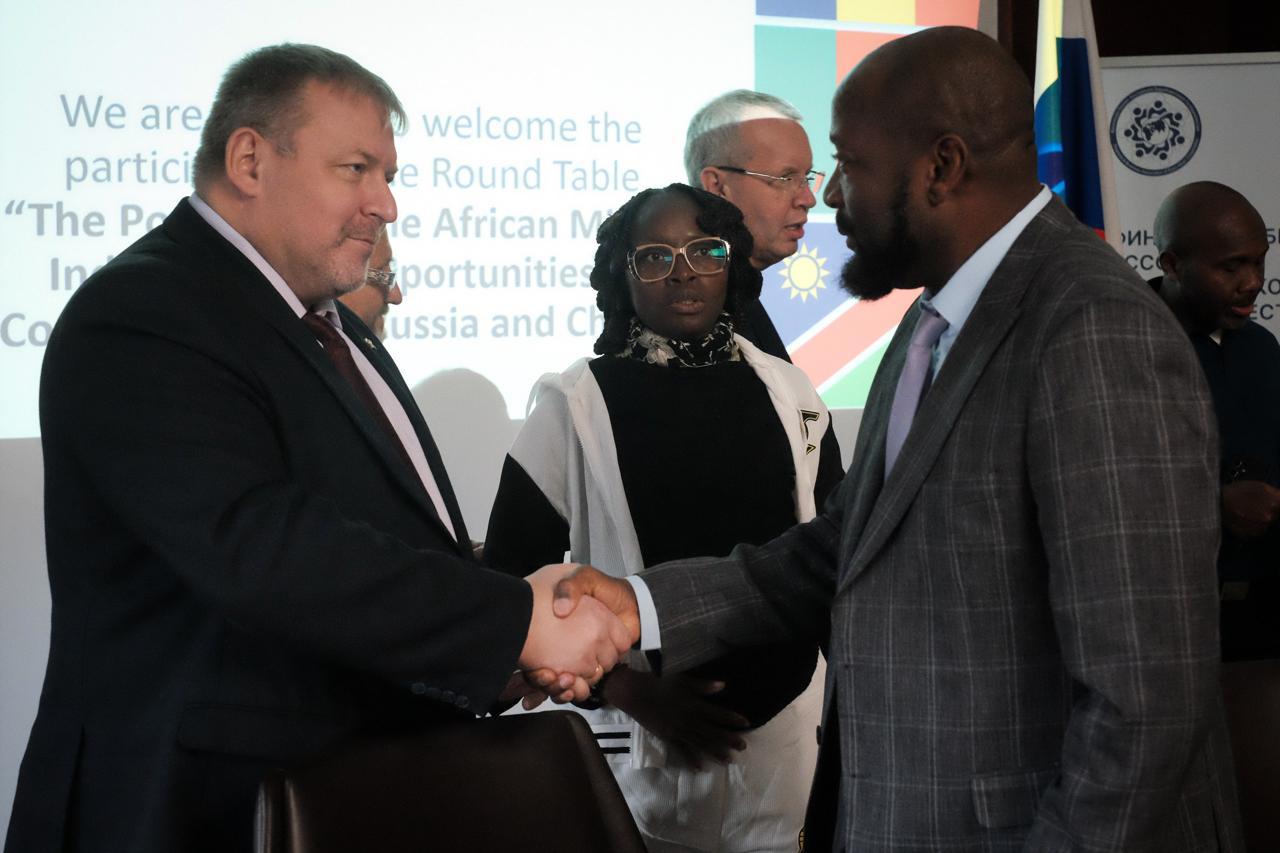
As part of the second international forum “Russia-Africa Expo-2025”, a roundtable discussion titled “The Potential of Africa’s Mining Industry: New Opportunities for Cooperation with Russia and China” was held at the conference hall of the Financial and Business Association of Euro-Asian Cooperation (FBAEAC). The event served as an important platform for strengthening the trilateral Russia-China-Africa partnership in industrial and technological development.
The roundtable was organized by the FBA EAC, with co-organizers including the Russian Chamber of Commerce and Industry’s Council for Financial, Industrial, and Investment Policy, the Peace Foundation, the State Duma Committee on International Affairs, the Russian-African Club of Lomonosov Moscow State University, Patrice Lumumba Peoples’ Friendship University of Russia (RUDN University), and the company “Kapital-Info.”
The event brought together over 70 participants – diplomats, as well as representatives from business, academia, and international organizations. Among them were delegations from more than 15 African countries, as well as from Russia, China, and Iran.
The Chinese delegation played a significant role in the event. Participants included Sun Yongjun, First Secretary of the Embassy of the People’s Republic of China, and Liu Yan, Second Secretary, along with representatives from the “Chongqing Pump Plant” (joining online): Su Ao, Ji Xiaodong, Yang Jiaquan, Yang Yiguang, and Wang Renjie. The participation of the Chinese side confirmed the practical focus of the trilateral cooperation and the readiness for joint implementation of projects in the mining industry.
The African side was represented by a wide range of participants: Jean Rick Biyaya Kadievu (Minister Plenipotentiary of the Embassy of the Democratic Republic of the Congo in Russia), Sid’Ahmed Cheikh Ould Aichetou (Ambassador Extraordinary and Plenipotentiary of the Islamic Republic of Mauritania); Eric Rubayita (Counsellor of the Embassy of Rwanda); Diarra Hadja Niamé Mariam Fofana (President of the Program of Consultations and Actions for Women Leaders of Mali); Gerry Mane (Chairman of the National Regulatory Authority for Communications and IT, Guinea-Bissau); Pierre Bangourou (Africa International Trade Connection, Côte d’Ivoire); Yumssi Tichuè (Général Import Export SARL, Cameroon); Amadou Demba Sy (Demba Mining & Frères, Cameroon); Domou Nouble Bruno Alkis (GIES, Cameroon).
The presentations by the African speakers emphasized the continent’s readiness to attract investments, adopt new technologies, and build sustainable production chains. Particular attention was paid to logistics, personnel training, and environmental issues.
The roundtable was also attended by a representative of Iran — Mehdi Rezazadeh, Founder and General Director of ZedPay Financial System & Services P.J.S.C. His participation further underscored the cross-regional nature of the discussion and the interest in expanding financial and technological cooperation within the context of industry projects.
Li Shaobin, President of the FBA EAC, addressed the participants with a welcome speech, noting that the development of cooperation with Africa in the mining industry opens new horizons for the entire Eurasian business space.
Ivan Borisovich Arkhipov, Deputy Chairman of the Russian-Chinese Friendship Society, also delivered a welcoming address, emphasizing the importance of strengthening humanitarian and economic ties.
Sergey Korotkov, Advisor to the President of the FBA EAC, presented a message from Vitaly Vovk, Deputy Director of the Industrial Policy Department of the Eurasian Economic Commission (EAEC). In his address, Vovk noted that the constructive discussion provides a new impetus for the development of sectoral cooperation and expressed the EAEC’s readiness to assist in developing specific mechanisms for collaboration.
A presentation by Roman Isakov, a recognized expert in the mining industry, attracted particular attention from the roundtable participants. Roman Isaevich delivered a report on “Technologies and Standards of Russian Mining Companies.”
Anatoly Tkachuk, Board Member of the Russian Union of Industrialists and Entrepreneurs (RSPP) and Head of the Center for International Projects and Programs at the International Congress of Industrialists and Entrepreneurs (ICIE), spoke about the RSPP and ICIE mechanisms for developing joint projects in the mining sector.
Furthermore, the Russian side was represented by Daria Michurina (RSPP), Yury Malakhov (Association of Machinery Manufacturers of Kuzbass), Alexander Kotlyarsky (PROMTEK LLC, First Vice President of FBA EAC), Anton Vasilyev (SPARTA LLC, Member of FBA EAC), Alexandra Matveeva (IBEC), Viktor Lazutin (RF CCI), and Igor Khmelkov (NOBIS Company), among others.
The roundtable was moderated by Louis Gouend, Founder and President of the African Business Club, Chairman of the Organizing Committee for “Russia-Africa Expo-2025”, and President of the Cameroonian Diaspora in Russia, together with Anna Geroldovna Bezdudnaya, Doctor of Economics, Professor, Head of the Department of Management and Innovations at SPbSUE, Executive Director of the R&D Center for Arctic Environmental-Economic Research, and Editor-in-Chief of the “FBA EAC Herald” journal.
During the discussion, participants examined a wide range of issues: the formation of joint working groups and industrial clusters, the creation of joint ventures, specialist training, financial support mechanisms, the implementation of environmental standards, and the expansion of logistics chains.
Following the event, participants highlighted the need to coordinate efforts among business communities, research centers, and government structures to implement specific investment and educational projects in the mining industry.
Key conclusions and recommendations developed during the discussion included:
(i) The need to promptly establish expert working groups to prepare pilot project initiatives.
(ii) Intensifying the exchange of technologies and equipment with the direct involvement of industrial manufacturers and engineering companies.
(iii) Developing joint educational programs and academic exchanges for training qualified personnel.
(iv) Strengthening institutional project support through guarantee mechanisms and financial instruments.
(v) Implementing unified environmental standards and sustainable development practices.
Within the framework of the changing global economic architecture, Russian enterprises are highly prioritizing investments in Africa, demonstrating readiness to invest, particularly in energy, industrial technology, and infrastructure; and compete with global players.
Undoubtedly, Africa is fast becoming one of the most significant centers of power, attracting external players. One lingering question is how promptly the recommended measures designed would address historical investment gaps and ensure that agreements reached at the ‘Russia-Africa Expo-2025’ would lead to tangible outcomes.
World
Africa Startup Deals Activity Rebound, Funding Lags at $110m in April 2026
By Adedapo Adesanya
Africa’s startup ecosystem showed tentative signs of recovery in April 2026, with deal activity picking up after a subdued March, though funding volumes remained weak by recent standards, Business Post gathered from the latest data by Africa: The Big Deal.
In the review month, a total of 32 startups across the continent announced funding rounds of at least $100,000, raising a combined $110 million through a mix of equity, debt and grant deals, excluding exits. The figure represents a notable rebound from the 22 deals recorded in March, suggesting renewed investor engagement after a slow start to the second quarter.
However, the recovery in deal count did not translate into stronger capital inflows. April’s $110 million total marks the lowest monthly funding volume since March 2025, when startups raised $52 million, and falls significantly short of the previous 12-month average of $275 million per month.
The data highlights a growing divergence between investor activity and cheque sizes, with more deals being completed but at smaller ticket values.
The data showed that, despite this, looking at the numbers on a month-to-month basis does not tell the whole story of venture funding cycles as a broader 12-month rolling view presents a more stable picture of Africa’s startup ecosystem.
Based on this, over the 12 months to April 2026 (May 2025–April 2026), startups across the continent raised a total of $3.1 billion, excluding exits – largely in line with the range observed since August 2025. The figure has hovered around $3.1 billion, with only marginal deviations of about $90 million, indicating relative stability despite recent monthly dips.
A closer breakdown shows that equity financing accounted for $1.7 billion of the total, while debt funding contributed $1.4 billion, alongside approximately $30 million in grants. This composition underscores the growing role of debt in sustaining overall funding levels.
The data suggests that while headline monthly figures may point to short-term weakness, the broader funding environment remains resilient, supported in large part by continued activity in debt financing, even as equity investments show signs of moderation.
The report said if April’s total amount was lower than March’s overall, it was higher on equity: $74 million came as equity and $36 million as debt, while March had been overwhelmingly debt-led ($55 million equity, $96 million debt).
In the review month, the deals announced include Egyptian fintech Lucky raising a $23 million Series B, while Gozem ($15.2 million debt) and Victory Farms ($15 milliomn debt) did most of the heavy lifting on the debt side. Ethiopia-based electric mobility start-up Dodai announced $13m ($8m Series A + $5m debt).
April also saw two exits as Nigeria’s Bread Africa was acquired by SMC DAO as consolidation continues in the country’s digital asset sector, and Egypt’s waste recycling start-up Cyclex was acquired by Saudi-Egyptian investment firm Edafa Venture.
Year-to-Date (January to April), startups on the continent have raised a total of $708 million across 124 deals of at least $100,000, excluding exits. The funding mix was almost evenly split, with $364 million in equity (51.4 per cent) and $340 million in debt (48.0 per cent), alongside a small contribution from grants (0.6 per cent). This is an early sign that funding startups is taking a different shape compared to what the ecosystem witnessed in 2025.
For instance, in the first four months of last year, startups raised a higher $813 million across a significantly larger 180 deals. More notably, last year’s funding was heavily skewed toward equity, which accounted for $652 million (80.1 per cent) compared to just $138 million in debt (16.9 per cent).
The year-on-year comparison points to two clear trends: a contraction in deal activity as evidenced by a 31 per cent drop, and a 13 per cent decline in total funding. At the same time, the composition of capital has shifted meaningfully, with debt now playing a much larger role in sustaining funding volumes.
World
Nigeria Summons South Africa Envoy Over Xenophobic Attacks
By Adedapo Adesanya
Nigeria’s Ministry of Foreign Affairs has summoned South Africa’s Acting High Commissioner to complain about xenophobic attacks against its citizens, weeks after a similar complaint was lodged by Ghana.
The ministry called the meeting to convey “profound concern regarding recent events that have the potential to impact the established cordial relations between Nigeria and South Africa,” it said in a statement posted on X on Monday.
It noted that the country is aware of the growing discontent among Nigerians concerning the treatment of their nationals in South Africa, but implored calm while it plans to repatriate those willing to return home voluntarily, amid growing fears that recent attacks on foreigners there could escalate.
Foreign Minister, Mrs Bianca Odumegwu-Ojukwu, said 130 applicants had already registered for the exercise, adding that the number was expected to rise.
She expressed President Bola Tinubu’s concern about the attacks in the southern African nation, and condemned the violence against foreign nationals and demonstrations characterised by “xenophobic rhetoric, hate speeches and incendiary anti-migrant statements”.
“Nigerian lives and businesses in South Africa must not continue to be put at risk, and we remain committed to working to explore with South Africa ways to put an end to this,” she said.
She cited the killing of two Nigerians in separate incidents involving local security personnel, insisting that her government was demanding justice.
She said the Nigerian president’s priority was for the safety of citizens and “consequently, arrangements are currently underway to collate details of Nigerians in South Africa for voluntary repatriation flights for those seeking assistance to return home”.
According to reports, four Ethiopian nationals have also been killed in recent weeks, while there have been attacks on citizens of other African countries.
South African President Cyril Ramaphosa has condemned the attacks but also cautioned foreigners to respect local laws.
He used his Freedom Day address last week – marking the country’s first democratic elections in 1994 – to remind South Africans of the support other African nations had given in the struggle against the racist system of apartheid.
However, anti-immigrant groups in South Africa have accused foreigners of being in the country illegally, taking jobs from locals and having links to crime, especially drug trafficking.
They have also reportedly been stopping people outside hospitals and schools, demanding to see their identity papers.
Last month, Ghana summoned South Africa’s top envoy after a video was widely shared showing a Ghanaian man being challenged to prove he had the correct immigration papers.
Anti-immigrant sentiment rose earlier this year after reports that the head of the Nigerian community in the port city of KuGompo (formerly East London) had been installed in a traditional role often translated as “king”. Some South Africans in the local area saw this as an attempt to grab political power and kicked against it.
South Africa is home to about 2.4 million migrants, just less than 4 per cent of the population, according to official figures. However, many more are thought to be in the country without official authorisation. Most come from neighbouring countries such as Lesotho, Zimbabwe and Mozambique, which have a history of providing migrant labour to their wealthy neighbour.
World
United States Building Entrepreneurial Partnerships With Africa
By Kestér Kenn Klomegâh
Within the heightening of geopolitical tension, the United States is actively building diversified entrepreneurial partnerships with African countries, reviewing and restyling working relations with relevant institutions and adopting new policy frameworks largely based on African-led initiatives. The economic policy architecture concentrates more on bilateral partnerships, but with some variation of investments in infrastructure and exploiting natural resources, while taking into account the needs of individual African countries.
In the context of broadening economic dimensions, the Corporate Council on Africa (CCA) and the Government of the Republic of Mauritius have agreed to hold the 18th US-Africa Business Summit on July 26-29, 2026.
According to reports, Dhananjay Ramful, Minister of Foreign Affairs, Regional Integration and International Trade of the Republic of Mauritius and Ms Florizelle (Florie) Liser, President and CEO of CCA, signed the agreement on the sidelines of the United Nations General Assembly in New York.
The US-Africa Business Summit is one of the most important business platforms that annually brings together African Heads of State and Government, Ministers, high-level US and African Government Officials, CEOs, and senior executives of the US and African companies to explore investment, trade and commercial opportunities.
The selection of Mauritius as the host country for the 18th US-Africa Business Summit bears testimony to the deep commitment of the country to play a key role in strengthening a mutually beneficial trade and investment relationship between Africa and the United States. Both envision facilitating bilateral trade and building long-term and high-value economic partnerships.
Positioned at the crossroads of Africa and Asia in the Indian Ocean, Mauritius is recognised for its political stability, reform-driven economy, strong governance, innovation-friendly policies and high-quality local infrastructure. It offers a strong regulatory framework, a sophisticated financial services sector, and a proven track record as a gateway for investment into Africa. As a dynamic financial and trade hub, Mauritius is an ideal setting for the 2026 US-Africa Business Summit.
With momentum building across both public and private sectors, this Summit provides an excellent opportunity for participants to engage on critical issues impacting the US-Africa trade and investment relationship and strike landmark deals in key sectors such as energy, infrastructure, agri-business, health, ICT and financial services that will have a high impact on the lives of African and American citizens, enterprises, workers and consumers.
In a thoroughly analytical study, the CCA has broadened its operational focus to the entire Africa, strategically dealing with institutions that matter for implementing its economic policy initiatives. In order to ensure a significant degree of success, CCA is seriously addressing the complex diversities on the continent, explaining to leaders within the political structures the essence of large-scale cooperation.
Florie Liser, President & CEO of CCA, said: “We are delighted to bring the 2026 U.S.-Africa Business Summit to Mauritius, a country known for its strategic location, strong governance, and dynamic business environment. This Summit will provide a critical platform to strengthen U.S.-Africa economic relations, explore investment opportunities, and foster partnerships that will increase two-way trade.”
Liser underlined the fact that high possibility exists for stronger engagement through initiatives that support trade and investment (including renewal of the African Growth and Opportunity Act (AGOA), and continued policy and financing support by key US government agencies including the Export-Import Bank of the U.S. (Eximbank), Development Finance Corporation (DFC), US Trade and Development Agency, Departments of State and Commerce, US Trade Representative and others.
The Dhananjay Ramful, Minister of Foreign Affairs, Regional Integration and International Trade of the Republic of Mauritius, stated: “Mauritius is honoured to host the 2026 US -Africa Business Summit and play a key role in strengthening a mutually beneficial trade and investment relationship between Africa and the United States. Our nation has long been a bridge between Africa and the world, and we are committed to creating an enabling environment that encourages trade, innovation, and inclusive growth. Hosting this prestigious gathering further underscores Mauritius’ role as a hub for investment and partnership in Africa.”
The United States brings a distinct and compelling value proposition to partnerships in Africa, grounded in transparency, high standards, and a long-term commitment to mutually beneficial US-Africa economic and commercial partnerships. In addition, the US companies are known for delivering quality products and services, fostering innovation, and building partnerships that prioritise local value creation, skills transfer, and economic impact. These are not short-term engagements—they are investments designed to support businesses and growth on both sides of the Atlantic.
That means continuing to mobilise capital, support competitive US participation in African markets, and ensure that partnerships are responsive to the priorities of African countries. The role of the Corporate Council on Africa is to help bridge that gap—connecting businesses to opportunities, advocating for policies that enable investment, and ensuring that the US–Africa commercial relationship remains strong, competitive, and mutually beneficial.
The Corporate Council on Africa (CCA) is the leading US business association focused solely on connecting business interests in Africa. It encourages US-Africa private sector partnerships and advocates for a business climate conducive to long-term investment. Founded in 1993, CCA has been at the forefront of fostering strategic partnerships, promoting investments, and facilitating trade between the United States and the diverse nations of Africa.
-
Feature/OPED6 years agoDavos was Different this year
-
Travel/Tourism10 years ago
Lagos Seals Western Lodge Hotel In Ikorodu
-
Showbiz3 years agoEstranged Lover Releases Videos of Empress Njamah Bathing
-
Banking8 years agoSort Codes of GTBank Branches in Nigeria
-
Economy3 years agoSubsidy Removal: CNG at N130 Per Litre Cheaper Than Petrol—IPMAN
-
Banking3 years agoSort Codes of UBA Branches in Nigeria
-
Banking3 years agoFirst Bank Announces Planned Downtime
-
Sports3 years agoHighest Paid Nigerian Footballer – How Much Do Nigerian Footballers Earn