

Connect with us

World

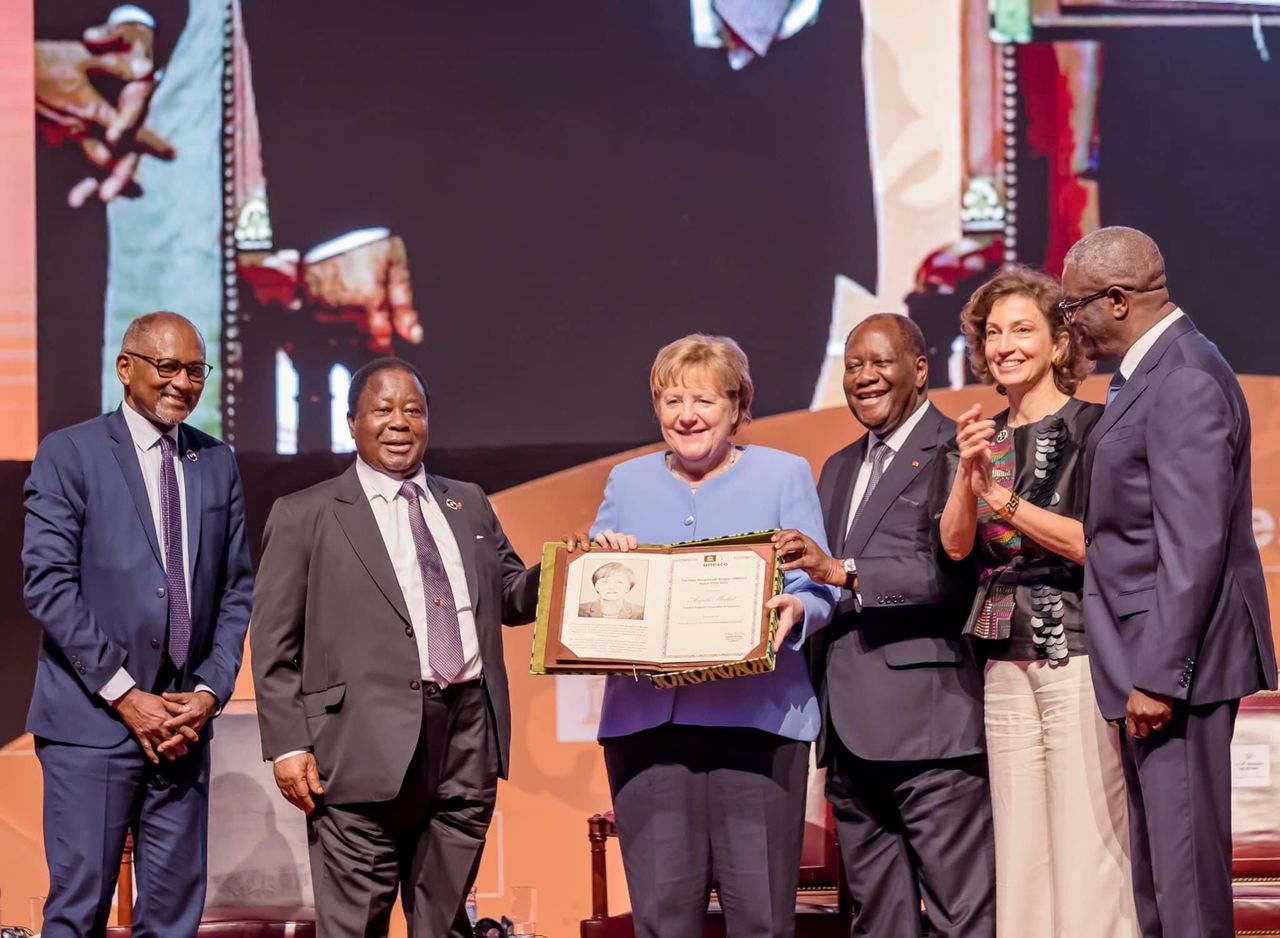
Angela Merkel Receives Félix Houphouët-Boigny-UNESCO Peace Prize

Published

on

Félix Houphouët-Boigny-UNESCO Peace Prize Angela Merkel
By Kestér Kenn Klomegâh

The Economic Community of West African States (ECOWAS, and also known as CEDEAO French and Portuguese) is a regional political and economic union of fifteen countries located in West Africa. Its main activities are connected with regional politics and economic and social questions in the region. But the organization also does cultural activities such as supporting exhibitions, traditional arts and music and offers public recognition to outstanding personalities.

In February, the ECOWAS officials gathered in Yamoussoukro to witness the Award Ceremony of the Félix Houphouët-Boigny-UNESCO Peace Prize. Many might have remembered the popular name – Félix Houphouët-Boigny – who was a politician and physician and later became the president of Cote d’Ivoire in West Africa. He served that country from 1960 until he died in 1993, according to his biography. Born on October 5, 1905.

Cote d’Ivoire, with an attractive beautiful sandy coastline, has a current estimated population of 25 million, and its citizens are French speakers. Côte d’Ivoire is a stunner, shingled with starfish-studded sands, palm-tree forests and roads so orange they resemble strips of bronzing powder. This is a true tropical paradise.

But what is important here is that Félix Houphouët-Boigny did a lot for his native country and its people. The Félix Houphouët-Boigny-UNESCO Peace Prize, named after the first President of the Republic of Cote d’Ivoire, was established in 1989 by a resolution unanimously adopted by 120 UNESCO Member States. It honours living individuals and active public or private institutions or organizations worldwide that have made a significant contribution to promoting, seeking, safeguarding or maintaining peace.

The 2022 Prize was awarded to Mrs Angela Merkel, former Chancellor of the Federal Republic of Germany, on 8 February during a special ceremony held in Yamoussoukro, Cote d’Ivoire. H.E. Mrs Fanta Cissé, ECOWAS Resident Representative in Cote d’Ivoire, took part in the official Award Ceremony of the Félix Houphouët-Boigny-UNESCO Peace Prize.

According to reports, the well-constituted jury awarded the 2022 Prize to Mrs Angela Merkel, former Federal Chancellor of Germany, for granting asylum and protection to more than one million people fleeing the war in Syria, Iraq, Afghanistan and Eritrea in 2015, when she was still in office.

Speaking during the occasion, President Alassane Ouattara noted that the hosting of the ceremony in Yamoussoukro was an opportunity to celebrate the efforts made to preserve the peace that was so dear to the Founding Father of the Ivorian nation while emphasizing the legendary hospitality of Cote d’Ivoire both in times of crisis and in times of peace.

He also congratulated and commended the Prize Winner, highlighting her leadership both in Germany and around the world and her values of courage, humanism and solidarity.

The ceremony featured several other addresses, notably by the Director-General of UNESCO, President Macky Sall, representing Mr Abdou Diouf, former President of the Republic of Senegal and Patron of the Prize, and former President Henri Konan Bedie, Sponsor of the Prize. They all commended the leadership of the Prize Winner, Mrs Angela Merkel, her courage, humanism and sense of solidarity. They also called for efforts towards building a better world.

After receiving her Prize, consisting of a certificate and a medal, from President Alassane Ouattara and Mrs Audrey Azoulay, the Director-General of UNESCO, Mrs Angela Merkel donated the accompanying cash prize worth $150,000 to “SOS Enfance en danger”, an NGO based in Cote d’Ivoire.

The jury also awarded an “honourable mention” to Mrs Julienne Lusenge, President of the NGO “Solidarité féminine pour la paix et le développement intégral,” for her commitment to women who were victims of sexual violence in the Democratic Republic of Congo. The ceremony ended with a group photograph and a reception hosted by the presidential couple.

The ceremony, chaired by Alassane Ouattara, President of the Republic of Cote d’Ivoire, was attended by several Heads of State, including Umaru Sissoco Embalo, President of the Republic of Guinea-Bissau, and Chairman of the ECOWAS Authority of Heads of State and Government; Nana Addo Dankwa Akufo-Addo, President of the Republic of Ghana; George Weah, President of the Republic of Liberia; and Macky Sall, President of the Republic of Senegal, and Chairperson of the African Union.

Former Presidents Henri Konan Bédié and Laurent Gbagbo, Mrs Thérèse Houphouët-Boigny, Tiémoko Meyliet Koné, Vice-President of the Republic of Cote d’Ivoire, Patrick Achi, Prime Minister of Cote d’Ivoire, Heads of State Institutions, Moussa Faki Mahamat, Chairperson of the African Union Commission, and the Director-General of UNESCO, Mrs Audrey Azoulay were also present at the important ceremony.


Advertisement
Click to comment

Leave a Reply

Your email address will not be published. Required fields are marked *

World

Russia’s Lukoil Losses Strategic Influence Across Africa

Published

on

Russias Lukoil

By Kestér Kenn Klomegâh

Lukoil, Russia’s energy giant, has seriously lost its grounds across Africa, due to United States sanctions. Sanctions have complicated the company’s potential continuity in operating its largest oil field projects, grappling its investment particularly in Republic of Ghana, Democratic Republic of Congo, and Federal Republic of Nigeria.

Reports indicated the sanctions are further dismantling most of Lukoil’s operations, causing significant staff layoffs in its offices worldwide. For instance, Lukoil’s significant upstream operations in the Middle East include a 75% stake in Iraq’s West Qurna 2 oilfield and a 60% stake in Iraq’s Block 10 development. In Egypt, the company holds stakes in various oilfields alongside local partners.

Lukoil has until December 13, 2025, to negotiate the sale of most of its international assets, including those in Asia, Africa and Latin America. It has already terminated several important agreements that were signed with international partners due to difficulties in circumventing the sanctions.

Reports said calculated efforts to diversify exploration business relations is turning extremely complex, and current at the cross-roads, Lukoil will have to ultimately give up existing contracts and agreements it had signed with external countries.

Lukoil’s website reports also pointed to reasons for abandoning oil and gas exploration and drilling project that it began in Sierra Leone.  According to those reports, Lukoil could withdraw from almost all of the projects in West Africa.

In addition to geopolitical sanctions, technical and geographical hitches, Lukoil noted on its website, an additional obstacles that “the African leadership and government policies always pose serious problems to operations in the region.” Similarly, the Kremlin-controlled Rosneft abandoned its interest in the southern Africa oil pipeline construction, negatively impacted on Angola, Mozambique, South Africa and Zimbabwe.

United States sanctions has hit Lukoil, one of the Russia’s biggest oil companies, like many other Russian companies, that has had a long history shuttling forth and back with declaration of business intentions or mere interests in tapping into oil and gas resources in Africa.

Continue Reading

World

Putin Launches RT India Broadcasting

Published

on

RT India Broadcasting

By Kestér Kenn Klomegâh

In New Delhi, President Vladimir Putin, alongside Editor-in-Chief of Russia Today, Margarita Simonyan, took part in the launch ceremony of the RT India TV channel. The TV channel will operate from a new studio complex in New Delhi, marking a new dimension in the bilateral media sphere.

Editor-in-Chief of Russia Today, Margarita Simonyan, indicated that the collaboration, naturally, points to India’s hospitality, affirming that this endeavour was not only worthwhile but long overdue.

Vladimir Putin, officially, launching the TV studio, also emphasized that the Russia Today channel in India, RT India, grants millions of Indian citizens clearer, more direct access into insights about contemporary Russia – the realities, aspirations, and perspectives. He reiterated the existing traditional friendship, and the ties between the Indian and Russian peoples go much deeper into the past; which rests on a solid historical foundation. And at the core of relationship lies mutual interest.

Russia Today is a source of truthful and reliable information, focused on serving the interests of its viewers and listeners. Its main mission is merely to promote Russia, its culture, and its positions on domestic and international issues. Above all, Russia Today strives to convey truthful information about the country and about what is happening in the world. This is the absolute value of Russia Today.

Continue Reading

World

Ease in Benin Republic as Attempt to Oust President Talon Fails

Published

on

Benin Republic map

By Adedapo Adesanya

The government of Benin Republic says its armed forces has foiled a coup attempt on President Patrice Talon by a group of soldiers , who claimed on national television to have seized power on Sunday.

At least eight soldiers, holding weapons, went on state television on Sunday morning to announce that a military committee led by Colonel Tigri Pascal had taken over and was dissolving national institutions, suspending the constitution and closing air, land and maritime borders.

According to their statement, Lieutenant-Colonel Tigri Pascal will be leading a military transition council.

Some hours after, the Interior Minister, Mr Alassane Seidou, said the country’s armed forces had thwarted the attempted coup and called for calm.

“Therefore, the government urges the population to go about their business as usual,” he said.

According to reports, 14 people had been arrested in connection with the foiled attempt to stop democracy in the country.

Foreign Minister, Mr Olushegun Adjadi Bakari, had earlier told Reuters that “a small group” of soldiers had attempted to overthrow the government but that forces loyal to President Talon were working to restore order.

He said the coup plotters had only managed to take control of state television, which was cut after the soldiers read out their statement. It resumed broadcasting shortly afterwards, allowing the interior minister to read his statement saying the coup bid had been foiled.

The Economic Commission of West African States (ECOWAS) and the African Union (AU) condemned the coup attempt.

Benin experienced several military coups and coup attempts in the first decades of independence from France in 1960. But there has not been a power grab by force in the country since it held multi-party elections in 1991.

Coups have become common place in Africa since 2020: Mali, Guinea, Sudan, Burkina Faso, Niger, Gabon, Madagascar, and recently Guinea-Bissau have seen military takeover in the recent times. This has raised alarms about possibilities in other African states.

Continue Reading

Trending
