Connect with us

World

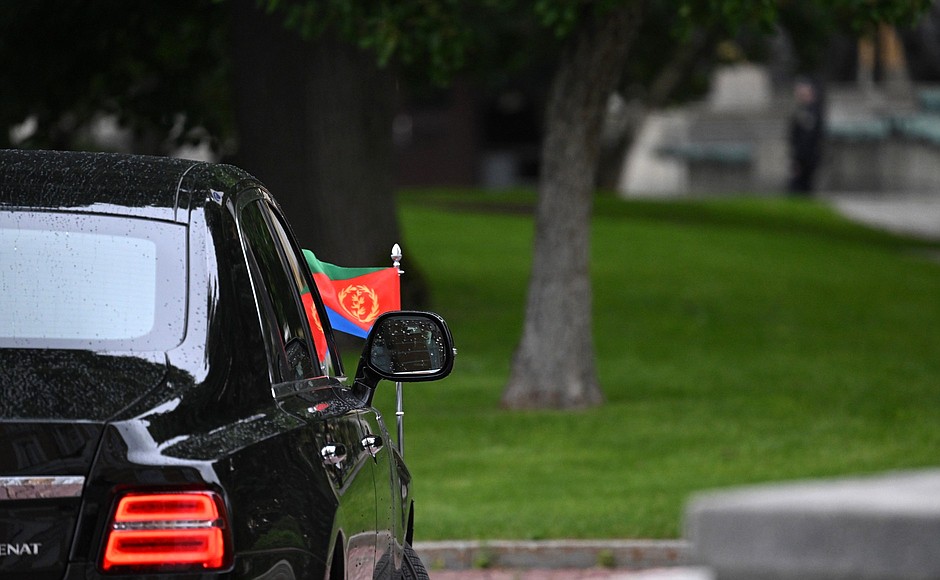
Imagine the Strategic Partnership between Asmara and Moscow

Published

on

Eritrea Asmara Moscow Kremlin

By Kestér Kenn Klomegâh

In this extremely poor Eritrea nation located in the Horn of Africa, with a population of 3.6 million, what factors could attract to strengthen cooperation in the spheres highlighted by Russian President Vladimir Putin during a meeting with President of the State of Eritrea Isaias Afwerki at the Kremlin.

According to reports from the Kremlin on May 31, Putin referred to the fact that Eritrea has recently marked 30 years of independence. This was when the two countries established diplomatic relations too.

Russia is attracted due to its highly strategic location. Eritrea is bordered to the northeast and east by the Red Sea, Sudan to the west, Ethiopia to the south, and Djibouti to the southeast. The undemarcated border with Ethiopia is the primary external issue currently facing Eritrea. Geopolitical history informed us that Eritrea’s relations with Ethiopia turned from that of cautious mutual tolerance, following the 30-year war for Eritrean independence, to a deadly rivalry that led to the outbreak of hostilities from May 1998 to June 2000 that claimed approximately 70,000 lives from both sides.

Despite the differences between Ethiopia and Eritrea, Russia maintains good relations with the two. But the main significance, as stressed during the meeting, was trade and economic relations which deserve primary attention. There could only be a few, of course not a lot, of potential in many areas. From our studies, agriculture makes up 11 per cent of the wider economy’s value and is the main economic activity in Eritrea.

In 2013, the pickup in growth had been attributed to the commencement of full operations in the gold and silver Bisha mined by Canadian Nevsun Resources, the production of cement from the cement factory in Massawa and investment in Eritrea’s copper and zinc. Chinese are very active in the mining sector, and the Australians operate Colluli potash mining. In 2020, the IMF estimated Eritrea’s GDP at $2.1 billion.

With that economic background, however, Russia sees an opportunity to develop trade and economic ties between the two countries. “Of course, we must, first of all, pay attention to the development of trade and economic ties, here we have good prospects in many areas,” Putin said.

As expected, there was a display of passion for packing official documents. After a series of substantive consultations on partnership and intensive preparations between Asmara and Moscow, the delegation signed several intergovernmental agreements. “I am sure that our talks today will be successful and will benefit the development of relations between the Russian Federation and Eritrea,” Putin stressed.

The trade turnover between Russia and Eritrea in 2022 amounted to $13.5 mln, including $11.5 mln from wheat exports, according to materials for the talks between Putin and Isaias Afwerki in the Kremlin.

“The trade turnover between Russia and Eritrea in 2022 amounted to $13.521 mln (exports: $12.745 mln, including $11.5 mln – wheat (27,500 tons); imports: $776,000),” the statement said.

In 2021, the trade turnover between the two countries amounted to $9.314 mln. Exports of wheat amounted to $8.125 mln, oil products – $175,000, and sulfates – $888,000. At the same time, imports of ready-made clothes reached $126,000.

According to the statement, Eritrea is highly interested in strengthening ties with Ural Automobile Plant and Kamaz. In 2018, Kamaz delivered 56 cars and 5 buses valued at around $5 million to Eritrea.

“In my view, the global order, which is on the cusp of a radical transformation, requires an objective appraisal and mutual consultations on the timeless subject matter and phenomena of paramount importance and significance. The common assessment that we undertake will, in turn, revitalise the formulation of programmes and partnerships that we chart on,” Isaias Afwerki said during the meeting.

Isaias Afwerki believes that Russia was the primary competitor and rival of the policy of encirclement and containment by the forces of domination from the early 1990s, and its global impact in the past 30 years was considerable indeed. Russia did not undertake, at the outset, all the necessary preparations for effective resistance.

An integrated and comprehensive strategy of resistance was not accordingly set in motion. But with time, as the latent policy of containment against China becomes more transparent, international awareness of the free people has increased.

“It is imperative to expand and deepen this awareness, chart out a comprehensive strategy and concrete plans that encompass all fields, create dynamic mechanisms, marshal the necessary resources to ascertain the advent of and transit to a civilised international order of mutual respect, cooperation, complementarity and prosperity, where justice and the rule of law prevail. This is not an option but an obligation,” he explicitly pointed out to Putin.

It is important to remember that Russian Foreign Minister Sergey Lavrov visited Eritrea in January 2023. He said the agenda for Russia-Eritrea cooperation focuses on implementing potential joint projects, including the logistics hub in Asmara. At a meeting at that time, Afwerki and Lavrov also discussed the radical changes in the international situation and key directions for the development of Russian-Eritrean relations. Lavrov reported to Putin about the results of his African tour at a Security Council meeting.

Afwerki has been president since 1993, when Eritrea gained independence from Ethiopia. He is the first and the only person to hold the post. Sergey Lavrov visited Eritrea in January as he toured Africa. The commercial activities revolve around this strategic location as a transit point, and the strategic location also makes the country prime for an increased military presence. This is the strategic importance for Russia.

Lavrov spoke extensively about economic cooperation. According to him, Russia’s truck maker KAMAZ was already working in Eritrea, supplying its products to that country, as was Gazprombank Global Resources, which was building cooperation in the banking sector. In the same year, 2018, concrete talks were held to build a logistics centre at the port of Eritrea, which makes the world’s class logistics and services hub for maritime transportation through the Suez Canal and is definitely set to promote bilateral trade.

Still that same year, Eritrea was interested in opening a Russian language department at one of the universities in the capital of the country, Asmara. Lavrov further indicated: “We agreed to take extra measures to promote promising projects in the sphere of mining and infrastructure development and to supply specialized transport and agricultural equipment to Eritrea.”

In April 2022, Eritrea’s top diplomat, Osman Saleh, made a quick reciprocal visit to Moscow to receive honour and congratulations for opposing the resolution in New York. That was in March 2022; Eritrea was one of the countries who voted against the resolution condemning Russia over the situation in Ukraine at the United Nations.

Eritrea is now a member of the African Union. The Eritrean government previously withdrew its representative to the African Union to protest the AU’s alleged lack of leadership in facilitating the implementation of a binding border decision demarcating the border between Eritrea and Ethiopia. Eritrea is also a member of the United Nations.


1 Comment

Leave a Reply

Your email address will not be published. Required fields are marked *

World

Russian Researchers Roadmap Africa’s Investment Sectors for Entrepreneurs

Published

on

Professor Irina Abramova Russian Researchers

By Kestér Kenn Klomegâh

The Centre for Transition Economy Studies of the Institute for African Studies of the Russian Academy of Sciences held a two-day scientific conference under the theme: “Industrial Development Strategies of African Countries” on March 18-19. The conference was opened by Professor Irina Abramova, Director of the Institute for African Studies. More than 40 researchers and experts from Russia, South Africa, Nigeria, Egypt and North Macedonia took part in the event.

The conference focused on a wide range of significant issues related to Africa’s industrial development, the modernisation of the African production base, and the potential for Russian-African cooperation. The in-person part of the conference focused on the development of the manufacturing and extractive industries, special economic zones, energy and transport infrastructure, digitalisation, and the agro-industrial complex. The second day of the conference was conducted as an online discussion in English, featuring African colleagues on the localisation of production chains in Africa, covering both agricultural and mineral processing.

Topics of the Conference included:

  1. Continental, regional and national programs and plans of industrial development in Africa. Prospects of continental and regional production chains.
  2. Study of the manufacturing market in African countries: manufacturing and agro-industrial complexes
  3. Energy, transport, and digitalisation: necessary infrastructure for industrial development.
  4. Interests of Multinational Corporations in Africa: conditions, forms of activities and geographical distribution. The role of free economic zones.
  5. Government policy regarding Multinational Corporations and control over export-import flows.
  6. The role of international organisations and activities of external actors.
  7. Possible areas and prospects for expanding mutually beneficial cooperation for Russian companies in Africa.

Experts in African studies from Russia, as well as representatives of the Russian government and business circles involved in trade and economic cooperation with African countries, actively participated. One of the significant outputs presented at the plenary session of the conference was the full-text on the African Development Strategy database created by Professors D. A. Degterev and A. D. Novikov, together with the staff of the IAS. The database covers more than 400 official strategic planning documents across 53 countries on the continent for the period 1997–2025. It systematises them under six thematic areas: long-term and medium-term development strategies, industrial policy, ICT, agriculture and the water sector.

The plenary session featured nine reports covering key dimensions of Africa’s industrial development. There were issues of trade and industrial potential of the continent that were highlighted in the report on the export specificity of African machine-building industries: based on ITC Trade Map data (2019–2024) that shows duties of South Africa, Tunisia, and industrial production, including on intracontinental markets.

Institutional mechanisms of Russian-African economic cooperation were reviewed in the report on the activities of Intergovernmental Commissions: the number of these ICC increased from four (4) in 2023 to nine (9) in 2025, and the volume of investment funds to support African projects is planned to increase, at least, to Rouble 5 billion for 2026–2027.

The conceptual dimension of financing industrialisation was presented through a critique of universal Western narratives and the justification for the need for an “application finance strategy”—a country model that takes into account the economy of Africa. Practical aspects of Russia’s investment presence in Africa are characterized on the example of projects in the countries of the Alliance of Sahel States (AES) with an emphasis on the specific risks of the subregion (DM Sinitsyn, VEB.RF). Digitalisation and artificial intelligence development in sub-Saharan African countries were also analysed and presented at the conference.

Russian-African cooperation in the field of technologies and education was covered in the reports on the transfer of agrobiotechnologies through the Afro-Russian Centre for Technology Development in Kampala, within which, in 2025/2026, this period, in which concretely 467 citizens of African countries were trained in Russian universities (NA Goncharova, FGBU “Agroexport”).

The competitive struggle of foreign players for African markets and the possibilities of Russian participation were considered in the reports on the position of the continent on the world energy markets, supplies of ground vehicles, and activities of pharmaceuticals for Africa. The digital dimension of industrialisation was covered by the reports on the cyber potential of West Africa, the formation of data processing centres in the industrial strategy of South Africa, and the digitalisation strategies of Algeria and Morocco.

The theme of most speeches, at the conference, became a reflection on the ‘disconnection’ between the proclaimed goals of industrialisation and the actual structure of African economies: despite the widespread proliferation of pre-national strategic documents, industries in the continent’s total GDP has not exceeded 10–12% for more than two decades, and exports still comprise mainly unprocessed raw materials.

In this regard, a number of reports justify the need to transition from external financial models formed by international organisations to sovereign country strategies based on state political, industrial and human resources. Global South—including, to deepen Russian-African cooperation in the spheres of technology, education and investment.

A collective monograph is, however, planned for publication following the conference. The event included the presentation of the full-text database on African development strategies, prepared by the team of the Institute for African Studies of the Russian Academy of Sciences.

Continue Reading

World

Court Finds Lafarge, Eight ex-Employees Guilty of Terrorism Financing

Published

on

Lafarge Africa

By Aduragbemi Omiyale

A court in Paris, France, has found notable French cement manufacturer, Lafarge, and eight of its former employees guilty of terrorism financing.

Delivering the judgment on Monday, Judge Isabelle Prevost-Desprez held that Lafarge paid some members of the Islamic State (IS or ISIS) in Syria about $6.5 million (€5.59 million; £4.83 million) between 2013 and 2014 to protect its plant operating in northern Syria.

The court said this action provided oxygen for the terror group to operate and carry out its violent acts.

The former chief executive of the company, Mr Bruno Lafont, was also found complicit and has been sentenced to six years.

“It is clear to the court that the sole purpose of the funding of a terrorist organisation was to keep the Syrian plant running for economic reasons. Payments to terrorist entities enabled Lafarge to continue its operations,” the judge said, adding that, “These payments took the form of a genuine commercial partnership with IS.”

The factory in Jalabiya, northern Syria, was bought by Lafarge in 2008 for $680 million and began operations in 2010, months before the civil war began in March 2011, following opposition to then-president Bashar al-Assad’s brutal repression of anti-government protests.

ISIS jihadists seized large swathes of Syria and neighbouring Iraq in 2014, declaring a so-called cross-border “caliphate” and implementing their brutal interpretation of Islamic law.

To keep its plant running and protect its employees, Lafarge, between 2013 and September 2014, paid about €800,000 to secure safe passage and €1.6 million to purchase source materials from quarries under the control of the jihadist groups.

According to the BBC, Lafarge acknowledged the court’s finding, which it said “concerns a legacy matter involving conduct that occurred more than a decade ago and was in flagrant violation of Lafarge’s code of conduct,” describing the decision as an “important milestone” in the company’s actions to “address this legacy matter responsibly.”

Continue Reading

World

Afreximbank Grows Assets to $48.5bn as Profit Hits $1.2bn

Published

on

Afreximbank

By Adedapo Adesanya

African Export-Import Bank (Afreximbank) has posted a robust financial performance for the 2025 financial year, with total assets and contingencies climbing to $48.5 billion.

This further shows its growing influence in financing trade and development across Africa and the Caribbean.

The Cairo-based multilateral lender, in its audited results released on April 9, reported a 21 per cent surge in total assets from $40.1 billion in 2024, underscoring sustained balance sheet expansion despite global economic headwinds and rating concerns.

Net loans and advances rose by 16 per cent to $33.5 billion, driven by strong disbursements into critical sectors including manufacturing, infrastructure, food security and climate adaptation, areas seen as pivotal to Africa’s long-term economic resilience.

Profitability remained strong, with net income climbing 19 per cent to $1.2 billion, up from $973.5 million in the previous year. Gross income also edged higher by 6.06 per cent to $3.5 billion, reflecting steady revenue growth supported by the bank’s expanding portfolio of trade finance and advisory services.

Afreximbank maintained solid asset quality, with its non-performing loan (NPL) ratio at 2.43 per cent, broadly stable compared to 2.33 per cent in 2024. This performance highlights disciplined risk management even as lending volumes increased across diverse markets.

Liquidity remained a key strength. Cash and cash equivalents rose significantly to $6.0 billion from $4.6 billion, while liquid assets accounted for 14 per cent of total assets, comfortably above the bank’s internal minimum threshold of 10 per cent.

Shareholders’ funds grew 17 per cent to $8.4 billion, supported by the strong profit outturn and fresh equity inflows of $299.4 million under its General Capital Increase II programme. The bank’s capital adequacy ratio stood at 23 per cent, well above regulatory benchmarks, providing a solid buffer for future growth.

Operating expenses increased to $459.2 million from $367.7 million, reflecting staff expansion and inflationary pressures. However, Afreximbank retained cost discipline, with a cost-to-income ratio of 21 per cent, still significantly below its 30 per cent ceiling.

The bank successfully tapped international capital markets, raising over $800 million through Samurai and Panda bond issuances in Japan and China during the year. The move helped counter concerns raised by some rating agencies and reaffirmed Afreximbank’s strong funding access and credibility.

Commenting on the results, Senior Executive Vice President, Mrs Denys Denya, said the performance reflects resilience and strategic execution amid a challenging global environment.

“Despite continuing global geopolitical challenges and disruptions caused by some rating actions, the Group delivered excellent financial performance in 2025,” he said.

He noted that the results cap a decade of transformative leadership under the erstwhile President, Mr Benedict Oramah, with the bank already ahead of most targets under its Sixth Strategic Plan, which runs through 2026.

Mr Denya added that newer subsidiaries, including the Fund for Export Development in Africa (FEDA) and AfrexInsure, are now profitable, contributing to earnings growth and strengthening the group’s diversified structure.

“The Group’s balance sheet is at its strongest level ever, with liquidity levels and capitalisation well above target and good asset quality,” he said.

Afreximbank said it is entering the 2026 financial year with strong momentum, positioning itself to scale impact, deepen trade integration and drive value addition across “Global Africa.”

Return metrics remained stable, with return on average equity at 15 per cent and return on average assets improving slightly to 3.04 per cent, signalling efficient use of capital.

With a fortified balance sheet, rising profitability and sustained investor confidence, Afreximbank said it is firmly on track to consolidate its role as a key engine of trade-led growth across the continent.

Continue Reading

Trending