Connect with us

World

Migration: UN Wants African Leaders to Tackle Poverty, Others

Published

on

By Dipo Olowookere

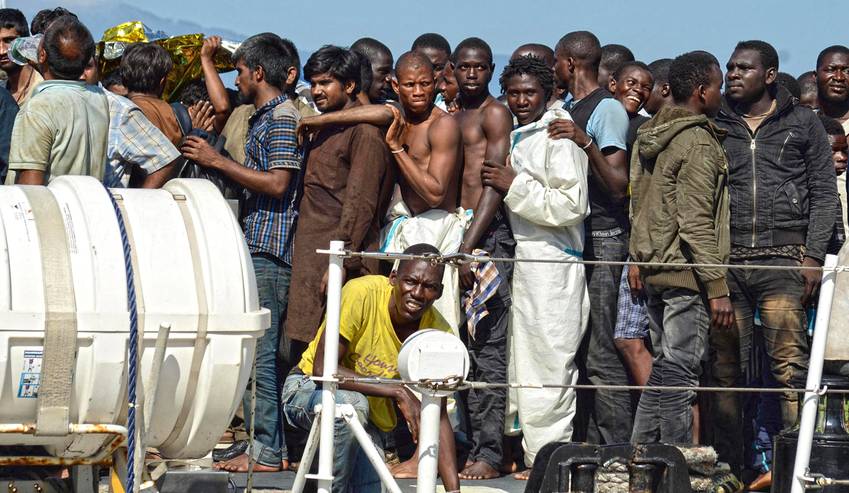
Every year, many Africans take the risky journey through the Libyan desert to the Mediterranean Sea and finally to Europe, where they feel the land is green.

While undertaking this journey, many of them die in the desert and the sea, while others are kicked up by Libyan rebels, who use them for slavery.

But the United Nations, which is worried by the issue, has advised African leaders to address the root causes of the mass migration to Europe. The global body said these root causes as poverty, conflict, discrimination and exclusion of all kinds.

Speaking at a special panel discussion, one of four Africa Dialogue Series 2019 side events, Secretary-General of the United Nations, Mr António Guterres, said, “The best way to protect refugees and displaced people is to prevent them from having to leave their homes. That means tackling root causes – poverty, conflict, discrimination and exclusion of all kinds.”

According to him, “The 2030 Agenda for Sustainable Development and the African Union’s Agenda 2063 are our roadmap. Both agendas are aligned around a people-centred and planet-sensitive transformation. Eradicating poverty is their overriding priority.”

He said, “African countries have a long record of keeping their borders, doors and hearts open to refugees and internally displaced people – an example not followed by everyone in the world.”

Business Post reports that at the meeting held on May 23 at the United Nations Headquarters in the United States, participant discussed the challenges faced by refugees, migrants and internally displaced persons (IDPs), their specific needs, including being recognized as a group that can bring significant benefits such as health, human capital development and the eradication of poverty.

Also speaking on the occasion, United Nations Deputy Secretary-General, Mrs Amina Mohammed, said the narrative about Africa needed to change in four principal respects.

“First, Africa’s progressive response to forced displacement must be recognized and supported

“Africa is not a continent of mass exodus. Most African migrants are educated and move within the continent for economic opportunities, contributing to growth.”

“Second, understandings of migration in Africa must align with the facts. Africa is not a continent of mass exodus; in fact, in 2017 less than 2.9 per cent of Africa’s population left the continent. Most African migrants are educated and move within the continent for economic opportunities, thereby contributing to growth,” she explained.

“Third, African youth play a catalytic role for peace, including by using social media to combat xenophobia. Finally, the economic outlook for Africa is positive, especially in light of the African Continental Free Trade Area, which will boost inclusive economic growth through infrastructure development and employment creation, especially for youth.”

“Forced displacement is not only a tale of human tragedy; it also poses a real threat to achieving peace, prosperity and development,” said Bience Gawanas, Under-Secretary General and Special Adviser on Africa to the UN Secretary-General.

“Behind each number (refugee), there is a human being. I, myself, am a product of African solidarity. Having left home in my teens during the war of liberation against apartheid in Namibia, I spent years in refugee camps in Angola and Zambia and benefitted immensely from the generosity of the Angolan and Zambian people. I want to take this opportunity to personally thank you for your big heart,” she said.

UNFPA strongly believes that durable solutions to forced displacement should include women and adolescent girls’ empowerment, as this is critical for peace, security and sustainable development of Africa, said Dereje Wordofa, Assistant Secretary-General and UNFPA Deputy Executive Director.

“When in possession of opportunities, education, safe environments, health care and services, regardless of their status [ … ] Africa’s young will continue to thrive.”

“Twenty-five years ago, a global revolution started in Cairo. The International Conference on Population and Development (ICPD) for the first time enshrined individuals’ right to make their own reproductive choices freely and responsibly.”

To harness the demographic dividend for Africa, investment in the continent’s youth is needed, he urged. “When in possession of opportunities, education, safe environments, health care and services, regardless of their status as citizens, migrant, forcibly displaced or refugee, Africa’s young will continue to thrive.”

María Fernanda Espinosa Garcés, President of the 73rd Session of the UN General Assembly, said Africa’s tremendous contribution to the UN continues to be under-appreciated and the region’s voice under-represented in the international system.

“We have what could be called a ‘solidarity deficit’ – multilateral decision-making processes, policies and programmes that should be skewed towards the needs, views and priorities of Africa are not yet there.

We need durable solutions – voluntary return or repatriation as appropriate, but also resettlement and integration.

“We need durable solutions – voluntary return or repatriation as appropriate, but also resettlement and integration. And we need greater political and financial support for transitions at the humanitarian-development nexus. The Global Compacts on refugees and migrations adopted last year provide a solid basis for us to move forward, and I call on leaders in Africa and across the world to implement them both,” she urged.

“It is critical to ensure that migrants and refugees have access to health and education services, including sexual and reproductive health, while protecting the health of host populations through improved implementation of international health regulations, said Mabingue Ngom, UNFPA Regional Director for UNFPA West and Central Africa.

Ekhlas Ahmed, a youth representative and former refugee from Sudan, spoke of her experiences:

“Everything started with the voice … Once I found my voice, I never stopped using it to ensure that women, girls and young refugees are treated with the dignity and respect they deserve.”

As part of the 2019 Africa Dialogue Series, the UN Office of the Special Adviser on Africa (OSAA), the Permanent Mission of the African Union to the United Nations, and UNFPA, the United Nations sexual and reproductive health agency, organized a side event at the United Nations Headquarters on 23 May on “Emerging issues from Africa ICPD Regional Reviews (Addis Ababa Declaration on Population and Development +5): Linkages between mobility, human dignity and refugees, returnees and IDPs – Celebrating successes and addressing challenges.”

The panel discussion was one of four Africa Dialogue Series 2019 side events organized around the 2019 theme of the African Union – “The Year of Refugees, Returnees and Internally Displaced Persons (IDPs): Towards Durable Solutions to Forced Displacement in Africa.” Moderated by UNFPA Regional Director for West and Central Africa Mabingue Ngom, under the chairmanship of UNFPA Deputy Executive Director Dereje Wordofa, it brought together a diverse panel.


Dipo Olowookere is a journalist based in Nigeria that has passion for reporting business news stories. At his leisure time, he watches football and supports 3SC of Ibadan. Mr Olowookere can be reached via [email protected]

Click to comment

Leave a Reply

Your email address will not be published. Required fields are marked *

World

Africa ‘Reawakening’ In Emerging Multipolar World

Published

on

Gustavo de Carvalho

By Kestér Kenn Klomegâh

In this interview, Gustavo de Carvalho, Programme Head (Acting): African Governance and Diplomacy, South African Institute of International Affairs (SAIIA), discusses at length aspects of Africa’s developments in the context of shifting geopolitics, its relationships with external countries, and expected roles in the emerging multipolar world. Gustavo de Carvalho further underscores key issues related to transparency in agreements, financing initiatives, and current development priorities that are shaping Africa’s future. Here are the interview excerpts:

Is Africa undergoing the “second political re-awakening” and how would you explain Africans’ perceptions and attitudes toward the emerging multipolar world?

We should be careful not to overstate novelty. African states exercised real agency during the Cold War, too, from Bandung to the Non-Aligned Movement. What has actually shifted is the structure of the international system around the continent. The unipolar moment has faded, the menu of partners has widened, and a generation of policymakers under fifty operates without the inhibitions of either the Cold War or the immediate post-Cold War period. African publics, however, are more pragmatic than multipolar rhetoric assumes. Afrobarometer’s surveys across more than thirty countries consistently show citizens evaluating external partners on tangible outcomes such as infrastructure, jobs and security, rather than on civilisational narratives. China is generally associated with positive economic influence, the United States retains the strongest pull as a development model, and Russia, despite a louder political profile, registers a smaller and more geographically concentrated footprint. Multipolarity is not a destination Africans are arriving at. It is a working environment that creates more options and more risks at once.

Do you think it is appropriate to use the term “neo-colonialism” referring to activities of foreign players in Africa? By the way, who are the neo-colonisers in your view?

The term has analytical value when used carefully, and loses it when deployed selectively against whichever power one wishes to embarrass. Nkrumah’s 1965 formulation was precise: political independence accompanied by continued external control over economic and political life. The honest test is whether contemporary patterns reproduce that asymmetry, irrespective of the capital from which they originate. The structural picture is well documented. Africa still exports primary commodities and imports manufactured goods. Intra-African trade hovers around fifteen per cent of total trade, well below Asian or European levels. African sovereigns pay a measurable risk premium on debt that exceeds what fundamentals alone justify. Applied consistently, the lens directs attention to opaque resource-for-infrastructure contracts, security-for-mineral bargains, debt agreements with confidentiality clauses, and aid architectures that bypass African institutions. That description fits legacy French commercial arrangements in francophone Africa, Chinese mining concessions in the DRC, Russian-linked gold extraction in the Central African Republic and Sudan, Gulf-backed port and farmland deals along the Red Sea, and Western corporate practices that have not always met the standards their governments preach. Naming a single neo-coloniser tells us more about the speaker’s politics than about the structure.

How would you interpret the current engagement of foreign players in Africa? Do you also think there is geopolitical competition and rivalry among them?

Competition is real and intensifying, and the proliferation of Africa-plus-one summits is the clearest indicator. Russia has held two summits, in Sochi in 2019 and St Petersburg in 2023. The EU, Turkey, Japan, India, the United States, South Korea, Saudi Arabia and the UAE all host their own variants. Trade figures give a more honest sense of weight than diplomatic theatre. China-Africa trade reached around 280 billion dollars in 2023, United States-Africa trade sits in the 60 to 70 billion range, and Russia-Africa trade is roughly 24 billion, heavily concentrated in grain, fertiliser and arms. Describing the continent as a chessboard, however, understates how African states themselves are shaping these dynamics, sometimes through skilful diversification and sometimes through security bargains that entail longer-term costs. The Sahel illustrates the latter starkly. Between 2020 and 2023, Mali, Burkina Faso and Niger expelled French forces, downgraded their relationships with ECOWAS and the UN stabilisation mission, and welcomed Russian security contractors. ACLED data shows civilian fatalities from political violence rising rather than falling across the same period. Substituting providers without strengthening domestic institutions does not produce sovereignty. It changes the terms of dependence.

Do you think much depends on African leaders and their people (African solutions to African problems) to work toward long-term, sustainable development?

The principle is correct, and it is regularly weaponised in two unhelpful directions. External actors invoke it to justify withdrawing from responsibilities they continue to hold, particularly over financial flows and arms transfers that pass through their own jurisdictions. Some African leaders invoke it to deflect legitimate scrutiny of governance failings, repression or corruption. Genuine African agency requires more than rhetoric. The AU’s operating budget remains modest in absolute terms, and external partners still cover a significant share of programmatic activities, which shapes what gets funded. The African Standby Force, conceived in 2003, remains only partially operational more than two decades on. The African Continental Free Trade Area, in force since 2021, has rolled out more slowly than drafters hoped because the political will to lower national barriers lags the speeches. Long-term development depends on African leaders financing more of their own security and development priorities, on publics holding them accountable, and on a clearer-eyed view of what foreign forces can deliver. Whether the actors are Russian-linked contractors in the Sahel and Central African Republic, Western counter-terrorism deployments, or others, external security providers tend to address symptoms while leaving the political and economic drivers of insecurity intact.

Often described as a continent with huge, untapped natural resources and large human capital (1.5 billion), what then specifically do African leaders expect from Europe, China, Russia and the United States?

Expectations differ across the three relationships, and that differentiation is itself a marker of agency. From China, leaders expect infrastructure financing, sustained commodity demand, and a partnership that does not condition itself on domestic governance reforms. FOCAC commitments have delivered visible results in ports, railways and power generation, though Beijing itself has shifted toward smaller, more selective lending since around 2018. From Russia, expectations are narrower because the economic footprint is. Moscow’s offer is political backing in multilateral forums, arms transfers, grain and fertiliser supply, civilian nuclear cooperation in a handful of cases, and security partnerships, including those involving private military formations. The record of those security arrangements in the Central African Republic, Mali, Sudan and Mozambique deserves a sober assessment on its own terms, because the human and political costs are documented and uneven. From the United States, leaders look for market access through instruments such as AGOA, whose post-2025 future has generated significant uncertainty, alongside private capital, technology partnerships and a posture that treats the continent as more than a counter-terrorism theatre. The priorities across all three relationships are essentially the same: transparency in the terms of agreements, arrangements that preserve future policy space, and partnerships that build domestic productive capacity rather than substitute for it. The continent’s leverage in this multipolar moment is real, but it is not permanent. It will be squandered if used to rotate among external dependencies rather than reduce them.

Continue Reading

World

Africa Startup Deals Activity Rebound, Funding Lags at $110m in April 2026

Published

on

By Adedapo Adesanya

Africa’s startup ecosystem showed tentative signs of recovery in April 2026, with deal activity picking up after a subdued March, though funding volumes remained weak by recent standards, Business Post gathered from the latest data by Africa: The Big Deal.

In the review month, a total of 32 startups across the continent announced funding rounds of at least $100,000, raising a combined $110 million through a mix of equity, debt and grant deals, excluding exits. The figure represents a notable rebound from the 22 deals recorded in March, suggesting renewed investor engagement after a slow start to the second quarter.

However, the recovery in deal count did not translate into stronger capital inflows. April’s $110 million total marks the lowest monthly funding volume since March 2025, when startups raised $52 million, and falls significantly short of the previous 12-month average of $275 million per month.

The data highlights a growing divergence between investor activity and cheque sizes, with more deals being completed but at smaller ticket values.

The data showed that, despite this, looking at the numbers on a month-to-month basis does not tell the whole story of venture funding cycles as a broader 12-month rolling view presents a more stable picture of Africa’s startup ecosystem.

Based on this, over the 12 months to April 2026 (May 2025–April 2026), startups across the continent raised a total of $3.1 billion, excluding exits – largely in line with the range observed since August 2025. The figure has hovered around $3.1 billion, with only marginal deviations of about $90 million, indicating relative stability despite recent monthly dips.

A closer breakdown shows that equity financing accounted for $1.7 billion of the total, while debt funding contributed $1.4 billion, alongside approximately $30 million in grants. This composition underscores the growing role of debt in sustaining overall funding levels.

The data suggests that while headline monthly figures may point to short-term weakness, the broader funding environment remains resilient, supported in large part by continued activity in debt financing, even as equity investments show signs of moderation.

The report said if April’s total amount was lower than March’s overall, it was higher on equity: $74 million came as equity and $36 million as debt, while March had been overwhelmingly debt-led ($55 million equity, $96 million debt).

In the review month, the deals announced include Egyptian fintech Lucky raising a $23 million Series B, while Gozem ($15.2 million debt) and Victory Farms ($15 milliomn debt) did most of the heavy lifting on the debt side. Ethiopia-based electric mobility start-up Dodai announced $13m ($8m Series A + $5m debt).

April also saw two exits as Nigeria’s Bread Africa was acquired by SMC DAO as consolidation continues in the country’s digital asset sector, and Egypt’s waste recycling start-up Cyclex was acquired by Saudi-Egyptian investment firm Edafa Venture.

Year-to-Date (January to April), startups on the continent have raised a total of $708 million across 124 deals of at least $100,000, excluding exits. The funding mix was almost evenly split, with $364 million in equity (51.4 per cent) and $340 million in debt (48.0 per cent), alongside a small contribution from grants (0.6 per cent). This is an early sign that funding startups is taking a different shape compared to what the ecosystem witnessed in 2025.

For instance, in the first four months of last year, startups raised a higher $813 million across a significantly larger 180 deals. More notably, last year’s funding was heavily skewed toward equity, which accounted for $652 million (80.1 per cent) compared to just $138 million in debt (16.9 per cent).

The year-on-year comparison points to two clear trends: a contraction in deal activity as evidenced by a 31 per cent drop, and a 13 per cent decline in total funding. At the same time, the composition of capital has shifted meaningfully, with debt now playing a much larger role in sustaining funding volumes.

Continue Reading

World

Nigeria Summons South Africa Envoy Over Xenophobic Attacks

Published

on

South Africa Xenophobic Attacks

By Adedapo Adesanya

Nigeria’s Ministry of Foreign Affairs has summoned South Africa’s Acting High Commissioner to complain about xenophobic attacks against its citizens, weeks after a similar complaint was lodged by Ghana.

The ministry called the meeting to convey “profound concern regarding recent events that have the potential to impact the established cordial relations between Nigeria and South Africa,” it said in a statement posted on X on Monday.

It noted that the country is aware of the growing discontent among Nigerians concerning the treatment of their nationals in South Africa, but implored calm while it plans to repatriate those willing to return home voluntarily, amid growing fears that recent attacks on foreigners there could escalate.

Foreign Minister, Mrs Bianca Odumegwu-Ojukwu, said 130 applicants had already registered for the exercise, adding that the number was expected to rise.

She expressed President Bola Tinubu’s concern about the attacks in the southern African nation, and condemned the violence against foreign nationals and demonstrations characterised by “xenophobic rhetoric, hate speeches and incendiary anti-migrant statements”.

“Nigerian lives and businesses in South Africa must not continue to be put at risk, and we remain committed to working to explore with South Africa ways to put an end to this,” she said.

She cited the killing of two Nigerians in separate incidents involving local security personnel, insisting that her government was demanding justice.

She said the Nigerian president’s priority was for the safety of citizens and “consequently, arrangements are currently underway to collate details of Nigerians in South Africa for voluntary repatriation flights for those seeking assistance to return home”.

According to reports, four Ethiopian nationals have also been killed in recent weeks, while there have been attacks on citizens of other African countries.

South African President Cyril Ramaphosa has condemned the attacks but also cautioned foreigners to respect local laws.

He used his Freedom Day address last week – marking the country’s first democratic elections in 1994 – to remind South Africans of the support other African nations had given in the struggle against the racist system of apartheid.

However, anti-immigrant groups in South Africa have accused foreigners of being in the country illegally, taking jobs from locals and having links to crime, especially drug trafficking.

They have also reportedly been stopping people outside hospitals and schools, demanding to see their identity papers.

Last month, Ghana summoned South Africa’s top envoy after a video was widely shared showing a Ghanaian man being challenged to prove he had the correct immigration papers.

Anti-immigrant sentiment rose earlier this year after reports that the head of the Nigerian community in the port city of KuGompo (formerly East London) had been installed in a traditional role often translated as “king”. Some South Africans in the local area saw this as an attempt to grab political power and kicked against it.

South Africa is home to about 2.4 million migrants, just less than 4 per cent of the population, according to official figures. However, many more are thought to be in the country without official authorisation. Most come from neighbouring countries such as Lesotho, Zimbabwe and Mozambique, which have a history of providing migrant labour to their wealthy neighbour.

Continue Reading

Trending