Connect with us

World

Russia Readies to Boost Cooperation with Mozambique

Published

on

By Kester Kenn Klomegah

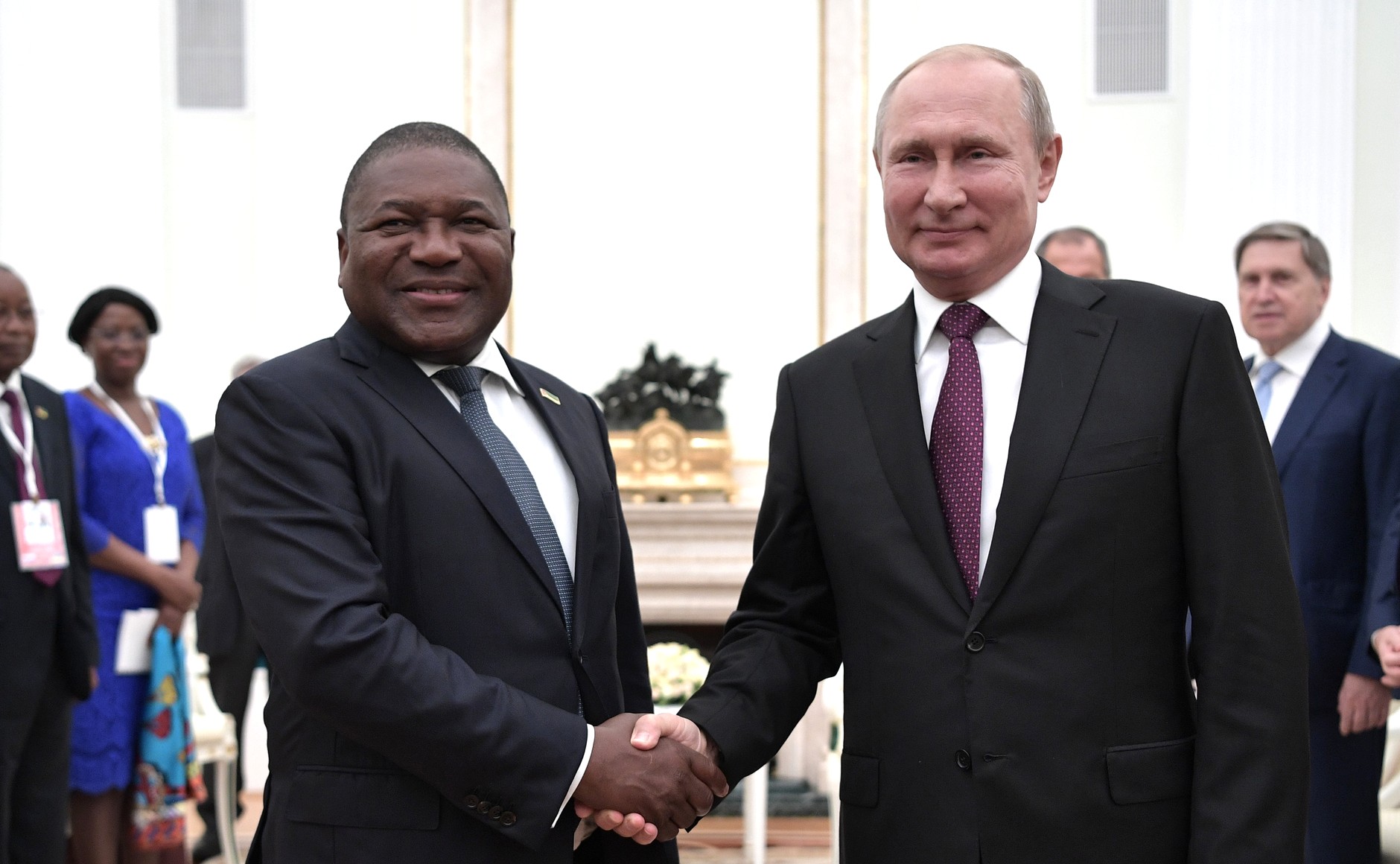
President Vladimir Putin has held an extended meeting with the visiting Mozambican leader Filipe Nyusi in the Kremlin where both discussed bilateral cooperation between the two countries. The leaders further discussed issues related to the current international and regional issues.

The visit, first for Mozambican leader after the collapse of the Soviet empire, was part of the consolidation and deepening of the existing relations of friendship and cooperation between Mozambique and Russia. Mozambique is a natural, time-tested and long-standing partner, the Soviet Union played an important role in Mozambique.

Diplomatic relations between the two countries were established on June 25, 1975, on the day Mozambique declared its independence. The Treaty of Friendship and Cooperation between the Soviet Union and the People’s Republic of Mozambique was signed in 1977.

“On the commercial and economic side our relations are still modest,” Putin said after signing the accords. “But we have good prospects.” Putin noted in his talks that there are issues related to the situation in the region, where a number of acute problems are being addressed by various countries.

Following the talks, Putin and Nyusi witnessed the exchange of documents signed during the official visit of the President of Mozambique to Russia. Russian companies, among them are Rosneft, UAZ, GAZ, Kamaz, Inter Rao – Export and Gazprombank, have an active interest in cooperation with Mozambican partners.

Mozambique has been looking to develop natural gas reserves that could make the African state a major exporter of liquified natural gas. As far back in 2015, the Russian oil and gas company Rosneft and US energy giant ExxonMobil received licenses for the development of three gas-rich deepwater blocks off the coast of Mozambique. The state-owned Qatar Petroleum company and Italy’s Eni oil and gas company later joined the project.

In October 2018, these companies signed concession contracts for hydrocarbon exploration and production with the government of Mozambique. Rosneft’s share in the projects is 20 percent. In July 2019, a mining and processing complex was launched in the city of Pebane, a province of Zambezia, for the exploitation, Primary treatment, and export of titanium and zirconium products from Tazetta Resources, which is part of the East Minerals international holding, controlled by a number of Russian investors.

Reports said that Mozambique’s National Hydrocarbon Company (ENH) was looking for more than US$2 billion to meet its project commitments. During the Moscow visit, Filipe Nyusi also held discussions, with representatives of Russian bank Gazprombank, which was dedicated to financing oil and gas sector projects in Mozambique.

“We have natural resources and we expect Russian investments to use those resources for the good of the people,” Nyusi said in an interview with local Russian news agency, published on the eve of his meeting with Putin.

There has been an increasing interest of the Russian business community in building a partnership with Mozambique, which matches Maputo’s intention to attract Russian investment and technical assistance.

Russia and Mozambique have re-affirmed commitment to promoting trade and economic cooperation, and believed that joint efforts in geological exploration and mineral extraction as well as telecommunications, energy and agriculture could possibly be the main priorities in the renewed bilateral relationship.

On August 21, the Russian-Mozambique Business Forum was held at the World Trade Center as part of the working visit of the President Nyusi and his delegation to Moscow.

The forum, aimed at reviewing and identifying potential spheres for strengthening bilateral economic cooperation between Russia and Mozambique, was organized jointly by the Embassy of Mozambique and the Chamber of Commerce and Industry of the Russian Federation with the support of the Moscow International Trade Center.

Vice President of the Russian Chamber of Commerce and Industry, Vladimir Padalko, noted that the African continent as a whole and Mozambique, in particular, are gaining increasing importance in the system of foreign economic relations of and are strategic interest to the Russian Federation.

The two countries currently maintain trade and economic relations. The Russian-Mozambique intergovernmental commission on trade and economic cooperation was established in March 2018. Its first meeting was held in Maputo in April 2018. The volume of trade between Russia and Mozambique in 2018 amounted to US$115 million. In the first half of 2019, trade increased by 32 percent compared to the same period in 2018.

The speech of the leader was, indeed, reassuring and offered hope. Mozambique’s economy is alive and well, judging by the volume of investments currently flowing in various sectors from many foreign sources, according to Filipe Nyusi, and added he would do his best to pursue the best strategies to improve the business environment in Mozambique, with the help of the business sector of the Russian Federation.

As a unique strategy, Moscow seems to prioritize and focus primarily on the southern African region. Mozambican leader’s visit followed that of South Africa, Zimbabwe, Angola and the Congo to meet President Vladimir Putin in the Kremlin since that beginning of 2019.

In October 2018, for instance, Southern African Development Community (SADC) and the Russian Federation signed a new Memorandum of Understanding (MoU) at an investment forum that aimed at creating a unified regional platform to share with potential Russian businesses, information on investment opportunities and the investment climate in the SADC Region.

The MoU envisages strengthening ties in a broad range of fields and shows that SADC remains as one of Russia’s key partners in Africa. Russian Foreign Minister Sergey Lavrov and Executive Secretary of the Southern African Development Community (SADC), Stergomena Lawrence Tax, signed for the Russian Federation and SADC, respectively.

On her part, the SADC Executive Secretary noted that “Russia and Africa have been partners for many years, and expressed a desire to achieve a new level in their relations.” She said it was encouraging that, in recent times, Russia had been repositioning itself to be a major partner with Southern Africa.

In an interview with the Hommes d’Afrique magazine, Minister Lavrov stressed: “At present, Russia’s relations with African countries are progressing both on a bilateral basis and along the line of African regional organizations, primarily the African Union and the Southern African Development Community.” Mozambique, among 16 southern African countries, is a member of the SADC. Russia has a long history of bilateral engagements with the Southern African countries, which constitute the Southern African Development Community.


Modupe Gbadeyanka is a fast-rising journalist with Business Post Nigeria. Her passion for journalism is amazing. She is willing to learn more with a view to becoming one of the best pen-pushers in Nigeria. Her role models are the duo of CNN's Richard Quest and Christiane Amanpour.

World

Accelerating Intra-Africa Trade and Sustainable Development

Published

on

Intra-Africa Trade

By Kestér Kenn Klomegâh

Africa stands at the cusp of a transformative digital revolution. With the expansion of mobile connectivity, internet penetration, digital platforms, and financial technology, the continent’s digital economy is poised to become a significant driver of sustainable development, intra-Africa trade, job creation, and economic inclusion.

The African Union’s Agenda 2063, particularly Aspiration 1 (a prosperous Africa based on inclusive growth and sustainable development), highlights the importance of leveraging technology and innovation. The implementation of the African Continental Free Trade Area (AfCFTA) has opened a new chapter in market integration, creating opportunities to unlock the full potential of the digital economy across all sectors.

Despite remarkable progress, challenges persist. These include limited digital infrastructure, disparities in digital literacy, fragmented regulatory frameworks, inadequate access to financing for tech-based enterprises, and gender gaps in digital participation. Moreover, Africa must assert its digital sovereignty, build local data ecosystems, and secure cyber-infrastructure to thrive in a rapidly changing global digital landscape.

Against this backdrop, the 16th African Union Private Sector Forum provides a timely platform to explore and shape actionable strategies for harnessing Africa’s digital economy to accelerate intra-Africa trade and sustainable development.

The 16th High-Level AU Private Sector forum is set to take place in Djibouti, from the 14 to 16 December 2025, under the theme “Harnessing Africa’s Digital Economy and Innovation for Accelerating Intra-Africa Trade and Sustainable Development”

The three-day Forum will feature high-level plenaries, expert panels, breakout sessions, and networking opportunities. Each day will spotlight a core pillar of Africa’s digital transformation journey.

Day 1: Digital Economy and Trade Integration in Africa

Focus: Leveraging digital platforms and technologies to enhance trade integration and competitiveness under AfCFTA.

Day 2: Innovation, Fintech, and the Future of African Economies

Focus: Driving economic inclusion through fintech, innovation ecosystems, and youth entrepreneurship.

Day 3: Building Policy, Regulatory Frameworks, and Partnerships for Digital Growth

Focus: Creating an enabling environment for digital innovation and infrastructure through effective policy, governance, and partnerships.

To foster strategic dialogue and action-oriented collaboration among key stakeholders in Africa’s digital ecosystem, with the goal of leveraging digital economy and innovation to boost intra-Africa trade, accelerate economic transformation, and support inclusive, sustainable development.

* Promote Digital Trade: Identify mechanisms and policy actions to enable seamless cross-border digital commerce and integration under AfCFTA.

* Foster Innovation and Fintech: Advance inclusive fintech ecosystems and support innovation-driven entrepreneurship, especially among youth and women.

* Policy and Regulatory Harmonization: Build consensus on regional and continental digital regulatory frameworks to foster trust, security, and interoperability.

* Encourage Investment and Public-Private Partnerships: Strengthen collaboration between governments, private sector, and development partners to invest in digital infrastructure, R&D, and skills development.

* Advance Digital Inclusion and Sustainability: Ensure that digital transformation contributes to environmental sustainability and the empowerment of marginalized communities.

The AU Private Sector Forum has held several forums, with key recommendations. These recommendations provide valuable insights into the challenges and opportunities facing the African private sector and offer guidance for policymakers on how to support its growth and development.

Continue Reading

World

Russia’s Lukoil Losses Strategic Influence Across Africa

Published

on

Russias Lukoil

By Kestér Kenn Klomegâh

Lukoil, Russia’s energy giant, has seriously lost its grounds across Africa, due to United States sanctions. Sanctions have complicated the company’s potential continuity in operating its largest oil field projects, grappling its investment particularly in Republic of Ghana, Democratic Republic of Congo, and Federal Republic of Nigeria.

Reports indicated the sanctions are further dismantling most of Lukoil’s operations, causing significant staff layoffs in its offices worldwide. For instance, Lukoil’s significant upstream operations in the Middle East include a 75% stake in Iraq’s West Qurna 2 oilfield and a 60% stake in Iraq’s Block 10 development. In Egypt, the company holds stakes in various oilfields alongside local partners.

Lukoil has until December 13, 2025, to negotiate the sale of most of its international assets, including those in Asia, Africa and Latin America. It has already terminated several important agreements that were signed with international partners due to difficulties in circumventing the sanctions.

Reports said calculated efforts to diversify exploration business relations is turning extremely complex, and current at the cross-roads, Lukoil will have to ultimately give up existing contracts and agreements it had signed with external countries.

Lukoil’s website reports also pointed to reasons for abandoning oil and gas exploration and drilling project that it began in Sierra Leone.  According to those reports, Lukoil could withdraw from almost all of the projects in West Africa.

In addition to geopolitical sanctions, technical and geographical hitches, Lukoil noted on its website, an additional obstacles that “the African leadership and government policies always pose serious problems to operations in the region.” Similarly, the Kremlin-controlled Rosneft abandoned its interest in the southern Africa oil pipeline construction, negatively impacted on Angola, Mozambique, South Africa and Zimbabwe.

United States sanctions has hit Lukoil, one of the Russia’s biggest oil companies, like many other Russian companies, that has had a long history shuttling forth and back with declaration of business intentions or mere interests in tapping into oil and gas resources in Africa.

Continue Reading

World

Putin Launches RT India Broadcasting

Published

on

RT India Broadcasting

By Kestér Kenn Klomegâh

In New Delhi, President Vladimir Putin, alongside Editor-in-Chief of Russia Today, Margarita Simonyan, took part in the launch ceremony of the RT India TV channel. The TV channel will operate from a new studio complex in New Delhi, marking a new dimension in the bilateral media sphere.

Editor-in-Chief of Russia Today, Margarita Simonyan, indicated that the collaboration, naturally, points to India’s hospitality, affirming that this endeavour was not only worthwhile but long overdue.

Vladimir Putin, officially, launching the TV studio, also emphasized that the Russia Today channel in India, RT India, grants millions of Indian citizens clearer, more direct access into insights about contemporary Russia – the realities, aspirations, and perspectives. He reiterated the existing traditional friendship, and the ties between the Indian and Russian peoples go much deeper into the past; which rests on a solid historical foundation. And at the core of relationship lies mutual interest.

Russia Today is a source of truthful and reliable information, focused on serving the interests of its viewers and listeners. Its main mission is merely to promote Russia, its culture, and its positions on domestic and international issues. Above all, Russia Today strives to convey truthful information about the country and about what is happening in the world. This is the absolute value of Russia Today.

Continue Reading

Trending