Connect with us

General

HWR Urges Nigeria To End Repression of Shia Group

Published

on

By Dipo Olowookere

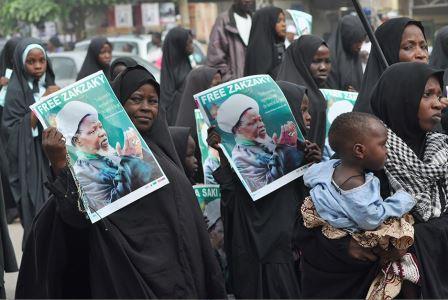
Nigerian authorities should end their violent repression of the Islamic Movement of Nigeria (IMN), a minority Shia group, that began with a three-day lethal crackdown on December 12-14, 2015, and free its leader, Human Rights Watch said today.

Sheik Ibraheem El Zakzaky, leader of the IMN, and his wife, Zeenatudeen, have been detained without trial for a year. On December 12, 2015, the Nigeria army used disproportionate force against the group’s street procession in Zaria, Kaduna State in north-western Nigeria to clear a route for the army chief’s convoy. In an ensuing three-day violent crackdown, the army killed 347 members of the group and injured and arrested scores more.

The violence against the group continued in a series of episodes in October and November 2016.

“The involvement of soldiers in the Zaria incidents, and subsequent police actions against the Islamic Movement raises major questions about Nigeria’s commitment to military reform,” said Mausi Segun, senior Nigeria researcher at Human Rights Watch. “The Kaduna state government’s continued repression of the group without holding the attackers responsible turns justice on its head.”

Nigerian authorities should hold accountable anyone who has committed crimes against Islamic Movement members, and take immediate steps to comply with a federal court order mandating the release of Sheik El Zakzaky and his wife, Human Rights Watch said.

Human Rights Watch reported in December 2015 that the killings were unjustified and called for an independent and impartial investigation into the carnage.

A judicial commission of inquiry, appointed to investigate the events, found that the army used “excessive force” against protesters and was responsible for the deaths and mass burial of the 347 members of the group. It recommended the prosecution of soldiers involved in the killings. The commission also recommended holding Islamic Movement members responsible for their “acts of habitual lawlessness,” and said that El Zakzaky bore responsibility for failing to call his followers to order when requested to do so.

In a White Paper responding to the report released on December 5, 2016, the Kaduna State government unilaterally declared the Islamic Movement to be an insurgent group against which the army was justified in using lethal force. Contrary to the commission’s findings, the state government stated that soldiers who shot at protesters, laid siege to religious sites belonging to the group, killed 347 members and buried them in unmarked mass graves, acted according to the army’s rules of operation.

The Kaduna State government is seeking the death penalty against 50 members of the group who are facing trial for the death of the only military casualty in the episode, Corporal Dan Kaduna Yakubu. But it has essentially exempted the army from any responsibility for the killings of the Islamic Movement members, and no-one has been held responsible for the deaths.

On October 7, the state government banned the Islamic Movement, citing the commission of inquiry’s finding that the group was unregistered. The move appears to have triggered a wave of police and mob violence against the group’s members participating in its annual religious processions, and the destruction of their properties in Kaduna as well as neighboring Kano, Katsina, Kebbi, Plateau, and Sokoto States, where the police followed the Kaduna example of banning activities of the group. Media reports allege that at least 12 people died in the violence in October, and more than 10 more were killed in subsequent clashes in November.

A federal high court ruled on December 2 that the continued detention without trial of El Zakzaky and his wife by the State Security Services, “amounted to a gross violation of the constitution and the African Charter on Human and People’s Rights.” The court ordered the government to release the couple within 45 days, pay them approximately US$170 million in damages, and provide them with a secure residence in view of the December 2015 destruction of their home. The federal government, in whose custody El Zakzaky and his wife have been detained, has not indicated whether it will comply with the court’s decision.

Hundreds of the group’s members have remained in prison since the Zaria incident and subsequent arrests during religious processions and protest marches to demand their leaders’ release, the group says. A few detainees, mostly women and children, were released but most others have been arraigned in courts in Kaduna, Kano, and Jos for offenses including disturbing public peace, incitement, unlawful assembly, and homicide.

The pattern of violent repressive conduct against the group may violate Nigeria’s constitution, which guarantees the rights to life; personal liberty; freedom of thought, conscience, and religion; peaceful assembly and association; and freedom of movement. Nigeria may also be in breach of its obligations under African regional and international human rights law to protect these rights.

“Nigeria’s federal and state authorities should reconsider the heavy-handed crackdown against IMN members, take urgent steps to protect them, and hold those responsible for the unlawful deaths of group members to account,” Segun said. “The government should carry out its law enforcement responsibilities without jeopardizing its own credibility by ignoring court decisions that rightly seek to check its agents’ excesses.”


Dipo Olowookere is a journalist based in Nigeria that has passion for reporting business news stories. At his leisure time, he watches football and supports 3SC of Ibadan. Mr Olowookere can be reached via [email protected]

Advertisement
Click to comment

Leave a Reply

Your email address will not be published. Required fields are marked *

General

NIMASA Rallies Stakeholders’ to Develop National Action Plan

Published

on

NIMASA revenue

By Adedapo Adesanya

The Nigerian Maritime Administration and Safety Agency (NIMASA) has pledged its commitment to provide the regulatory leadership, technical coordination, and stakeholder engagement required to successfully develop and implement a robust National Action Plan on maritime decarbonization in Nigeria.

The Director General of the agency, Mr Dayo Mobereola, made this known during the National Stakeholders’ workshop on the development of a National Maritime Decarbonization Action Plan, further describing the workshop as a critical step in actualising the Federal Government’s blue economy and climate objectives.

Represented by the Executive Director, Operations, Mr Fatai Taiye Adeyemi, the NIMASA DG underscored the significance of the IMO GreenVoyage2050 Project, a technical cooperation initiative /designed to support developing countries in implementing the IMO GHG Strategy.

According to him, the National Action Plan being developed will reflect national realities, leverage existing capacities, address identified gaps, and align with broader economic and environmental priorities of the federal government.

Mr Mobereola stressed that “this transition is not merely about compliance with international obligations, it is about safeguarding our marine environment, protecting public health, strengthening the blue economy, and ensuring that our maritime industry remains competitive and future-ready”, the DG said.

Also speaking at the event was the Technical Manager of the IMO GreenVoyage2050 Project, Ms Astrid Dispert, who highlighted that the overarching objective of the initiative is to advance a coherent and globally aligned regulatory framework to accelerate maritime decarbonization.

She also emphasised that NIMASA plays a pivotal role in driving the project at the national level.

The IMO GreenVoyage2050 Project provides technical expertise and institutional support to assist countries in developing and implementing National Action Plans that promote sustainable shipping practices, encourage investment in clean technologies, and strengthen capacity for long-term emissions reduction.

Through this collaboration, the federal government is advancing deliberate steps towards maritime decarbonization, reinforcing its commitment to global climate goals and ensuring a cleaner, greener, and more sustainable future for the sector.

Continue Reading

General

BPP Mandates Digital Submission for MDAs From March 1

Published

on

procurement standard BPP

By Adedapo Adesanya

The Bureau of Public Procurement (BPP) has directed all Ministries, Departments and Agencies (MDAs) to comply with its digital submission process effective March 1.

The directive was contained in a circular signed by the Director-General of the Bureau, Mr Adebowale Adedokun, noting that the move was part of the bureau’s commitment to digital transformation and paperless governance.

It explained that the transition followed an earlier circular of Aug. 4, 2025, which introduced electronic submission procedures.

According to the bureau, it has successfully moved from physical filings to a dedicated e-mail service for document submissions and is now advancing to a more robust and integrated system.

The circular announced the inauguration of the BPP Digital Submission Portal, a web-based platform designed to enable MDAs submit procurement-related documents directly to the Bureau.

It stated that the automated platform would streamline the submission process, enhance transparency and ensure accelerated tracking of procurement-related documents and petitions.

“With effect from March 1, all MDAs will be required to use the portal to submit requests for ‘No Objection’ Certificates, approvals for ‘No Objection’ for special procurements, clarifications and status updates on submissions,” the bureau said.

It added that the portal would be hosted on the Bureau’s official website and would become fully operational from the effective date.

The bureau warned that physical submissions or manual hand-deliveries would no longer be prioritised and would eventually be rejected following the full transition to the digital platform.

It urged accounting officers to brief their procurement departments and ICT units on the development to ensure seamless processing of procurement activities from March 1.

It further advised MDAs to contact the Bureau via its official email for information on the onboarding process and integration into the portal.

The bureau emphasised that full compliance by all MDAs was required to ensure a smooth transition and avoid delays in the implementation of the 2026 fiscal year procurement processes.

Continue Reading

General

Senate Seeks Removal of CAC Boss Hussaini Magaji

Published

on

Hussaini Magaji CAC boss

By Adedapo Adesanya

The Senate has asked President Bola Tinubu to remove the Registrar General of the Corporate Affairs Commission (CAC), Mr Hussaini Ishaq Magaji, from office.

The Senate Committee on Finance, while passing a resolution in Abuja on Thursday, accused Mr Magaji, a Senior Advocate of Nigeria (SAN), of failing to honour the Senate’s invitations to account for the finances of his agency.

“He refused on so many occasions to honour our invitation to appear before this committee.

“We have issues with the reconciliation of the revenue of CAC.

“Each time we invite him, he gives us excuses,” the Chairman of the committee, Mr Sani Musa, said as the committee passed the resolution.

CAC was part of a group of agencies that the House of Representatives Public Accounts Committee (PAC) recommended zero allocation for the year 2026, for allegedly failing to account for public funds appropriated to them.

The committee, at an investigative hearing held two weeks ago, accused CAC and some other ministries, departments and agencies (MDAs) of shunning invitations to respond to audit queries contained in the Auditor-General for the Federation’s annual reports for 2020, 2021 and 2022.

The PAC chairman, Mr Bamidele Salam, stated that the National Assembly should not continue to appropriate public funds to institutions that disregard accountability mechanisms, saying this will create fiscal discipline and strengthen transparency across federal institutions and conform with extant financial regulations and the oversight powers of the parliament.

“Public funds are held in trust for the Nigerian people. Any agency that fails to account for previous allocations, refuses to submit audited accounts, or ignores legislative summons cannot, in good conscience, expect fresh budgetary provisions. Accountability is not optional; it is a constitutional obligation,” he said.

Continue Reading

Trending