

Economy
Senate’s Economic Bills Target 7.5m Jobs, Cut Poverty by 16.4%

By Modupe Gbadeyanka
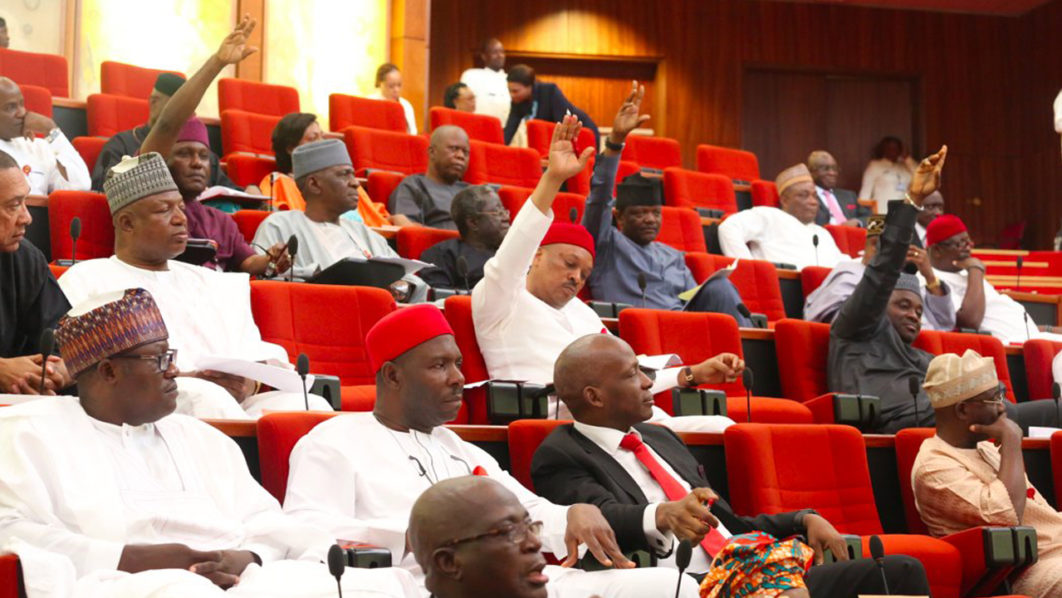
The 11 economic bills now receiving accelerated consideration by the 8th Senate will help to create 7.5million jobs and reduce poverty by 16.4 percent when passed into law, Senate President, Mr Bukola Saraki has said.
The number three man disclosed this in his welcome address to his colleagues on resumption from their Christmas and New Year recess on Tuesday.
He urged the relevant committees to fast-track the priority Bills so they can be passed and submitted to the executive alongside the 2017 budget.
According to a statement by his Chief Press Secretary, Mr Sanni Onogu in Abuja, the Senate President also stated that the 2017–2019 Medium Term Expenditure Framework and Fiscal Strategy Paper (MTEF/FSP) would be debated and passed this week while the consideration of the 2017 Appropriation Bill (budget) would occupy the “three sitting days” of next week.
He, however, urged all heads of Ministries, Department and Agencies (MDA) to ensure timeous submission of their annual budgets within the current budget cycle or risk waiting for the next fiscal cycle if they fail.
“As long as our economy is still in recession, our work is not done. Because our people are still being laid off; so long as factories are closing shop, for as long as the hardship in the land continues to bite harder, investment continues to dwindle and the foreign exchange market remains fragmented, I will be demanding even much more from us to get all our economic reform bills passed,” Mr Saraki said.
Mr Saraki pointed out that, “Ideally, we would like to see them pass together with the 2017 budget. Let me, therefore, urge all our committees involved with our priority bills to double efforts to ensure that by the end of the first quarter of this year we will have these bills ready.
“We promise to pass our priority economic reform bills to help aid our economic recovery. This is a promise we must keep. There are already, new NASSBER (National Assembly Business Environment Roundtable) research findings projecting that our priority bills, will have an output impact equivalent to an average of 6.87 percent of GDP over a 5-year period on the economy.
“The average annual growth in jobs is estimated at approximately 7.55 million additional employments as well as an average of 16.42 poverty reduction in Nigeria’s poverty rate.
“Over the projected 5-year period, it is suggested that the reforms, which these bills would engender, may add an average of N3.76 Trillion to National incomes (National Disposable Income was the N85.62 trillion in 2014), equivalent to 4.39 percent of 2014 figures.
“These statistics make the delivery of these bills imperative and confirm evidently that we have got our priorities right so far. It is hoped that as we begin to turn our focus now towards the passage of the 2017 budget, these bills will be implemented simultaneously with the budget to enable us to exit the recession quickly.
“It is, therefore, imperative that we immediately begin work earnestly on the MTEF to ensure passage by the end of the week. In this way, consideration and debate on the 2017 budget will immediately follow in the three ‘sitting days’ of the next week.”
“It is our hope that we will with this budget begin the implementation of the report of the Committee on Budget Reforms, which has since submitted its report.
“This will enable more Nigerians to participate in the budget consideration process, deepen the review and create the necessary efficiencies we expect from our budget implementation,” he said.
He noted that 2016 was a ‘very challenging year’ for Nigerians, but assured the lawmakers that the work the Senate has done is gradually setting the stage for a greater and better 2017.
“It is already historic that within the last quarter, which incidentally is the second quarter of this session, we all rolled up our sleeves, with sweat on our brows and successfully passed 49 bills through 3rd reading and 68 bills through second reading,” Mr Saraki said.
“This is a record-setting feat, which has never been matched in the history of the National Assembly. That within a period of four months in the middle of the term of any past National Assembly, 49 bills are passed in a single quarter.
“I want to especially thank all the committees who worked tirelessly to help us achieve this milestone. Let me also thank President Muhammadu Buhari for showing faith with the work we are doing here at the National Assembly as he has by today signed into law 16 of the bills we have passed into law already,” he said.
He condemned the recent crisis and killings in Southern Kaduna and said that the Senate would carry out a thorough investigation to unravel the issues and advise the executive appropriately.
The Senate President further said, “While we have our attention on the economy and are working with sweat on our brows to improve it for the betterment of our people, we cannot lose sight of the callous and growing circle of violence across the country, especially now in Southern Kaduna.
“We condemn in totality the depravity being exhibited on the streets of Kafanchan. This Senate will not pay lip service to it neither will it sit idly by and watch innocent Nigerians being slaughtered on the basis of their religion, ethnic group or political persuasion.
“No, we will not stand aloof. Let me, therefore; use this opportunity to call on the leadership in the state to use its authority and constitutional mandate to bring to an immediate halt the growing orgy of violence that has enveloped Southern Kaduna.
“This new theatre of conflict is one too many and must be nipped in the bud. Thankfully, a motion to this effect is already before us. We will ensure a thorough investigation is carried out to unravel the issues and advice government appropriately on the matter in order to ensure that all those found culpable are severely dealt with irrespective of who may be behind them.
“This will ensure there is no repeat of this madness and assure the people of Kaduna that injustice and impunity will not be allowed to triumph over our collective will to maintain our national unity and coherence,” he said.
He reiterated the importance of the 2017 budget in helping the economy to exit recession and urged his colleagues to double up efforts to get the passed budget to the executive for implementation within the shortest possible time.
“There is hardly a point reiterating the importance of making the 2017 budget the most successful budget we have ever passed, neither is it important to emphasize the need to have this budget back on the desk of the executive on time for implementation,” he said.
“As you may be aware, based on the recommendations of the Budget Reform Committee, we are working towards ensuring that budgets are prepared and submitted timely so that implementation will follow a regular fiscal circle.
“In this regard, the National Assembly will not tolerate agencies of government not submitting their budgets within the budget period. This is why I urge all agencies yet to submit their budgets to do so quickly as budgets not received within time may have to wait for the next budget circle,” he said.
He emphasised the need for the National Assembly to pursue and conclude the ongoing constitutional review process by the end of March and said “We must do this to ensure that our people begin to enjoy the benefits of the intended reforms which will help strengthen our unity, increase our prosperity and opportunity as we as expand our liberty and happiness across the country.”
He said the Senate would henceforth not spare any organization that trample on the rights of consumers in the country by paying keen attention to the “protection and preservation of consumer rights” adding that the “current situation where consumers’ rights are violated and treated with indignity must stop.”
“We are prepared to defend the rights of Nigerians to receive a superior quality of product or service purchased with their hard-earned resources,” Saraki said. “We will not stand for the exploitation of consumers and we have already shown that we are unafraid to tackle such an issue whether perpetrated by public or private sector service providers;
“As was the case of the intended data tariff hike proposed by the Nigerian Communications Commission (NCC) which we moved swiftly to prevent. We want people to know that they can run to us and we will in turn rise in defence of the Nigerian consumer who should be respected as a driving force in the economy,” he said.
On the power sector, Mr Saraki said, “Before we left for the break, me, a select few of us and stakeholders in the power sector met to get an understanding of why no progress has been made thus far despite the best intention; and the revelations were mind-boggling.
“There had been errors in the privatization process and the model by which the power sector is being operated—whether at generation or distribution—will never take us where we need to be.
“It has failed and nobody appears willing to tackle the issue head-on towards a permanent resolution. I have mandated the Senate Committee on Power to continue the consultation with the relevant parties to forge a path to solving our crippling power deficit. After all, if we are going to drive Nigerian industry, we need to resolve this and fast,” he said.
He lamented that the issue of policy inconsistencies continues to challenge the nation’s business environment and reiterated his view that “for a private sector-led economy to thrive, we need to reform our policy environment to give investors and our businessmen and women ample adjustment time to make informed investment decisions rather than have uncertainties.”
According to him, “This is especially important in the agriculture and solid mineral sectors where we have significant economies of scale and opportunities for diversification of our economy. In view of this we shall, in consultation with stakeholders across the board be looking at legislative measures that could increase the potential for a more stable policy environment starting with the agricultural businesses and solid mineral resources sectors of our economy,” he said.
He also called on the executive to commence an open and meaningful dialogue with the Niger Delta militants in order to stabilize the petroleum industry and take advantage of rising crude prices in the international community to turn around the fortunes of the nation’s economy.
“The Petroleum Industry continues to be critical to the health of our economy. This is why the Senate is urging the Executive to take positive steps to begin an open and meaningful dialogue with those aggrieved in the Niger Delta to proffer lasting solutions that will help us take advantage of the emerging international oil market outlook to revamp our economic fortunes.
“The proposed engagement we suggest must be sincere, constructive, open, and confidence building. This Senate is willing to assist and play whatever role necessary to facilitate a successful agreement that would help us see to the end if the lingering conflict,” Mr Saraki said.



