Connect with us

Economy

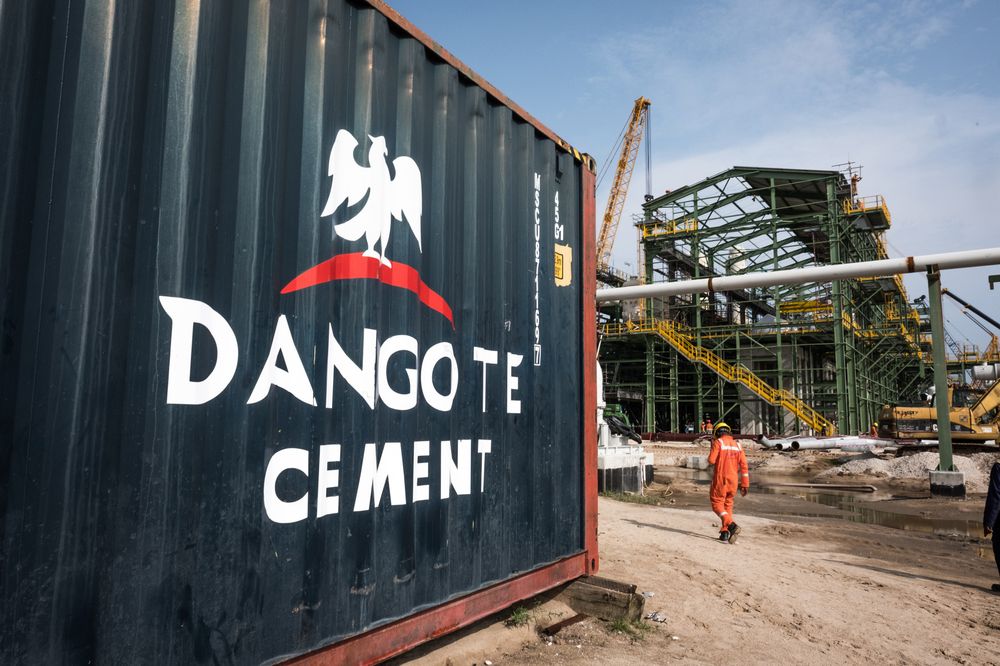
Dangote Cement’s African Subsidiaries Contribute 41.2% to FY 2023 Sales

Published

on

Dangote Cement stocks

By Dipo Olowookere

Dangote Cement Plc has revealed that sales from its factories outside Nigeria, its base, improved in the 2023 fiscal year by 12.7 per cent, contributing about 41.2 per cent to its total volume for the period under review, with its Nigerian operations accounting for the rest.

In its audited financial statements for the year ended December 31, 2023, filed to the Nigerian Exchange (NGX) Limited, the cement maker said revenue generated from its pan-African operations increased by a record 123.2 percent to N925.9 billion, while EBITDA surged by over four-fold to N263.7 billion.

Business Post reports that last year, the cement firm grew its revenue by 36.4 per cent to N2.208 trillion as its post-tax profit went up by 19.2 per cent to N455.6 billion, and the earnings per share expanded by 18.8 per cent at N26.47.

As a result of these improvements, the board has proposed the payment of N30 per share as dividend to shareholders, 50 per cent higher than the 20 per share paid for the 2022 accounting year.

However, the proposed increase in dividend is subject to ratification by the shareholders at the forthcoming Annual General Meeting (AGM).

Commenting on the company’s performance in the year under review, the Managing Director of Dangote Cement, Mr Arvind Pathak, said, “This positive full-year outcome is a combination of the strength in the diversity of our operations across Africa and our sustained drive to contain cost amidst an accelerating inflationary environment.

“The group achieved double-digit growth in revenue at N2.208 trillion, while group EBITDA reached a record high, increasing 25.1 per cent to N886.0 billion.

“Despite the challenging macroeconomic conditions, 2023 was yet another testament to the effectiveness of our diversification strategy.

“Our diverse operations acted as a cushion, providing resilience to country-specific risks. Pan-African volumes were up 12.7 per cent and now account for 41.2 percent of group volume.

“Consequently, pan-African revenue increased by a record 123.2 per cent to N925.9 billion, while EBITDA surged by over four-fold to N263.7 billion.”

“In response to the heightened inflationary environment, we implemented new and innovative business strategies that helped to drive up revenues, contain costs, and protect margins.

“These initiatives included fuel mix optimisation, propelling the use of alternative fuels to replace more expensive fossil fuels.

“We also began the phased transition from diesel power trucks to full Compressed Natural Gas (CNG) trucks,” he further stated.

“Looking ahead, following the commissioning of our 0.45Mta grinding plant in Takoradi, we are focusing on our export to import strategy in West and Central Africa, while concurrently optimising assets in Eastern Africa.

“Our strategy remains centred on enhancing our value proposition through the production of high-quality cement and delivering sustainable value to our stakeholders,” Mr Pathak added.


Advertisement
Click to comment

Leave a Reply

Your email address will not be published. Required fields are marked *

Economy

Tinubu Okays Extension of Ban on Raw Shea Nut Export by One Year

Published

on

Raw Shea Nut Export

By Aduragbemi Omiyale

The ban on the export of raw shea nuts from Nigeria has been extended by one year by President Bola Tinubu.

A statement from the Special Adviser to the President on Information and Strategy, Mr Bayo Onanuga, on Wednesday disclosed that the ban is now till February 25, 2027.

It was emphasised that this decision underscores the administration’s commitment to advancing industrial development, strengthening domestic value addition, and supporting the objectives of the Renewed Hope Agenda.

The ban aims to deepen processing capacity within Nigeria, enhance livelihoods in shea-producing communities, and promote the growth of Nigerian exports anchored on value-added products, the statement noted.

To further these objectives, President Tinubu has authorised the two Ministers of the Federal Ministry of Industry, Trade and Investment, and the Presidential Food Security Coordination Unit (PFSCU), to coordinate the implementation of a unified, evidence-based national framework that aligns industrialisation, trade, and investment priorities across the shea nut value chain.

He also approved the adoption of an export framework established by the Nigerian Commodity Exchange (NCX) and the withdrawal of all waivers allowing the direct export of raw shea nuts.

The President directed that any excess supply of raw shea nuts should be exported exclusively through the NCX framework, in accordance with the approved guidelines.

Additionally, he directed the Federal Ministry of Finance to provide access to a dedicated NESS Support Window to enable the Federal Ministry of Industry, Trade and Investment to pilot a Livelihood Finance Mechanism to strengthen production and processing capacity.

Shea nuts, the oil-rich fruits from the shea tree common in the Savanna belt of Nigeria, are the raw material for shea butter, renowned for its moisturising, anti-inflammatory, and antioxidant properties. The extracted butter is a principal ingredient in cosmetics for skin and hair, as well as in edible cooking oil. The Federal Government encourages processing shea nuts into butter locally, as butter fetches between 10 and 20 times the price of the raw nuts.

The federal government said it remains committed to policies that promote inclusive growth, local manufacturing and position Nigeria as a competitive participant in global agricultural value chains.

Continue Reading

Economy

NASD Bourse Rebounds as Unlisted Security Index Rises 1.27%

Published

on

Alternative Bourse NASD Securities

By Adedapo Adesanya

The NASD Over-the-Counter (OTC) Securities Exchange expanded for the first session this week by 1.27 per cent on Wednesday, February 25.

This lifted the NASD Unlisted Security Index (NSI) above 4,000 points, with a 50.45-point addition to close at 4,025.25 points compared with the previous day’s 3,974.80 points, as the market capitalisation added N30.19 billion to close at N2.408 trillion versus Tuesday’s N2.378 trillion.

At the trading session, FrieslandCampina Wamco Nigeria Plc grew by N5.00 to trade at N100.00 per share compared with the previous day’s N95.00 per share, Central Securities Clearing System (CSCS) Plc improved by N4.18 to sell at N70.00 per unit versus N65.82 per unit, and First Trust Mortgage Bank Plc increased by 14 Kobo to trade at N1.59 per share compared with the previous day’s N1.45 per share.

However, the share price of Geo-Fluids Plc depreciated by 27 Kobo at midweek to close at N3.27 per unit, in contrast to the N3.30 per unit it was transacted a day earlier.

At the midweek session, the volume of securities went down by 25.3 per cent to 8.7 million units from 11.6 million units, the value of securities decreased by 92.5 per cent to N80.7 million from N1.2 billion, and the number of deals slipped by 33.3 per cent to 32 deals from the preceding session’s 48 deals.

At the close of business, CSCS Plc remained the most traded stock by value on a year-to-date basis with 34.1 million units exchanged for N2.0 billion, trailed by Okitipupa Plc with 6.3 million units traded for N1.1 billion, and Geo-Fluids Plc with 122.0 million units valued at N478.0 million.

Resourcery Plc ended the trading session as the most traded stock by volume on a year-to-date basis with 1.05 billion units valued at N408.7 million, followed by Geo-Fluids Plc with 122.0 million units sold for N478.0 million, and CSCS Plc with 34.1 million units worth N2.0 billion.

Continue Reading

Economy

Investors Lose N73bn as Bears Tighten Grip on Stock Exchange

Published

on

Nigeria's stock exchange

By Dipo Olowookere

The bears consolidated their dominance on the Nigerian Exchange (NGX) Limited on Wednesday, inflicting an additional 0.09 per cent cut on the market.

At midweek, the market capitalisation of the domestic stock exchange went down by N73 billion to N124.754 trillion from the preceding day’s N124.827 trillion, and the All-Share Index (ASI) slipped by 114.32 points to 194,370.20 points from 194,484.52 points.

A look at the sectoral performance showed that only the consumer goods index closed in green, gaining 1.19 per cent due to buying pressure.

However, sustained profit-taking weakened the insurance space by 3.79 per cent, the banking index slumped by 2.07 per cent, the energy counter went down by 0.24 per cent, and the industrial goods sector shrank by 0.22 per cent.

Business Post reports that 25 equities ended on the gainers’ chart, and 54 equities finished on the losers’ table, representing a negative market breadth index and weak investor sentiment.

RT Briscoe lost 10.00 per cent to sell for N10.35, ABC Transport crashed by 10.00 per cent to N6.75, SAHCO depreciated by 9.98 per cent to N139.35, Haldane McCall gave up 9.93 per cent to trade at N3.99, and Vitafoam Nigeria decreased by 9.93 per cent to N112.50.

Conversely, Jaiz Bank gained 9.95 per cent to settle at N14.03, Okomu Oil appreciated by 9.93 per cent to N1,765.00, Trans-nationwide Express chalked up 9.77 per cent to close at N2.36, Fortis Global Insurance moved up by 9.72 per cent to 79 Kobo, and Champion Breweries rose by 5.39 per cent to N17.60.

Yesterday, 1.4 billion shares worth N46.2 billion were transacted in 70,222 deals compared with the 1.1 billion shares valued at N53.4 billion traded in 72,218 deals a day earlier, implying a rise in the trading volume by 27.27 per cent, and a decline in the trading value and number of deals by 13.48 per cent and 2.76 per cent, respectively.

Fortis Global Insurance ended the session as the busiest stock after trading 193.7 million units for N152.7 million, Zenith Bank transacted 120.7 million units worth N11.1 billion, Japaul exchanged 114.8 million units valued at N407.0 million, Ellah Lakes sold 98.4 million units worth N999.2 million, and Access Holdings traded 63.1 million units valued at N1.7 billion.

Continue Reading

Trending