Connect with us

Economy

No More Licenses to Gas Firms Without Pipeline Capacity—FG

Published

on

gas distribution

By Adedapo Adesanya

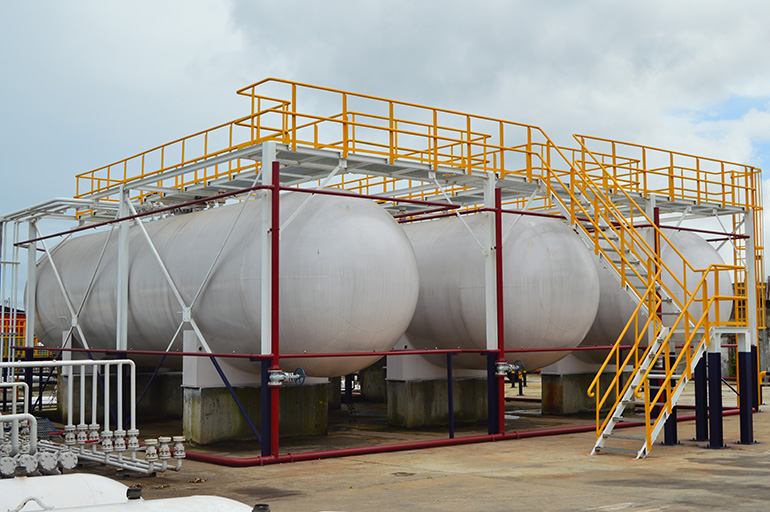
The federal government has said it would stop granting licences to gas companies with no capacity to build pipelines for gas distribution following the aftermath of the explosion which claimed a life in Abeokuta, the Ogun State capital.

This was communicated by the Minister of State For Petroleum Resources (Gas), Mr Ekperikpe Ekpo, when he visited Abeokuta for an on-the-spot assessment of Saturday’s CNG explosion at Ita Oshin.

According to him, the development became imperative to discourage the transportation of compressed natural gas through the roads.

On Saturday (April 28), a Compressed Natural Gas (CNG) gas truck owned by Gasco Marine suffered a brake failure, rammed into the road barricade and went up in flames, killing one person and razing some vehicles.

Mr Ekpo, who was received into the state by Governor Dapo Abiodun and his deputy, Mrs Noimot Salako-Oyedele, stated that he was sent by President Bola Tinubu to see to the root cause of the incident and sympathise with the people of Ogun State.

While saying the country must transit from fossil fuel to CNG, Mr Ekpo revealed that he had directed the Chief Executive Officer (CEO) of the Nigerian Midstream and Downstream Regulatory Authority (NMDPRA), Mr Farouk Ahmed, not to issue licenses to anyone who could not pipe CNG to the end users.

The gas Minister emphasised, that there was the need to stop virtual gas transportation, saying the federal government was putting efforts in top gear to build pipelines for seamless transmission of CNG.

According to him, this would prevent explosions on the road, while saving lives and property.

“As the Federal Government, we are trying all that we can to ensure we reduce virtual transportation of gas because of the volatility of it, especially with the Ajaokuta–Kaduna–Kano pipeline,” he said

“I have directed the authority chief executive that for any further issuance of a licence, the company should be competent enough to pipe it to their end users so that we are not exposed to this kind of danger any longer.

“As a ministry, we are looking at how we can reduce a lot of virtual conveyance of gas. That is why we are putting much in developing the gas pipeline infrastructure so that the transportation would not be virtual, but rather through the pipelines. This will reduce this kind of incident and take off the pressure on our roads,”

Mr Ekpo stressed that despite the incident, CNG remains a better alternative to petrol, urging Nigerians not to be discouraged.

“This is better than even fuel if you look at what happened in Port Harcourt where lives were lost and so many vehicles burnt. It is better we go this route,” he added.

He harped on the importance of companies using only quality cylinders for the distribution of gas to avoid incidents.

On his part, Mr Ahmed the NMDPRA boss, assured Nigerians that the agency is working with the Standard Organisation of Nigeria and the Federal Road Safety Corps to forestall similar explosions on the road.

Ahmed maintained that some of the accidents occur due to the roadworthiness of the vehicle, adding that training programmes are being organised for truck drivers to ensure safety on the road.


Adedapo Adesanya is a journalist, polymath, and connoisseur of everything art. When he is not writing, he has his nose buried in one of the many books or articles he has bookmarked or simply listening to good music with a bottle of beer or wine. He supports the greatest club in the world, Manchester United F.C.

Economy

Naira Loses 18 Kobo Against Dollar at Official Market, N5 at Black Market

Published

on

forex Black Market

By Adedapo Adesanya

The Naira marginally depreciated against the United States Dollar in the Nigerian Autonomous Foreign Exchange Market (NAFEM) on Thursday, December 4 amid renewed forex pressure associated with December.

At the official market yesterday, the Nigerian currency lost 0.01 per cent or 18 Kobo against the Dollar to close at N1,447.83/$1 compared with the previous day’s N1,447.65/$1.

It was not a different scenario with the local currency in the same market segment against the Pound Sterling as it further shed N15.43 to sell for N1,930.97/£1 versus Wednesday’s closing price of N1,925.08/£1 and declined against the Euro by 20 Kobo to finish at N1,688.74/€1 compared with the preceding session’s N1,688.54/€1.

Similarly, the Nigerian Naira lost N5 against the greenback in the black market to quote at N1,465/$1 compared with the previous day’s value of N1,460/$1 but closed flat against the Dollar at the GTBank FX counter at N1,453/$1.

Fluctuations in trading range is expected to continue during the festive season as traders expect the Nigerian currency to be stable, supported by intervention s by to the Central Bank of Nigeria (CBN)in the face of steady dollar demand.

Support is also expected in coming weeks as seasonal activities, particularly the stylised “Detty December” festivities, will see inflows that will give the Naira a boost after it depreciated mildly last month, according to a new report.

“As the festive Detty December season intensifies, inbound travel, tourism spending, and diaspora inflows are expected to provide moderate support for FX liquidity,” analysts at the research unit of FMDA said in its latest monthly report for November.

Traders cited by Reuters expect that the Naira will trade within a band of N1,443-N1,450 next week, buoyed by improved FX interventions by the apex bank.

Meanwhile, the crypto market was down as the US Federal Reserve’s preferred inflation gauge, core PCE, likely rose in September—moving in the wrong direction. However, volatility indices show no signs of major turbulence.

If the actual figure matches estimates, it would mark 55 straight months of inflation above the US central bank’s 2 per cent target. The sticky inflation would strengthen the hawkish policymakers, who are in favour of slower rate cuts.

Ripple (XRP) depreciated by 4.5 per cent to $2.08, Solana (SOL) went down by 3.8 per cent to $138.11, Litecoin (LTC) shrank by 3.1 per cent to $83.23, Dogecoin (DOGE) slid by 2.5 per cent to $0.1463, Cardano (ADA) declined by 2.1 per cent to $0.4368, Bitcoin (BTC) fell by 0.9 per cent to $91,975.45, Binance Coin (BNB) crumbled by 0.9 per cent to $899.41, and Ethereum (ETH) dropped by 0.7 per cent to $3,156.44, while the US Dollar Tether (USDT) and the US Dollar Coin (USDC) closed flat at $1.00 apiece.

Continue Reading

Economy

Fed Rate Cut Signal, Stalling Ukraine Peace Talks Raise Oil Prices

Published

on

oil prices driving up Trump

By Adedapo Adesanya

Oil prices were up on Thursday amid investors’ expectations for the Federal Reserve to cut interest rates, while stalled Ukraine peace talks tempered expectations of a deal restoring Russian oil flows.

Brent crude gained 59 cents or 0.94 per cent to trade at $63.26 a barrel and the US West Texas Intermediate (WTI) crude appreciated by 72 cents or 1.22 per cent to $59.67 per barrel.

The market ticked up on expectations that a US rate cut will support the world’s largest economy and oil demand, after data showed employment is slowing.

Markets are pricing in an 89 per cent chance of a cut when the Federal Reserve meets on December 9-10, significantly higher than rate-cut bets just a couple of weeks ago, according to the CME FedWatch tool.

Support also came as the dollar edged lower for its 10th straight day of losses against a basket of major currencies, making crude cheaper for buyers using other currencies.

Analysts noted that escalating tensions between the US and Venezuela were also supporting prices on concerns of a drop in crude supplies from the South American country, which is a member of the Organisation of the Petroleum Exporting Countries (OPEC).

US President Donald Trump’s administration is ratcheting up pressure on Venezuelan President Nicolás Maduro, signalling the possibility of a US invasion.

The perception that progress on a peace plan for Ukraine was stalling also supported prices, after President Trump’s representatives emerged from peace talks with the Kremlin with no resolution in sight.

Expectations of an end to the war had pressured prices lower, as traders anticipated a deal would allow Russian oil back into an already oversupplied global market..

Meanwhile, Ukraine continued its assault on Russia’s energy infrastructure as it hit the Druzhba oil pipeline in Russia’s central Tambov region, the fifth attack on the pipeline that sends Russian oil to Hungary and Slovakia.

Kpler noted that Ukraine’s drone campaign against Russian refining infrastructure has affected production to down around 5 million barrels per day between September and November, a 335,000 barrels per day year-on-year decline, with gasoline (petrol) hit hardest and gasoil output also materially weaker.

US crude and fuel inventories rose last week as refining activity picked up, the Energy Information Administration (EIA) said on Wednesday.
Crude inventories rose by 574,000 barrels to 427.5 million barrels in the week ended November 28, the EIA said, compared with analysts’ expectations in a Reuters poll for an 821,000-barrel draw.

Fitch Ratings on Thursday cut its 2025-2027 oil price assumptions to reflect market oversupply and production growth that is expected to outstrip demand.

Continue Reading

Economy

Nigeria Approves Fiscal Plan Proposing N54.5trn 2026 Budget

Published

on

Finance 35% of 2024 Budget

By Adedapo Adesanya

The Federal Executive Council (FEC) has signed off on a medium-term fiscal plan that projects spending of around N54.5 trillion in 2026, as it approved the 2026-2028 medium-term expenditure framework (MTEF), outlining Nigeria’s economic outlook, revenue targets, and spending priorities for the next three years.

The Minister of Budget and National Planning, Mr Atiku Bagudu, said oil price was pegged at $64 per barrel, while the exchange rate assumption for the budget year is N1,512/$1.

He said while the council set an oil production benchmark of 2.06 million barrels per day for 2026, the fiscal planning is based on a cautious 1.8 million barrels per day.

Mr Bagudu stated the exchange rate projection reflects the fact that 2026 precedes a general election year, adding that all the assumptions were drawn from detailed macroeconomic and fiscal analyses by the budget office and its partner agencies.

According to the minister, inflation is projected to average 18 per cent in 2026.

Mr Bagudu said based on the assumptions, the total revenue accruing to the federation in 2026 was estimated at N50.74 trillion, to be shared among the three tiers of government.

“From this projection, the federal government is expected to receive N22.6 trillion, states N16.3 trillion, and local governments N11.85 trillion,” he said.

“When revenues from all federal sources are consolidated, including N4.98 trillion from government-owned enterprises, total Federal Government revenue for 2026 is projected at N34.33 trillion —representing a N6.55 trillion or 16 per cent decline compared to the 2025 budget estimate.”

The minister said statutory transfers are expected to amount to roughly N3 trillion, while debt servicing was projected at N10.91 trillion.

He said non-debt recurrent spending — covering personnel costs and overheads — was put at N15.27 trillion, while the fiscal deficit for 2026 is estimated at N20.1 trillion, representing 3.61 per cent of gross domestic product (GDP).

The MTEF also projected that nominal GDP will reach over N690 trillion in 2026 and climb to N890.6 trillion by 2028, with the GDP growth rate projected at 4.6 per cent in 2026.

The non-oil GDP is also expected to grow from N550.7 trillion in 2026 to N871.3 trillion in 2028, while oil GDP is estimated to rise from N557.4 trillion to N893.5 trillion over the same period.

Continue Reading

Trending