Economy
Panel Submits Report on Minimum Wage

By Modupe Gbadeyanka
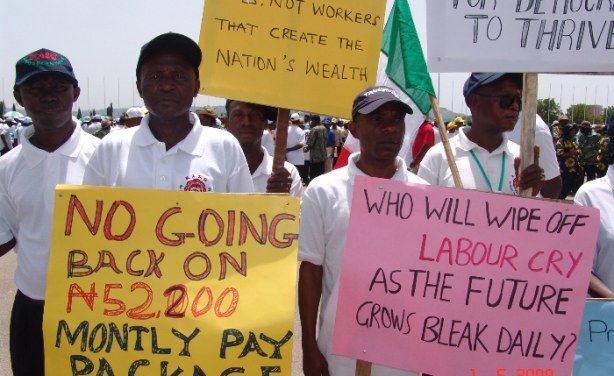
The panel set up by the Federal Government to look into the issue of minimum wage in the country has submitted its report.
Chairman of the Technical Committee on Minimum Wage and Palliatives, Mr Chris Ngige, who doubles as the Minister of Labour and Employment, stated that his team came up with an all-encompassing recommendations in the areas of salaries, allowances, promotions and pensions both at the state and federal levels; affordable housing and transport to help out suffering workers of Nigeria.
While presenting the report to the main Committee on Minimum Wage and Palliatives headed by the Secretary to the Government of the Federation (SGF), Mr Babachir David Lawal, the Minister said the welfare of Nigerian workers was paramount to the President Muhammadu Buhari administration.
He noted that the minimum wage was last reviewed in 2010 and signed into law in 2011 under the previous administration of President Jonathan, adding that the current exercise was in compliance to a five –year constitutional provision on minimum wage review.
Mr Ngige said further that the submissions of his committee were in two volumes comprising the Minimum Wage and the Palliatives.
“We have no problem in tackling the issue of the minimum wage. We recommended a 29-man Minimum Wage Committee to be chaired by a reputable Nigerian, who will be neutral and non-partisan, with labour and civil service experience so that the person would be on a familiar turf,” the Minister recommended in his report.
He also said there would be a secretary with the secretariat of the committee to be domiciled at the National Salaries Income and Wages Commission.
Eight persons are expected to represent each of the following; the Federal Government, the organized labour, organized private sector and three members representing the state government to be drawn from the Governors Forum, the All Progressives Congress (APC) Governors Forum and the People’s Democratic Party (PDP) Governors Forum.
On palliatives, the Minister said the committee identified dwindling economic fortunes of the Federal Government as the major problem having taken submissions from the Ministry of Petroleum Resources, Budget and Planning as well as the Ministry of Finance.
“We also looked at the mass transit scheme. And in housing, we recommended that government through its ministries and agencies should give more support for mass housing for civil servants by invigorating the Federal Mortgage Bank, as well as assisting the housing schemes being undertaken by the labour unions and further support workers to venture into agriculture,” Mr Ngige said.
In his remark, the SFG thanked the technical committee especially the organized labour for their cooperation and input into the report and restated the commitment of the Federal Government to study and take it to fruition.
“We have to work hard and diligently too, to conclude our report and make a submission to government because I know that this government is favourably disposed to the improved welfare of Nigerians as a whole.
“We should take the opportunity of this disposition to conclude our report and send it to the President for consideration,” he said.
In May 2016, the Federal Government effected an upward review of the pump price of premium motor spirit to between N143 to N145 and on May 17, set up a committee comprising labour and government to seek out palliatives to cushion the effects of the pump price increase as well as look into the review of the minimum wage which is a constitutional matter.
Economy
N636bn BoI Loans to MSMEs Validate Economic Reform Agenda—Tinubu
By Modupe Gbadeyanka
President Bola Tinubu has expressed satisfaction with the disbursement of N636 billion as loans to business owners in the Micro, Small and Medium Enterprises (MSMEs) in the country by the Bank of Industry (BoI) in 2025.
In a statement signed by his Special Adviser on Information and Strategy, Mr Bayo Onanuga, the Nigerian leader disclosed that the development validates his government’s economic reform agenda.
Over 7,000 enterprises were given soft loans worth N636 billion by the lender last year, the highest annual financing volume in the institution’s history.
A breakdown of the financing shows that N202 billion was allocated to agro-allied enterprises, N100 billion to critical national infrastructure, including broadband, power, aviation, and transportation, N79 billion to manufacturing, N77 billion to extractive industries, and N55 billion to services.
In addition, the bank deployed N73 billion in managed and matching funds on behalf of state governments and institutional partners.
Under the BoI 2025 disbursement, strategic interventions included upgrading a tomato processing facility from 3.1 metric tonnes per hour to 10 metric tonnes per hour and linking 47,508 smallholder farmers to formal processing value chains.
The bank also supported the deployment of 100 mini-grids in partnership with global development finance institutions, connecting 11,777 new customers to electricity. BOI-financed projects contributed to an estimated annual reduction of over 20,000 tonnes of carbon emissions.
“The N636 billion disbursed by the Bank of Industry in 2025 translates directly into productive capacity across Nigeria. It financed agro-processing expansion, strengthened manufacturing output, supported infrastructure delivery, and empowered thousands of enterprises across our states.
“At a time of global financing constraints, Nigeria expanded access to long-term capital for its businesses. That is a direct outcome of reform, credibility, and institutional discipline,” Mr Tinubu said.
It was observed that disbursement by business size reflects a deliberate inclusion strategy. Nano enterprises received N51 billion. Micro businesses accessed N32 billion. Small and medium enterprises received N178 billion in financing, while large enterprises accounted for N375 billion.
Under the federal government’s N200 billion MSMEs intervention programme, BoI recorded over 95 per cent performance as the disbursing institution. The Presidential Conditional Grant Scheme reached 957,400 beneficiaries in 2025 alone.
In addition, BOI’s financing activities led to the creation and retention of approximately 1.6 million jobs. The bank supported more than 7,000 MSMEs and 570 startups during the year.
Inclusive financing initiatives also recorded a measurable impact. Through the Guaranteed Loans for Women Programme, a N10 billion gender-focused facility providing up to N50 million per beneficiary, women-owned enterprises expanded access to affordable credit. Youth-owned enterprises received N12 billion in financing. Under the Rural Area Programme on Investment for Development, 880 rural-based enterprises across the 36 states and the FCT accessed over N6.5 billion.
The President further noted that BOI maintained strong asset quality, recording a non-performing loan ratio below 1.5 per cent despite macroeconomic headwinds. He also acknowledged the €2 billion syndicated facility secured in 2024 and the additional €210 million mobilised from international partners in 2025, which strengthened the Bank’s lending capacity.
“Development finance must be disciplined, measurable, and aligned with national priorities. What we are witnessing is the transition from strategy to scale.
“Our economic transformation will be built on production, value addition, and enterprise growth. We will continue to crowd in capital, deepen institutional reform, and ensure that access to finance supports real sector expansion across Nigeria,” President Tinubu stated.
He reaffirmed his administration’s resolve to consolidate reform gains and expand credit access to enterprises as part of a long-term strategy to accelerate industrialisation and inclusive economic growth.
Economy
Six Securities Inspire NASD Exchange’s 2.13% Gain
By Adedapo Adesanya
Six equities buoyed the NASD Over-the-Counter (OTC) Securities Exchange by 2.13 per cent on Thursday, February 12, as the market capitalisation added N49.12 billion to end at N2.357 trillion compared with the previous day’s N2.308 trillion.
In the same vein, the NASD Unlisted Security Index (NSI) went up by 82.09 points during the session to settle at 3,940.90 points versus Wednesday’s closing value of 3,858.81 points.
Okitipupa Plc improved its value by N22.00 yesterday to N242.00 per share from N220.00 per share, Central Securities Clearing System (CSCS) Plc grew by N6.55 to N77.08 per unit from N70.53 per unit, NASD Plc rose by N4.62 to N50.88 per share from N46.26 per share, Food Concepts Plc appreciated by 29 Kobo to N3.20 per unit from N2.91 per unit, IPWA Plc advanced by 28 Kobo to N3.13 per share from N2.85 per share, and UBN Property Plc rose 1 Kobo to sell at N2.20 per unit compared with the preceding session’s N2.19 per unit.
Conversely, FrieslandCampina Wamco Nigeria Plc went down by N1.57 to N68.10 per share from N69.67 per share, and Geo-Fluids Plc depreciated by 39 Kobo to N3.63 per unit from N4.02 per unit.
As for the activity chart, the volume of trades declined by 99.2 to 8.6 million units from 1.06 billion units, the value of transactions shrank by 88.4 per cent to N53.9 million from N465.7 million, and the number of deals decreased by 25 per cent to 42 deals from 56 deals.
CSCS Plc remained the most active stock by value (year-to-date) with 18.2 million units valued at N790.9 million, trailed by Resourcery Plc with 1.05 billion units traded at N408.6 million, and Geo-Fluids Plc with 29.5 million units sold for N150.9 million.
Resourcery Plc closed the session as the most traded stock by volume (year-to-date) with 1.05 billion units worth N408.6 million, followed by Geo-Fluids Plc with 29.5 million units exchanged for N150.9 million, and Mass Telecom Innovation Plc with 20.1 million units transacted for N8.1 million.
Economy
All-Share Index Rallies 0.25% as Seplat, Others Lead Gainers’ Chart
By Dipo Olowookere
The Nigerian Exchange (NGX) Limited almost succumbed to profit-taking on Thursday, but for Seplat, which pulled its string to salvage the situation.
Seplat triggered a buying interest in its shares after informing the investing public of its intention to release its full-year results for 2025 on February 26, 2026.
It almost singlehandedly lifted the energy index by 4.64 per cent yesterday. This sector was the only one of the five with green at the close of business.
The others were in red, with the insurance space down by 1.47 per cent, the industrial goods segment went down by 1.09 per cent, the banking index closed lower by 0.13 per cent, and the consumer goods sector shrank 0.04 per cent.
Analysis showed that the All-Share Index (ASI) soared on Thursday by 441.28 points to 178,625.63 points from 178,184.35 points, and the market capitalisation grew by N283 billion to N114.660 trillion from N114.377 trillion.
Business Post reports that 46 equities were in green during the session and 35 equities ended in red, implying a positive market breadth index and bullish investor sentiment.
The trio of Deap Capital, RT Briscoe, and Seplat gained 10.00 per cent each to settle at N8.69, N15.84, and N8,107.00 apiece, while Zichis rose by 9.97 per cent to N9.82, with ABC Transport surging by 9.91 per cent to N7.43.
On the flip side, NAHCO lost 9.98 per cent to trade at N148.45, Abbey Mortgage Bank depressed by 9.68 per cent to N11.20, Eterna gave up 9.50 per cent to close at N30.00, May and Baker depreciated by 9.19 per cent to N40.50, and Ecobank weakened by 8.72 per cent to N45.00.
Access Holdings was the most active stock yesterday with 52.1 million units sold for N1.3 billion, Zenith Bank exchanged 42.5 million units worth N3.3 billion, Tantalizers transacted 42.1 million units valued at N253.9 million, GTCO traded 40.8 million units worth N4.3 billion, and Deap Capital transacted 34.4 million units valued at N298.1 million.
When the closing gong was struck by 2:30 pm to signify the end of trading activity, investors had bought and sold 698.3 million shares worth N28.4 billion in 50,886 deals compared with 939.2 million shares valued at N34.0 billion exchanged in 61,279 deals a day earlier.
This showed that yesterday, the trading volume, value, and number of deals decreased by 25.65 per cent, 16.47 per cent, and 16.96 per cent, respectively.
-
Feature/OPED6 years agoDavos was Different this year
-
Travel/Tourism10 years ago
Lagos Seals Western Lodge Hotel In Ikorodu
-
Showbiz3 years agoEstranged Lover Releases Videos of Empress Njamah Bathing
-
Banking8 years agoSort Codes of GTBank Branches in Nigeria
-
Economy3 years agoSubsidy Removal: CNG at N130 Per Litre Cheaper Than Petrol—IPMAN
-
Banking3 years agoSort Codes of UBA Branches in Nigeria
-
Banking3 years agoFirst Bank Announces Planned Downtime
-
Sports3 years agoHighest Paid Nigerian Footballer – How Much Do Nigerian Footballers Earn