Economy
Tinubu’s Economic Reforms Poorly Timed, Lacked Critical Safeguards—Yemi Kale
By Adedapo Adesanya
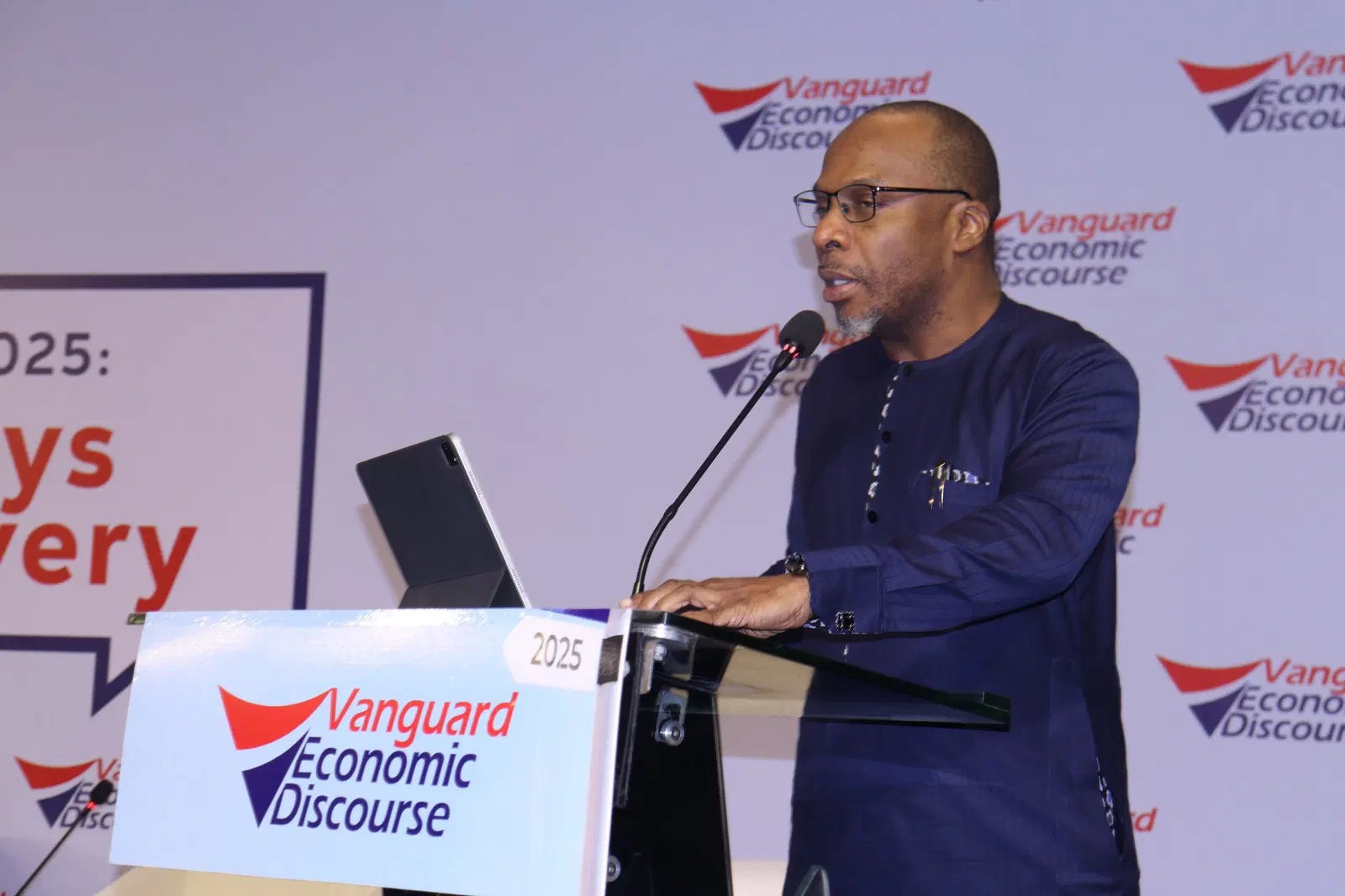
Renowned economist, Dr Yemi Kale, says Nigeria must recalibrate its economy through disciplined reforms, forward-looking governance, and people-centred development.
Mr Kale, a former head of Nigeria’s statistics bureau and now Group Chief Economist at Africa Export-Import Bank (Afreximbank), gave this advice at the 2025 Vanguard Economic Discourse, where he delivered a keynote address that examined Nigeria’s current economic hardship and offered a compelling and urgent roadmap toward sustainable recovery and shared prosperity.
According to the economist, Nigeria is grappling with both external shocks and internal structural fragilities: from global inflationary pressures to domestic policy missteps.
“Business as usual is no longer an option,” he quipped, warning that slowing growth, commodity volatility, rising protectionism, and geopolitical instability are compounding Nigeria’s vulnerabilities.
“From exchange rate volatility to eroding investor confidence, Nigeria finds itself navigating a storm with limited buffers,” he explained.
He critiqued the removal of fuel subsidies, FX rate unification, tax overhauls, and monetary tightening, leading to surging inflation, currency depreciation, contracting investment, and intensifying socioeconomic hardship, noting that while the reforms instituted by President Bola Tinubu were necessary steps toward a rules-based economy, they were poorly sequenced and lacked critical safeguards.
“Most of Nigeria’s economic hardship is not caused by unforeseen events but by policies introduced without adequate safeguards. Public trust is built not just by making policies—but by implementing them with foresight, fairness, and firmness,” he submitted.
The economist then outlined a clear, actionable framework to transition Nigeria from macroeconomic fragility to resilient, inclusive growth revolving around three pillars: macroeconomic stability, economic diversification, and social investment and inclusive governance.
He noted that restoring confidence begins with fiscal discipline, transparent FX management, and tighter coordination between monetary and fiscal authorities.
“The first pillar is macroeconomic stability. Macroeconomic stability is not an outcome—it is a prerequisite. Nigeria must rebuild investor and citizen confidence by addressing fiscal imbalances, taming inflation, and restoring exchange rate credibility.”
He noted that this can be done via enforcing tax reform, curb leakages, and ensure budget credibility, empowering the central bank with operational independence and clear mandates, tackling inflation through supply-side reforms—particularly in agriculture and logistics, maintaining a transparent, market-reflective exchange rate supported by non-oil exports and reserve buffers, as well as creating a predictable investment climate that encourages long-term capital formation.
“The second pillar is economic diversification. Diversification is no longer optional. Nigeria’s dependence on oil exposes it to external volatility and fiscal instability. We must rapidly expand our productive base,” adding that core focus should be on agriculture, manufacturing, services and digital economy, small businesses, and infrastructure.
“The third and final pillar is social investment and governance. True growth is people-centered. It must deliver meaningful improvements in the lives of Nigerians across all demographics and regions.”
Dr Kale emphasised that key focus areas include the need to expand social safety nets to protect vulnerable populations from systemic shocks, improve access to basic services—housing, healthcare, electricity, water, and strengthen education through curriculum reform, teacher training, and vocational pathways.
He also advocated fostering entrepreneurship and digital inclusion, particularly for youth and women, deepening institutional trust through anti-corruption enforcement and policy continuity, and usage of digital governance to increase transparency, reduce leakages, and improve service delivery.
“Inclusive growth is not just a social ideal—it is a strategic economic necessity,” he said.
Economy
Regency Alliance Urges Shareholders to Participate in N3.04bn Rights Issue
By Aduragbemi Omiyale
The N3.04 billion rights issue of Regency Alliance Insurance Plc is expected to open on Monday, June 22, 2026, and close on Friday, July 3, 2026, with shareholders urged to participate.
The underwriting firm recently signed an agreement on the rights issue, with board members, management, issuing houses, legal advisers, stockbrokers, and other key stakeholders in attendance.
Regency Alliance is offering to shareholders 3,201,000,000 ordinary shares of 50 Kobo each at 95 Kobo per share on the basis of one new ordinary share for every five ordinary shares held.
The purpose of the fresh capital raise is to bolster the company’s solvency ratios, support business growth, and invest in digital infrastructure and new product development.
The insurance company noted that the rights issue provides an opportunity to existing shareholders to subscribe for additional shares in proportion to their current holdings, protecting them from dilution while enabling them to participate in the organisation’s future growth.
“This capital raise will give us the firepower to meet evolving risks, expand our reach, and deepen the promise we make to every policyholder; that Regency Alliance will be there when it matters most,” the acting chairman of Regency Alliance, Mr Wale Taiwo (SAN), stated.
“We are particularly encouraged by the unwavering support of our shareholders who have stood by the company through its growth journey. We urge all eligible shareholders to take advantage of this rights issue and fully exercise their rights.
“By doing so, they will not only protect their investment from dilution but also participate directly in the exciting growth opportunities that lie ahead for Regency Alliance Insurance,” he added.
Also commenting, the Managing Director of the firm, Mr Bode Oseni, said, “Regency Alliance has always prided itself on being agile, customer-focused xd, and financially sound. The proceeds from this rights issue will accelerate our digital transformation, enhance claims efficiency, and enable us to introduce innovative products tailored to SMEs, Gen Z, and other underserved segments across Nigerian and beyond. We are not merely raising capital; we are raising our ambition.”
“We remain optimistic that our shareholders will embrace this opportunity and demonstrate their confidence in the company’s future by taking up their rights. Together, we are building a strong and more competitive insurance institution,” he added.
Economy
Unlisted Securities Exchange Retreats After Okitipupa Price Decline
By Adedapo Adesanya
Oil palm processing firm, Okitipupa Plc, and two other securities weakened by the NASD Over-the-Counter (OTC) Securities Exchange by 0.4 per cent on Thursday, June 18.
During the trading day, Okitipupa Plc lost N20.00 to end at N280.00 per share compared with the previous day’s N300.00 per share, NASD Plc declined by 36 Kobo to finish at N37.00 per unit versus N37.36 per unit, and Central Securities Clearing System (CSCS) Plc depreciated by 23 Kobo to N86.34 per share from N86.57 per share.
As a result, the market capitalisation retreated by N10.39 billion to N2.609 trillion from N2.619 trillion, and the NASD Unlisted Security Index (NSI) slid by 17.36 points to 4,361.09 points from 4,378.45 points.
Business Post reports that the sole price gainer for the session was Afriland Properties Plc, which improved by 65 Kobo to N16.20 per unit from N15.55 per unit.
Yesterday, the volume of securities transacted by market participants shrank by 71.6 per cent to 792,835 units from Wednesday’s 2.8 million units, the value of securities fell by 61.8 per cent to N49.0 million from N128.3 million, while the number of deals went down by 39.4 per cent to 20 deals from 33 deals.
Great Nigeria Insurance (GNI) Plc remained the most active stock by value on a year-to-date basis, with 3.4 billion units sold for N8.4 billion, followed by Infrastructure Credit Guarantee (Infracredit) Plc with 2.3 billion units valued at N6.5 billion, and CSCS Plc with 67.7 million units traded for N4.7 billion.
GNI Plc also closed the day as the most traded stock by volume on a year-to-date basis, with 3.4 billion units worth N8.4 billion, followed by Infracredit Plc with 2.3 billion units exchanged for N6.5 billion, and Resourcery Plc with 1.1 billion units sold for N415.7 million.
Economy
Naira Falls to N1,363/$ at Official Market
By Adedapo Adesanya
The Naira free-fall against the US Dollar continued in the Nigerian Autonomous Foreign Exchange Market (NAFEX) on Thursday, June 18, losing 0.24 per cent or N3.23 to trade at N1,363.30/$1 compared with the previous day’s N1,360.07/$1.
However, the domestic currency appreciated against the Pound Sterling in the official market during the session by N19.12 to trade at N1,805.69/£1 versus midweek’s N1,824.81/£1, and gained N12.89 on the Euro to sell at N1,565.07/€1, in contrast to the preceding day’s N1,577.96/€1.
At the GTBank FX counter, the Naira lost N1 against the Dollar to trade at N1,373/$1 versus Wednesday’s closing rate of N1,372/$1, and at the black market, it remained unchanged at N1,385/$1.
Tightness in FX liquidity continued to pressure the local currency, contributing to a decline in the official exchange rate due to rising demand for foreign payments.
Analysts also attribute the market liquidity dynamics to the lack of substantial Open Market Operation (OMO) bill positioning by foreign portfolio investors, who are key sources of hard currency inflows for the Central Bank of Nigeria (CBN).
The apex bank’s daily FX report revealed that interbank FX turnover increased to $69.918 million across 85 interbank transactions, up from $54.293 million the previous day.
As for the cryptocurrency market, Bitcoin (BTC) traded below $63,000 after losing 1.7 per cent to close at $62,742.28 on Thursday, as risk assets sold off worldwide, erasing the gains it made earlier in the week on the back of the US-Iran peace deal.
The pressure came from a wider retreat in markets as shipping through the Strait of Hormuz returned to normal under the signed US-Iran deal and eased what had been a historic supply shock.
Attention now turns to talks over Iran’s nuclear programme, with Vice President JD Vance saying a 60-day clock to settle the deal’s details has started.
During the session, Solana (SOL) crashed by 3.3 per cent to $68.68, Ripple (XRP) depreciated by 2.7 per cent to $1.13, Cardano (ADA) slid 2.4 per cent to $0.1606, Binance Coin (BNB) slumped 2.0 per cent to $576.11, Dogecoin (DOGE) slipped by 1.9 per cent to $0.0826, and Ethereum (ETH) went down by 1.7 per cent to $1,696.74.
However, TRON (TRX) improved by 0.1 per cent to $0.3204, while the US Dollar Tether (USDT) and the US Dollar Coin (USDC) traded flat at $1.00 each.
-
Feature/OPED6 years agoDavos was Different this year
-
Travel/Tourism10 years ago
Lagos Seals Western Lodge Hotel In Ikorodu
-
Showbiz3 years agoEstranged Lover Releases Videos of Empress Njamah Bathing
-
Banking8 years agoSort Codes of GTBank Branches in Nigeria
-
Economy3 years agoSubsidy Removal: CNG at N130 Per Litre Cheaper Than Petrol—IPMAN
-
Banking3 years agoSort Codes of UBA Branches in Nigeria
-
Banking3 years agoFirst Bank Announces Planned Downtime
-
Sports3 years agoHighest Paid Nigerian Footballer – How Much Do Nigerian Footballers Earn