Economy
Dangote Refinery’s ‘Dangerous’ Monopoly Could Crush Competitors—IPMAN
By Adedapo Adesanya
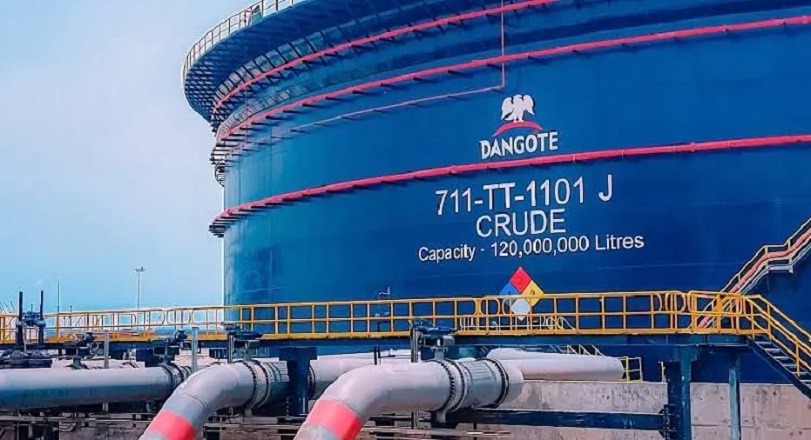
The Independent Petroleum Marketers Association of Nigeria (IPMAN) has expressed concerns over plans by Dangote Petroleum Refinery to begin free distribution of petrol and diesel nationwide, warning the move could mark the onset of a dangerous monopoly in Nigeria’s downstream sector.
According to IPMAN Chairman in Rivers State, Mr Tekena Ikpaki, the plan, backed by a fleet of 4,000 newly acquired Compressed Natural Gas, CNG-powered tankers, as a veiled strategy that could severely undermine the operations of over 10,000 independent marketers and dealers across the country.
“This initiative may appear generous on the surface, but beneath the goodwill lies a disturbing threat to market diversity and the survival of small and medium-scale operators. If left unchecked, this level of vertical integration, refining, transportation, and retail, by a single company will cripple competition,” he warned.
Dangote Petroleum Refinery had recently announced plans to distribute fuel free of charge to marketers, dealers, and large-scale consumers, citing efforts to support the sector and reduce logistics burdens.
However, IPMAN has warned that such move could distort pricing, force smaller operators out of the market, and grant Dangote undue control over the entire fuel supply chain.
“We acknowledge and support the development of domestic refining capacity. But allowing a single entity to control refining, logistics, and distribution without checks or counterweights is a recipe for monopolistic dominance.”
Mr Ikpaki noted that the introduction of thousands of CNG-powered trucks by Dangote could also push out independent logistics providers, who lack the capital and fleet capacity to compete on such a scale.
“The downstream sector thrives on diversity and accessibility. A monopolized system, no matter the initial goodwill, will inevitably distort market pricing, reduce supply options for retailers, and lead to massive business closures.”
It called on the federal government, the Nigerian Midstream and Downstream Petroleum Regulatory Authority (NMDPRA), and other oversight bodies to act swiftly and decisively to safeguard the sector.
“We call on the government to enforce the anti-monopoly provisions of the Petroleum Industry Act (PIA) ensure fair access to depots and infrastructure, monitor pricing strategies, and provide protection for independent marketers and logistics players,” IPMAN urged.
Mr Ikpaki stressed that IPMAN’s position is not an attack on investment or innovation but a necessary warning against unregulated dominance.
“This is not about stalling progress. It’s about protecting the integrity, inclusiveness, and sustainability of Nigeria’s petroleum distribution landscape. Without safeguards, this so-called generous distribution initiative could mark the beginning of a dangerous monopoly that the country can ill afford.”
Economy
Bellwether Equities Shrink Nigerian Stock Market by 2.35%
By Dipo Olowookere
The Nigerian stock market crashed by 2.35 per cent on Wednesday after some bellwether equities performed badly as a result of profit-taking in them.
BUA Cement, Dangote Cement, and Geregu Power lost 10.00 per cent each to settle at N340.20, N963.00, and N917.40, respectively. Custodian Investment shrank by 9.97 per cent to N73.15, and Academy Press weakened by 9.88 per cent to N28.12.
On the flip side, SAHCO gained 9.92 per cent to trade at N171.20, International Energy Insurance grew by 9.66 per cent to N6.70, Tantalizers improved by 6.98 per cent to N4.60, Omatek added 5.70 per cent to close at N2.04, and AIICO Insurance increased by 5.19 per cent to N4.26.
At the close of business, the Nigerian Exchange (NGX) Limited recorded 10 appreciating stocks and 21 depreciating stocks.
Data from the activity log revealed that 488.1 million shares worth N20.9 billion exchanged hands in 46,239 deals at midweek compared with the 564.9 million shares valued at N39.4 billion traded in 49,230 deals on Tuesday, representing a fall in the trading volume, value, and number of deals by 13.60 per cent, 46.95 per cent, and 6.08 per cent, respectively.
On top of the activity chart yesterday was First Holdco, which sold 57.4 million equities for N3.5 billion. Chams transacted 42.3 million shares valued at N166.9 million, Access Holdings traded 36.1 million stocks worth N831.1 million, Linkage Assurance exchanged 32.0 million equities for N49.4 million, and Sterling Holdings traded 29.4 million shares valued at N224.8 million.
Business Post observed that the bears dominated Customs Street during the trading day, resulting in all the major sectors closing in the red.
The industrial goods space suffered the heaviest loss, 8.31 per cent, as a result of the sell-offs in cement stocks. The insurance counter shed 0.97 per cent, the banking segment declined by 0.71 per cent, the consumer goods landscape gave up 0.29 per cent, and the energy sector crumbled by 0.11 per cent.
Consequently, the All-Share Index (ASI) retreated by 5,668.65 points to 235,074.54 points from 240,743.19 points, and the market capitalisation moderated by N3.637 trillion to N150.847 trillion from N154.484 trillion.
Economy
Nigeria’s Inflation Outlook Improves as US-Iran Tensions Ease
By Adedapo Adesanya
Easing tensions between the US and Iran in the Middle East is expected to offer more respite to the Nigerian economy in the coming months.
Analysts at Comercio Partners noted in a report that there is an increased likelihood of a gradual moderation in inflation from July into the third quarter of 2026.
The analysts opined that the near-term outlook for inflation “has become less tilted to the upside” following the peace deal reached by the warring parties in the Middle East conflict and the sharp decline in global oil prices.
The report read in part: “May inflation data showed that price pressures remain sticky, but the near-term outlook has become less tilted to the upside following the peace deal and the sharp decline in global oil prices.
“Headline inflation rose to 15.93 per cent year-on-year from 15.69 per cent in April, while food inflation climbed to 16.96 per cent and core inflation increased to 16.82 per cent, suggesting that both food and underlying non-food price pressures remain elevated.
“However, the easing in crude oil prices below $85/bbl reduces the risk of a renewed energy-led inflation shock. This is important for Nigeria, where fuel, diesel, transport, logistics, and food distribution costs are key channels through which global energy prices feed into domestic inflation.
“If lower oil prices are sustained and domestic fuel prices remain stable or decline, pressure on transport and production costs should gradually ease.”
It noted that in June, inflation may remain sticky because the pass-through of lower oil prices to consumer prices is unlikely to be immediate.
It added that food prices remain elevated, and core inflation picked up month-on-month in May, indicating that underlying price pressures have not fully faded. According to the National Bureau of Statistics (NBS), the inflation rate on a month-on-month basis was 1.75 per cent, which was 0.39 per cent lower than the rate recorded in April 2026 (2.13 per cent).
“However, the balance of risks has shifted. The likelihood of another sharp energy-driven acceleration has reduced, while the probability of gradual moderation from July into Q3 has improved.”
The analysts said in the report that while the latest CPI data, “still supports a cautious tone across rates and fixed income, as annual headline, food, and core inflation all moved higher in May,” the decline in oil prices gives the Central Bank of Nigeria (CBN) “more room to maintain a wait-and-see stance rather than respond aggressively to external energy-price risks, provided domestic prices begin to reflect the easing in global crude markets.”
Economy
All On Invests $1m in Eja-Ice Nigeria Limited to Strengthen Cold-Chain Infrastructure in Off-Grid Markets
All On, an impact investing company focused on expanding access to renewable energy solutions in Nigeria, has announced a $1 million investment in Eja-Ice Nigeria Limited, a provider of solar-powered refrigeration and cold chain infrastructure.
The investment will support Eja-Ice’s manufacturing and operational scale-up as the company enters its next phase of growth. It is expected to enable the expansion of its cold-chain solutions and improve access to reliable cooling services for households, small businesses, and institutions operating in off-grid and weak-grid environments.
Access to dependable cold storage remains a significant constraint across Nigeria, particularly in coastal and rural communities where limited energy infrastructure contributes to post-harvest losses and income instability for small-scale agro-producers.
By delivering energy-efficient refrigeration systems, Eja-Ice is helping to address these challenges while supporting the preservation of perishable goods and strengthening local value chains.
“All On’s investment in Eja-Ice reflects our approach of supporting solutions that improve energy access while enhancing livelihoods, reducing costs, and enabling businesses to grow. Strengthening cold-chain infrastructure is an important step towards building more resilient local economies and expanding opportunities in underserved markets,” the chief executive of All On, Ms Caroline Eboumbou, commented on the investment.
Eja-Ice’s integrated cold-chain model allows for greater control over product design, operational efficiency, and service delivery, ensuring that its solutions are tailored to the needs of underserved markets. The company’s systems are already supporting micro enterprises, cooperatives, and community-level infrastructure, particularly in areas where reliable electricity remains limited.
Also commenting, the founder and chief executive of Eja-Ice Nigeria Limited, Mr Yusuf Bilesanmi, said, “This capital raise is a huge step forward in our vision to power homes and businesses with products designed, assembled, and optimised right here on the continent. It’s not just about access to electricity—it’s about dignity, productivity, and opportunity for the over 600 million people across sub-Saharan Africa who are still off-grid.”
Through this investment, All On continues to advance its mission of closing Nigeria’s energy access gap by supporting the renewable energy ecosystem and businesses that deliver sustainable, market-driven solutions.

-
Feature/OPED6 years agoDavos was Different this year
-
Travel/Tourism10 years ago
Lagos Seals Western Lodge Hotel In Ikorodu
-
Showbiz3 years agoEstranged Lover Releases Videos of Empress Njamah Bathing
-
Banking8 years agoSort Codes of GTBank Branches in Nigeria
-
Economy3 years agoSubsidy Removal: CNG at N130 Per Litre Cheaper Than Petrol—IPMAN
-
Banking3 years agoSort Codes of UBA Branches in Nigeria
-
Banking3 years agoFirst Bank Announces Planned Downtime
-
Sports3 years agoHighest Paid Nigerian Footballer – How Much Do Nigerian Footballers Earn


Pingback: IPMAN Changes Tone, Hails Dangote's Distribution Move | Business Post Nigeria