Connect with us

Economy

Greenpeace Advises West Africa on Ways to Stop Illegal Fishing

Published

on

gree

By Dipo Olowookere

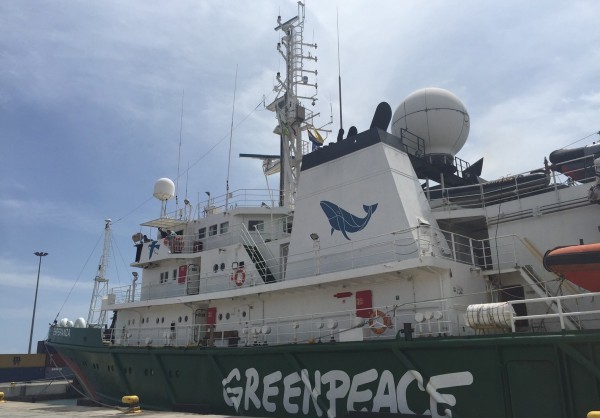
After two months of joint surveillance with local authorities in West African waters, Greenpeace has completed its mission and has recommended ways governments of the region can tackle the issue of illegal fishing.

Greenpeace says an effective regional fisheries management body should be established and national fisheries policies harmonised.

Transparency, including bilateral fisheries agreements, the sharing of resources to optimise Vessel Monitoring Systems for tracking fishing vessels, and the setting up of a black list of IUU vessels and non-cooperating captains in the region must be adopted by all countries, it further suggested.

Greenpeace noted that there was an urgent need to establish a committee to monitor stock assessment and catches to bring fisheries capacity in balance with available resources.

In addition, the voices of local fishing communities, those hit hardest by industrial fishing in the region, must be made central to the planning and implementation of fisheries management. With West African fish stocks plummeting, the need for such a system is urgent.

It said in just three weeks of joint surveillance with local authorities in West African waters, 11 arrests of vessels fishing illegally occurred.

This, it said, is out of 13 fishing regulation infractions identified during the two month ‘Hope in West Africa’ ship tour, which also included fisheries monitoring and civil society and political engagement in a total of six countries.

The results of Greenpeace’s ship tour, which ends this weekend in Dakar, have been compiled in a preliminary report released today. The findings are symptomatic of West African fisheries’ desperate need for effective regulations at a regional level.

In total, Greenpeace and inspectors from Guinea, Guinea Bissau, Sierra Leone and Senegal boarded and inspected 37 industrial fishing vessels in the region.

In Mauritania Greenpeace conducted its own monitoring and presented the findings to the Minister of Fisheries, Mr Nani Chrougha. The 13 infractions included shark finning, incorrect net mesh sizes, transshipment at sea, lack of documentation and fishing outside of permits. The infractions were committed by fishing vessels with Chinese, Italian, Korean, Comoros and Senegalese flags.

According to Hope in West Africa project leader, Pavel Klinckhamers, “After two months at sea documenting and inspecting industrial fishing vessels in the waters of West Africa, it is clear that illegal fishing is worryingly common.

“We also found an eagerness among local fishermen, civil society and governments across the region to address the situation and move towards a sustainable fisheries system. The next step is for these stakeholders to show real commitment in working together towards that goal. We look forward to supporting that process.”

Without decision making powers current managing bodies for the seas, from Cabo Verde to Sierra Leone, including the Sub-Regional Fisheries Commission (SRFC) and the Fishery Committee for the Eastern Central Atlantic (CECAF), can only perform insufficient advisory roles. A lack of transparency on fisheries policies and practices also blights the region. Fisheries authorities’ vessel lists are often incomplete or inaccurate, and the numbers and details of joint venture companies and fisheries access agreements in the region remains opaque.

Also, Ahmed Diame, Greenpeace Africa Oceans campaigner, said “with West African fish stocks already in free-fall, governments must act right now to ensure food security is no longer threatened by overfishing and illegal fishing.

“Fish stocks are not restricted to national boundaries, and that is why the solutions to end the overfishing of West Africa’s waters can only come from joint efforts between the countries of this region.

“Governments must work together to set up and implement an effective regional fisheries management system to safeguard these precious resources now and for generations to come.”

In the latest round of joint surveillance, in Senegal, from 25 to 29 April, Greenpeace and inspectors from the Office of Fisheries Protection and Surveillance (DPSP) identified two cases of illegal fishing. The Marcantonio Bragadin, owned by a Senegalese-Italian joint venture, and Kanbal III, owned by a Senegalese-Spanish joint venture, were both caught using methods to constrict the mesh size of their nets, effectively making the net mesh smaller than the permitted size. The Marcantonio Bragadin reportedly paid a deposit of West African CFA 30 million (€45,700) one day later in order to continue fishing. The Kanbal III will be further investigated by the DPSP.

Greenpeace is handing its report to government representatives from Cape Verde, Mauritania, Guinea Bissau, Guinea, Sierra Leone and Senegal with strong recommendations as to how West African governments can live up to their responsibility and jointly manage both foreign and local fishing activities in order to safeguard their waters and ensure a fair and sustainable distribution of resources at sea. In the coming months, Greenpeace will also share its findings concerning the poor working conditions on board many foreign fishing vessels, where drinking water is often in scarce supply and many local crew are left to sleep, eat and wash outside.


Dipo Olowookere is a journalist based in Nigeria that has passion for reporting business news stories. At his leisure time, he watches football and supports 3SC of Ibadan. Mr Olowookere can be reached via [email protected]

Advertisement
Click to comment

Leave a Reply

Your email address will not be published. Required fields are marked *

Economy

Customs Street Chalks up 1.08% on Renewed Buying Pressure

Published

on

Customs Street NGX

By Dipo Olowookere

A 1.08 per cent growth was further printed by the Nigerian Exchange (NGX) Limited on Friday on improved appetite for Nigerian stocks.

Data showed that the insurance sector lost 0.61 per cent yesterday due to profit-taking as the energy space gave up 0.08 per cent, while the commodity counter closed flat.

However, the industrial goods landscape appreciated by 2.06 per cent, the banking index improved by 1.31 per cent, and the consumer goods sector expanded by 0.83 per cent.

At the close of business on Customs Street, the All-Share Index (ASI) increased by 1,563.92 points to 147,040.07 points from 145,476.15 points and the market capitalisation went up by N996 billion to N93.722 trillion from N92.726 trillion.

UAC Nigeria led the advancers’ log yesterday after it grew by 10.00 per cent to N96.80, Transcorp Hotels jumped by 9.71 per cent to N172.80, Royal Exchange appreciated by 8.89 per cent to N1.96, Ikeja Hotel soared by 8.74 per cent to N31.10, and Veritas Kapital leapt by 8.07 per cent to N1.74.

On the flip side, Union Dicon declined by 10.00 per cent to N6.30, ABC Transport slipped by 9.88 per cent to N3.10, AXA Mansard depreciated by 7.19 per cent to N12.90, FTN Cocoa lost 4.62 per cent to trade at N4.75, and Guinea Insurance dropped 3.36 per cent to finish at N1.15.

A total of 38 stocks ended on the gainers’ table and 17 stocks finished on the losers’ table, representing a positive market breadth index and strong investor sentiment.

Traders transacted 361.6 million equities for N14.8 billion in 21,051 deals yesterday versus the 1.9 billion equities worth N19.2 billion traded in 23,369 deals a day earlier, showing a decline in the trading volume, value, and number of deals by 80.97 per cent, 22.92 per cent, and 14.20 per cent, respectively.

The busiest stock for the session was Zenith Bank with 59.5 million units worth N3.6 billion, Access Holdings traded 46.1 million units valued at N973.0 million, Fidelity Bank exchanged 29.4 million units for N560.4 million, FCMB transacted 27.9 million units worth N293.9 million, and Tantalizers sold 13.0 million units valued at N29.8 million.

Continue Reading

Economy

Nipco, 11 Plc Crash OTC Securities Exchange by 4.76%

Published

on

NIPCO LPG Depot

By Adedapo Adesanya

Energy stocks influenced the 4.76 per cent loss recorded by the NASD Over-the-Counter (OTC) Securities Exchange on Friday, December 5.

The culprits were the duo of 11 Plc and Nipco Plc,with the former shedding N32.17 to end at N291.83 per share compared with the previous day’s N324.00 per share, and the latter down by N21.00 to sell at N195.00 per unit versus the previous session’s N216.00 per unit.

Consequently, the NASD Unlisted Security Index (NSI) slumped by 170.16 points to 3,401.37 points from 3,571.53 points and the market capitalisation lost N101.81 billion to close at N2.035 billion from the N2.136 trillion quoted in the preceding session.

The OTC securities exchange suffered the decline yesterday despite the share prices of three companies closing green.

Central Securities Clearing System (CSCS) Plc was up by N1.80 to close at N39.80 per share compared with Thursday’s price of N38.00 per share, Air Liquide Plc appreciated by N1.09 to N11.99 per unit from N10.90 per unit, and FrieslandCampina Wamco Nigeria Plc grew by 78 Kobo to N56.57 per share from N55.79 per share.

During the session, the volume of transactions rose by 6,885.3 per cent to 18.2 million units from 4.3 million units, the value of transactions ballooned by 10,301.7 per cent to N389.7 million from N347.2 million, but the number of deals declined by 29.7 per cent to 26 deals from 37 deals.

Infrastructure Credit Guarantee Company (InfraCredit) Plc ended the day as the most traded stock by value on a year-to-date basis with 5.8 billion units worth N16.4 billion, followed by Okitipupa Plc with 170.4 million units valued at N8.0 billion, and Air Liquide Plc with 507.5 million units worth N4.2 billion.

InfraCredit Plc also finished the day as the most traded stock by volume on a year-to-date basis with 5.8 billion units transacted for N16.4 billion, followed by Industrial and General Insurance (IGI) Plc with 1.2 billion units sold for N420.2 million, and Impresit Bakolori Plc with 536.9 million units worth N524.9 million.

Continue Reading

Economy

Naira Depreciates to N1,450/$1 at Official Forex Market

Published

on

Naira-Dollar exchange rate gap

By Adedapo Adesanya

The Naira depreciated further against the US Dollar in the Nigerian Autonomous Foreign Exchange Market (NAFEX) on Friday, December 5, as FX demand pressure mounts.

The Nigerian currency lost N2.60 or 0.18 per cent against the greenback to close at N1,450.43/$1 compared with the previous day’s N1,447.83/$1.

Equally, the domestic currency declined against the Pound Sterling in the official forex market during the session by N4.48 to trade at N1,935.45/£1, in contrast to Thursday’s closing price of N1,930.97/£1 and shrank against the Euro by 43 Kobo to end at N1,689.17/€1 versus the preceding session’s rate of N1,688.74/€1.

Similarly, the local currency performed badly against the US Dollar at the GTBank FX counter by N2 to close at N1,455/$1 versus Thursday’s N1,453/$1 but traded flat at the parallel market at N14.65/$1.

As the country gets into the festive period, pressure mounted on the local currency reflecting higher foreign payments and lower FX inflows.

However, there are expectations that the Nigerian currency will be stable, supported by interventions by to the Central Bank of Nigeria (CBN) in the face of steady dollar Demand and inflows from Detty December festivities that will give the Naira a boost after it depreciated mildly last month.

Traders cited by Reuters expect that the Naira will trade within a band of N1,443-N1,450/$1 next week, buoyed by improved FX interventions by the apex bank.

As for the crypto market, it was down yesterday due to profit-taking associated with year-end trading. However, the December 1-Year Consumer Inflation Expectation by the University of Michigan fell to 4.1 per cent from 4.5 per cent previously and 4.5 per cent expected. The 5-Year Consumer Inflation Expectation fell to 3.2 per cent from 3.4 per cent previously and 3.4 per cent expected.

With the dearth of official economic data of late, these private surveys have taken on a new level of significance and the market banks of them to make decisions.

Cardano (ADA) depreciated by 5.7 per cent to $0.4142, Dogecoin (DOGE) slid by 5.1 per cent to $0.1394, Ethereum (ETH) dropped by 3.9 per cent to $3,039.75, Solana (SOL) declined by 3.8 per cent to $133.24, and Litecoin (LTC) fell by 3.7 per cent to $80.59.

Further, Bitcoin (BTC) went down by 2.6 per cent to sell at $89,683.72, Binance Coin (BNB) slumped by 2.2 per cent to $883.59, and Ripple (XRP) shrank by 2.1 per cent to $2.04, while the US Dollar Tether (USDT) and the US Dollar Coin (USDC) remained unchanged at $1.00 each.

Continue Reading

Trending