Feature/OPED
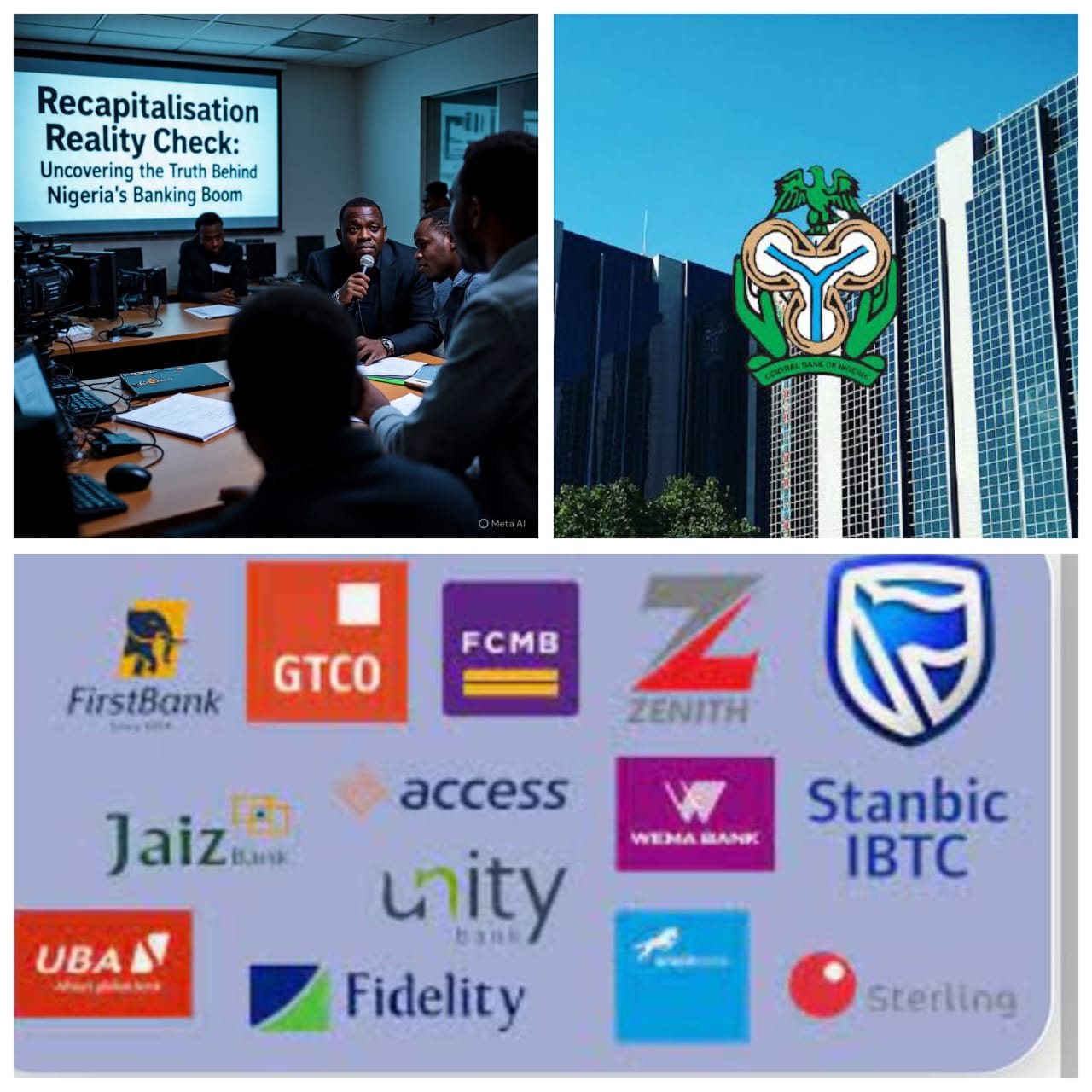
Recapitalisation Reality Check: Uncovering the Truth Behind Nigeria’s Banking Boom
By Blaise Udunze
When the Central Bank of Nigeria (CBN) announced a new round of bank recapitalisation in March 2024, many expected the leading banks, especially those boasting record-breaking profits in the hundreds of billions and trillions, to sail through with ease. Their financial statements glistened with prosperity, with expanding balance sheets, rising dividends, and bullish share prices.
Indeed, five of Nigeria’s top 10 banks reported a combined pre-tax profit of N4.6 trillion in 2024, showing a staggering 70 percent increase from the previous year, with Zenith Bank and Guaranty Trust Holding Company crossing the trillion-naira mark for the first time. The results painted a picture of robust profitability and resilience.
Yet, barely months after the profit announcements, the same banks found themselves racing back-to-back to the capital market to raise fresh funds. By the first half of 2025, Nigeria’s banking industry was at a crossroads. Behind the glitter of trillion-naira profits lay a more sobering reality of an industry scrambling to meet the CBN’s recapitalisation directive.
The contradiction is stark: record profits on one hand, desperate fundraising on the other. If the banks were truly as profitable and resilient as they claimed, they wouldn’t be begging investors for fresh equity to meet new thresholds.
Behind the strong showing of the market leaders lies an even deeper concern. The smaller commercial and regional banks are struggling to formulate credible recapitalisation strategies. As the March 31, 2026 deadline looms, the CBN has confirmed that only 14 banks have so far scaled the recapitalisation hurdle. That leaves nearly 19 institutions still in search of capital in a market already skeptical of their true worth.
The recapitalisation push has therefore become the clearest indicator of the sector’s underlying fragility. The CBN’s new capital requirements of N500 billion for international banks, N200 billion for national banks, and N50 billion for regional banks have forced lenders to confront a fundamental question. How much of their reported profits actually represents real financial strength?
Much of Nigeria’s profit boom has been a deception, a mirage built on foreign exchange revaluation gains and arbitrary fees rather than genuine operational efficiency. The unification of exchange rates and subsequent naira depreciation in 2023 and 2024 delivered massive revaluation windfalls on dollar-denominated assets, inflating balance sheets overnight. But these were paper gains, not cash profits, and could not be deployed to strengthen capital or fund new loans.
Beyond FX gains, Nigerian banks have increasingly relied on fees and charges as easy revenue. Despite repeated CBN sanctions for breaching its Guide to Charges, banks continue to extract billions from customers through transfers, withdrawals, ATM fees, SMS alerts, and account maintenance. With over 312 million active bank accounts, these charges now contribute more to profitability than traditional lending or genuine financial intermediation.
It is little surprise, then, that the recapitalisation exercise has exposed the widening gap between declared profitability and true solvency. While five Tier-1 banks together raked in N4.6 trillion in pre-tax profit in 2024, nearly 70 percent higher than in 2023, many mid-tier banks can barely keep pace. The recapitalisation gap across the sector is now estimated at N4.7 trillion.
As of September 2025, only 14 banks had crossed the line, while others scramble for mergers, rights issues, or license downgrades to survive. The CBN’s insistence that only paid-up capital and share premium will count while excluding retained earnings has stripped away the accounting camouflage that once masked weakness.
For the market leaders, the race has been aggressive but achievable. Access Holdings raised N351 billion through a fully subscribed rights issue. Zenith Bank’s N350.4 billion hybrid offer was oversubscribed by 160 percent. Wema Bank, once a mid-tier lender, successfully raised N200 billion and became a national success story. Among specialised institutions, Greenwich Merchant Bank sealed its own recapitalisation, supported by capital injections and debt-to-equity conversions that secured its merchant banking license, while Jaiz Bank rose above the N20 billion target to remain the flagship of Islamic banking. Lotus has met the N10 billion bar, consolidating its place in Nigeria’s fast-growing alternative sector.
Another notable entrant is Globus Bank, which in 2024 raised N52.9 billion to lift its capital to N98.6 billion and followed in 2025 with a further N102 billion via rights issues and private placements. The raise subscribed entirely by existing shareholders took its capital above N200 billion. The bank now awaits final verification from the CBN before being formally recognized as compliant.
For others, however, it has been a painful crawl. Fidelity Bank’s N205.45 billion hybrid offer still leaves a N160 billion gap to the N500 billion benchmark. Guaranty Trust Bank reached its own target through a two-phased approach that started with a rights issue in Nigeria that netted N365.8 billion. Subsequently, GT listed shares on the London Stock Exchange with proceeds of $105 million to reach the required target, while UBA Plc launched a N157 billion rights issue in July 2025, following a N239 billion offer in November 2024 that was oversubscribed at N251 billion, with N240 billion accepted. The new offer, extended to September 19, 2025, helped the bank meet the CBN’s N500 billion capital requirement.
As of September 2025, First Bank has secured N187.6 billion and plans an additional N350 billion in private placements, but it still needs to secure the remaining funds to meet the CBN’s requirements. FCMB Group Plc launched a N160 billion public share offer to meet the CBN’s N500 billion capital requirements for international banks, with the offer closing on November 6, 2025. The offer follows a successful N147.5 billion share sale in 2024.
Fidelity raised N176 billion in fresh capital in 2024 and is moving to get an additional N195 billion via private placement before the end of the year. Sterling Bank has not yet completed its recapitalisation as it commenced an N87.067 public offer. This offer follows completion of a N75 billion private placement and a N28.79 billion rights issue, which was significantly oversubscribed by its shareholders.
Consolidation pressures are once again reshaping Nigeria’s banking landscape. Titan Trust’s acquisition of Union Bank and the completed Providus and Unity Bank’s merger reflect the reality that not every institution will raise sufficient equity alone. More combinations are expected in the months ahead, with smaller lenders likely to be folded into stronger franchises as the recapitalisation deadline approaches.
This trend mirrors the 2005 consolidation era, which trimmed 89 banks down to 25, ushering in a new era of scale and scrutiny. The 2024-2026 recapitalisation may well repeat history, producing fewer but sturdier players, banks large enough to finance Nigeria’s economic transformation.
But history offers a warning that recapitalisation is not reform. Bigger balance sheets may shield banks from global shocks, but they do not guarantee developmental relevance. Unless the philosophy of Nigerian banking itself changes from profit-first to purpose-driven intermediation, the sector will keep producing “giant banks in a fragile economy.”
The real challenge is not size, but substance. Nigeria doesn’t just need bigger banks; it needs better banks. It needs institutions that see SMEs as partners rather than liabilities, that lend to real producers rather than recycle deposits into government securities. It needs lenders that adopt fintech-driven underwriting, regulators that reward productive lending, and policymakers that create the infrastructure, power, and security needed to make risk-taking viable.
Recapitalisation, in this light, should not be seen merely as a regulatory hurdle but as a mirror reflecting both the success and the shame of Nigeria’s banking system. The trillion-naira profits may have dazzled investors, but the scramble for new capital reveals the truth that the sector’s foundations remain fragile, its governance inconsistent, and its contribution to real economic development still limited.
The CBN’s policy, painful as it may be, is a necessary reality check. It forces banks to prove that their wealth is more than paper-deep and that their balance sheets can support Nigeria’s ambitious $1 trillion economy vision. For investors and depositors, it is a wake-up call that what glitters in the financial statements may not always be gold.
In the end, recapitalisation is not just about raising funds; it is about restoring credibility. Because trust, once eroded by profit manipulation and corporate posturing, takes far more than a balance sheet to rebuild.
Blaise, a journalist and PR professional writes from Lagos, can be reached via: [email protected]
Feature/OPED
How AI Levels the Playing Field for SMEs
By Linda Saunders
Intro: In many small businesses, the owner often starts out as the bookkeeper, the customer-service desk, the IT technician and the person who steps in when a delivery goes wrong. With so many balls up in the air – and such little room for error – one dropped ball can derail the entire day and trigger a chain of problems that’s hard to recover from. Unlike larger companies that have the luxury of spreading the load across dedicated teams and systems, SMEs carry it all on a few shoulders.
South Africa’s SME sector carries significant weight, contributing around 19% of GDP and a third of formal employment, according to the latest available Trade & Industrial Policy Strategies (TIPS) 2024 review. That is causing persistent constraints, including tight margins, erratic demand, high administrative load, and limited internal capacity.
This is not unique to South Africa. Many smaller businesses across the continent still rely on manual processes. It is common to find sales records kept separately from customer notes, or inventory data that is updated only occasionally. The result is slow turnaround times, duplicated effort and a lack of visibility across the business. Given that SMEs have such a huge influence on national economies, accounting for over 90% of all businesses, between 20-40% of GDP in some African countries, and a major source of employment, providing around 80% of jobs, these operational constraints have a broad impact on economies.
What has changed in recent years is that digital tools once seen as the preserve of larger companies have become more attainable for smaller operators. They do not remove the structural challenges SMEs face, but they can ease the load. Better systems do not replace judgement, experience or customer relationships; they simply give small companies more room to work with.
Cloud-based systems, automation and integrated customer-management tools have become more affordable and easier to deploy. They do not remove the structural pressures facing small businesses, but they can ease the operational load and create more space for productive work.
Doing more with the teams SMEs already have
Small teams often end up wearing several hats. One person might take customer calls, update stock records, handle service issues and manage follow-ups. When demand rises, these manual processes become harder to sustain. Local surveys regularly point to this strain, showing that smaller companies spend significant portions of the week on paperwork, compliance and routine administrative tasks – work that adds little value but cannot be ignored.
This is where automation is proving useful. Routine tasks such as onboarding new customers, checking documents, routing queries to the right person, logging interactions and sending follow-ups can now run quietly in the background. In larger companies, whole departments handle this work. In small businesses, the same burden has traditionally fallen on one or two people. When these processes run reliably without constant attention, a business with 10 employees can manage busier periods without rushed outsourcing or slipping service standards.
The point is not to replace staff, but to reduce the operational drag that limits what small teams can deliver. Structured workflows give SMEs a level of steadiness they have rarely had the time or money to build themselves.
Using better data to make better decisions
A second constraint facing SMEs is disorganised information. When customer details are lost in email, sales notes in chat groups, stock figures in spreadsheets and queries in separate systems, decisions depend on whatever information happens to be at hand. Forecasting becomes guesswork, and early warning signs are easy to miss.
Putting all this information in a single place changes the quality of decision-making. When sales, service and stock data can be viewed together, patterns become easier to spot: which products are moving, which customers are becoming less active, where delays tend to occur, and which periods consistently drive higher demand.
Importantly, SMEs do not need corporate analytics teams for this. Modern CRM platforms can organise information automatically and surface basic trends. For retailers preparing for 2026, this can help avoid over – or under – stocking. For service businesses, it can highlight customers who may be at risk of leaving, prompting earlier intervention. In competitive markets, having clearer information is a practical advantage.
Building a foundation before the pressure arrives
Rapid growth can be as destabilising for SMEs as an economic downturn. When orders increase, manual processes quickly reach their limit. Errors are more likely, staff become overwhelmed and the customer experience suffers. Many small businesses only upgrade their systems once these problems appear, by which time the cost, both financial and reputational, is already significant.
Putting basic workflow tools and a unified customer record in place early provides a useful buffer. Tasks follow the same steps every time, reducing inconsistency. Customers reach the right person more quickly. Staff spend less time checking or re-entering information and more time on work that matters. These small operational gains compound over time, especially during busy periods.
This is not about chasing every new technology. It is about avoiding a common pattern in the SME sector: when demand rises, systems buckle, and growth becomes more difficult.
Confidence matters as much as capability
Smaller companies understandably worry about risk when adopting new systems. Data protection, monitoring, and compliance can feel daunting without an IT department. The advantage of modern platforms is that many of these protections, like encryption, audit trails, and event monitoring, are built in. Transparent design also helps SMEs understand how automated decisions are made and how customer data is handled.
This reassurance is important because SMEs should not have to choose between improving their operations and protecting their customers’ information.
2026 will reward readiness
Technology will not replace the qualities that give SMEs their edge: personal service, flexibility, and the ability to respond quickly to customer needs. What it can do is relieve the administrative load that prevents those strengths from being fully used.
SMEs that invest in simple automation and better data practices now will enter 2026 with greater capacity and clearer insight. They won’t be competing with larger companies by matching their resources, but by removing the disadvantages that have traditionally held them back.
In the year ahead, the most competitive businesses will not be the biggest; they’ll be the ones that prepared early for the year ahead.
Linda Saunders is the Country Manager & Senior Director Solution Engineering for Africa at Salesforce
Feature/OPED
Why Africa Requires Homegrown Trade Finance to Boost Economic Integration
By Cyprian Rono
Africa’s quest to trade with itself has never been more urgent. With the African Continental Free Trade Area (AfCFTA) gaining momentum, governments are working to deepen intra-African commerce. The idea of “One African Market” is no longer aspirational; it is emerging as a strategic pathway for economic growth, job creation, and industrial competitiveness. Yet even as infrastructure and regulatory reforms advance, one fundamental question remains; how will Africa finance its cross-border trade, across markets with diverse currencies, regulations, and standards?
Today, only 15 to 18 percent of Africa’s internal trade happens within the continent, compared to 68 percent in Europe and 59 percent in Asia. Closing this gap is essential if AfCFTA is to deliver prosperity to Africa’s 1.3 billion people.
A major constraint is the continent’s huge trade finance deficit, which exceeds USD 81 billion annually, according to the African Development Bank. Small and medium-sized enterprises (SMEs), which provide more than 80 percent of the continent’s jobs, are the most affected. Many struggle with insufficient collateral, stringent risk profiling and compliance requirements that mirror international banking standards rather than the realities of African business.
To build integrated value chains, exporters and importers must operate within trusted, predictable, and interconnected financial systems. This requires strong pan-African financial institutions with both local knowledge and continental reach.
Homegrown trade finance is therefore indispensable. Pan-African banks combine deep domestic roots with extensive regional reach, making them the most credible engines for financing trade integration. By retaining financial activity within the continent, homegrown lenders reduce exposure to external shocks and keep liquidity circulating locally. They also strengthen existing regional payment infrastructure such as the Pan-African Payment and Settlement System (PAPSS), developed by the Africa Export-Import Bank (Afreximbank) and backed by the African Continental Free Trade Area (AfCFTA) Secretariat, enabling faster, cheaper and seamless cross-border payments across the continent.
Digital transformation amplifies this advantage. Real-time payments, seamless Know-Your-Customer (KYC) verification, automated credit scoring and consistent service delivery across markets are essential for intra-African trade. Institutions such as Ecobank, operating in 34 African countries with integrated core banking systems, demonstrate how such digital ecosystems can enable continent-wide commerce.
Platforms such as Ecobank’s Omni, Rapidtransfer and RapidCollect, together with digital account-opening services, make it much easier for traders to operate across borders. Rapidtransfer enables instant, secure payments across Ecobank’s 34-country network, reducing delays in regional trade, while RapidCollect gives cross-border enterprises the ability to receive payments from multiple African countries into a single account with real-time confirmation and automated reconciliation. Together, these solutions create an integrated digital ecosystem that lowers friction, accelerates payments, and strengthens intra-African commerce.
Trust, however, remains a significant barrier. Cross-border commerce depends on the confidence that partners will honour contracts, deliver goods as promised, pay on time, and present authentic documentation. Traders often lack reliable information on potential partners, operate under different regulatory regimes, and exchange documents that are difficult to verify across borders. This heightens the risk of fraud, non-payment, and contractual disputes, discouraging businesss from expanding beyond familiar markets.
Technology is closing this trust gap. Artificial Intelligence enables lenders to assess risk using alternative data for SMEs without formal credit histories. Distributed ledger tools make shipping documents, certificates of origin, and inspection reports tamper-proof. In addition, supply-chain visibility platforms enable real-time tracking of goods and cross-border digital KYC ensures that both buyers and sellers are verified before any transaction occurs.
Ecobank’s Single Trade Hub embodies this trust infrastructure by offering a secure digital marketplace where buyers and sellers can trade with confidence, even in markets where no prior relationships exist. The platform’s Trade Intelligence suite provides customers instant access to market data from customs information and product classification tools across 133 countries.
Through its unique features such as the classification of best import/export markets, over 25,000 market and industry reports, customs duty calculators, and local and universal customs classification codes, businesses can accurately assess market opportunities, anticipate trends, reduce compliance risks, and optimise supply chains, ultimately helping them compete and grow in regional and global markets.
SMEs need more than financing. Many operate in cash-heavy cycles where suppliers and logistics providers require upfront payment. Lenders can support these businesses with advisory services, business intelligence, compliance guidance, and platforms for secure partner verification, contract negotiation, and secure settlement of payments. Trade fairs, industry forums, and partnerships with chambers of commerce further build the trust networks needed for cross-border trade.
Ultimately, Africa’s path toward meaningful trade integration begins with financial integration. AfCFTA’s promise will only be realised when enterprises can trade with confidence, knowing that payments will be honoured, partners verified, and disputes resolved. This requires collaboration between banks, regulators, and trade institutions, alongside harmonised financial regulations, interoperable payment systems, and continent-wide verification networks.
Africa can no longer rely on external actors to finance its trade. Its economic transformation depends on strong, trusted, and digitally enabled African financial institutions that understand Africa’s unique risks and opportunities. By building an African-led trade finance ecosystem, the continent can unlock liquidity, reduce dependence on external currencies, empower SMEs, and retain more value locally. Africa’s trade revolution will accelerate when its financing is driven by African institutions, African systems, and African ambition.
Cyprian Rono is the Director of Corporate and Investment Banking for Kenya and EAC at Ecobank Kenya
Feature/OPED
Tax Reform or Financial Exclusion? The Trouble with Mandatory TINs
By Blaise Udunze
It is not only questionable but an aberration that a nation where over 38million Nigerians remain financially excluded, where trust in institutions is fragile, and where citizens are pressured under the weight of rising living costs, the use of Tax Identification Number (TIN) has been specified as the only option for their bank accounts operation from January 1, 2026 by the Federal Government of Nigeria.
In practice, the policy spearheaded by Taiwo Oyedele, Chairman of the Presidential Committee on Fiscal Policy and Tax Reforms, is rooted in the Nigerian Tax Administration Act (NTAA), and the intention can be understood in the areas of improving tax compliance, widening the tax net, and formalizing economic activities. But in practice, the directive risks becoming yet another well-meaning reform that punishes the wrong people, disrupts financial inclusiveness, and potentially destabilises an already stressed economy.
Yes, Nigeria needs tax reforms. Yes, the country must broaden its tax base. And yes, public revenues must increase to address fiscal pressures.
But compelling citizens to obtain TINs as a condition for operating bank accounts is the wrong tool for the right objective.
Below are five core arguments against the directive, and sustainable alternatives that actually strengthen tax compliance without endangering banking access or punishing informal earners.
The Directive Risks Deepening Financial Exclusion
Nigeria still struggles with financial inclusion. According to several official assessments, over 38 million adults remain outside the formal financial system. Many of them operate small, irregular businesses, survive through subsistence earnings, or depend on cash-based livelihoods.
The Federal Government’s compulsory TIN-for-bank-accounts policy is built on the assumption that every banked Nigerian is structured, organised, and tax-ready. This is false.
For instance, the rural market woman with N30,000 in rotating savings, the okada rider who deposits cash once a week, the petty trader using a mobile POS agent account, the retiring pensioner managing a small monthly income, and the migrant worker sends small remittances to their family. These are not tax evaders; they are survivalists.
Most operate bank accounts not because they run formal businesses, but because those accounts are essential to modern financial life: receiving transfers, accessing loans, participating in digital commerce, saving against emergencies, and avoiding the risks of moving cash in insecure environments.
By creating an additional bureaucratic barrier, the directive risks pushing millions back into a cash-dominant shadow economy, precisely the opposite outcome of what Nigeria’s financial-sector reforms are trying to achieve.
Bank Accounts Are Not Proof of Taxable Income
The NTAA clarifies that the TIN requirement applies only to taxable persons, individuals engaged in trade, employment, or income-generating activities.
But herein lies the problem: banks cannot determine who is “taxable” and who is not. Banks only see deposits and withdrawals. They do not audit the source or consistency of income. They are not tax authorities.
A student may run a small online clothing resale gig. A retiree may occasionally rent out farmland.
A dependent may receive cash support from a relative abroad. A job seeker may get intermittent gifts from family.
Who decides which of these scenarios qualifies as taxable? Banks? FIRS? Or will citizens be expected to self-declare under threat of account restrictions?
The result will be confusion, over-compliance, and mass panic with banks indiscriminately demanding TINs from everyone to avoid regulatory penalties.
This not only contradicts the spirit of the law but also exposes ordinary Nigerians to harassment and arbitrary compliance requirements.
The Policy Could Trigger Disruption, Panic Withdrawals, and Cash Hoarding
Whenever Nigerians perceive threats to their access to funds, the natural reaction is withdrawal and hoarding. We saw it during:
– the 2023 Naira redesign crisis,
– the 2016 TSA-bank consolidation tightening, and multiple periods of financial instability.
Telling citizens that bank accounts may face “operational restrictions” if they do not obtain a TIN creates a predictable behavioural response: people will rush to withdraw money.
This would be disastrous for a banking system already pressured by:
– high interest rates,
– inflation eroding deposits,
– rising loan defaults, and
– declining public trust.
Any government policy that unintentionally creates an incentive for citizens to flee the formal banking system is counterproductive.
The TIN Requirement Will Become a Bureaucratic Nightmare
Even if millions of Nigerians want to comply, the system is not ready. Nigeria’s administrative infrastructure does not have the capacity to process tens of millions of TIN registrations within months without:
– long queues,
– delays,
– data mismatches,
– duplicate records, and
– systemic errors.
The National Identity Number (NIN)-SIM registration experience is a painful reminder of what happens when ambitious policy meets weak execution capacity.
– Citizens spent months in overcrowded enrolment centres.
– Millions were blocked from services.
– Data inconsistencies persisted.
– The economy suffered productivity losses.
If Nigeria could not seamlessly synchronise NIN and SIM data, how will it synchronise NIN, BVN, and TIN at a national scale without dislocation?
Forcing TIN Adoption Ignores the Real Problem: Nigeria’s Broken Tax Culture
The Federal Government’s real challenge is not that citizens lack TINs, but that they lack trust in how taxes are used.
A government cannot widen the tax net when:
– tax leakages remain widespread,
– citizens feel services do not match taxation,
– corruption perceptions are high,
– government spending lacks transparency, and
– taxpayers do not feel seen, heard, or valued.
Coercion does not build a tax culture. Engagement does. Policy does not create legitimacy. Accountability does.
If the Federal Government wants Nigerians to freely participate in the tax system, it must earn legitimacy first, not mandate compliance through financial restrictions.
What the Government Should Do Instead: A Smarter Path to Tax Reform
Instead of enforcing a policy that may backfire economically and socially, the Federal Government can adopt four smarter, people-centred alternatives.
– Automatic TIN Issuance Linked to NIN and BVN
Rather than forcing Nigerians to apply manually, the government should:
- auto-generate TINs for all existing BVN/NIN holders,
- send the TINs via SMS, email, and bank alerts,
- allow self-activation only when needed for tax obligations.
This eliminates queues, delays, and confusion.
– Build a Voluntary Tax Compliance Culture Through Transparency and Incentives
Tax morale improves when citizens see value. Government should:
- publish annual audited reports of tax revenue use,
- incentivise compliant taxpayers with benefits (priority access to government grants, credit scoring, etc.),
- simplify tax filings for small businesses.
People comply more when they feel respected, not coerced.
– Target High-Value Tax Evaders, Not Low-Income Account Holders
Nigeria’s real tax leakages come from:
- large corporations shifting profits,
- politically exposed persons,
- illicit financial flows,
- multinational tax avoidance strategies,
- the informal “big money” class operating outside the banking system.
Instead of threatening small depositors, the government should strengthen:
- FIRS intelligence and investigation units,
- inter-agency data integration (CAC, Customs, Immigration),
- beneficial ownership transparency enforcement.
The fight against tax evasion should focus on those hiding billions, not those depositing thousands.
– Strengthen Digital Tax Platforms for Easy Self-Registration and Compliance
If tax registration becomes as easy as opening a social media account, compliance will rise naturally. The government should build:
- a mobile-first tax app,
- simplified online TIN retrieval,
- one-click tax filing for gig workers and small traders.
Digital convenience can achieve what regulatory coercion cannot.
Reform Should Not Punish the Public
No doubt, tax reforms are needed urgently, but they must come with a human face, an intelligent, equitable, and aligned with the realities of ordinary Nigerians.
The TIN-for-bank-accounts policy, while well-intentioned, risks undermining financial inclusion, triggering economic instability, and imposing unnecessary burdens on millions who are not tax evaders but survival-based earners.
Good tax policy is built on trust, not fear. On transparency, not threats. On civic legitimacy, not administrative compulsion.
If the Federal Government truly wants to modernise Nigeria’s tax system, it must focus not on restricting citizens’ access to their own money, but on:
- repairing tax trust,
- digitising compliance,
- targeting the real evaders, and
- making participation easier, not harder.
Financial inclusion took Nigeria decades to build. We cannot afford a policy that carelessly reverses these gains.
A better tax system is possible, but it must start with the people, not with their bank accounts.
Blaise, a journalist and PR professional, writes from Lagos, can be reached via: [email protected]

-
Feature/OPED6 years agoDavos was Different this year
-
Travel/Tourism9 years ago
Lagos Seals Western Lodge Hotel In Ikorodu
-
Showbiz3 years agoEstranged Lover Releases Videos of Empress Njamah Bathing
-
Banking7 years agoSort Codes of GTBank Branches in Nigeria
-
Economy3 years agoSubsidy Removal: CNG at N130 Per Litre Cheaper Than Petrol—IPMAN
-
Banking3 years agoFirst Bank Announces Planned Downtime
-
Banking3 years agoSort Codes of UBA Branches in Nigeria
-
Sports3 years agoHighest Paid Nigerian Footballer – How Much Do Nigerian Footballers Earn