General
Saraki, Civil Societies Want Child Rights’ Law Domesticated

By Dipo Olowookere
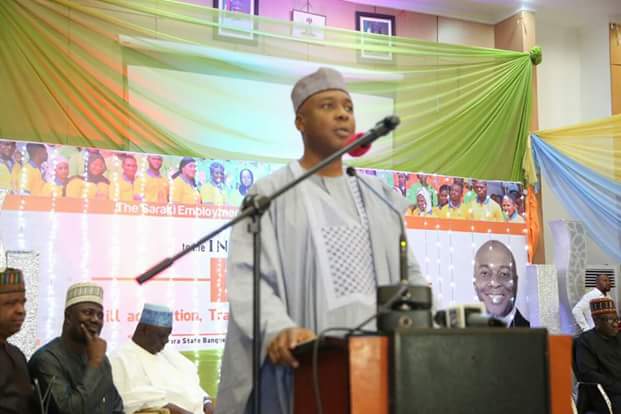
The domestication of and strict implementation of the Child Rights Act (CRA) across the country has been advocated for by the Senate President, Mr Bukola Saraki and a group of Civil Society Organization (CSOs).
Speaking at a roundtable on ‘Advancing the Rights of the Nigerian Child’ organized by the Office of the Senate President in commemoration of the 2017 Children’s Day celebration in Abuja, Mr Saraki lamented that out of every five children, two currently live in poverty, millions in poor housing, crowded rooms, squalid conditions, on streets and affected by communal conflicts and insurgency.
He argued that “these type of beginnings can hold a child back for the rest of his or her life. At just 22 months, a poor child’s skills already trail behind those of better-off toddlers. At age five, that poor child, even if he or she is very bright, will have been overtaken at school by a less talented but more privileged classmate.”
He noted that, “Releasing these children from that trap, unleashing their potentials is critical if we are to create a society that is truly fair. A starting point is to review what protection our laws offer this demographic vulnerability.”
While wishing Nigerian children a happy celebration, Mr Saraki noted that the event was meant to celebrate the resilience and perseverance of Nigerian children in overcoming the many obstacles of childhood.
“With this in mind, we celebrate the recent release of the 82 Chibok girls and take time to make constructive and critical evaluation of our commitment to the next generation,” Mr Saraki said.
He further stated that the existing laws which offer special protection to children and other vulnerable groups in the country include the Violence Against Persons Prohibition Act, (VAPP Act, 2015) and the Child Rights Act (2003).
“These laws contain specific provisions to protect the Nigerian child. In order for our objective to be realized, much more needs to be done at all levels of State governance, but particularly at the local level, through meaningful cooperation and collaboration of all actors involved in the field of protecting children.
“The need remains to establish well-functioning Child Protection Units, provide quality social services for child protection and empower families in need.
“The domestication of the Child Rights Act has been concluded in 24 States. Other States are examining it to see how it relates to local sensitivities and values, and thereby make the law more relevant and effective. It is my hope that the scrutiny of the Act will enhance its inclusiveness and the comprehensive protection and the Nigerian child,” he said.
He stated that domestication and strict implementation of CRA and VAPP are critical for success in the battle to raise a future generation of national touch bearers.
“I must also add that, domestication alone will not turn the tide; we must be willing to vigorously implement the law to match words with action,” Saraki said. “Otherwise we risk making a caricature of ourselves, government, and governance if we fail to give the law teeth to protect the vulnerable for whom we are gathered today.”
He enjoined State Houses of Assembly, traditional heads, political leaders, civil societies and all Nigerians to initiate discussion at their various levels, to ensure that all stakeholders are carried along and their views captured in the advocacy to fully domesticate and implement the CRA.
“We in the 8th Senate are willing to back you up by ensuring adequate appropriation to institutions charged with response and protection such as the police and public health agencies,” he said. “In the years to come, I want us to be able to turn around and say that Nigeria is an ideal place to raise a child.”
“I want us to be able to look back and say: We tackled the deficit, we protected the futures of our children, and we gave them the childhood they deserved. These are not big ambitions. This is what government and leaders are here to do!” he added.
In his remarks, Speaker of the Bauchi State House of Assembly, Mr Kauwa Damina, reaffirmed the commitment of the Bauchi Assembly to domesticate the CRA in view of the centrality of children to the growth and development of the country.
On her part, Professor Joy Ezillo of the University of Nigeria, Nsukka called on the nation’s leaders to reflect their love for children with action and appropriate foster, adoption and child support laws.
Others at the event were representatives of the European Union (EU), The Malala Foundation, United Nations Children’s Fund (UNICEF), National Council of Women Societies (NCWS), Youths of Africa, National Democratic Institute (NDI), Civil Society Legislative and Advocacy Centre (CISLAC), and a cross section of teachers, students and pupils from primary and secondary schools in Abuja.
General
Police Arrest Fake PFIPC DG Adeniyi Adeyemi After Court Warrant
By Adedapo Adesanya
Operatives of the Nigeria Police Force (NPF) have apprehended the Director General of the phantom Presidential Foreign Intervention Promotion Council (PFIPC), Mr Adeniyi Adeyemi.
His arrest happened a few hours after Justice Mohammed Umar of the Federal High Court in Abuja issued a warrant for his arrest.
The police had announced plans to arraign Mr Adeyemi before the court on Tuesday over allegations bordering on forgery, impersonation, and related offences.
The security agency, in a fresh charge marked FHC/ABJ/CR/562/2025, listed Mr Adeyemi, “Femi Surname Unknown,” and “Anu Surname Unknown” as the first to third defendants, respectively, over alleged forgery and impersonation.
The prosecution has lined up several witnesses, including the Chief of Staff to the President, Mr Femi Gbajabiamila, alongside officials from the Office of the Accountant-General of the Federation, police officers, civil servants, and individuals allegedly linked to the operations of the purported agency. It was reported that a hotel operator, a clergyman, and persons said to have worked with Mr Adeyemi at the alleged agency are also expected to testify.
Investigators alleged that Mr Adeyemi operated the purported agency from the Federal Secretariat Complex in Abuja before his arrest.
The police case follows a public debate over the existence of the alleged PFIPC after Mr Adeyemi challenged the Presidency’s denial that the body ever existed.
Mr Adeyemi accused Mr Gbajabiamila of making conflicting statements regarding both the Presidential Foreign Intervention Promotion Council (PFIPC) and the Presidential Economic Advisory Council (PEAC).
During a recent press briefing, Mr Adeyemi called for an independent probe into the two bodies and alleged that Mr Gbajabiamila demanded financial payments linked to his purported appointment.
He claimed that N400 million was paid through intermediaries, with an additional N200 million allegedly requested—claims that have not been substantiated.
Mr Adeyemi also argued that references to both the PFIPC and the Presidential Economic Advisory Council appeared in the 2026 Appropriation Act, questioning the government’s position that the organisations never officially existed.
The planned prosecution comes as the Independent Corrupt Practices and Other Related Offences Commission (ICPC) continues a broader investigation ordered by President Tinubu.
The Senate had earlier declined to immediately investigate the inclusion of the alleged PFIPC in the 2026 Appropriation Act, opting instead to await the outcome of the anti-graft agency’s probe.
General
NMDPRA Shuts Down Two Petrol Stations in Ogun for Under-Dispensing
By Adedapo Adesanya
The Nigeria Midstream and Downstream Petroleum Regulatory Authority (NMDPRA) has sealed two fuel stations in Ogun State engaging in under-dispensing of petroleum products and non-compliance with the Petroleum Industry Act of 2021.
Leading the enforcement team around the Akute-Ajuwon axis of the state, the Head of Distribution Systems Storage and Retailing Infrastructure, Mr Olufemi Adebowale, said the move became imperative in view of repeated breaches of regulatory requirements by the affected stations and the need to protect the rights of consumers from sharp practices.
According to him, the development is part of its ongoing efforts to enforce compliance with industry regulations, protect consumers from sharp practices, and ensure that petroleum marketers dispense the correct quantity of products across the state.
He explained that records available to the authority showed that the fuel stations have consistently violated regulatory compliance by under-dispensing petroleum products, illegally breaking official seals placed on the facility, and resuming operations without authorisation.
According to him, such actions amount to a violation of the Petroleum Industry Act 2023 and undermine efforts to protect consumers from exploitation.
“The Nigerian Midstream and Downstream Petroleum Regulatory Authority is carrying out a lawful enforcement on this facility. Our records have consistently shown that this company has been violating regulatory compliance.”
“It is high time we made it clear that they cannot continue to under-dispense products, deliberately remove our seals, and believe that nothing will happen; that is why we are here to enforce the provisions of the Petroleum Industry Act 2023 he said.
“When it comes to under-dispensing, they are cheating members of the public by not selling the correct quantity of fuel. Also, once a station is sealed, it has no authorisation to operate. But this station deliberately removed our seal and continued operations, which is against the law.”
Mr Adebowale disclosed that the authority has been monitoring the station’s activities since 2025, describing the violations as persistent despite several enforcement actions.
He revealed that the affected station had been sealed no fewer than six times within the period, but continued to remove the authority’s seals and ignore invitations extended by the regulator.
“From our records, this has been happening since last year. The station has also refused to honour our invitations. It has been sealed not less than six times, yet it keeps removing our seals and resuming operations.”
On the sanctions awaiting the operators, Adebowale said the authority had served the stations with enforcement notices, while the facilities would remain shut until all stipulated conditions are met.
He added that the NMDPRA management would also consider suspending the operating licence of the affected stations, while also sending a strong warning to any fuel station intending to go against the rules of PIA.
“That is against the rules. They do not have any right to operate until we authorise them to do so. This is a clear deviation from regulatory compliance. According to the Petroleum Industry Act (PIA), when this happens, we must carry out enforcement, and that is why we are here today.
Beyond conducting this exercise, we are also using this opportunity to address the public through the media. As long as operators are doing the right thing, they have nothing to fear. However, for those going against compliance levels—whether through under-dispensing or direct violation of our seal—all necessary enforcement, penalties, and sanctions will be strictly applied against such offenders.”
“A letter has been served, the station has been completely shut down, and they must meet all the conditions, including payment of the applicable penalties. We are also looking at suspending the operating licence, subject to management’s approval,” he said, warning that any further attempt to tamper with the seals or resume operations illegally would attract criminal prosecution.
General
NPA Introduces Phased Truck Entry to Ease Apapa Port Congestion
By Adedapo Adesanya
The Nigerian Ports Authority (NPA) says it has moved to reduce port gridlock by releasing trucks into Apapa and Tin Can ports in scheduled batches based on terminal demand, while enforcing strict rules against indiscriminate parking on port access roads.
The General Manager, Lagos Port Complex, Mr Debo Lawal, said the NPA management, led by Managing Director, Mr Abubakar Dantsoho, was committed to ending indiscriminate truck parking around the ports and aligning operations with global best practices.
He said the authority was working with Truck Transit Parks Limited (TTP) to regulate truck movement into terminals through a phased release system.
According to him, trucks will now be released in scheduled batches based on terminal demand, instead of allowing all approved trucks to enter the port corridor simultaneously.
“If a terminal requires 100 trucks, they will not all be released at once. They will come in batches to reduce pressure on the port access roads,” he said in an interview with the News Agency of Nigeria (NAN) on Monday in Lagos.
Mr Lawal said a joint task force had been clearing Apapa and Tin Can port access roads since June 26, 2026, operating until about 8 pm daily to prevent indiscriminate parking.
He added that another clearance exercise would soon be conducted to sustain the gains and prevent a return to the persistent gridlock that previously characterised the port corridors.
The port manager, however, urged truck operators to support the initiative by exiting the port environment immediately after loading or offloading cargo.
He noted that some truck drivers still parked along access roads after completing port operations, despite repeated engagements by the authority.
“We engage truckers and their leadership every day, but enforcement will continue alongside sensitisation to ensure compliance,” he said.
On infrastructure, Mr Lawal said the federal government, through the NPA, had begun payment of the five per cent counterpart funding required for the 726 million dollar port rehabilitation project.
He disclosed that preliminary activities, including borehole drilling and site investigations, had been completed, while contractors were expected to mobilise to the site before the end of July.
According to him, a technical stakeholders’ meeting was held on July 7, while a broader stakeholders’ review was scheduled for July 13 to assess progress and address implementation gaps.
Mr Lawal said the rehabilitation project, alongside ongoing reforms, was aimed at reducing cargo clearance time, eliminating documentation bottlenecks and improving operational efficiency at the nation’s seaports.
He added that the National Single Window project was about 80 per cent completed, with a dedicated office already established near the port to improve inter-agency coordination.
According to him, the digital platform will integrate banks, the Nigeria Customs Service, shipping companies and other government agencies to improve efficiency, plug revenue leakages and enhance revenue collection.
Mr Lawal expressed confidence that improved digitisation, reduced human interference and more efficient truck management would strengthen Nigeria’s trade competitiveness and enhance operations at the Apapa and Tin Can ports.