Economy
Lagos Prepares 12,000 Students for Labour Market

By Dipo Olowookere
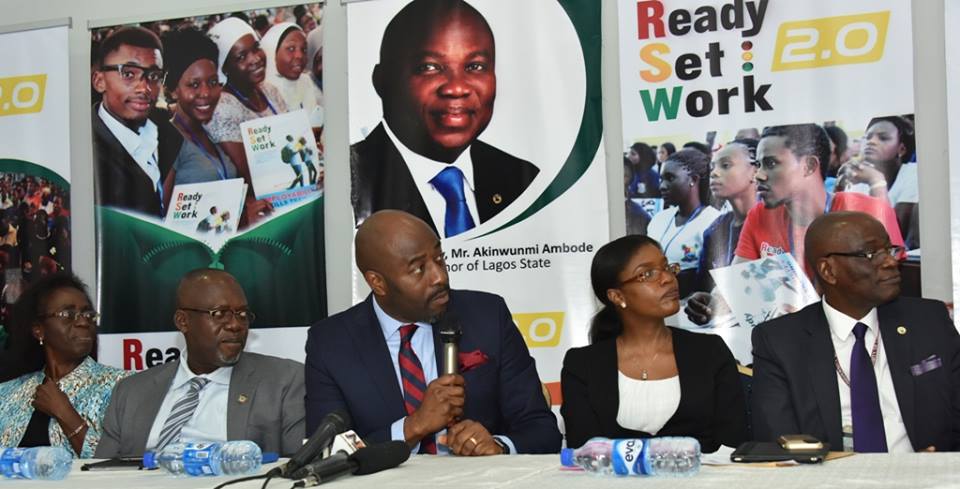
Plans have been concluded by the Lagos State government to train 12,000 undergraduates in tertiary institutions in the state on entrepreneurship and employability skills.
Out of the 12, 000 students, it was gathered that 2,000 final year students would be selected for the training at the three designated centres, while the remaining 10,000 would be selected from students in their penultimate year at the institutions and trained.
The beneficiaries, Special Adviser to Governor Akinwunmi Ambode on Education, Mr Obafela Bank-Olemoh explained, would been chose from those who register for the 2017 edition of the Ready, Set, Work (RSW) scheme of the state government.
On Thursday, government opened the programme’s website, www.readysetwork.com.ng, for intending applicants to register.
Mr Bank-Olemoh told newsmen that while registration begins from June 16, the training will run from July 1 to September 16, 2017.
He said as an improvement on the initiative which started in 2016, students of six tertiary institutions in the State would benefit, while three centres have been designated to host the training.
The six institutions, according to Bank-Olemoh are Adeniran Ogunsanya College of Education (ACCOED), Lagos State College of Health Science (LASCOHET), Lagos State Polytechnic (LASPOTECH), Lagos State University (LASU), Michael Otedola College of Education (MOCPED) and University of Lagos (UNILAG).
“When the administration of Governor Ambode came on board, one of the issues he was confronted with from the private sector was that there were major gaps in the work readiness of graduates, and his immediate response was to come up with a scheme to equip graduates from our tertiary institutions with the right skills needed to add value to the society.
“And so, the vision of the RSW is that every graduate from a tertiary institution situated in Lagos must have the knowledge, skills and attitudes required to gain meaningful employment or be self-employed and our plan is to train all graduates in tertiary institutions through the RSW,” the Governor’s aide said.
He said beneficiaries of the scheme would be selected to participate only on competence, and would be trained for thirteen weeks on labour market, mindset reorientation, 21st century skills, entrepreneurship, employability skills and teacher track.
He said about 750 of the beneficiaries would be helped to secure internship placement and given skill for life, while there would also be seed funding for winners of the business pitch competition to be held as part of the training.
Responding to questions on sustainability of the scheme and the need to accommodate other tertiary institutions in the state, Mr Bank-Olemoh said plans are afoot to integrate the RSW into the education curriculum of the state, and also expand the modules as well as the benefiting institutions.
Out of the 500 students that were registered for the scheme in 2016, only 422 graduated after the rigorous training with Sarunmi Oluwafemi and Dada Samuel who emerged as the overall winners of the pitch competition walking away with N6 million seed funding and N100,000 monthly working capital for six months.
The second and third place winners also got N500,000 and N250,000 respectively with N100,000 working capital for six months.
Economy
Lekki Deep Sea Port Reaches 50% Designed Operational Capacity
By Adedapo Adesanya
The Managing Director of Lekki Port LFTZ Enterprise Limited, Mr Wang Qiang, says the port has reached half of its designed operational capacity, with steady growth in container throughput since September 2025, reflecting increasing confidence by shipping lines and cargo owners in Nigeria’s first deep seaport.
“We already reached 50 per cent of our capacity now, almost 50 per cent of the port capacity.
“There is consistent improvement in the number of 20ft equivalent units (TEUs) handled monthly,” he said.
Mr Qiang explained further that efficient multimodal connectivity remains critical to sustaining and accelerating growth at the port.
According to him, barge operations have become an important evacuation channel and currently account for about 10 per cent of cargo movement from the port.
Mr Qiang mentioned that the ongoing Lagos–Calabar Coastal Road project would help ease congestion and improve access to the port.
He said that rail connectivity remained essential, particularly given the scale of industrial activities emerging within the Lekki corridor.
He said that Nigeria Government was concerned about the cargoes moving through rail and that the development would enhance more cargoes distribution outside the port.
Mr Qiang reiterated that Lekki port was a fully automated terminal, noting that delays may persist until all stakeholders, including government agencies, fully aligned with end-to-end digital processes.
He explained that customs procedures, particularly physical cargo examinations, and other port services should be fully digitalised to significantly reduce cargo dwell time.
“We must work together very closely with customers and all categories of operations for automation to yield results.
“Integration between the customs system, the terminal operating system and customers is already part of an agreed implementation schedule.
“For automation to work efficiently, all players must be ready — customers, government and every stakeholder. Only then can we have a fantastic system,” Mr Qiang said.
He also stressed that improved connectivity would allow the port to effectively double capacity through performance optimisation without expanding its physical footprint.
Economy
Investors Reaffirm Strong Confidence in Legend Internet With N10bn CP Oversubscription
By Aduragbemi Omiyale
The series 1 of the N10 billion Commercial Paper (CP) issuance of Legend Internet Plc recorded an oversubscription of 19.7 per cent from investors.
This reaffirmed the strong confidence in the company’s financial stability and growth trajectory.
The exercise is a critical component of Legend Internet’s N10 billion multi-layered financing programme, designed to support its medium- to long-term growth.
Proceeds are expected to be used for broadband infrastructure expansion to deepen nationwide penetration, optimise the organisation’s working capital for operational efficiency, strategic acquisitions that will strengthen its market position and accelerate service innovation.
The telecommunications firm sees the acceptance of the debt instruments as a response to its performance, credit profile, and disciplined operational structure, noting it also reflects continued trust in its ability to execute on its strategic vision for nationwide digital infrastructure expansion.
“The strong investor participation in our Series 1 Commercial Paper issuance is both encouraging and validating. It demonstrates the market’s belief in our financial integrity, operational strength, and long-term vision for digital infrastructure growth. This support fuels our commitment to building a more connected, competitive, and digitally enabled Nigeria.
“This milestone is not just a financing event; it is a strategic enabler of our expansion plans, working capital needs, and future acquisitions. We extend our sincere appreciation to our investors, advisers, and market partners whose confidence continues to propel Legend Internet forward,” the chief executive of Legend Internet, Ms Aisha Abdulaziz, commented.
Also commenting, the Chief Financial Officer of Legend Internet, Mr Chris Pitan, said, “This achievement is powered by our disciplined financing framework, which enables us to scale sustainably, innovate continuously, and consistently meet the evolving needs of our customers.
“We remain committed to building a future where every connection drives opportunity, productivity, and growth for communities across Nigeria.”
Economy
Tinubu to Present 2026 Budget to National Assembly Friday
By Adedapo Adesanya
President Bola Tinubu will, on Friday, present the 2026 Appropriation Bill to a joint session of the National Assembly.
The presentation, scheduled for 2:00 pm, was conveyed in a notice issued on Wednesday by the Office of the Clerk to the National Assembly.
According to the notice, all accredited persons are required to be at their duty posts by 11:00 am on the day of the presentation, as access into the National Assembly Complex will be restricted thereafter for security reasons.
The notice, signed by the Secretary, Human Resources and Staff Development, Mr Essien Eyo Essien, on behalf of the Clerk to the National Assembly, urged all concerned to ensure strict compliance with the arrangements ahead of the President’s budget presentation.
The 2026 budget is projected at N54.4 trillion, according to the approved 2026–2028 Medium-Term Expenditure Framework (MTEF) and Fiscal Strategy Paper (FSP).
Meanwhile, President Tinubu has asked the National Assembly to repeal and re-enact the 2024 appropriation act in separate letters to the Senate and the House of Representatives on Wednesday and read during plenary by the presiding officers.
The bill was titled Appropriation (Repeal and Re-enactment Bill 2) 2024, involving a total proposed expenditure of N43.56 trillion.
In a letter dated December 16, 2025, the President said the bill seeks authorisation for the issuance of a total sum of N43.56 trillion from the Consolidated Revenue Fund of the Federation for the year ending December 31, 2025.
A breakdown of the proposed expenditure shows N1.74 trillion for statutory transfers, N8.27 trillion for debt service, N11.27 trillion for recurrent (non-debt) expenditure, and N22.28 trillion for capital expenditure and development fund contributions.
The President said the proposed legislation is aimed at ending the practice of running multiple budgets concurrently, while ensuring reasonable – indeed unprecedentedly high – capital performance rates on the 2024 and 2025 capital budgets.
He explained that the bill also provides a transparent and constitutionally grounded framework for consolidating and appropriating critical and time-sensitive expenditures undertaken in response to emergency situations, national security concerns, and other urgent needs.
President Tinubu added that the bill strengthens fiscal discipline and accountability by mandating that funds be released strictly for purposes approved by the National Assembly, restricting virement without prior legislative approval, and setting conditions for corrigenda in cases of genuine implementation errors.
The bill, which passed first and second reading in the House of Representatives, has been referred to the Committee on Appropriations for further legislative action.
-
Feature/OPED6 years agoDavos was Different this year
-
Travel/Tourism9 years ago
Lagos Seals Western Lodge Hotel In Ikorodu
-
Showbiz3 years agoEstranged Lover Releases Videos of Empress Njamah Bathing
-
Banking7 years agoSort Codes of GTBank Branches in Nigeria
-
Economy3 years agoSubsidy Removal: CNG at N130 Per Litre Cheaper Than Petrol—IPMAN
-
Banking3 years agoFirst Bank Announces Planned Downtime
-
Banking3 years agoSort Codes of UBA Branches in Nigeria
-
Sports3 years agoHighest Paid Nigerian Footballer – How Much Do Nigerian Footballers Earn