Connect with us

Economy

FMDQ, Stakeholders Laud Nwankwo’s Achievements at DMO

Published

on

By Dipo Olowookere

Former Director General of the Debt Management Office (DMO), Mr Abraham Nwankwo, was recently honoured by the FMDQ OTC Securities Exchange (FMDQ) for his success at the agency in a period spanning 10 years.

During his time at the debt office, Mr Nwankwo ensured the DMO released credible data to the public especially when some would have thought he would want to dance to the tunes of the sitting governments.

Following a decade of dedicated service, Mr Nwankwo, whose highly successful tenure as the head of DMO, spanning the period July 2007 to June 2017, was honoured by FMDQ and key financial market stakeholders at a memorable ceremony held at the FMDQ offices in Lagos.

This ceremony, which was in acknowledgement of his efforts towards the growth of the Nigerian bond market, and invariably, the economy, brought together key financial market stakeholders, friends and well-wishers, all wishing to celebrate him on his retirement from the agency.

Among those present at the Ceremony were the newly-appointed DG of DMO, Ms Patience Oniha; the DG, Securities and Exchange Commission (SEC), represented by Mr Stephen Falomo, Head, Lagos Zonal Office, SEC; Chairman of FMDQ, Dr Okwu Joseph Nnanna (Deputy Governor, Financial System Stability, Central Bank of Nigeria), ably represented by Mr Jibril Aku, Vice Chairman of FMDQ; Mr Bolaji Balogun, Founder/Chief Executive Officer of Chapel Hill Advisory Partners represented by Mr Ayo Fashina, Mr Ayo Gbeleyi, former Commissioner for Finance, Lagos State, Mr Frank Aigbogun, Publisher/CEO of BusinessDay, Mr Olufemi Awoyemi, the Founder/Managing Director, Proshare Nigeria, representatives of the Primary Dealer Market Makers (PDMMs) who are also Dealing Member (Banks) of FMDQ, the debt capital-focused OTC Exchange, amongst others.

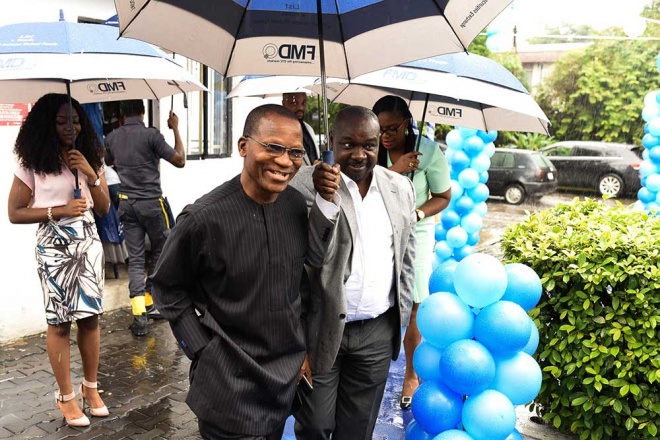
The rains did not douse the guard of honour-reception the FMDQ staff had planned for Dr Nwankwo. the staff, along with some beautifully erected balloons stands, formed a path on both sides of a blue carpet, for him, his wife and daughter to walk through the entrance, to the humble OTC Exchange building, with FMDQ-branded umbrellas held high by the staff in a spectacle akin to the military pulling out parade! It was indeed a wonderful sight to experience.


From the very eloquently delivered citation to the series of well-articulated and goodwill messages, and even the level of attendance at the Ceremony, it was clear that the positive impact Dr Nwankwo had made in the bond market, and by extension, the economy, over the last decade, was indeed felt and very much appreciated by all. In reliving the decade-long and successful tenure, a one-on-one discourse, anchored by FMDQ’s MD/CEO, Mr Bola Onadele. Koko was held with the outgoing DG, DMO, following which a special symbol depicting Dr Nwankwo’s key achievements, including, the developments which the Nigerian bond market had experienced over the last decade, was presented to and unveiled by the guest of honour, among other mementos.

Described as a “pacesetter” in the goodwill messages which flocked in, Dr Nwankwo set out to redefine the public debt management landscape in Nigeria, bringing on commendable verve and innovativeness to the hitherto conservative area of public finance management. From the development of a comprehensive and accurate national debt database to deepening the domestic bond market via the introduction of regular monthly bond issuances supported with the PDMMs System and the consistent launch of innovative bond products including the Federal Government of Nigeria (FGN) Savings Bond, Sukuk, and the soon to be finalised FGN Dollar and Green Bonds, the DMO, under Dr Nwankwo’s leadership, progressively pursued the alignment of the Nigerian debt capital markets (DCM) to international standards. In recording landmark achievements, including the first-ever domestic listing of the Federal Government of Nigeria Eurobond, the agency is seen to have set an audacious pace towards effectively developing the domestic bond market.

Dr Nwankwo’s quest for excellence, his consistency, integrity, professionalism and humility, were a few of the words and phrases used to describe the outgoing DG and were attributed to his exceptional performance during his 10-year tenure, under four different administrations.

In consolidation of the strategic and value-adding initiatives undertaken by the DMO in developing the Nigerian DCM, FMDQ, with a deep sense of appreciation as Dr Nwankwo retires, continues to show great commitment to actualising the objectives of the agency vis-a’vis those of the OTC Exchange for the transformation of the markets within its purview. FMDQ looks forward, in excited anticipation, to maintaining this formidable collaboration with the DMO under the new leadership of Ms Oniha, towards the further development of the Nigerian DCM, and by extension, the economy.

By serving as a point of integration between the domestic and international markets, FMDQ has, in its short period of existence, become the ambassador of foreign portfolio capital for Nigeria and lent itself as an efficient and operationally excellent platform for fixed income and currency.

This is well in line with its mission to empower the financial markets to be innovative and credible, in support of the Nigerian economy. In promoting and supporting economic development therefore, the active collaboration of all stakeholders is required to erect the necessary market infrastructures, transform and position the Nigerian financial markets towards maximising its potential, and its partnership with the DMO remains a steady and right path towards actualising the shared objectives and desires of the markets.


Dipo Olowookere is a journalist based in Nigeria that has passion for reporting business news stories. At his leisure time, he watches football and supports 3SC of Ibadan. Mr Olowookere can be reached via [email protected]

Advertisement
Click to comment

Leave a Reply

Your email address will not be published. Required fields are marked *

Economy

UK Backs Nigeria With Two Flagship Economic Reform Programmes

Published

on

UK Nigeria

By Adedapo Adesanya

The United Kingdom via the British High Commission in Abuja has launched two flagship economic reform programmes – the Nigeria Economic Stability & Transformation (NEST) programme and the Nigeria Public Finance Facility (NPFF) -as part of efforts to support Nigeria’s economic reform and growth agenda.

Backed by a £12.4 million UK investment, NEST and NPFF sit at the centre of the UK-Nigeria mutual growth partnership and support Nigeria’s efforts to strengthen macroeconomic stability, improve fiscal resilience, and create a more competitive environment for investment and private-sector growth.

Speaking at the launch, Cynthia Rowe, Head of Development Cooperation at the British High Commission in Abuja, said, “These two programmes sit at the heart of our economic development cooperation with Nigeria. They reflect a shared commitment to strengthening the fundamentals that matter most for our stability, confidence, and long-term growth.”

The launch followed the inaugural meeting of the Joint UK-Nigeria Steering Committee, which endorsed the approach of both programmes and confirmed strong alignment between the UK and Nigeria on priority areas for delivery.

Representing the Government of Nigeria, Special Adviser to the President of Nigeria on Finance and the Economy, Mrs Sanyade Okoli, welcomed the collaboration, touting it as crucial to current, critical reforms.

“We welcome the United Kingdom’s support through these new programmes as a strong demonstration of our shared commitment to Nigeria’s economic stability and long-term prosperity. At a time when we are implementing critical reforms to strengthen fiscal resilience, improve macroeconomic stability, and unlock inclusive growth, this partnership will provide valuable technical support. Together, we are laying the foundation for a more resilient economy that delivers sustainable development and improved livelihoods for all Nigerians.”

On his part, Mr Jonny Baxter, British Deputy High Commissioner in Lagos, highlighted the significance of the programmes within the wider UK-Nigeria mutual growth partnership.

“NEST and NPFF are central to our shared approach to strengthening the foundations that underpin long-term economic prosperity. They sit firmly within the UK-Nigeria mutual growth partnership.”

Continue Reading

Economy

MTN Nigeria, SMEDAN to Boost SME Digital Growth

Published

on

MTN Nigeria SMEDAN

By Aduragbemi Omiyale

A strategic partnership aimed at accelerating the growth, digital capacity, and sustainability of Nigeria’s 40 million Micro, Small and Medium Enterprises (MSMEs) has been signed by MTN Nigeria and the Small and Medium Enterprises Development Agency of Nigeria (SMEDAN).

The collaboration will feature joint initiatives focused on digital inclusion, financial access, capacity building, and providing verified information for MSMEs.

With millions of small businesses depending on accurate guidance and easy-to-access support, MTN and SMEDAN say their shared platform will address gaps in communication, misinformation, and access to opportunities.

At the formal signing of the Memorandum of Understanding (MoU) on Thursday, November 27, 2025, in Lagos, the stage was set for the immediate roll-out of tools, content, and resources that will support MSMEs nationwide.

The chief operating officer of MTN Nigeria, Mr Ayham Moussa, reiterated the company’s commitment to supporting Nigeria’s economic development, stating that MSMEs are the lifeline of Nigeria’s economy.

“SMEs are the backbone of the economy and the backbone of employment in Nigeria. We are delighted to power SMEDAN’s platform and provide tools that help MSMEs reach customers, obtain funding, and access wider markets. This collaboration serves both our business and social development objectives,” he stated.

Also, the Chief Enterprise Business Officer of MTN Nigeria, Ms Lynda Saint-Nwafor, described the MoU as a tool to “meet SMEs at the point of their needs,” noting that nano, micro, small, and medium businesses each require different resources to scale.

“Some SMEs need guidance, some need resources; others need opportunities or workforce support. This platform allows them to access whatever they need. We are committed to identifying opportunities across financial inclusion, digital inclusion, and capacity building that help SMEs to scale,” she noted.

Also commenting, the Director General of SMEDAN, Mr Charles Odii, emphasised the significance of the collaboration, noting that the agency cannot meet its mandate without leveraging technology and private-sector expertise.

“We have approximately 40 million MSMEs in Nigeria, and only about 400 SMEDAN staff. We cannot fulfil our mandate without technology, data, and strong partners.

“MTN already has the infrastructure and tools to support MSMEs from payments to identity, hosting, learning, and more. With this partnership, we are confident we can achieve in a short time what would have taken years,” he disclosed.

Mr Odii highlighted that the SMEDAN-MTN collaboration would support businesses across their growth needs, guided by their four-point GROW model – Guidance, Resources, Opportunities, and Workforce Development.

He added that SMEDAN has already created over 100,000 jobs within its two-year administration and expects the partnership to significantly boost job creation, business expansion, and nationwide enterprise modernisation.

Continue Reading

Economy

NGX Seeks Suspension of New Capital Gains Tax

Published

on

capital gains tax

By Adedapo Adesanya

The Nigerian Exchange (NGX) Limited is seeking review of the controversial Capital Gains Tax increase, fearing it will chase away foreign investors from the country’s capital market.

Nigeria’s new tax regime, which takes effect from January 1, 2026, represents one of the most significant changes to Nigeria’s tax system in recent years.

Under the new rules, the flat 10 per cent Capital Gains Tax rate has been replaced by progressive income tax rates ranging from zero to 30 per cent, depending on an investor’s overall income or profit level while large corporate investors will see the top rate reduced to 25 per cent as part of a wider corporate tax reform.

The chief executive of NGX, Mr Jude Chiemeka, said in a Bloomberg interview in Kigali, Rwanda that there should be a “removal of the capital gains tax completely, or perhaps deferring it for five years.”

According to him, Nigeria, having a higher Capital Gains Tax, will make investors redirect asset allocation to frontier markets and “countries that have less tax.”

“From a capital flow perspective, we should be concerned because all these international portfolio managers that invest across frontier markets will certainly go to where the cost of investing is not so burdensome,” the CEO said, as per Bloomberg. “That is really the angle one will look at it from.”

Meanwhile, the policy has been defended by the chairman of the Presidential Fiscal Policy and Tax Reforms Committee, Mr Taiwo Oyedele, who noted that the new tax will make investing in the capital market more attractive by reducing risks, promoting fairness, and simplifying compliance.

He noted that the framework allows investors to deduct legitimate costs such as brokerage fees, regulatory charges, realised capital losses, margin interest, and foreign exchange losses directly tied to investments, thereby ensuring that they are not taxed when operating at a loss.

Mr Oyedele  also said the reforms introduced a more inclusive approach to taxation by exempting several categories of investors and transactions.

Continue Reading

Trending